The Quest for Ultimate Love

Embracing All of Existence

In the whirlwind of our modern lives, we often find ourselves in search of meaning, connection, and purpose. Among the most profound and enduring of human desires is the quest for love. But what if we were to redefine what love means to us? What if we were to aspire for the highest form of love – one that encompasses all sentient and non-sentient beings?

**Sentient Beings: A Conscious Connection**

When we think of love, our minds often gravitate towards the sentient – our family, friends, pets, and even strangers. These are beings with consciousness, feelings, and experiences. To love them means to understand them, to empathize with their pain, joy, and struggles. It means to extend compassion even when it’s challenging, to forgive even when hurt, and to be there even in silence. Loving sentient beings is to recognize the spark of life that we share, the thread of existence that connects us.

**Non-Sentient Beings: Beyond The Obvious**

On the other hand, loving non-sentient beings may seem a tad more abstract. How do we love a rock, a gust of wind, or a droplet of water? It’s about cherishing the interwoven tapestry of life. Every element, no matter how inanimate it might seem, plays an essential role in our existence. By loving non-sentient entities, we are acknowledging the importance of everything around us. We are recognizing that even the seemingly insignificant has its place in the cosmos.

**The Interconnectedness of All Things**

Loving both sentient and non-sentient beings brings to light an essential truth about existence – everything is interconnected. Nothing exists in isolation. The air we breathe, the water we drink, the ground we walk upon – all of it sustains us. Similarly, our actions, thoughts, and feelings reverberate through the vast web of life. By directing love towards every facet of existence, we are nourishing this web, strengthening our bond with the universe.

**Why Ultimate Love Should Be Our Life’s Goal**

Embracing ultimate love isn’t just about affection. It’s a conscious choice to see the world in its entirety, to appreciate the grandeur of existence, and to foster a deep sense of gratitude. This expansive perspective shifts our priorities, deepens our connections, and fills our lives with purpose.

As we journey through life, aiming for this boundless love ensures that we leave no stone unturned, and no heart untouched. The pursuit of ultimate love becomes a path to enlightenment, a journey toward understanding the true nature of existence.

In conclusion, to love all sentient and non-sentient beings with all our hearts is to experience the universe in its totality. It’s a clarion call to recognize the divine in the mundane and to elevate our human experience to a cosmic dance of love and connection. This, indeed, should be the goal of life. For in this love, we find not just the meaning of existence, but also its ultimate celebration.

Morgan O. Smith

Yinnergy Meditation & My Book, Bodhi in the Brain…Available Now!

https://linktr.ee/morganosmith

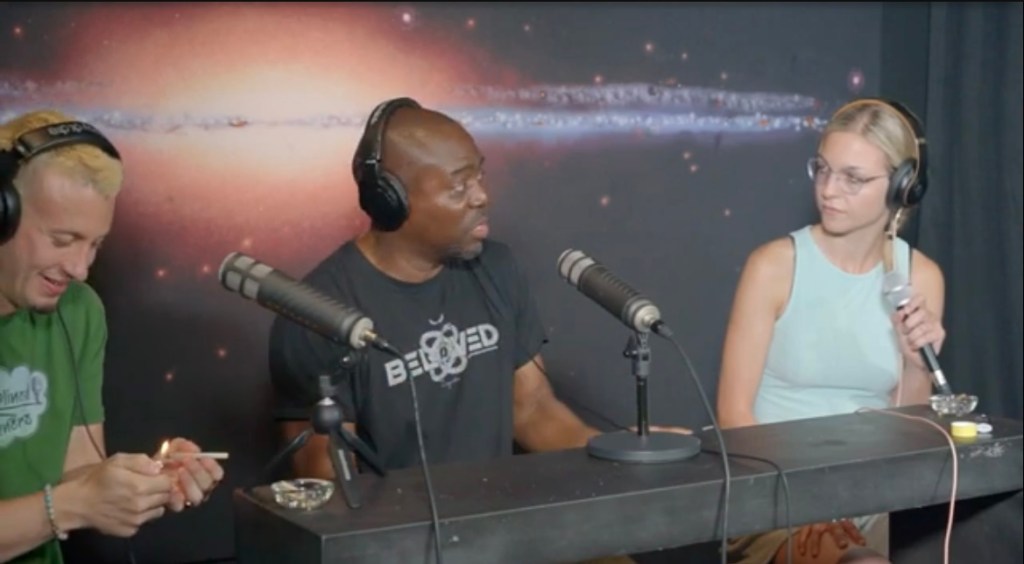
Enlighten Up! w/ Special Guest, Stephanie Mercury (Ep 14)

Welcome to Episode 14 of Enlighten Up! Join our dynamic hosts, Spiritual Teacher Morgan O. Smith and Comedian Nathan Griffith, as they engage with Stephanie Mercury, a gifted visual artist and natural energy healer.

Join the fun as Morgan and Stephanie gently tease Nathan about his claims of university education, particularly his apparent lack of knowledge on the Four Noble Truths, despite his studies in Buddhism. Listen to Morgan as he sings praises of Stephanie’s innate healing talents, sparking a nostalgic trip down memory lane to the time Stephanie attended Morgan’s transformative program, “9 for the Mind.”

Prepare for an intellectual challenge as Morgan presents to Stephanie and Nathan the theory that the entire universe originates from a single thought in the mind of The All. Gain unique insights as he discusses the universe’s neutrality and its diverse forms, from the gross to the non-dual.

Take a journey into the supernatural with Morgan’s intriguing perspective on the ghost realm and the hypothesized state of being of these spectral entities. Explore the fascinating duality of spiritual enlightenment and its unsettling counterpart, depersonalization disorder. To cap off the discussion, Morgan employs the metaphor of ‘tomorrow’ to illustrate the concept of enlightenment.

Don’t miss out on our insightful and entertaining content! Remember to check out “Bodhi in the Brain” and Yinnergy Meditation at https://linktr.ee/morganosmith. Enlighten up your life with us!

Yinnergy Meditation & Bodhi in the Brain Available Now! https://linktr.ee/morganosmith

The Ego

Many Faces of the “I”

In our quest to understand ourselves, few concepts are as debated, dissected, and deliberated as the ego. Spanning from ancient spiritual scriptures to the modern therapist’s couch, the ego stands as a reflection of our sense of self and our relation to the world. Yet, its definitions vary, painting a multifaceted picture of this central aspect of human existence.

### **1. Ego in Psychoanalysis: The Mediator**

Freud’s tripartite model of the psyche introduced us to the ego as the balancing force between the primal urges of the id and the moral compass of the superego. Here, the ego isn’t an adversary but a necessary mediator, guiding our actions in a world of societal norms. It poses the question: Is our ego the voice of reason amidst internal chaos?

### **2. Ego in General Psychology: The Self’s Mirror**

When we talk about self-esteem or self-worth, we’re often referring to the ego. This definition paints the ego as a mirror reflecting our perceived value and place in the world. Yet, this raises a thought-provoking inquiry: If our ego is a mirror, who or what determines its reflection?

### **3. Ego in Philosophy: The Conscious Observer**
Descartes’ famous dictum “Cogito, ergo sum” (I think, therefore I am) encapsulates the philosophical perspective of the ego as the conscious thinking subject. If our ego is the conscious observer of our experiences, it invites us to ponder: Without this observer, do experiences lose their significance?

### **4. Ego in Spirituality: The Illusory Self**
Many spiritual traditions view the ego as a barrier to enlightenment. It’s the illusory sense of separateness that binds us to suffering. The spiritual perspective urges us to ask: If the ego is an illusion, then who indeed are we beneath this veneer?

### **5. Ego in Pop Culture: The Mask of Pride**
Everyday parlance often equates a “big ego” with arrogance. It’s seen as a mask, sometimes shielding insecurities, other times amplifying genuine pride. This usage compels us to consider: Is the ego merely a façade, and what lies behind it?

### **6. Ego in Eastern Philosophies: The Creator of “I-ness”**

Hindu philosophy introduces Ahamkara, the aspect of us that births the sense of “I.” This ego is neither good nor bad but a natural facet of being human. Reflecting on this, we might wonder: Is the ego, not an enemy but an inevitable companion on our human journey?

**In Conclusion: The Infinite Layers of “I”**

The ego, regardless of its definition, remains at the core of human introspection. Its multifaceted interpretations offer not just explanations but a myriad of questions. As we navigate our understanding of the ego, we’re not just uncovering the layers of this concept but also the layers of our very existence.

In exploring the ego, we’re invited to embark on a profound journey inward, to question, understand, and perhaps even transcend the confines of the “I.” For as varied as its definitions might be, the ego’s ultimate gift is the invitation to self-reflection.

Morgan O. Smith

Yinnergy Meditation & My Book, Bodhi in the Brain…Available Now!
https://linktr.ee/morganosmith

The Veils of Maya

Navigating Illusion in the Quest for Truth

The labyrinthine nature of existence, adorned with its pleasures and pitfalls, has been a subject of deep contemplation for ages. At the heart of many philosophical inquiries in Hinduism lies the enigmatic concept of ‘Maya’. Far from being a mere illusion, Maya reveals layers of truth, each pointing towards an understanding of the universe and our place in it.

**The Cosmic Dance of Prakriti and the Three Gunas**


Imagine the universe as a grand stage, with Prakriti, the primal nature, as the backdrop. From this vast expanse springs forth everything we see, feel, and experience. Yet, what gives rhythm to this cosmic dance?

Enter the Three Gunas – Sattva, Rajas, and Tamas. These are not just passive qualities but dynamic forces shaping our experiences. The serenity of a tranquil lake embodies Sattva, the turbulence of a storm epitomizes Rajas, and the still darkness of the night echoes Tamas. Together, they create a spectrum of experiences in our lives.

**The Individual’s Tryst with Ignorance**


Closer to our personal experience is Avidya, the fog of ignorance clouding our perception. Under its influence, we misidentify with our transient selves, overlooking the eternal essence within. It’s like mistaking the waves for the vast ocean.

In this state, we are ensnared by Karma, the ever-entwining web of action and consequence. The Kleshas, those tormenting afflictions, further deepen our entanglement. Desires and aversions play tug-of-war, with the ego stoking the flames.

**The Divine Masquerade**

But is Maya merely a cosmic error or a deceptive trap? Not necessarily. Maya, when seen as the divine power or Shakti, becomes the grand choreographer of the universe’s dance. It’s a divine play, a Leela, where the One chooses to manifest as many, experiencing itself through myriad forms.

**Beyond Duality: The Advaita Perspective**


The school of Advaita Vedanta offers a profound insight. It suggests that beneath the multiplicity lies a singular truth, the Brahman. Maya, in this view, is the sublime artist crafting the many from the one, making the undivided appear divided.

**Conclusion: The Play and Beyond**

Maya, far from being a mere illusion to discard, becomes a lens to navigate our existence. It offers lessons, challenges, and experiences, pushing us to question, understand, and ultimately transcend.

In the dance of Maya, we are both the dancer and the audience. The key lies in recognizing the play, enjoying its beauty, and seeking the truth beyond the performance. In this quest, we don’t just find answers about the universe, but also about ourselves.

Morgan O. Smith

Yinnergy Meditation & My Book, Bodhi in the Brain…Available Now!
https://linktr.ee/morganosmith

AUM

The Symphony of the Cosmos

In the vast expanse of the universe, there is a sound – an eternal hum that reverberates through the galaxies, stars, and the very fabric of existence. This sound is “AUM,” often pronounced as “OM,” a sacred resonance in various Eastern traditions believed to be the primordial vibration from which the universe sprung to life. But have we ever paused to ponder what this sound represents and how it is mirrored in the intricate dance of our cosmos?

Imagine for a moment that each facet of sound is a thread weaving the tapestry of the universe.

**Frequency** – Every sound has a pitch, a frequency. The universe too has its rhythm, a foundational vibration echoing the constant hum of existence. It’s as if AUM is the universe’s heartbeat.

**Waveform**
– Just as sound waves take unique forms, the universe, in its myriad manifestations, is a collection of diverse waveforms – galaxies, nebulae, and dark matter – all branching out from AUM’s fundamental waveform.

**Amplitude** – The energy of the cosmos, from the explosive birth of stars to the calm vastness of space, can be likened to the amplitude of sound. It’s the universe breathing in and out, pulsating to the rhythm of AUM.

**Timbre** – While a note might remain the same, the instrument playing it lends a unique character. Similarly, every galaxy, star, and planet has its distinct essence, yet they all resonate with the timbre of AUM.

**Harmonics** – In the grand orchestra of existence, there are layers and dimensions we’ve yet to uncover. Like harmonics in sound, these layers add richness and depth to the universe’s melody.

**Envelope** – From the universe’s explosive inception to its potential quietus, its story can be visualized as the envelope of sound, with AUM framing this vast timeline.

**Duration** – AUM, unfettered by time, represents the universe’s eternal song, from its first note to its never-ending echo.

**Velocity** – The universe doesn’t stand still. Stars dance, galaxies spiral, and cosmic winds blow, all at the velocity set by AUM’s tempo.

**Phase** – Just as sound waves can align or clash, celestial entities move in a cosmic ballet, sometimes in harmony and at times in opposition, all choreographed to the phase of AUM.

**Dynamics** – From deafening cosmic events to silent voids, the universe has its crescendos and diminuendos, a dynamic range that parallels the sonorous depths of AUM.

**Pitch** – As the universe evolves, its melody might shift, but AUM remains the grounding chord amidst the symphonic changes.

In contemplating AUM, we’re not just musing on a sound, but the very essence of existence. It’s an invitation to attune ourselves to the universe’s music, to find our place in its vast orchestra, and to understand that every note, every vibration, and every moment is a reflection of that sacred sound.

So, the next time you find yourself gazing at the night sky, listen closely. Perhaps, if you attune your heart and mind, you’ll hear the universe’s age-old song – the eternal AUM.

Morgan O. Smith

Yinnergy Meditation & My Book, Bodhi in the Brain…Available Now!
https://linktr.ee/morganosmith

The Mystical Peak Experience of Pure Sexual Love

Exploring Eros

In the diverse tapestry of human experience, few phenomena are as enigmatic and profound as the experience of love. Among its many facets, the experience of Eros stands apart as a sublime manifestation of pure sexual love that transcends the ordinary and becomes mystical.

Eros: More than Just Desire

Named after the Greek god of love, Eros is often relegated to the realm of mere physical attraction or romantic infatuation. However, to those who have encountered its mystical peak, it represents something far more profound. Eros is an expression of love that transcends mere physicality, reaching into the spiritual realm and connecting us to something greater.

The Peak Experience: A Transcendental Connection


The mystical experience of Eros is not about hedonistic pleasure or fleeting passion. It’s a profound peak experience that transcends the mundane, awakening a deeper connection not only with a partner but with existence itself.

In this state, lovers are not merely engaging in a physical act; they are participating in a sacred ritual that symbolizes unity, trust, and transcendence. It’s a moment where boundaries dissolve, and two individuals become one, not just physically, but emotionally and spiritually.

The Philosophical Dimensions of Eros

The experience of Eros brings into focus philosophical questions about the nature of love, connection, and existence. Is love merely a biochemical reaction, or does it hint at a more profound, cosmic truth? Can sexual love be a pathway to spiritual enlightenment? What does it mean to truly connect with another human being?

Many philosophers and mystics have explored these questions, recognizing the potential for sexual love to be a vehicle for self-realization and spiritual growth. Eros, in its purest form, challenges our conventional understanding of love, encouraging us to see beyond the superficial and to recognize the sacred in the everyday.

Conclusion: Eros as a Path to Understanding

The mystical peak experience of Eros is not just a fleeting moment of pleasure; it’s a profound philosophical insight into the nature of connection, existence, and the human condition. It offers a glimpse into a realm where love is not confined to physical attraction but is a unifying force that binds us all.

To understand Eros is to engage with some of the most fundamental questions about what it means to be human, what it means to love, and what it means to connect with something greater than ourselves. It’s a journey that invites us to look within, to question, to explore, and to grow.

The mystical experience of Eros reminds us that love is not merely an emotion but a transformative power that can lead us to deeper understanding and spiritual awakening. It is a beacon that guides us toward a more profound connection with ourselves, with others, and with the universe itself. In embracing Eros, we may find not just pleasure, but wisdom, joy, and a sense of unity that transcends our earthly existence.

Morgan O. Smith

Yinnergy Meditation & My Book, Bodhi in the Brain…Available Now!
https://linktr.ee/morganosmith


Disciplined Stoners (Episode 155) – Bodhi in the Brain

My Journey with Meditation, Consciousness, and Awakening

Exploring the intricate facets of consciousness and the enigma of meditation has been a lifelong quest for me. This week, I had the privilege to join Ellevan & Winny Clarke on the “Disciplined Stoners” podcast, sharing my insights, experiences, and discoveries.

I’m not just here as a meditation enthusiast; I introduced them to my creation, Yinnergy, a program born from my years of exploring and understanding the depths of inner peace and mental clarity. We also delved into the themes of my latest book, “Bodhi in the Brain,” embarking on a thrilling discourse on states of consciousness, spiritual awakenings, and the fascinating world of psychological development.

It was a transformative conversation, touching upon the delicate line between mere understanding and direct experience – a distinction that’s been pivotal in my personal and spiritual journey.

For those of you intrigued to dive deeper into my Yinnergy meditation or to navigate the pages of “Bodhi in the Brain,” you can explore them here at https://linktr.ee/morganosmith

Join us in this episode, where we venture beyond mere conversation, stepping into a realm of true transformation!


Agape: The Dichotomy of Universal Love

In the spiritual journey towards understanding and living in universal love, or agape, two enlightened beings emerge on parallel paths. They both embrace agape, yet their personalities and the way they manifest this profound love are strikingly different.

The Introverted Universal Love

The first enlightened being, whom we shall call Seraphina, channels agape through introverted universal love. This means her love is directed inward, nurturing the self and radiating outwards in subtle, non-obtrusive ways.

Impact on Others

Seraphina’s love affects others through quiet acts of kindness and a gentle presence. She may not actively seek to spread love, but those who come into contact with her feel a calm, loving energy that often leads to inner transformation. Her love is a tranquil pond, reflecting the beauty of the world without rippling its surface.

The Extroverted Universal Love

On the other hand, we have Gabriel, who embodies extroverted universal love. His love is outward-facing, actively engaging with the world, and seeking to connect with others.

Impact on Others

Gabriel’s love is a dynamic force, touching lives through acts of charity, teachings, and open-hearted connections. His love is a roaring river, sweeping people along in its powerful current and leaving change in its wake.

A Harmonious Dichotomy

While their approaches differ, both Seraphina and Gabriel contribute to the universal energy of love. They show us that love is not a one-size-fits-all concept. It’s a multifaceted gem that can shine through various personalities.

The Introverted Love: A Deep Well

Seraphina teaches us that love does not always have to be loud or grand. It can be a silent force, a deep well that nourishes the soul. Her love invites contemplation and self-reflection, allowing for a profound connection with oneself and the universe.

The Extroverted Love: A Brilliant Flame

Gabriel, on the other hand, shows us that love can be a brilliant flame that illuminates the world. It’s about embracing others, taking action, and spreading joy. His love is a call to action, urging us to engage with the world and make a difference.

Conclusion

The paths of introverted and extroverted universal love, though different, are equally valuable. They teach us that love can be manifested in diverse ways, tailored to our unique personalities and life paths.

In a world torn by division and conflict, the lessons from Seraphina and Gabriel remind us that agape is within everyone’s reach. It’s a love that transcends boundaries and unites us all. Whether you’re drawn to the tranquil pond or the roaring river, the journey toward universal love is an expedition worth embarking on.

Morgan O. Smith

Yinnergy Meditation & My Book, Bodhi in the Brain…Available Now!

https://linktr.ee/morganosmith

Agape

Embracing Universal Love for All of Creation

Introduction

In a world rife with division, turmoil, and individualism, the concept of Agape, or universal love, emerges as a beacon of hope and harmony. Rooted in various philosophical, spiritual, and religious traditions, Agape transcends borders, biases, and barriers, inviting us to embrace a love that binds all of creation. This blog post delves into the profound essence of Agape, its significance, and how it calls us toward a greater realization of our interconnectedness.

What is Agape?

Agape, often translated as “universal love” or “divine love,” represents a love that goes beyond the personal, emotional, or conditional. It’s a selfless love, free from judgment, that recognizes the inherent value and interconnectedness of all beings.

The Roots of Agape

The concept of Agape can be traced back to various traditions:

– **Christianity**: In Christian theology, Agape is the highest form of love, mirroring God’s unconditional love for humanity.
– **Buddhism**: Concepts like Metta (loving-kindness) reflect universal compassion and love for all sentient beings.
– **Hinduism**: Bhakti, the devotional love for the Divine, can be seen as a form of Agape that transcends worldly distinctions.

Agape in Everyday Life

The beauty of Agape is that it’s not confined to mystical experiences; it applies to our daily interactions. How can we embody Agape in our lives?

– **Seeing Beyond Differences**: Agape challenges us to recognize the common humanity in each other, regardless of race, religion, or nationality.
– **Cultivating Compassion**: Agape invites us to feel empathy for others’ suffering and respond with kindness and understanding.
– **Living Selflessly**: Embracing Agape means letting go of ego, self-interest, and judgment, allowing love to flow freely.

Agape and the Environment

Agape is not limited to human relationships. It extends to our relationship with nature and the environment. Recognizing the sacredness in all forms of life fosters respect and stewardship for the Earth.

Conclusion: The Transformative Power of Agape


Agape is more than a philosophical concept or mystical state; it’s a way of being. It calls us to expand our hearts, to love without conditions, to see the Divine in all, and to recognize our profound interconnectedness.

The journey toward Agape is not just a personal transformation; it’s a collective awakening. It heals, unites, and elevates our existence, turning love from a mere emotion into a universal principle that guides our lives.

In a world that often feels fragmented, the embrace of Agape offers a path toward wholeness and harmony. It’s not just a love for one another; it’s a love for all of creation.

As we contemplate Agape, we are invited to ponder: What would our world look like if we all lived with such love? How would it transform our relationships, our communities, and our very essence?

The answers to these questions may lie in the very heart of Agape, waiting for us to discover, embrace, and embody this universal love.

Morgan O. Smith

Yinnergy Meditation & My Book, Bodhi in the Brain…Available Now!

https://linktr.ee/morganosmith

Exploring the Emotional Spectrum

A Journey Through Plutchik’s Wheel and the Hindu Subtle Body

Introduction

The exploration of human emotion transcends disciplines, cultures, and time. From psychological models such as Plutchik’s Wheel of Emotions to the spiritual teachings within Hinduism concerning the subtle body, the pursuit to understand our emotional selves is as complex as it is enriching. This blog post takes a deep dive into these seemingly disparate concepts, examining the intersection of emotion, spirituality, and subtle awakening.

Plutchik’s Wheel of Emotions

Plutchik’s model identifies eight basic emotions:

1. **Joy** – A sense of happiness and fulfillment.
2. **Trust** – Confidence in something or someone.
3. **Fear** – A response to perceived danger or threat.
4. **Surprise** – A reaction to the unexpected.
5. **Sadness** – A feeling of loss or despair.
6. **Disgust** – A strong aversion or repulsion.
7. **Anger** – A reaction to perceived wrong or injustice.
8. **Anticipation** – Expectation or excitement for what’s to come.

These primary emotions combine to form complex emotions and are mapped in a way that each emotion has an opposite.

The Emotional Subtle Body in Hinduism

Hindu philosophy introduces the concept of the subtle body, an intricate and vital part of our spiritual being, separate from the physical body. Comprised of the mind (Manas), intellect (Buddhi), ego (Ahamkara), and conditioned consciousness (Chitta), the subtle body is responsible for our thoughts, emotions, and consciousness.

Connecting the Dots: Emotions and the Subtle Body

The profound connection between Plutchik’s emotional spectrum and the emotional subtle body within Hinduism lies in the universality of emotions and the depth of human experience. Here’s a breakdown:

– **Joy & Trust**: These positive emotions align with spiritual awakening and the cultivation of inner peace and compassion, reflecting a higher level of consciousness.

– **Fear & Anger**: These emotions can be linked to spiritual blocks or ignorance (Avidya) within Hinduism, which hampers spiritual growth.

– **Surprise & Anticipation**: These emotions speak to our deep connection with the universe and the ever-changing nature of life, echoing the Hindu belief in the transient nature of our physical existence.

– **Sadness & Disgust**: Often seen as negative emotions, they can be channels for growth and understanding of the self, mirroring the Hindu concept of Dharma or righteous living.

Conclusion: Emotions as Pathways to Spiritual Awakening


The emotional spectrum is not merely a psychological construct but a spiritual pathway. By understanding emotions through the lens of both Plutchik’s model and Hindu philosophy, we can embark on a journey toward subtle spiritual awakening.

The nuances of emotions, their combinations, and their reflections within the emotional subtle body offer us tools to navigate our spiritual paths. The profound connection between these concepts suggests that our emotions are not transient or superficial but deeply entwined with our very essence.

This exploration encourages us to recognize emotions as more than reactions to the world around us. They are signposts guiding us toward self-realization and a deeper connection with the divine within.

Morgan O. Smith

Yinnergy Meditation & My Book, Bodhi in the Brain…Available Now!

https://linktr.ee/morganosmith