Author, Philosopher, Spiritual Teacher, A Lead Facilitator at Sacred Media's Integral Mastery Academy, Founder of Yinnergy Meditation/Neurofeedback, Bodhi Mental Care & Wellness, Co-founder of KeMor Centre for Innovative Development
Introduction: In an age where spirituality is often a trend, the differentiation between authentic spiritual pursuit and a mere display of piety becomes pivotal. If one merely adopts the garb of spirituality without authenticity, is it spirituality at all? This article seeks to explore the delicate balance between presenting oneself as spiritual and embarking on an authentic spiritual journey. The Allure of Spiritual Image: Social media, popular culture, and sometimes peer pressure portray spirituality as a serene and enlightened state. This depiction can be tantalizing. People are enticed to showcase themselves as spiritual beings, oftentimes to fit into a community, gain admiration or even as a refuge from self-accountability. Defining Authenticity: On the other side lies authenticity, which is the honesty and genuineness in one’s thoughts, actions, and intentions. Authenticity in spirituality means that one’s quest is not for show, but a sincere endeavour to seek meaning, connection, and perhaps even transcendence. Dissecting Inauthentic Spirituality: If spirituality is worn as a mask and not lived, it becomes hollow. For instance, one might engage in spiritual practices in public but live a life contrary to those principles in private. This lack of alignment between external display and internal values questions the very essence of one’s spirituality. Is it spirituality or is it pretense? Authentic Spirituality – A Journey Within: Authentic spirituality, by contrast, is unshackled by the need for external validation. It is a deeply personal journey, irrespective of the eyes that may or may not be watching. This path might be replete with doubts, stumbles, and personal challenges, but it’s real and grounded in honest pursuit.
The Purity Test: So, how can one discern authentic spirituality? A question that individuals must ask themselves is whether their spiritual actions and pursuits would remain the same if there was no one to witness them. The answer can be very telling.
Conclusion: To embrace spirituality is to undertake a journey of profound depth. It’s not just a robe one wears but the very fabric of one’s being. As such, authenticity should be its cornerstone. When spirituality is stripped of pretense, what remains is a raw and real quest – a journey that can be tumultuous, rewarding, and ultimately transformative. Let us aspire to ensure that our spiritual pursuits are rooted in the genuine soil of our being, not just the sands of outward display.
Morgan O. Smith
Yinnergy Meditation & My Book, Bodhi in the Brain…Available Now!
Immerse yourself in another episode of “Enlighten Up!” Join your hosts, Spiritual Teacher Morgan O. Smith, and Comedian Nathan Griffith, along with our special guest, Spiritual Life Coach Nathalie Delorme. Explore intriguing discussions that touch upon personal experiences with Qigong Master, Master Lee, and delve into the profound realizations encountered at the moment of enlightenment. Witness Morgan O. Smith share his transformative journey, describing the pivotal shift that led him to a constant state of meditative trance or samadhi. Hear Nathalie as she probes the mysteries of brain entrainment, which sets the stage for a compelling conversation on the brain’s discernment process. Nathan navigates the conversation towards the mesmerizing world of flow states, questioning the potential of these states as a permanent dwelling. All this, peppered with a hearty dose of humor, as Morgan pokes fun at Nathan’s pronunciation hurdles with Ramana Maharshi’s name, and shares amusing anecdotes about Nathan’s past shroom escapades. The discourse deepens as Nathalie asks about the influential work and books of Ken Wilber, triggering Morgan to recount the transformative incident that set him off on his spiritual journey. As the episode unfolds, Morgan ponders upon the concept of the 50 states of consciousness, suggesting there might be even more. Concluding the episode, Nathan imparts wisdom that surpasses the confines of spoken words. Engage with our special guest, Nathalie Delorme, a guide to those traversing the path of conscious awakening, as she assists them in transforming their life experiences and actualizing their fullest potential. Connect with her on Instagram: @evolution.nathalie. Remember to explore the Yinnergy Meditation at https://linktr.ee/morganosmith, which can help deepen your spiritual journey. Also, grab a copy of Morgan’s insightful book, “Bodhi in the Brain,” now available on Amazon and Barnes & Noble for a deeper understanding of spiritual wisdom. Don’t miss out on future enlightening discussions. Subscribe to our channel, and stay tuned for upcoming episodes!
Follow Nathalie Delorme on Instagram for more spiritual insights: @evolution.nathalie
Welcome to Episode 4 of “Enlighten Up!” In this episode, spiritual teacher Morgan O. Smith and comedian Nathan Griffith are joined by DJ Akeem Raphael, also known as Kwame Sky. Akeem kicks off the episode by attempting to theorize about cycles, before presenting his unique interpretation of what God is. Nathan and Morgan can’t resist a bit of good-natured teasing, poking fun at Akeem for claiming credit for the viral “God is Water” video. The conversation then shifts to Nathan’s quest for advice on breaking his cycle with certain types of women. Akeem steps up, sharing some valuable insights on creative content development. Further deepening the discourse, Morgan explores the concept of the state of dreamless sleep. Akeem shares his ambition of stepping into the world of stand-up comedy, sparking a lively debate. But when Morgan accuses Akeem of being ‘New Age’, things really heat up! In a more reflective moment, Nathan opens up about what he’s searching for in a woman. Join us for this lively, candid, and thought-provoking conversation. Dive into the depth of spiritual insights, personal revelations, and friendly banter. Subscribe to “Enlighten Up!” for more explorations into the world of spirituality and consciousness. Don’t forget to check out Yinnergy Meditation at https://linktr.ee/morganosmith, and pick up Morgan’s book, “Bodhi in the Brain,” now available on Amazon and Barnes & Noble. DJ Akeem Raphael aka Kwame Sky: @djkwamesky. Enjoy the journey of enlightening up with us!
Life is a tapestry of personal narratives. Each of us is the author of our own story, swept up in the whirl of our everyday trials and tribulations, from the mundane to the monumental. We’re all preoccupied with our victories and defeats, joys and sorrows, dreams and disappointments, which collectively form our unique, personal content. Yet, amidst this tumultuous weave of personal stories, there lurks a broader tapestry, a profound, immutable context that transcends our existences—the Ultimate Reality or the Ultimate Context.
This Ultimate Context is akin to a vast ocean upon which our individual lives are but transient waves. We are too often ignorant of its presence, absorbed in the details of our fleeting crests and troughs, beginnings, and endings. But our myopic vision deprives us of the understanding that our waves are inseparable from the larger, unfathomable expanse of the ocean—the Ultimate Reality.
Unveiling the Veil of Illusion
Many philosophical traditions, such as Buddhism and Hinduism, refer to our preoccupation with personal content as an illusion—maya or samsara. This illusion stems from our inability to recognize that the seemingly separate, solid, and enduring ‘self’ we believe ourselves to be is just a wave on the ocean’s surface, part of the boundless, interconnected, and constantly changing Ultimate Reality.
Our inability to perceive this reality is often compared to a dream from which we struggle to awaken. Our ‘personal content’ may seem to us the full reality because it engrosses our senses and emotions, yet it is merely a fragment of the ‘Ultimate Context.’
Rediscovering the Ultimate Context
How do we reorient our focus away from our narratives to understand the Ultimate Context? Philosophies and spiritual traditions around the world suggest varied paths, from rigorous intellectual inquiry to deep meditation. Regardless of the method, the goal remains the same: to transcend the confines of our consciousness and recognize our union with the Ultimate Reality.
Practicing mindfulness and living in the ‘here and now’ is one approach that offers us the chance to step away from our content. Mindfulness offers a way to become aware of the ‘nowness’ of existence, to experience the world and ourselves as a series of interconnected, ephemeral phenomena. Through this process, we can gradually attune ourselves to the Ultimate Context.
The Potential Impact
Imagine what our lives would look like if we acknowledged the Ultimate Context. Our struggles, while not diminished, might be seen in a new light. We would recognize that we are not isolated entities combating a hostile universe, but integral parts of a vast, interconnected whole. This understanding could engender a profound sense of peace, compassion, and interconnectedness, transforming our relationships with ourselves, others, and the world at large.
Embracing the Journey
Venturing into the realm of the Ultimate Context is not an easy task. It requires us to shift our perceptions, to question our deeply ingrained beliefs about ourselves and reality. But the journey, while challenging, holds the promise of a profound transformation—a metamorphosis from a wave oblivious of its oceanic nature to one that rides the currents of existence with grace, understanding, and wonder.
In the end, the Ultimate Context is not a lofty abstraction to be pondered upon, but a living reality to be experienced. It invites us to shift our gaze from the canvas of our content and behold the magnificent tapestry of existence. To make this shift is to awaken from our dream of separateness and embrace the full richness of our interconnected lives. This is not an escape from our day-to-day trials and tribulations but a broader understanding of their place within a larger panorama of existence. By grounding our narratives within the Ultimate Context, we can navigate life’s ups and downs with greater equanimity, wisdom, and inner peace.
Implications for Society
If we expand this understanding from the individual to the collective level, the implications are profound. Recognizing the Ultimate Context could revolutionize our approach to societal issues, from climate change to social inequality. Instead of viewing these problems through the narrow lens of individualistic concerns, we would perceive them as disruptions in the interconnected web of existence that they truly are. This could catalyze a more compassionate, holistic, and effective response.
The Ultimate Journey
The journey toward the Ultimate Context is more than a philosophical quest. It is a profound transformation, an inner pilgrimage towards a fuller, more interconnected understanding of reality. It is a journey from the known to the unknown, from the surface to the depth, from separateness to oneness.
Embracing the Ultimate Context does not mean rejecting our content, our individual stories. Instead, it invites us to view them as integral threads of a grander cosmic tapestry. The beauty of our trials and tribulations, our victories and defeats, lies in their interconnectedness with everything else that exists.
In this journey, we are not alone. Every individual, consciously or unconsciously, is a traveller on this path. We are all part of the same quest, the same unfolding story of discovering and understanding the Ultimate Context. As we navigate this path, let us remember that our waves are not separate from the ocean. They are the ocean, expressing itself in all its diversity, beauty, and mystery. In embracing the Ultimate Context, we celebrate not just our narratives, but the grand saga of existence itself.
Morgan O. Smith
Yinnergy Meditation & My Book, Bodhi in the Brain…Available Now!
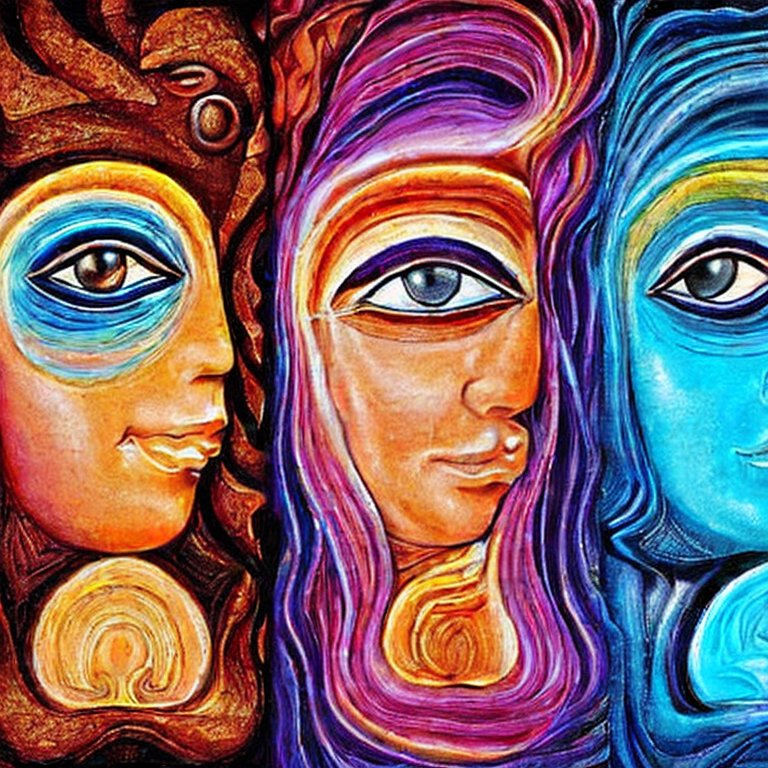
Metaphorical Exploration of the Three Faces of God
As we endeavour to understand the divine, let’s imagine sketching three different portraits of God, each revealing a unique aspect of the divine. These are the “Three Faces of God,” metaphorically spoken of as “I am That,” “Thou art,” and “It, the Ground of All Being.” Each face provides a different set of facial features, offering a new perspective and experience of the divine.
1. The First Portrait: “I am That”
Envision drawing the first portrait, where you sketch not with your hand, but with your consciousness. This portrait, entitled “I am That,” represents the divine as the reflection of our inner selves. The eyes in this portrait mirror our own, sparkling with the wisdom of unity and oneness. These eyes are windows into the soul, witnessing the divine within us and in everything around us.
The lips are sealed, symbolizing the silence that encapsulates the profound realization of this facet of divinity. It is a silence not born of absence but of completeness, tranquillity that resonates with the essence of existence. The serene countenance of this portrait is a silent affirmation of our inherent divinity.
2. The Second Portrait: “Thou Art”
Now, we turn to the second portrait, “Thou Art.” Here, the divine is perceived as the other, an entity separate from ourselves. In this image, the eyes are compassionate, gazing at us with empathy and understanding, reflecting a personal deity who knows us intimately, one who listens, guides, and protects.
The lips are gently curved into a comforting smile, a symbol of the divine’s eternal love and benevolence. This portrait embodies a divine entity that exists independently of us, yet is deeply connected in a loving and caring relationship.
3. The Third Portrait: “It, the Ground of All Being”
The third portrait, “It, the Ground of All Being,” is an abstract masterpiece. Instead of conventional facial features, it is an evolving canvas of colours, shapes, and patterns, capturing the unfathomable depths and dimensions of the divine as the fundamental essence of existence.
This image lacks eyes and lips because it symbolizes the impersonal aspect of the divine. It is the primordial backdrop from which all forms arise and into which they merge. This face does not interact or engage in the usual sense but is simply there, perpetually present, the immutable reality underlying all of existence.
Wrapping Up
This metaphorical exploration of the “Three Faces of God” is like an artful journey into divinity’s vast and varied landscapes. It encourages us to recognize the divine in our reflections, in a comforting gaze, and in the ever-changing canvas of existence.
Each of these faces, with its unique set of features, invites us to a different experience and understanding of God, enabling us to connect with the divine on multiple levels. It’s a contemplative journey that opens up possibilities for self-discovery and spiritual growth, enhancing our cosmic connection. In these divine portraits, we don’t just see different faces of God; we see reflections of our own quest for spiritual understanding and existential meaning.
Morgan O. Smith
Yinnergy Meditation & My Book, Bodhi in the Brain…Available Now!
Welcome to Episode 3 of “Enlighten Up!” Join us for another riveting conversation as spiritual teacher Morgan O. Smith and comedian Nathan Griffith welcome special guest Nathalie Delorme, a dedicated Spiritual Life Coach. In this episode, Morgan scolds Nathan about not being ready for Yinnergy Level 4, despite nearly a decade of meditation practice. He delves into an explanation of the different levels of the unconscious mind and aspects of the dark shadow. Our discussion revolves heavily around Yinnergy Meditation, a Brain Entrainment Program created by Morgan. He talks about the carrier frequencies that are the backbone of Yinnergy and explains the role of high amplitude and low entropy binaural beats within entrainment. Morgan sheds light on the specific frequencies embedded in Yinnergy Purge Level 1 and their influence on the subtle bodies. He also explores lower and slower frequencies, linking them with the experiential stage of development, and discusses their connection to subtle bodies. This episode goes deeper into the unique Yinnergy Audio Coil and how it was created through microdosing. Morgan elaborates on the distinct frequencies responsible for triggering ultimate love and various types of spiritual awakenings, even sharing an experience of a nature spiritual awakening he had in the delta state. Join Morgan, Nathan, and Nathalie for this insightful discussion that promises to illuminate your understanding of spirituality, meditation, and consciousness. Make sure to check out Nathalie Delorme’s transformative work on Instagram @evolution.nathalie and remember, Yinnergy Meditation is available at https://linktr.ee/morganosmith. Don’t forget to grab a copy of Morgan’s book, “Bodhi in the Brain,” now available on Amazon and Barnes & Noble. Like, share, and subscribe to stay updated on upcoming episodes!
Every human being, at some point, grapples with the concept of divinity. How we perceive the divine greatly influences how we understand ourselves and our place in the cosmos. While there are many ways to envision divinity, let us ponder the “Three Faces of God” – “I am That,” “Thou art,” and “It, the Ground of All Being.” Each provides a distinct lens through which we may view and experience the divine.
1. Divine Within: The Face of “I am That”
“I am That” is a call to recognize the divine within us. It is not just a statement; it’s an acknowledgment of our inherent divinity. This perspective dissolves the illusion of separateness, helping us realize that we’re not merely fleeting existences in an indifferent universe, but integral fragments of a divine whole.
This face asks us to engage in deep introspection, to see beyond the veil of our mundane identities, and to understand that our true essence is not our transient ego, but the eternal spirit. Could it be that we’re more divine than we’ve ever imagined? This face prompts us to explore that possibility.
2. Divine As Other: The Face of “Thou Art”
The face of “Thou Art” offers a contrasting perspective. Here, the divine is seen as the ‘Other,’ an entity outside ourselves with whom we can establish a personal connection. This relationship with the divine, filled with reverence and love, is akin to the bond between a devotee and their deity.
In this model, God is the figure we pray to, seek comfort from, and surrender our troubles to. It’s a perspective that creates a powerful, intimate bond with the divine, letting us experience the divinity not as a part of us, but as a separate, caring, and guiding entity.
3. Divine As All: The Face of “It, the Ground of All Being”
The third face, “It, the Ground of All Being,” portrays God as an impersonal essence, the primal energy that permeates the cosmos. This face of divinity does not personify the divine but sees it as the raw material of existence. It is the unchanging reality amidst the ceaseless flux of the universe.
This view urges us to go beyond the traditional understandings of God and probe deeper into the mysteries of existence. Could it be that the divine is not just a deity or a spirit within, but also the very fabric of reality?
Wrapping Up
The Three Faces of God offer a multidimensional understanding of the divine, guiding us on our spiritual and philosophical quest. They propose different ways to connect with the divine, based on our personal inclinations and spiritual needs. More than a simple triad, they represent a spectrum of possibilities on our spiritual journey.
In acknowledging these perspectives, we can foster a richer understanding and experience of God, allowing us to discover the divine within ourselves, in an intimate relationship, and as the underlying reality of existence. Such an exploration can become a catalyst for personal growth and spiritual evolution, leading us to new levels of self-discovery and cosmic connection. After all, isn’t that what the quest for understanding divinity is all about?
Morgan O. Smith
Yinnergy Meditation & My Book, Bodhi in the Brain…Available Now!
Introduction: In the realm of philosophy and spirituality, two captivating concepts often spark profound contemplation and open doors to expanded understanding: paradox and nonduality. Both concepts challenge our conventional modes of thinking and invite us to explore the nature of reality and consciousness. In this thought-provoking blog, we will delve into the differences and similarities between paradox and nonduality, and delve into their roles in the context of spiritual awakening.
Paradox: Illuminating the Mystery Within Paradoxes are enigmatic statements or situations that defy our logical expectations and challenge our understanding of reality. They present us with apparent contradictions, forcing us to question our assumptions and explore deeper layers of truth. Paradoxes are often the gateways to expanded consciousness, as they push the boundaries of our thinking and invite us to embrace the complexities and mysteries of existence. They are the mind’s playground, a fertile ground for philosophical inquiry and intellectual growth. Nonduality: Beyond Duality, Towards Unity Nonduality, on the other hand, transcends the realm of paradox by recognizing the illusory nature of dualistic distinctions altogether. It is a profound philosophical and spiritual concept that asserts the fundamental unity of all things, beyond conventional boundaries. Nonduality suggests that the apparent separation between self and other, subject and object, is an illusion that obscures the deeper truth of interconnectedness. It invites us to explore the essence of oneness that lies at the heart of existence, beyond the limitations of dualistic thinking.
Differences and Similarities: While paradox and nonduality are distinct in their approaches, they share some intriguing similarities. Both concepts challenge our preconceived notions and invite us to embrace uncertainty. Paradoxes expose the limitations of linear thinking and expand our intellectual horizons, while nonduality goes beyond the realm of paradox by embracing a holistic view of reality. They both foster an open-mindedness that allows for new perspectives and insights to emerge.
In the realm of spiritual awakening, both paradox and nonduality play crucial roles. Paradoxes serve as catalysts, shaking us out of our complacency and inviting us to question our deeply held beliefs. They disrupt our habitual patterns of thinking and awaken us to the inherent mystery and wonder of existence. Nonduality, on the other hand, offers a framework for understanding the ultimate truth of interconnectedness. It guides us towards a direct experience of unity and helps dissolve the illusory boundaries that separate us from the world and others.
Conclusion: Paradox and nonduality are two fascinating concepts that contribute to our philosophical and spiritual growth. Paradoxes challenge our intellect and expand our understanding, while nonduality transcends dualistic thinking and reveals the profound interconnectedness of all things. By embracing both paradox and nonduality, we can embark on a transformative journey of self-discovery and spiritual awakening. They invite us to explore the depths of our consciousness and contemplate the profound mysteries of existence. Let us embrace the paradoxes that confront us and open our hearts to the boundless unity that nonduality reveals. In this harmonious dance, we find the keys to unlocking the doors of awakening and embracing the vastness of our being.
Morgan O. Smith
Yinnergy Meditation & My Book, Bodhi in the Brain…Available Now!
Welcome back to the second episode of “Enlighten Up!” – your ultimate source for all things spiritual. We have our regular hosts, Morgan O. Smith, a former comedian turned spiritual teacher, and Nathan Griffith, a comedian with a deep spiritual quest. Our special guest, Gabrielle Bell, an autobiographical cartoonist and spiritual seeker, also joins us for another enlightening conversation.
In this episode, Nathan, aka The Light-Skinned Guru, asks a profound question, “If you’re having an experience, how do you know it’s real?” Meanwhile, Gabrielle seeks to understand the sacrifices needed for spiritual awakening, “What does one have to give up to experience waking up?”
Morgan introduces the topic of Absolute Presence, a state of being that transcends yet includes rationality. He also shares an awe-inspiring experience with a multi-dimensional being, which he refers to as a demigod.
Gabrielle shares her experience with Yinnergy Meditation, Morgan’s brainwave entrainment program, which she combined with her traditional meditative practice over the past week. The insights she gained paved the way for more deep discussions about various states of consciousness and the causal awakening known as Nirvikalpa Samadhi.
Morgan also provides an overview of the Vedanta schools and their key differences. He explains nature mysticism, a spiritual experience deeply connected to the natural world, yet distinct from The Absolute.
Nathan shifts the discussion towards a more existential question: “Why would God create all this?” This leads Morgan to discuss the purpose of understanding our true selves and the ultimate liberation it can bring. He also delves into the motivational potential of near-death experiences, and their power to spark a spiritual path.
Join us for this insightful episode. Dive deep into these spiritual discussions and transform your understanding of existence. Don’t forget to check out the Yinnergy Meditation program: https://linktr.ee/morganosmith
And Morgan’s enlightening book, “Bodhi in the Brain,” is still available on Amazon and Barnes & Noble.
Like, subscribe, and share this episode. Stay enlightened!
Parallel Philosophies Across Cultures Introduction: In the realms of spirituality, the Buddhist concept of Trikaya and the Christian doctrine of the Trinity share an intriguing resemblance. Trikaya, which translates to ‘Three Bodies’, refers to the Dharmakāya, the Saṃbhogakāya, and the Nirmāṇakāya, while the Trinity consists of the Father, the Son, and the Holy Ghost. This blog delves into the philosophical parallels between these central tenets in Buddhism and Christianity. Trikaya in Buddhism: The Dharmakāya or “Truth Body” represents the unmanifested aspect of Buddha, embodying the ultimate nature of reality and enlightenment. The Saṃbhogakāya or “Enjoyment Body” refers to the celestial Buddha who brings teachings to enlightened beings. The Nirmāṇakāya or “Emanation Body” represents the historical and physical form of the Buddha, which is accessible and relatable to ordinary beings.
The Trinity in Christianity: The Trinity comprises the Father, the Son, and the Holy Ghost. The Father signifies the unmanifest aspect of God, the ultimate creator. The Son, Jesus Christ, symbolizes the physical embodiment of God’s will. The Holy Ghost represents the guiding spiritual force, which brings wisdom and understanding to believers.
Philosophical Parallels:
1. Unmanifest and Eternal: In Buddhism, the Dharmakāya is akin to the Christian concept of the Father. Both represent the unmanifest, eternal aspects of the divine. While the Dharmakāya embodies the ultimate truth and wisdom, the Father signifies the ultimate creative force.
2. Physical Embodiment: The Nirmāṇakāya in Buddhism and the Son in Christianity are manifestations of the divine in human form. They are relatable and accessible to ordinary beings. Through their physical forms, they guide and lead by example. The Nirmāṇakāya (Buddha) through enlightenment and the Son (Jesus) through sacrifice and resurrection. 3. Guiding Force: The Saṃbhogakāya and the Holy Ghost serve as the connecting link between the divine and the earthly realms. The Saṃbhogakāya, through celestial teachings, guides enlightened beings, while the Holy Ghost acts as a messenger of God, bringing wisdom and understanding to the faithful.
Conclusion: The Trikaya and the Trinity represent complex theological concepts that offer deep insights into the nature of divinity. The parallel elements in these concepts hint at a universal human yearning to understand the divine and to connect with it. While they emerge from different cultural and religious traditions, their striking similarities foster an appreciation of the rich tapestry of spiritual thought across the world. Through the exploration of such parallels, we can find common ground in our quest for spiritual understanding and fulfillment.
Morgan O. Smith
Yinnergy Meditation & My Book, Bodhi in the Brain…Available Now!