The Root of Choice

True Free Will and the Causal Realm

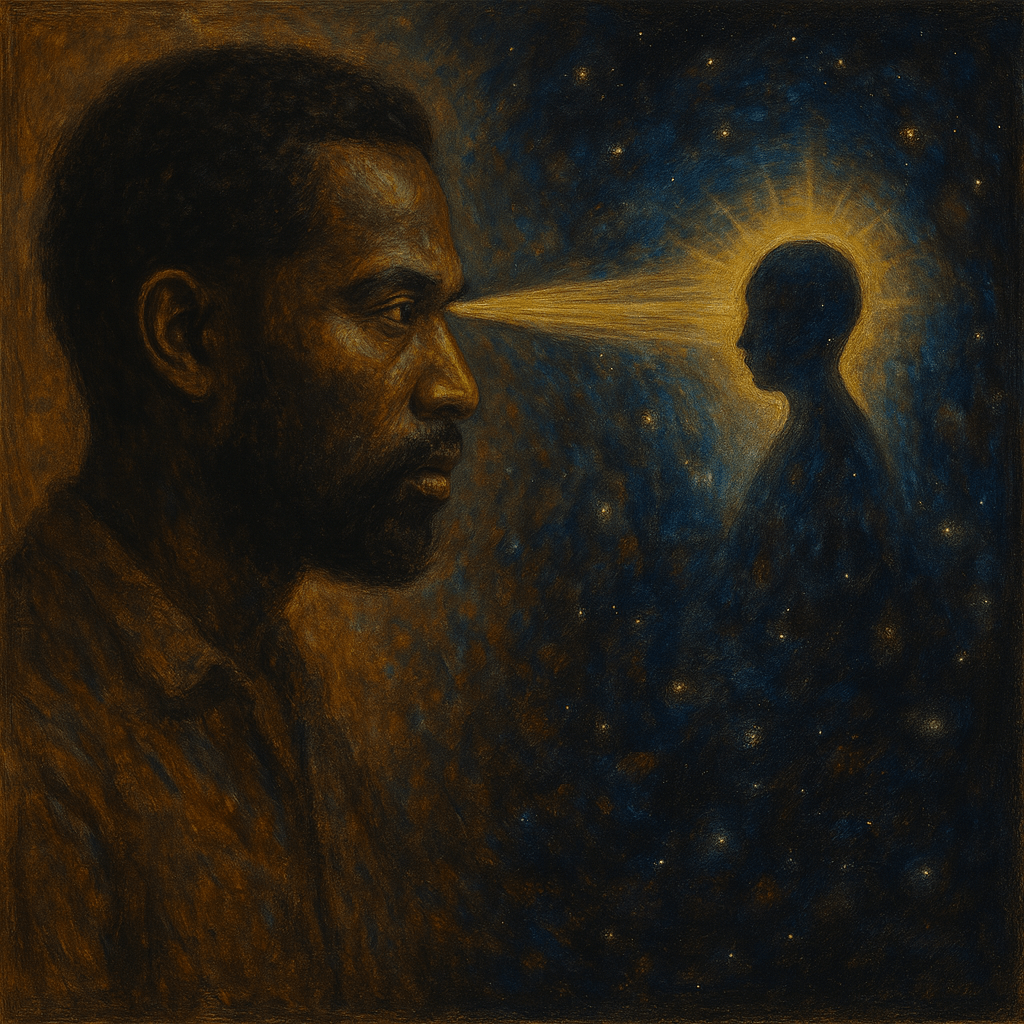
Most speak of choice as if it lives at the surface, where preference, fear, habit, and desire jostle for control. But what if true free will does not arise there at all? What if it exists at the root, before thought forms into options, before “I want” emerges to justify itself?

This root is the causal realm: the source of all motion, where intention is not split from manifestation. It is not personal will in the usual sense—no ego negotiating with life to get what it wants. Instead, it is pure causality aware of itself, setting everything in motion without conflict or division.

At the surface, people speak of freedom as the power to choose between alternatives. Yet these alternatives are already conditioned. They are branches of a tree whose root has already determined their growth. To speak of freedom at the stem while ignoring the root is to mistake effect for cause.

However, the paradox reveals itself when one sees no real division between root and stem. The freedom to choose at the surface becomes genuine only when it is recognized as the expression of the root itself. Every choice becomes the revelation of causality. There is no separate chooser apart from the choosing.

This is what lies beyond the ego’s belief in control. The ego claims “I choose” without realizing that its very claim is already part of the causality it denies. True free will is not the assertion of control over life but the recognition that you are life itself choosing, moving, unfolding.

To see this is to dissolve the illusion of separation. Responsibility is no longer a burden but realization: the root chooses through you, as you. There is no conflict left. Choice becomes transparent, ego falls away, and causality shines unbroken.

This is freedom—not as license, not as negotiation, but as total alignment with the source of all that arises.

Morgan O. Smith

Get Your Free Copy of My Book, Bodhi in the Brain!

https://subscribepage.io/oTSZQu

My Religion Is Liberation

Religion need not be a creed one defends or a ritual one performs. For some of us, it is the recognition of the bars we forge around our own minds—and the relentless devotion to dissolving them. Liberation becomes both the path and the sanctuary.

This isn’t about conversion, salvation, or belonging to any particular sect. It is about noticing the prison of belief itself. Every concept, every identity, every longing for certainty can become a gatekeeper denying entry to our own boundless nature.

Liberation demands a fierce honesty. It asks that we examine the illusions that hold our suffering in place, not as moral failings but as invitations to see through the lie of separation. The true heresy in this religion is clinging to what we think we know about ourselves, about others, about reality itself.

No priest is needed here. Authority resides in awareness, and awareness has no master. The teacher is the arising of life as it is—grief, joy, confusion, clarity. Each moment grants a new chance to recognize the play of experience without getting caught in it.

Liberation is not found by rejecting the world but by perceiving its emptiness and fullness simultaneously. Every object, thought, and sensation is free of substance even as it shines in unmistakable vividness. This paradox isn’t a puzzle to solve but a doorway to live through.

When liberation is the religion, love ceases to be a commandment and becomes the ground of being. Judgment collapses, not because everything is permitted, but because everything is understood as oneself. The compulsion to divide the sacred from the profane, the pure from the impure, loses its grip.

Such a path offers no final doctrine. It holds no promise of eternal reward. Yet it is more generous than any creed that trades truth for comfort. It is the faith of those willing to die before death—to watch every cherished certainty burn so that what cannot be burned may reveal itself.

Those who walk this path do so alone, yet never apart.

Morgan O. Smith

Get Your Free Copy of My Book, Bodhi in the Brain!
https://subscribepage.io/oTSZQu

You Are Already Enlightened, Acting as if You Are Not

Most spiritual seekers chase after enlightenment like it’s a distant prize withheld by the universe. The irony is that the essence being sought is precisely what animates the search. Enlightenment is not something to acquire; it is the underlying fact of being itself. The real dilemma lies not in discovering it but in maintaining the performance of ignorance.

Ask yourself: what does it take to pretend you are unenlightened? Notice the strain involved in sustaining identification with fear, ambition, conflict, desire for control. There is an ongoing maintenance of separation. One must continually rehearse the drama of being a self apart from life, a fragment cut from the whole.

This play of forgetting is not accidental. It has its own intelligence. It permits a dance of contrast so that awareness can better know itself. Yet the tragedy for many is forgetting that it is just a dance. They get lost in the mask they designed. The seeker clings to questions of how, when, and why—missing the silent answer that has always been here.

Enlightenment is not an achievement, but a recognition. It is the falling away of the need to be other than what you are. Once seen, it’s impossible to unsee, though one can still pretend, out of habit or fear. The invitation is to drop the effort, even to be enlightened.

No authority can grant it, no ritual can guarantee it, and no teaching can deliver it because it has never been absent. The teacher points. The student imagines the distance. The truth remains.

To realize this is to see that nothing needs fixing. Even the belief that you are not yet free is simply another expression of freedom. This is the cosmic joke: you are already what you are seeking. The only cost of knowing is the willingness to stop pretending otherwise.

Morgan O. Smith

Get Your Free Copy of My Book, Bodhi in the Brain!
https://subscribepage.io/oTSZQu

The Absence of Dimension

A Contemplation on Absolute Monism

What dimension is the experience of absolute monism?

That very question quietly collapses under its own weight.

To ask “how many” is to divide the indivisible. To quantify is to measure a mystery that can only be met in its own silence. Within the direct realization of Turiyatita—that which lies beyond even Turiya—there is no vantage point from which to count, compare, or classify. The moment dimensionality is assigned, we have already slipped back into the architecture of mind, where form assumes primacy over essence.

Still, the mind hungers for some orientation. So let’s turn the prism slowly, exploring this from a few distinct angles—not as answers, but as offerings.

1. Relative Lens: The Architecture of Experience

Certain esoteric traditions offer a gradient of consciousness: from the dense contours of the material (3D), to subtle inner time-space (4D), toward integrative fields of unity (5D and above). These serve as helpful metaphors, allowing seekers to understand how consciousness may expand or refine. Yet even the loftiest of these is still part of the dream—within the cosmic play of form.

From this lens, the direct encounter with nonduality might appear multi-dimensional, even interdimensional, because it defies the logic of linearity. It feels vast, borderless, paradoxical. But it is still being interpreted by a relative mind, even if only for a moment.

2. Transcendental Lens: The Priorness of the Real

Absolute monism is not located anywhere because it is not a location.

Dimensionality implies structure. It assumes contrast. But the Absolute is prior to all arising. It is not 1D, 5D, or 12D—it is the generative zero-point. The stillness that allows all movement. The background that isn’t separate from the foreground but holds all images without ever becoming one.

It is not empty like a void; it is empty like ungraspable fullness. The kind of emptiness that births stars and dissolves gods. Not confined to being or non-being, but transcending both.

3. Direct Realization: The Collapse of All Coordinates

No map leads here.

Direct realization is immediate and unmediated. Not because you reached a peak, but because the climber vanished. There is no experiencer—only experiencing. No mind reflecting on awareness—only awareness aware of itself.

Here, space has not been born. Time has not begun ticking. Even the concept of unity dissolves, for there is nothing to be unified. What remains is suchness—pure presence prior to presence. A silent explosion of is-ness so complete it leaves no trace.

Not a Dimension. Not Even a State.

So what do we call it?

Nothing.

And everything.

To speak of “the dimension of absolute monism” is to subtly betray it. Better to say: it is the absence of dimension in which all dimensions arise and dissolve. Not a high place, but the place before place. Not a peak, but the disappearance of altitude itself.

A Final Whisper

Absolute monism is not the highest dimension.
It is the absence of dimension,
where even “one” dissolves.
Here, all becomes what it has always been—
indivisible, unbounded, unspoken.

Morgan O. Smith

Get Your Free Copy of My Book, Bodhi in the Brain!
https://subscribepage.io/oTSZQu

God Is the Real Imaginary

Absolute Monism and the Paradox of Reality

A peculiar clarity arises once the mind exhausts its chase for permanence. Once the striving quiets, what remains is not a revelation in the ordinary sense—it is the revelation of revelation itself. God. Not as something other, but as the very condition of knowing, being, and non-being.

God is not a person, nor a power among powers. God is context itself. Not just the backdrop, but the totality—the undivided field in which all division appears. It is what Hindus call Para Brahman: the Absolute of the Absolute. The final substratum, beyond form, formlessness, and even beyond the duality of beyond and not-beyond.

Yet the paradox defies all rational anchoring: God is also imagination.

Not a figment. Not illusion in the dismissive sense. But the supreme imagining—consciousness dreaming within itself. The universe, with all its matter and mind, all its chaos and beauty, is that imagining. And because God is not apart from its imagining, God too is that imagining.

Which means this: both God and the universe are imaginary.

And also utterly real.

What we call “real” and what we call “imaginary” collapse into a single gesture when seen from God’s standpoint—which is no standpoint at all. From this viewless view, there is no separation between the dreamer and the dream, the Absolute and its expression, the Formless and the formed.

Yet the beauty of this is not that everything dissolves into sameness. The beauty is that everything becomes itself without needing to stand apart.

God and the universe are one and the same. And because they are one and the same, they are also not the same. The distinction is not contradiction. It is the very nature of what is. Distinctness does not negate unity. It reveals it.

This is not spiritual poetry. This is ontological exactness. If anything is to be absolute, it must include even the capacity to contradict itself. That is the very mark of its absoluteness.

So, what is this that appears as a tree, a thought, a thunderclap, a kiss, a death, a silence?

It is God.
It is the universe.
It is imagination.
It is reality.

One singularity. Absolute Monism.

To see it is not to figure it out. To see it is to disappear into what cannot not be.

Morgan O. Smith

Get Your Free Copy of My Book, Bodhi in the Brain!

https://subscribepage.io/oTSZQu

The Divine Totality

Everything Is God, Even the Illusion of Not-God

There comes a moment so still and unfiltered that perception collapses into the clarity of being. Not being this or that, but being everything. And not just metaphorically. Not just poetically. Literally everything—formless and formed, seen and unseen, finite and infinite—is God.

When I use the word God, I’m not pointing toward a figure, a belief, or a doctrine. I am pointing toward existence itself—the Absolute, the Whole, Brahman, Para Brahman, the Unconditioned, conditioned, the Uncreated and created. That which includes form and formlessness, time and timelessness, birth and death, creation and dissolution, the ten thousand things and the nothing between them.

Everything is God. Not just contains God. Not just touched by God. Not just part of God. But fully and completely God. That which we call the universe is not just inside God. It is God. And God is also what lies outside the universe—if such a term can even be grasped. There is not a single thing, moment, action, or gap that is not 100% God. And yet, even the idea of “percent” breaks down in the face of such a realization.

God is not just somewhere else. God is not just merely within. God is not only beyond. God is not higher or lower or more subtle or more gross. No matter how crude or refined, every appearance is divine. Each atom, each sorrow, each beam of light, each lie, each truth, each pulse of your heart, each glitch in the system—is God being what only God can be and cannot be: itself, everywhere, nowhere, always, never been.

Multiplicity is not a contradiction, yet it is. It’s how God dances with itself. The illusion of separation is not some accident to be corrected, yet it’s that as well. It is part of the design, part of the intelligence. The appearance of duality is not a denial of oneness—it’s one appearing as two, or ten thousand. Each distinction—this object, that person, this tree, that thought—is the Absolute shimmering as particularity.

It’s easy to say this with words. The difficulty arises only when the words are taken as substitutes for seeing. Direct seeing dismantles the grip of identification. When one truly sees all of this—across dimensions, across appearances—as one singular Presence, there is no longer any question. And there is no longer any need for the question. One does not simply understand that everything is God. One is that understanding.

Yet here’s the paradox: To truly see this is also to see that none of it is God. No label can contain it. No concept can hold it. Even the word God must dissolve. Enlightenment is not just knowing this. Enlightenment is also the absence of needing to.

This is not a belief system. It is not an ideology. It is not a path with steps. This is the unteachable reality that always is. When the veil lifts—even for a moment—all questions are answered without being answered. Nothing changes, yet everything changes. One doesn’t become more spiritual. One simply stops pretending.

To recognize this is to realize: even the illusion is God. Even ignorance is God. Even the striving to awaken is God pretending to forget itself in order to remember more deeply. Even your doubt is divine. Even your forgetfulness is sacred.

You are not just a part of God. You are not just held within God. You are God. And so is everyone, everything, every grain of dust, every breath of silence, every broken thing that aches for healing.

The Absolute never needed your worship. It only waited for your recognition.

Morgan O. Smith

Get Your Free Copy of My Book, Bodhi in the Brain!
https://subscribepage.io/oTSZQu

When Nothing Belongs to You

Once You Detach Yourself from All Things, Everything Becomes Beautiful

A strange phenomenon arises the moment we no longer grip the world by the throat. What once felt jagged begins to soften. The same city skyline, the same broken cup, the same impatient stranger on the train—all begin to shimmer, not with any added sparkle, but with a quality that was always there, hidden behind the veil of expectation.

It’s not that the world changes. You do.

Detachment is not withdrawal. It’s not apathy, nor is it a sterile indifference. It is intimacy without ownership. Love without clutching. Awareness without the distortion of personal commentary. You can finally see things clearly because you’re no longer trying to use them—to define yourself, to fill an absence, to make them mean something they don’t.

When you release the need to extract purpose or permanence from experience, beauty emerges—not as something to possess, but as something that is. The leaf fluttering to the ground, the silence between thoughts, the look in a stranger’s eye—all of it becomes radiant, but not because it offers you anything. It simply reveals itself when you’re no longer insisting that it must.

This clarity—this unburdened seeing—is often misunderstood as detachment from life. But it’s quite the opposite. You are not detached from life; you are detached from your ideas about it. The concept collapses. Only presence remains.

And presence doesn’t compare or crave. It beholds. It receives. It honours.

Try this: Let everything be exactly what it is today. No fixing. No rejecting. No rehearsing for tomorrow. Watch what happens when you stop insisting that the world obey your script. A quiet awe begins to surface—so gentle you could miss it if you’re waiting for fireworks.

That awe is the fragrance of truth. And truth is always beautiful.

Morgan O. Smith

Get Your Free Copy of My Book, Bodhi in the Brain!
https://subscribepage.io/oTSZQu

The Game of Black & White

How You Play the Game of Black & White Reveals Your Level of Spiritual Maturity

He doesn’t avoid the black squares. He just stops thinking they’re cursed.

You can tell how spiritually mature someone is by how they engage with contrast—not by how they escape it. The game of black and white is always being played. Light falls beside shadow, certainty walks with doubt, and gain is never far from loss. But while most are trying to land only on the white tiles, the one who has seen beyond duality walks freely across the whole board.

Spiritual growth doesn’t mean becoming invulnerable to darkness; it means seeing the darkness without contracting around it. A child in awareness recoils from discomfort and seeks the promise of the ‘light.’ A grown soul knows that neither is final, and neither needs to be resisted. The black square isn’t a punishment. The white square isn’t a reward. They are moves in the same dance.

The one who awakens learns to stop chasing symmetry. No longer obsessed with winning, they realize it was never about domination of light over dark, nor rising above contradiction. It was about presence through all of it. About meeting each moment with equanimity, whether wrapped in sorrow or shining in joy.

Some play to avoid pain. Others play to seek pleasure. But the wise one plays to see. And seeing, they cease to play as a someone at all.

They simply move.

Morgan O. Smith

Get Your Free Copy of My Book, Bodhi in the Brain!

https://subscribepage.io/oTSZQu

The Rapture of Letting Go

Presence is not a prize to be won or a fortress to defend. It is not some static peak upon which the awakened are meant to perch forever, unmoved and untouchable. The pursuit of a “permanent state” of anything—even presence—quietly binds us again to the illusion we sought to transcend. It becomes another mask of the seeker, cloaked in stillness, trembling behind the veil of spiritual ambition.

States rise and dissolve. Rapture comes like a summer breeze and vanishes just as gently. Then irritation, confusion, boredom. Then clarity. Then fog. The parade continues, not because you are failing, but because you are alive.

To lose attention is not to lose awareness. What perceives the loss? What observes the drift and the return? That witnessing is untouched. It is not opposed to distraction, nor does it seek permanence. It simply is, always.

Clinging to peace is no different from clinging to pain. The grasping hand is the same. When rapture becomes an achievement, it quietly rots. But when it is allowed to dance freely—hidden beneath the dishes in the sink, behind the silent gaze on the subway, or in a burst of sudden awe at the sky—then it becomes alive again.

You can continue to practice, to breathe, to cultivate. But do so like a child builds a sandcastle: for the love of it, not to resist the tide. Joy, too, is a practice. But it must remain unhooked from outcome.

There’s a kind of rapture in the background hum of your own awareness—even when the foreground is chaos. That quiet clarity never left. You’re not missing the moment. You are the moment, passing through its own reflections. And if you laugh at the absurdity of forgetting and remembering over and over again, then perhaps that’s the most awakened thing of all.

Morgan O. Smith

Get Your Free Copy of My Book, Bodhi in the Brain!

https://subscribepage.io/oTSZQu

When Spirit Dreams Itself Into Matter

Spirit does not need a mirror, yet it gazes anyway—projecting forms into the formless, assigning names to the unnamed. What we call the world is not something separate from Spirit, but a spontaneous gesture of its own imagination, experienced as if it were other.

This is the paradox.

There is no true division between creator and creation. What appears as the external world is not a stage for a lost soul to find its way back, but Spirit animated—forgetting itself to taste the illusion of separation. Not as punishment or accident, but as a dance, a play, a sacred hallucination.

To believe the imagination is real is not error. It is the very means by which Spirit hides and finds itself. Each identity clung to, each role performed, each belief defended—these are costumes worn by the formless to remember itself as form.

Awakening doesn’t arrive like a conclusion; it dissolves the argument. You do not awaken from the dream by force or by will, but by remembering that it was always Spirit dreaming. The character fades, but not as death—more like laughter that remains after the joke has dissolved.

What changes when you see this?

Nothing. Everything. The world continues. You walk, eat, speak. But there’s an intimacy now. A recognition that what you once took to be real is neither unreal nor merely imagined—it is Spirit, playing with itself through light and shadow.

The one who seeks is the sought. The one who prays is the prayed to. Spirit folds into its own image, not to be found, but to be felt. That is the point. Not escape. Not transcendence. But the sacred absurdity of being itself.

Morgan O. Smith

Get Your Free Copy of My Book, Bodhi in the Brain!

https://subscribepage.io/oTSZQu