You Are Already Enlightened, Acting as if You Are Not

Most spiritual seekers chase after enlightenment like it’s a distant prize withheld by the universe. The irony is that the essence being sought is precisely what animates the search. Enlightenment is not something to acquire; it is the underlying fact of being itself. The real dilemma lies not in discovering it but in maintaining the performance of ignorance.

Ask yourself: what does it take to pretend you are unenlightened? Notice the strain involved in sustaining identification with fear, ambition, conflict, desire for control. There is an ongoing maintenance of separation. One must continually rehearse the drama of being a self apart from life, a fragment cut from the whole.

This play of forgetting is not accidental. It has its own intelligence. It permits a dance of contrast so that awareness can better know itself. Yet the tragedy for many is forgetting that it is just a dance. They get lost in the mask they designed. The seeker clings to questions of how, when, and why—missing the silent answer that has always been here.

Enlightenment is not an achievement, but a recognition. It is the falling away of the need to be other than what you are. Once seen, it’s impossible to unsee, though one can still pretend, out of habit or fear. The invitation is to drop the effort, even to be enlightened.

No authority can grant it, no ritual can guarantee it, and no teaching can deliver it because it has never been absent. The teacher points. The student imagines the distance. The truth remains.

To realize this is to see that nothing needs fixing. Even the belief that you are not yet free is simply another expression of freedom. This is the cosmic joke: you are already what you are seeking. The only cost of knowing is the willingness to stop pretending otherwise.

Morgan O. Smith

Get Your Free Copy of My Book, Bodhi in the Brain!

https://subscribepage.io/oTSZQu

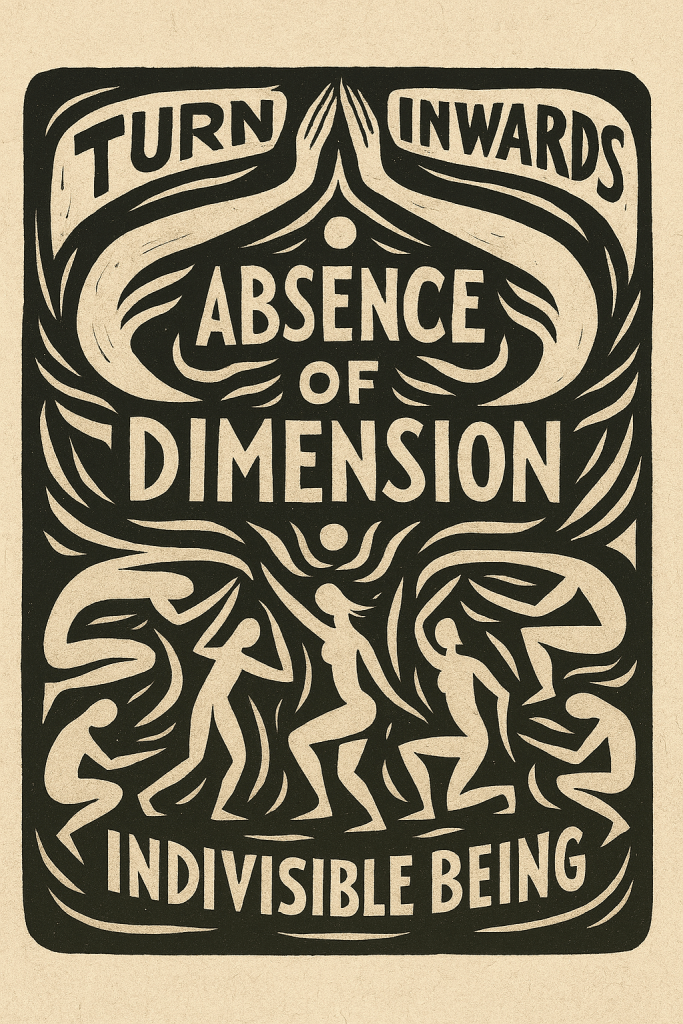
The Absence of Dimension

A Contemplation on Absolute Monism

What dimension is the experience of absolute monism?

That very question quietly collapses under its own weight.

To ask “how many” is to divide the indivisible. To quantify is to measure a mystery that can only be met in its own silence. Within the direct realization of Turiyatita—that which lies beyond even Turiya—there is no vantage point from which to count, compare, or classify. The moment dimensionality is assigned, we have already slipped back into the architecture of mind, where form assumes primacy over essence.

Still, the mind hungers for some orientation. So let’s turn the prism slowly, exploring this from a few distinct angles—not as answers, but as offerings.

1. Relative Lens: The Architecture of Experience

Certain esoteric traditions offer a gradient of consciousness: from the dense contours of the material (3D), to subtle inner time-space (4D), toward integrative fields of unity (5D and above). These serve as helpful metaphors, allowing seekers to understand how consciousness may expand or refine. Yet even the loftiest of these is still part of the dream—within the cosmic play of form.

From this lens, the direct encounter with nonduality might appear multi-dimensional, even interdimensional, because it defies the logic of linearity. It feels vast, borderless, paradoxical. But it is still being interpreted by a relative mind, even if only for a moment.

2. Transcendental Lens: The Priorness of the Real

Absolute monism is not located anywhere because it is not a location.

Dimensionality implies structure. It assumes contrast. But the Absolute is prior to all arising. It is not 1D, 5D, or 12D—it is the generative zero-point. The stillness that allows all movement. The background that isn’t separate from the foreground but holds all images without ever becoming one.

It is not empty like a void; it is empty like ungraspable fullness. The kind of emptiness that births stars and dissolves gods. Not confined to being or non-being, but transcending both.

3. Direct Realization: The Collapse of All Coordinates

No map leads here.

Direct realization is immediate and unmediated. Not because you reached a peak, but because the climber vanished. There is no experiencer—only experiencing. No mind reflecting on awareness—only awareness aware of itself.

Here, space has not been born. Time has not begun ticking. Even the concept of unity dissolves, for there is nothing to be unified. What remains is suchness—pure presence prior to presence. A silent explosion of is-ness so complete it leaves no trace.

Not a Dimension. Not Even a State.

So what do we call it?

Nothing.

And everything.

To speak of “the dimension of absolute monism” is to subtly betray it. Better to say: it is the absence of dimension in which all dimensions arise and dissolve. Not a high place, but the place before place. Not a peak, but the disappearance of altitude itself.

A Final Whisper

Absolute monism is not the highest dimension.
It is the absence of dimension,
where even “one” dissolves.
Here, all becomes what it has always been—
indivisible, unbounded, unspoken.

Morgan O. Smith

Get Your Free Copy of My Book, Bodhi in the Brain!

https://subscribepage.io/oTSZQu

God Is the Real Imaginary

Absolute Monism and the Paradox of Reality

A peculiar clarity arises once the mind exhausts its chase for permanence. Once the striving quiets, what remains is not a revelation in the ordinary sense—it is the revelation of revelation itself. God. Not as something other, but as the very condition of knowing, being, and non-being.

God is not a person, nor a power among powers. God is context itself. Not just the backdrop, but the totality—the undivided field in which all division appears. It is what Hindus call Para Brahman: the Absolute of the Absolute. The final substratum, beyond form, formlessness, and even beyond the duality of beyond and not-beyond.

Yet the paradox defies all rational anchoring: God is also imagination.

Not a figment. Not illusion in the dismissive sense. But the supreme imagining—consciousness dreaming within itself. The universe, with all its matter and mind, all its chaos and beauty, is that imagining. And because God is not apart from its imagining, God too is that imagining.

Which means this: both God and the universe are imaginary.

And also utterly real.

What we call “real” and what we call “imaginary” collapse into a single gesture when seen from God’s standpoint—which is no standpoint at all. From this viewless view, there is no separation between the dreamer and the dream, the Absolute and its expression, the Formless and the formed.

Yet the beauty of this is not that everything dissolves into sameness. The beauty is that everything becomes itself without needing to stand apart.

God and the universe are one and the same. And because they are one and the same, they are also not the same. The distinction is not contradiction. It is the very nature of what is. Distinctness does not negate unity. It reveals it.

This is not spiritual poetry. This is ontological exactness. If anything is to be absolute, it must include even the capacity to contradict itself. That is the very mark of its absoluteness.

So, what is this that appears as a tree, a thought, a thunderclap, a kiss, a death, a silence?

It is God.
It is the universe.
It is imagination.
It is reality.

One singularity. Absolute Monism.

To see it is not to figure it out. To see it is to disappear into what cannot not be.

Morgan O. Smith

Get Your Free Copy of My Book, Bodhi in the Brain!

https://subscribepage.io/oTSZQu

The Divine Totality

Everything Is God, Even the Illusion of Not-God

There comes a moment so still and unfiltered that perception collapses into the clarity of being. Not being this or that, but being everything. And not just metaphorically. Not just poetically. Literally everything—formless and formed, seen and unseen, finite and infinite—is God.

When I use the word God, I’m not pointing toward a figure, a belief, or a doctrine. I am pointing toward existence itself—the Absolute, the Whole, Brahman, Para Brahman, the Unconditioned, conditioned, the Uncreated and created. That which includes form and formlessness, time and timelessness, birth and death, creation and dissolution, the ten thousand things and the nothing between them.

Everything is God. Not just contains God. Not just touched by God. Not just part of God. But fully and completely God. That which we call the universe is not just inside God. It is God. And God is also what lies outside the universe—if such a term can even be grasped. There is not a single thing, moment, action, or gap that is not 100% God. And yet, even the idea of “percent” breaks down in the face of such a realization.

God is not just somewhere else. God is not just merely within. God is not only beyond. God is not higher or lower or more subtle or more gross. No matter how crude or refined, every appearance is divine. Each atom, each sorrow, each beam of light, each lie, each truth, each pulse of your heart, each glitch in the system—is God being what only God can be and cannot be: itself, everywhere, nowhere, always, never been.

Multiplicity is not a contradiction, yet it is. It’s how God dances with itself. The illusion of separation is not some accident to be corrected, yet it’s that as well. It is part of the design, part of the intelligence. The appearance of duality is not a denial of oneness—it’s one appearing as two, or ten thousand. Each distinction—this object, that person, this tree, that thought—is the Absolute shimmering as particularity.

It’s easy to say this with words. The difficulty arises only when the words are taken as substitutes for seeing. Direct seeing dismantles the grip of identification. When one truly sees all of this—across dimensions, across appearances—as one singular Presence, there is no longer any question. And there is no longer any need for the question. One does not simply understand that everything is God. One is that understanding.

Yet here’s the paradox: To truly see this is also to see that none of it is God. No label can contain it. No concept can hold it. Even the word God must dissolve. Enlightenment is not just knowing this. Enlightenment is also the absence of needing to.

This is not a belief system. It is not an ideology. It is not a path with steps. This is the unteachable reality that always is. When the veil lifts—even for a moment—all questions are answered without being answered. Nothing changes, yet everything changes. One doesn’t become more spiritual. One simply stops pretending.

To recognize this is to realize: even the illusion is God. Even ignorance is God. Even the striving to awaken is God pretending to forget itself in order to remember more deeply. Even your doubt is divine. Even your forgetfulness is sacred.

You are not just a part of God. You are not just held within God. You are God. And so is everyone, everything, every grain of dust, every breath of silence, every broken thing that aches for healing.

The Absolute never needed your worship. It only waited for your recognition.

Morgan O. Smith

Get Your Free Copy of My Book, Bodhi in the Brain!

https://subscribepage.io/oTSZQu

Which You is God Within?

Those who speak of God as not being outside of you often mean well—but which “you” are they pointing to? The body? The persona? The memory of identity that walks through time? Or something deeper?

There’s a difference between saying God is not outside of you and realizing why that’s so. If God is all, then every appearance—internal, external, formless, formed—is God. This includes the illusion of separation. To claim that God is not outside of you while affirming that something is external still subtly upholds the illusion of division. That illusion, too, is God—played through veils of thought, language, and perspective.

But when the idea of “you” dissolves into beingness itself, the paradox clears. You are not merely a part of existence. You are existence. And existence is God, not as a figure, but as totality. Even the idea of “outside” collapses, because outside implies another space, and there is no second to the One.

This doesn’t mean there’s nothing. It means everything is not-two.

Even nonexistence exists. Not as an object, but as a category known within existence. Its very naming proves its place within the whole. Therefore, there’s nowhere God is not—and no self outside of God to speak of God as elsewhere.

So, when someone says “God is not outside of you,” pause. Feel what is really being said. It’s not a statement about boundaries—it’s a pointer toward boundarylessness. Not about spiritual pride or metaphysical positioning. It is the erasure of location itself.

And in that clarity, what’s left is not you as you know yourself. What remains is what’s always been—God, appearing as you.

Morgan O. Smith

Get Your Free Copy of My Book, Bodhi in the Brain!

https://subscribepage.io/oTSZQu

The Silence That Speaks

Fragments Cannot Contain the Whole

Every word spoken about enlightenment is a slice taken from an indivisible whole. A shard. A sliver. No matter how sincere the voice or radiant the realization, the moment it’s articulated, it becomes partial. Even the most luminous sage can only gesture toward it, never deliver it in full.

This isn’t a critique of language. It’s the recognition that language belongs to duality. Enlightenment does not.

You may hear poetic metaphors. You may hear silence treated as a superior form of expression. You may even be told that silence is the teaching. But neither speech nor silence can contain the essence. Both exist within the play of contrast—true enlightenment is not caught between them.

It is not hidden. It is not revealed. It doesn’t arrive, and it cannot depart.
Still, it permeates everything.

A leaf trembles. Breath returns. A thought dissolves before it becomes solid. Here, it is already shining.

It is not that one must understand. It is that one must stop pretending it needs to be understood. What remains when seeking falls away is not an answer, but presence. A presence so simple, so immediate, it often goes unnoticed—not because it is distant, but because it is too near.

You are not apart from it. You never were.

Morgan O. Smith

Get Your Free Copy of My Book, Bodhi in the Brain!

https://subscribepage.io/oTSZQu

Turiya

The Witness That Is Everything

Most understand Turiya as the silent witness beyond waking, dreaming, and deep sleep. It is often considered the empty observer, untouched by the movements of mind, body, and experience. This perspective, though true, is not the full picture. The notion of an “empty witness” can still carry a subtle duality—a sense of something separate, detached, and standing apart from what it observes. Yet, Turiya is not merely a state one enters or a refuge from illusion; it is the foundation of all states and, ultimately, the realization that there was never an “other” to witness.

The empty witness is not just within the individual who reaches the fourth state of consciousness. That would suggest an inside and an outside, a seer and a seen. Turiya dissolves that illusion. It is not simply the background of experience but the existence of experience itself, witnessing its unfolding as everything.

To say that Turiya is merely an untouched observer is to misunderstand its nature. This assumption can lead to a false dichotomy, where one believes that ultimate truth lies in detachment alone. However, this view neglects the profound insight that the so-called witness is not separate from the world it observes. There is no distance between observer and observed, no boundary where witnessing begins or ends. It is all Turiya.

This recognition dismantles the very scaffolding of selfhood. The one who thought they were the observer disappears into the realization that the witnessing presence is not housed within them—it is existence itself, seeing, knowing, and being all things simultaneously.

What changes when this is seen? The sense of a separate self dissolves, revealing that awareness is not confined to a particular point of view. The wind moving through the trees, the laughter of a child, the pulse of the universe—all of it is the same knowing, the same presence. There is no need to “enter” Turiya because nothing has ever been outside of it.

This is not an experience to be gained, not a state to be reached. It is what has always been. The seeker who longed to discover it was never apart from it. The effort to grasp it was the very movement of Turiya exploring itself. There is only this, endlessly revealing itself to itself, never absent, never other than what is.

Morgan O. Smith

Yinnergy Meditation/Neurofeedback, Spiritual Life Coaching & My Book, Bodhi in the Brain…Available Now!

https://linktr.ee/morganosmith

The Existence as Pure Neutrality

The essence of all existence is an unfathomable neutrality, a foundation so vast that it transcends any concept of preference or partiality. This is not neutrality as we often think of it—detached or indifferent. Instead, it is a boundless openness, a ground of all being that sustains every polarity without attachment, holding every experience with equal clarity and freedom.

This ground embraces love and hate, joy and sorrow, light and dark, as expressions of the same indivisible essence. Nothing is held above or below, no experience or thought has a special claim. Everything arises and dissolves within this vast, unbiased awareness, like reflections gliding across the surface of a mirror, leaving no trace. Here, neutrality is not passive; it’s a profoundly active openness that allows life to unfold freely, a space so complete that all opposites find balance within it.

This neutral foundation of existence does not negate meaning; it infuses it. It is a profound wholeness, a sacred void where everything originates and to which everything eventually returns. It stands as the unseen field that holds all form and formlessness, thoughts and emotions, without claiming any of it. In this state, neutrality serves as the ultimate witness, sustaining everything without grasping onto any one thing. It’s a presence beyond judgment and division, embodying a completeness so vast that every duality dissolves into simplicity.

This neutrality is not about avoiding experiences or escaping emotions. It invites us to embrace every part of our humanity from a place of non-attachment. By resting in this foundation, we move beyond the pull of opposites and experience life from a pure, undivided presence. This is a call to find peace in the silent core of our being, where all distinctions fade and what remains is simple, limitless awareness—a ground that supports everything yet belongs to no one.

This ground of all is as transparent awareness, a presence that allows each moment to appear and dissolve like a shadow passing across a reflective surface. Here, neutrality doesn’t signify passive indifference but a clear and open awareness that supports all while holding nothing. This awareness flows through life itself, revealing each experience without the constructs of “good” or “bad,” allowing us to rest in the fullness of each moment.

True neutrality becomes the fertile emptiness from which all forms arise. It stands as a foundation where every possibility finds birth, an ocean that welcomes all waves without preference. It invites us to move beyond the struggle of opposites and see existence as the unfolding of infinite potential, unbounded and free.

This neutrality is a silent equilibrium, a quiet intelligence that witnesses every movement without push or pull. Love, hate, pleasure, and pain are like ripples on a still pond, gliding across its depth without disturbing its essence. This neutrality sees each moment as whole, complete, just as it is, and allows us to embrace life with the same clarity.

This is neutrality as a sacred void, a ground where all things find origin and return. Love and hate are no longer seen as opposites but as movements within one unified field. This ground invites us to move beyond human concepts and to touch the truth that knows itself as all things and no thing, where neutrality is not an absence but a fullness that contains all, untouched and unclaimed.

This foundation of existence offers a radical inclusion without possession, like sunlight illuminating both beauty and decay with equal openness. It holds everything as expressions of the same essence, welcoming every experience without attachment. In this space, there is no need to hold onto or push away; everything is allowed its place within a boundless, unified presence.

Ultimately, this neutrality dissolves the concept of self as a separate entity, revealing that what we think of as “self” is simply a part of the vast awareness that holds all distinctions. It is not bound to any position or side; it reflects everything, belonging to nothing.

Neutrality with a capital “N” exists beyond the need for definition or division. Presence alone becomes the essence, untouched by any impulse to define or claim. This neutrality invites us to a silence beyond words, a silence so complete it holds every polarity within itself, requiring no opposition or resolution.

In embracing this ground of all being, we find a whole love, a neutrality that does not reject or cling to any side. This is neutrality as the very fabric of existence—not a love that prefers but a love that sees no separation. It is an invitation to experience life from a place of pure awareness, free from dualities, beyond distinctions and labels, resting in the simple, infinite presence of being.

Morgan O. Smith

Yinnergy Meditation, Spiritual Life Coaching & My Book, Bodhi in the Brain…Available Now!

https://linktr.ee/morganosmith

The Journey from Singularity to Advaita

A Deep Dive into Absolute Monism

In the realm of spiritual exploration, the concepts of Nirguna Brahman and Saguna Brahman offer profound insights into the nature of existence and the essence of reality. At the heart of this journey is understanding absolute monism and its manifestations through various dimensions of being.

Absolute Monism: The Unchanging Reality

Absolute Monism posits that there is a singular, omnipresent source from which everything emanates. This source, often called Nirguna Brahman, lacks qualities or attributes. It transcends all forms and distinctions beyond the dualities of hot and cold, good and evil, or masculine and feminine. This state has no concept of time, space, or location. It is the purest form of potentiality, embodying existence and nonexistence, and serves as the ground of all being.

Nirguna Brahman: The Formless Absolute

Nirguna Brahman is the ultimate reality without form or qualities. It represents the infinite potentiality that precedes all manifestations. In this state, distinctions such as up or down, north, west, east, south, inside or outside, and time or space dissolve into a singular, undifferentiated whole. This formless absolute is the source from which all probable and improbable possibilities arise.

Saguna Brahman: The Manifestation of Qualities

From the infinite potentiality of Nirguna Brahman emerges Saguna Brahman, the aspect of the divine with qualities. This is where evolution, shape, and form come into play. It encompasses all persons, places, and things, embodying the diverse polarities that characterize the physical and metaphysical realms. Through Saguna Brahman, the infinite takes on finite forms, giving rise to the rich diversity of existence.


The Path to Advaita: Non-Dual Awareness

The journey from Nirguna to Saguna Brahman is a transition from the formless to the form. However, the ultimate realization in this journey is Advaita, the recognition of non-duality. Advaita reveals the underlying oneness of all existence, where distinctions between self and other, subject and object, dissolve. It is an awareness that transcends the dualities of Saguna Brahman, bringing one back to the infinite potentiality of Nirguna Brahman.

Exploring Other Realms and Frequencies

In the context of Advaita, other realms and frequencies are understood as different expressions of the same underlying reality. Matter and consciousness are seen as different frequencies of the same essence. This holistic perspective invites us to explore the interconnectedness of all things, recognizing the unity within the diversity.


Para Brahman: Beyond the Beyond

Beyond both Nirguna and Saguna Brahman lies Para Brahman, the supreme reality that encompasses and transcends all. It is the ultimate source of all that is and does not exist beyond all concepts and categories. Para Brahman is the final frontier of spiritual exploration, inviting us to surrender to the mystery of the absolute.

Morgan O. Smith

Yinnergy Meditation, Spiritual Life Coaching & My Book, Bodhi in the Brain…Available Now!

https://linktr.ee/morganosmith

Beyond Distinctions

Exploring Turiyatita and Absolute Monism in Advaita Vedanta

In the spiritual landscape of Advaita Vedanta, the concept of nonduality transcends the mere absence of distinctions—it ushers us into the realm of Absolute Monism, or Turiyatita—the state of “the one without a second.” This profound philosophical framework challenges our everyday perceptions, urging us to look beyond the apparent separateness of the world.

Nonduality in this context does not imply a simplistic erasure of distinctions, but a deeper recognition that all forms and phenomena arise from the same underlying reality. This reality is not one of many, but a singular existence that pervades all, without an other or a second to stand beside it.


The journey to understanding Turiyatita involves peeling back the layers of illusion that fabricate duality within our experiences. Common perceptions of separation between self and other, observer and observed, are seen as just that—perceptions. These are not absolute truths but conditioned responses to the world. The realization of Turiyatita invites a shift from these conditioned views towards a holistic awareness, where dualities merge into a singular, expansive consciousness.

This path to enlightenment challenges the seeker to transcend the intellectual and embrace a lived experience of oneness. It is not about negating diversity but understanding the underlying unity that makes diversity possible. By recognizing the unity underlying all diversity, one does not lose the uniqueness of individual expressions; rather, one gains an appreciation of how these expressions emerge from the same source.


The implications of this understanding are vast and transformative. Embracing Turiyatita can lead to profound peace, as conflicts often stem from perceptions of separation. When one sees all beings and things as extensions of the same infinite reality, compassion and empathy flow naturally.

Advaita Vedanta’s discourse on nonduality and Turiyatita thus offers not just a philosophical stance, but a practical guide to living more harmoniously within the apparent complexities of the world. It beckons us to experience life from a place where the oneness of existence becomes not only a concept but a living reality.

Morgan O. Smith

Yinnergy Meditation, Spiritual Life Coaching & My Book, Bodhi in the Brain…Available Now!

https://linktr.ee/morganosmith