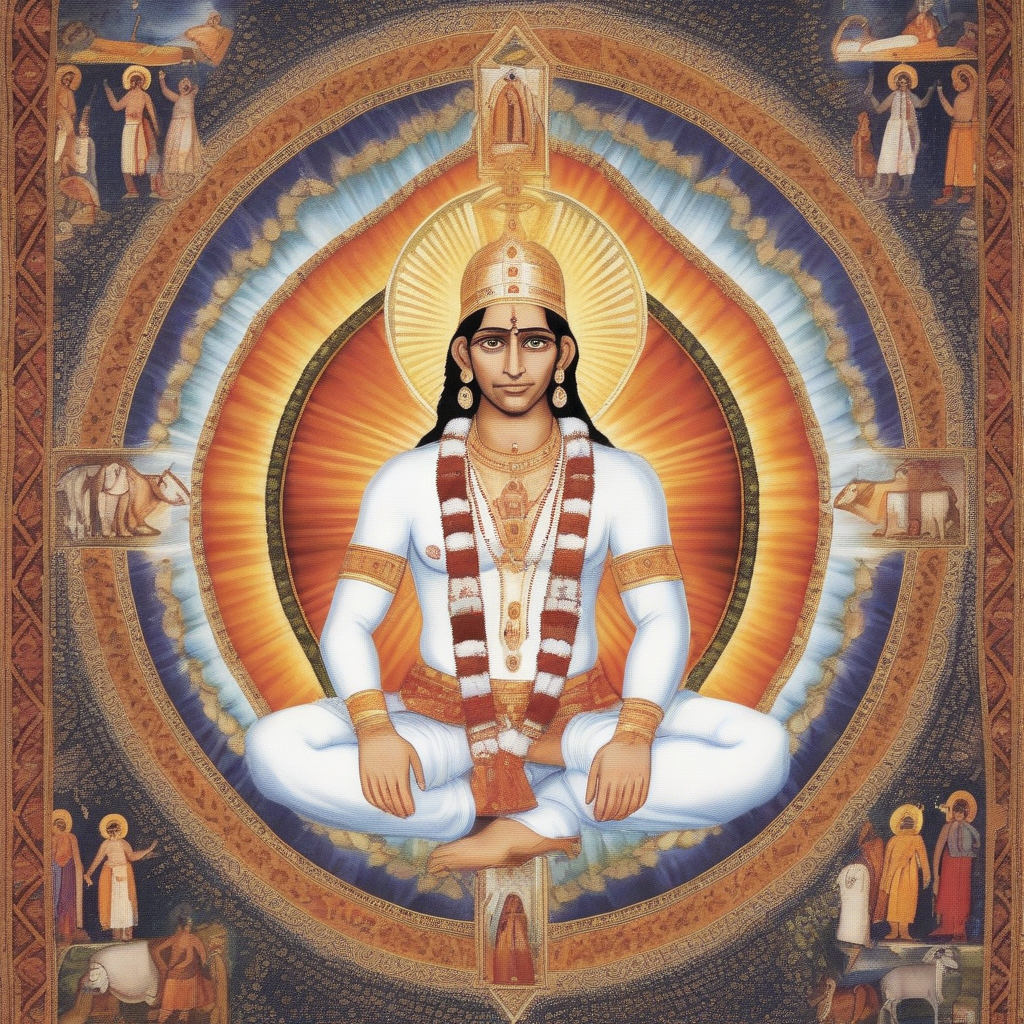
Exploring the Divine Tapestry
In the lush gardens of spiritual thought, there exist concepts that, at first glance, may appear to belong to entirely different landscapes. Yet, upon closer examination, one finds threads that weave them together into a grand tapestry of the divine. Such is the case when one seeks to understand the Hindu concept of Brahman from a Christian perspective.
At the heart of Hindu philosophy lies Brahman, the ultimate reality, the absolute existence, knowledge, and bliss. Brahman is not merely a god among many but the ineffable ground of all being, beyond form, beyond limits, the essence of everything that was, is or will be. It is an ocean of consciousness, infinite and eternal, from which the universe springs forth like waves from a boundless sea.
How, then, can a Christian approach this concept? Christianity speaks of God in terms of a personal deity, a Trinity of Father, Son, and Holy Spirit, yet also affirms that God is beyond all comprehension, omnipresent, and the source of all that exists. The Christian mystical tradition, with its contemplative gaze, has long sought union with the divine, echoing the Hindu pursuit of realizing one’s oneness with Brahman.
In the Christian mystical experience, one might glimpse parallels to the understanding of Brahman. The Apostle Paul, in his letter to the Colossians, speaks of Christ as the one “in whom all things hold together.” This echoes the sense of Brahman as the underlying reality that upholds the universe. Theologians like St. Augustine have described God as being closer to us than we are to ourselves, resonating with the Hindu notion of Atman, the innermost self, ultimately one with Brahman.
Furthermore, the Christian concept of agape, or self-giving love, can be seen as a reflection of the blissful aspect of Brahman. In creation, God pours out love, which might be understood as a movement from the fullness of divine bliss. The Incarnation, the event of God becoming human in the person of Jesus, is a profound expression of this divine self-outpouring, analogous to the way Brahman manifests as the universe.
Yet, there are also profound differences. Christianity insists on a personal relationship with God, while the realization of Brahman is often described in impersonal terms. The Christian God enters into history and suffers with humanity, whereas Brahman is often seen as beyond all duality and unaffected by the play of cosmic forces.
In exploring Brahman from a Christian standpoint, we tread a path of mystery and paradox, where words falter and concepts blur. It is a journey that calls for humility, for what we encounter is the divine mystery, which, whether named Brahman or God, ultimately eludes all attempts at definition.
As we reflect on Brahman through a Christian lens, we are invited not to a debate but to a dance of understanding, where diverse beliefs can enrich each other. It is a reminder that our grasp of the Infinite is always incomplete and that perhaps, in the silent spaces between our words and concepts, there might be more that unites than divides.
Morgan O. Smith
Yinnergy Meditation & My Book, Bodhi in the Brain…Available Now!

 Morgan O. Smith