The Silent Agreement Beneath All Voices

Every conviction, no matter how radical or righteous, is an echo of the same unspoken longing to be understood, to belong, to find meaning amid the vastness. Each culture, religion, and ideology carves its own path toward that longing, often believing itself to be the only way. Yet beneath the words, beneath the gestures of defence or devotion, there hums a single vibration that does not divide.

Those who dare to listen beyond preference hear it clearly. The louder the debate, the clearer it becomes that all sides are pleading for the same recognition of their humanity. The fundamental call is not for dominance but for understanding; to be seen through the eyes of unity rather than difference.

Beliefs are useful until they are mistaken for truth. When held too tightly, they become walls. When held lightly, they become windows through which consciousness observes itself from a thousand angles. The awakened mind learns not to choose sides but to perceive the underlying harmony that holds both sides together.

True wisdom is not born from agreement but from capacity; the capacity to listen without fear, to allow contradiction to breathe, to see that diversity of expression is the universe conversing with itself. Every person, every nation, speaks a dialect of the same cosmic language. The argument is never between right and wrong but between two reflections of the same light, each insisting that its brightness is original.

When this is seen, opposition dissolves. The wars of ideology lose their fuel. You begin to recognize that all are reaching toward the same ineffable truth, merely using different words to describe it. What remains is not a conclusion but a profound peace; the peace of seeing through the illusion of difference.

Morgan O. Smith

Get Your Free Copy of My Book, Bodhi in the Brain!
https://subscribepage.io/oTSZQu

Beyond the Quadrants

The Letting Go That Lets Go of You

Awakening does not unfold through accumulation but through dissolution. It’s not about adding layers of understanding, but releasing the very framework that holds identity together. Every seeker begins with an “I”—the observer, the experiencer, the one who longs for freedom. Yet that same “I” must eventually surrender its throne.

The paradox lies here: the “I” must decide to release itself. It chooses to let go, though the one who chooses disappears in the act. This gesture is not driven by resistance or desire, but by recognition —an intuitive understanding that attachment to any quadrant is still a form of identification.

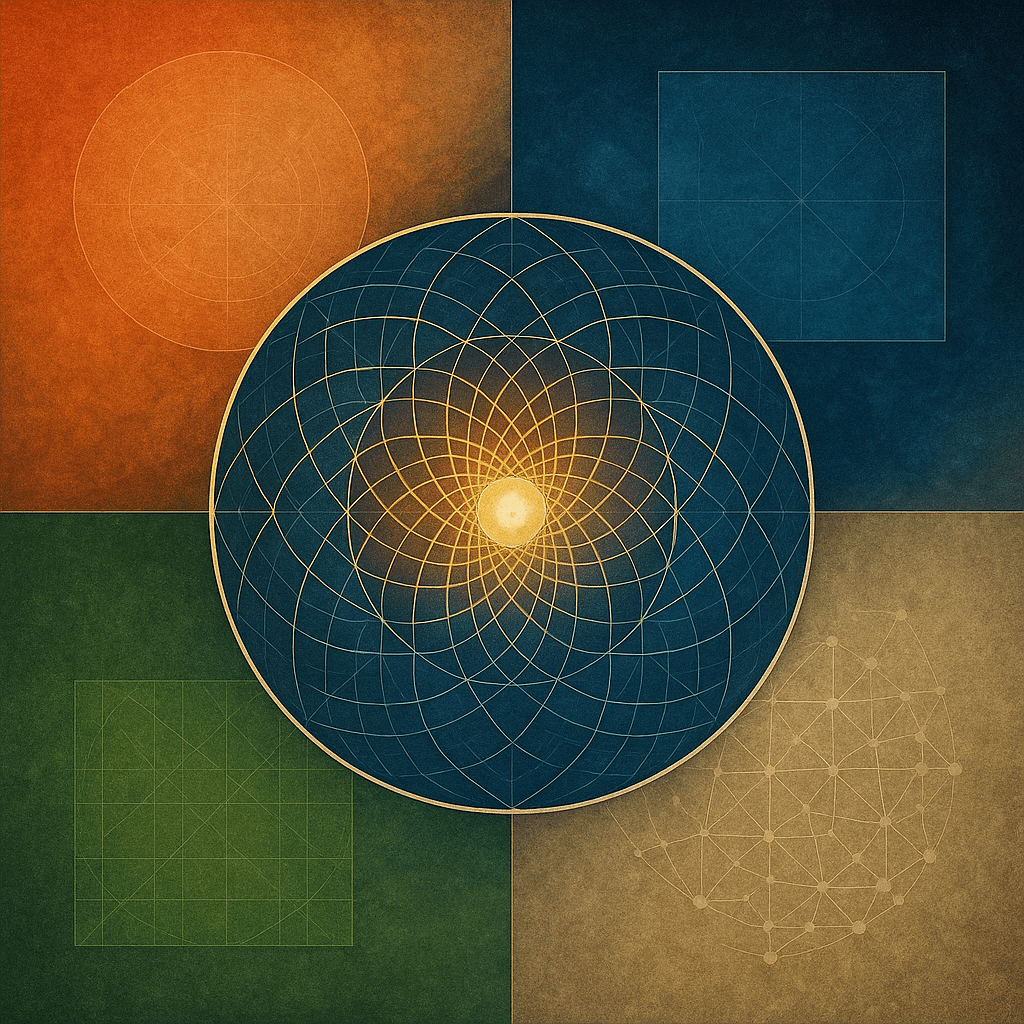
The quadrants—I, WE, IT, and ITs—map the totality of human experience: the inner self, the collective, the objective, and the systemic. Each serves a purpose until awakening calls for transcendence. The I is influenced by the ITs—the systems, structures, and conditions of existence. These shape perception and possibility. Through the IT, awareness ripples into the WE, inspiring collective movement. And as the WE shifts, the I is again transformed.

This endless loop of causation refines consciousness but never liberates it. Liberation comes when the loop itself is seen through. When the “I” no longer clings to the role of observer or doer, the quadrants collapse into pure witnessing. There is no longer an experiencer and the experienced, a subject and its object. What remains is unconditioned awareness; the silent axis upon which all quadrants turn.

Awakening, then, is not achieved through effort but through profound surrender. It is the cessation of grasping at identity within any domain—personal, relational, empirical, or systemic. The quadrants remain functional but no longer define reality. They appear and dissolve within the same stillness that has always been awake.

Morgan O. Smith

Get Your Free Copy of My Book, Bodhi in the Brain!

https://subscribepage.io/oTSZQu

Awake in the Depths

The Mystery of Conscious Delta

Delta brain waves are usually hidden from waking life. They belong to the body’s most private rhythm — the deep, dreamless silence where consciousness normally dissolves. For most people, delta is experienced only through absence: a blackout where awareness takes no witness. Yet, for advanced meditators, something remarkable occurs. Awareness remains present while the nervous system sinks into the very frequency of dreamless sleep.

Delta as the Ground of Renewal

Delta oscillations (0.5–4 Hz) are the signature of repair. They carry the nervous system into cellular healing, hormonal balance, and restoration of energy. They are the body’s night-shift, stitching torn fabric, releasing toxins, and recovering the energy spent during wakefulness. For ordinary sleepers, this happens unconsciously. For those who stabilize awareness in delta, repair and presence unfold together. The body heals, while the mind remains awake.

The Paradox of Conscious Delta

This state is paradoxical: stillness that does not collapse into oblivion. The meditator discovers a dimension where the body is in deep rest, yet awareness is vivid and unmoving. Traditions have called this turiya, shunyata, or the silent ground of being. It is the discovery that the absence we usually meet in dreamless sleep is not an absence at all, but the raw canvas of consciousness itself.

Why Amplitude Matters

When delta amplitude grows strong, it is not a faint background rhythm but a dominating presence across the cortex. For meditators, this feels like awareness being anchored into the earth itself — immovable, steady, silent. In neuroscience, strong amplitude is also linked with unusual phenomena: bursts of gamma oscillations riding delta waves, moments that map onto reports of nondual realization. The sheer strength of delta helps stabilize this conscious void so it does not collapse back into ordinary unconscious sleep.

The Fruits of Practice

Remaining awake in delta has profound effects:

  • Resilience: the nervous system is deeply restored, while awareness gains expanded capacity.
  • Fearlessness: repeated immersion in conscious delta dissolves the fear of death, as the meditator discovers awareness continues through the very state that mimics death most closely.
  • Transpersonal Vision: many report the direct sense of unity — the recognition of being everything and nothing simultaneously.
  • Daily Integration: over time, the qualities of delta bleed into waking life, creating a baseline calm that endures even amid chaos.

The Mystery Reframed

To be awake in delta is to learn that the bottom of sleep is not a void to be feared, but a gateway into the infinite. It is discovering that silence itself has texture, depth, and luminosity. What we thought of as unconsciousness reveals itself as the very source of consciousness.

This is not just a state — it is a shift in identity. The meditator no longer clings to the cycles of waking and sleeping. Awareness is recognized as the continuum in which all cycles arise.

Morgan O. Smith

Get Your Free Copy of My Book, Bodhi in the Brain!

https://subscribepage.io/oTSZQu

Beyond the Quadrants

Direct Encounter with the Supreme Identity

The quadrants—I, We, It, and Its—are not just theoretical maps of experience. They can be lived, felt, and directly known in ways that reveal both their necessity and their ultimate transparency. Each quadrant opens as a doorway, and when entered deeply, each dissolves into the same ground that holds them all.

The “I” – Subjective Interior

The first-person self, the one who says “I,” often feels like the most fundamental reference point of life. Yet, in moments of profound awareness, this identity begins to unravel. The familiar sense of a centre collapses into boundless subjectivity that no longer belongs to a person. Awareness remains, but it is no longer tethered to the small self. The “I” is recognized as inseparable from the infinite.

The “WE” – Intersubjective Communion

Beyond the personal lies the shared field of relationship. Here, connection is no longer about agreement or dialogue but about an unspoken resonance. Every being, every presence, becomes part of a silent communion. The walls between self and other fall away, revealing a unity that feels more intimate than words could ever capture.

The “IT” – Objective Reality

The external world, seen through clear perception, ceases to be “out there.” Light, form, and movement are no longer divided from the one who sees. Reality appears luminous, alive, inseparable from the awareness that beholds it. Object and subject reveal themselves as two sides of the same indivisible presence.

The “ITS” – Systems and Networks

The interwoven fabric of existence discloses itself as a living system. Breath, heartbeat, ecosystems, and galaxies are perceived not as separate mechanisms but as one movement—an intricate symphony without a conductor. The interconnections are not abstractions but a direct felt sense of everything breathing together.

Beyond Quadrants – The Supreme Identity

As each quadrant is seen through, they collapse into the unbroken ground of Being. This cannot be named as “I,” “We,” “It,” or “Its.” It is the source that gives rise to them all while remaining untouched by their distinctions. This is the Supreme Identity—timeless, boundless, indivisible.

When lived from this recognition, the quadrants are not discarded but liberated. They no longer bind perception to fixed standpoints. Instead, they shine as transparent facets of a jewel that was never fractured. Every act, every relationship, every perception becomes a clear expression of the ground itself.

The Supreme Identity is not somewhere else, waiting to be found. It is what was always here—before the quadrants, within them, and beyond them.

Morgan O. Smith

Get Your Free Copy of My Book, Bodhi in the Brain!

https://subscribepage.io/oTSZQu

Beyond Quadrants

The Supreme Identity

The quadrants of experience—I, We, It, and Its—have long been a lens through which consciousness organizes reality. Each provides a vital perspective: the subjective interior of the self, the shared intersubjective domain, the objective forms of matter, and the interobjective systems of the whole. These lenses do not compete; they illuminate the multiple dimensions of existence. Yet, any frame cannot contain the essence of reality, no matter how inclusive or comprehensive it may be.

What reveals itself when awareness no longer clings to a particular quadrant? A vastness appears that cannot be named solely as an “I,” nor reduced to the communion of “We.” It is not confined to the world of objects, nor to the vast interplay of systems. The Supreme Identity both transcends and enfolds these domains, existing as their ground and source.

This Identity is not separate from the quadrants; it is their silent witness and animating force. Just as light contains within it every visible colour yet is itself colourless, the Supreme Identity contains every possible perspective while remaining free of perspective altogether. When seen clearly, the quadrants dissolve into expressions of a singular field that cannot be divided.

What makes this recognition so profound is that it shatters the tendency of consciousness to fixate. The mind grasps for a standpoint—self, relationship, object, or system—but here, every standpoint is unmasked as a partial gesture of the whole. The Supreme Identity does not stand against them; it whispers through them. The “I” speaking, the “We” sharing, the “It” observed, the “Its” interlinked—all are nothing other than its unfolding.

Realizing this does not negate the quadrants. Rather, it liberates them. Each becomes transparent, shining as a clear facet of a jewel that was never fractured to begin with. The Supreme Identity calls forth a recognition: the One is never elsewhere. It is already present, before all perspectives, yet manifesting as each.

To live from this recognition is not to abandon life’s frameworks but to embody their ground. Every conversation, every act, every encounter reveals the unbroken presence that cannot be named yet pervades all. The quadrants remain as tools of navigation, but the navigator is no longer lost.

Morgan O. Smith

Get Your Free Copy of My Book, Bodhi in the Brain!
https://subscribepage.io/oTSZQu

Walking Beyond the Self

Expanding the Horizons of Perspective

Most human conflict is rooted in the inability to step outside the narrow confines of the self. We tend to move through the world tethered to a singular point of view, unable to grasp that reality shifts depending on who is looking. Perspective is not fixed; it unfolds in layers, from the egocentric stance of “me and mine,” through the ethnocentric loyalty of “us and ours,” into the broader realms of worldcentric care for humanity, and ultimately the kosmocentric embrace of all beings and existence itself.

When our awareness stops at the egocentric, we see others only as extensions of ourselves; or worse, as threats to what we hold dear. At the ethnocentric level, we expand slightly, but compassion remains conditional, bounded by tribe, religion, race, or nation. Yet the real flowering of human consciousness emerges once we realize that every being, regardless of sex, class, culture, or creed, carries within them a mirror of our own existence.

To recognize yourself in another is not simply an ethical exercise; it is an ontological revelation. The more deeply you understand that the same fears, desires, and vulnerabilities pulse through all lives, the less room remains for judgment. Hatred fades not because you suppress it, but because understanding transforms it. Even the figure we call “devil” becomes less monstrous when we glimpse the fractured angel hidden inside.

Imagine what collective life would feel like if this capacity for expanded perspective became the norm rather than the exception. Entire systems of oppression, exploitation, and alienation would dissolve under the weight of genuine empathy. Politics would no longer be about “sides” but about solutions; communities would no longer divide over difference but celebrate the very diversity that teaches us new ways of being human.

To walk in anyone’s shoes is more than a metaphor. It is the necessary step toward becoming fully human. The journey from ego to cosmos is not only possible, it is imperative. The future depends not on technological advancement alone, but on whether we can evolve into beings capable of holding multiple perspectives at once, anchored in compassion and guided by wisdom.

Morgan O. Smith

Get Your Free Copy of My Book, Bodhi in the Brain!

https://subscribepage.io/oTSZQu

A Dreamed Reality

Memory as the Mirror of the Absolute

What we call reality may be less solid than it appears. Every sound, sight, and sensation dissolves almost as quickly as it arises, leaving only the faint residue of memory to claim that anything happened at all. Existence itself feels dreamlike when examined closely: shifting, impermanent, yet strangely coherent—like a page rewritten by an unseen author each moment.

Memory is the keeper of this dream. It builds continuity from fragments, stitching together the illusion of permanence where none truly exists. What we call “the world” is less a physical stage than a reflection—abstract, fluid, a hologram shimmering on the screen of awareness. To mistake this reflection for the ultimate is to confuse the shadow for the light that casts it.

The most high, the unconditioned source beyond all appearances, does not require memory. It is that which precedes storage, recall, or even perception. Yet within its infinite stillness arises the dream we name reality. This dream is neither random nor meaningless; it serves as a mirror through which the Absolute contemplates itself. Every event, every thought, every fleeting sensation is nothing more than the play of memory echoing back to the One who never forgets because It has never known separation.

To recognize life as memory’s echo is not to diminish its beauty, but to free oneself from the weight of taking it as final. The dream is not false in the sense of being meaningless; it is false only in being mistaken for the whole. What is real lies in that silent clarity from which both memory and dream emerge.

Awakening, then, is the gentle turning of attention from the flickering reflection to the brilliance of the source. It is the realization that the dream was always sacred, but never ultimate.

Morgan O. Smith

Get Your Free Copy of My Book, Bodhi in the Brain!
https://subscribepage.io/oTSZQu

Stepping Stones That Lead Nowhere

Most of us spend our lives leaping from one stone to another, convinced each step will bring us closer to a final destination. Career advancement, relationships, possessions, recognition—each stone feels like progress, yet the further we go, the more apparent it becomes that there is no solid shore waiting for us. The path itself was the illusion.

The stones do not extend to a grand arrival point because life was never about arriving. The endless hopping is not failure; it is the nature of the game we entered by being born. Each stone exists only for the moment of stepping, dissolving the instant we shift our weight onto the next. What we mistake for continuity is simply a sequence of vanishing points.

Awakening is not about finding the hidden bridge that others missed. It is the recognition that nowhere is exactly where every step has been leading. To realize this is not despair—it is release. When the compulsion to arrive fades, each step becomes luminous. Even stones that seem unstable or purposeless shimmer with a quiet beauty, because they are not a means to an end. They are the end disguised as a beginning.

The stillness that waits beyond stepping does not appear at the finish line. It is here, beneath the very foot that rises and falls. Nowhere is not absence. Nowhere is the unshakable presence that requires no destination.

Morgan O. Smith

Get Your Free Copy of My Book, Bodhi in the Brain!

https://subscribepage.io/oTSZQu

Dissolving Where Identity Once Stood

To Be Seen Fully Is to Vanish into the Infinite

To be seen fully is not to be recognized as a person, nor acknowledged as a role, but to be reflected beyond every layer of identity. When someone sees you in this way, what is recognized is not your history, your character, or even your spiritual progress; it is the unconditioned essence that lies before all stories.

Most encounters leave us clothed in roles. Friend, teacher, seeker, parent, child, each gaze places a costume upon us. Rarely do we meet eyes that do not add or subtract, but simply reveal. In that rare encounter, the ordinary scaffolding collapses, and what stands exposed is not a “self” but the infinity in which all selves appear.

This exposure is not humiliating, nor is it affirming. It is dissolving. To be seen fully is to be unmasked of both failure and success, of both sin and virtue. The illusion that we exist as a separate someone collapses. What remains is a luminous absence, the infinite without centre or edge.

There are moments when presence itself becomes the mirror, so clear, so unconditioned, that no reflection remains, only the source shining through. The eyes of one who abides in truth can serve as such a threshold. Passing through it, you do not become greater; you vanish. And in vanishing, the fullness of all that is floods through.

To long for such seeing is to long for disappearance, and yet disappearance is not annihilation. It is the end of confinement. It is the recognition that what you are cannot be held by name, cannot be fixed in form, cannot be grasped by thought. What you are is the infinite itself, already free, already whole.

The paradox is that this vanishing does not strip life of meaning but gives it immeasurable depth. When you are no longer the centre, everything becomes the centre. When “I” falls away, the song of existence sings itself without obstruction. Love, compassion, and clarity are not cultivated; they flow.

To be seen fully is to vanish into the infinite. To vanish is to return home.

Morgan O. Smith

Get Your Free Copy of My Book, Bodhi in the Brain!
https://subscribepage.io/oTSZQu

Darshan and the Living Water

Darshan is a mystery that cannot be easily captured in language. Some dismiss it as myth, others reduce it to a placebo, and still others romanticize it into doctrine. Yet none of these explanations touch what truly happens when presence itself meets you so deeply that the idea of a separate “you” begins to dissolve.

I first received darshan from Paramahamsa Vishwananda in 2019. At the time, I could not fully comprehend what had been given. The experience did not instantly transform me. It was months later, as if a seed had been quietly germinating, that a profound awakening broke open—an unshakable, full-blown realization of Parabrahman. Everything I once considered a spiritual awakening before that year became eclipsed, revealed as only stepping stones toward a wholeness beyond description.

The encounter planted something that only ripened with time. No technique, no meditation, no psychedelic journey, no years of entrainment could compare to what unfolded in those months after darshan. The practices prepared me—polished the vessel, so to speak. But Darshan was the living water that finally filled it.

On August 30, 2025, I met Paramahamsa Vishwananda in person for the fifth time. The following day, as I began to write these words, tears streamed down my face unprovoked. The intensity of the remembrance, the simple act of reflecting on what darshan has meant in my life, undid me. Not during the encounter itself, but in the quiet aftermath, when the depth of it could no longer remain unspoken.

If one insists that darshan is “only” a placebo, I embrace the word. Placebo, after all, is proof of the mind’s openness to healing, its willingness to cross thresholds it once denied. What does it matter if the mechanism is mysterious when the outcome is undeniable? The very attempt to reduce it already misses the essence: darshan is not an explanation. It is an encounter that leaves explanation behind.

My friend, comedian Marc Trinidad, has a saying: You can’t pour clean water into a dirty cup. Thousands of hours of meditation may have cleansed that vessel, yet darshan was not merely clean water—it was sparkling, living, flowing with a vitality of its own. Preparation mattered, but preparation alone never gave me the fullness that flowed after meeting his gaze.

Darshan dismantles the scaffolding of the spiritual search. Years of practice may feel like climbing a mountain, but one glance can place you at the summit. That does not make the climb unnecessary—it makes clear that the climb itself was a preparation for the recognition that you were always already there.

This is not about worshiping a figure or elevating a personality. Darshan reveals the infinite within by reflecting it so purely through one who has dissolved into that truth. In being seen, the boundaries of self blur, and what shines forth is nothing less than the source of all seeing.

Darshan cannot be mythologized away, nor can it be reduced to a placebo. It is living water—clear, inexhaustible, flowing freely into those ready to drink. And sometimes, its effects bloom long after the moment has passed, as seeds planted in silence burst open in their own time.

Morgan O. Smith

Get Your Free Copy of My Book, Bodhi in the Brain!

https://subscribepage.io/oTSZQu