The Paradox of a Spiritually Enlightened Peak Experience

Imagine being pushed from a plane mid-flight, without a parachute. There’s no time to think, no time to brace yourself for impact. You are hurtling through the sky, weightless, untethered, and completely vulnerable. Fear may grip you momentarily, but something unexpected happens. You hit the ground—yet not only do you survive, but you rise and walk away unscathed, untouched by the experience as if the fall was merely an illusion.

This analogy comes close to capturing the essence of a fully spiritually enlightened peak experience. It is both terrifying and liberating, a moment where everything you thought you knew is shattered, yet something deeper emerges untouched. It’s not the kind of experience that fits neatly into the confines of logic or the safety of intellectual understanding. It pulls you beyond those limits, forcing you to confront the raw truth of existence in ways you hadn’t anticipated.

During such an experience, there’s no parachute to cushion the ego’s fall. The self—the constructed identity you’ve held onto for so long—dissolves, leaving nothing to cling to. Everything you believe about who you are, what reality is, and how life works evaporates in a moment of pure awareness. But instead of devastation, there is a strange sense of freedom. You realize the ground you thought you were plummeting toward was never real, to begin with.

What’s remarkable about this peak state is how it feels after. There’s a profound sense of survival, not in the physical sense, but at the level of awareness. You walk away from the experience unscathed because the true self, the part of you that is beyond mind and body, was never at risk. The fall, the impact, and the survival all exist within the realm of the illusion, but the awareness that experiences it all remains whole and untouched.

This awakening doesn’t come gently; it forces a reckoning with reality. But through that reckoning, you realize that what is truly real cannot be harmed. The body, the ego, the mind—all of these can be torn apart by life’s challenges and transformations. But the awareness that witnesses the fall? That remains pure and intact.

Living after such an experience brings with it a lightness, a profound sense of detachment that doesn’t arise from apathy but from clarity. You’ve seen through the illusion of the fall, and now, you move through life knowing that no matter what happens, the essence of who you are remains untouched. There’s nothing left to fear, no more clinging to the safety of the mind’s constructions.

This is the gift of spiritual enlightenment: not just the revelation that you can survive the fall, but the deeper realization that there was never anything to fall from in the first place.

Morgan O. Smith

Yinnergy Meditation, Spiritual Life Coaching & My Book, Bodhi in the Brain…Available Now!

https://linktr.ee/morganosmith

Turiyatitta

The Singularity of All That Is

Turiyatitta, often referred to as the state beyond the fourth, is an experience that defies conventional understanding. While Turiya encompasses the witness state within waking, dreaming, and deep dreamless sleep, Turiyatitta transcends even this. It represents the complete dissolution of the witness, where all states merge into an indivisible, absolute singularity. Here, the boundaries that once defined waking, dreaming, and deep dreamless sleep no longer exist—everything and nothing become one.

In Turiyatitta, consciousness no longer stands apart, observing. The very notion of a witness dissolves into an awareness so expansive and complete that there is nothing left to observe. There is no division between subject and object, no experience of separation because nothing exists outside of this infinite awareness. This state is considered the final stage of enlightenment—where the full nondual awareness of absolute Monism is realized.

Imagine being both everything and nothing at the same time. Not merely perceiving this intellectually, but embodying the paradox in a way that no words can fully express. The divine empty witness, once perceived as separate, fully dissolves within itself. All distinctions—between time and space, self and other—collapse into the infinite. What remains is not emptiness in the typical sense, but a fullness so complete that it transcends all concepts of existence or non-existence.

Turiyatitta feels like the ultimate convergence of all possible experiences into one absolute awareness. It is a state where nothing is hidden, nothing is separate, and there is no need for perception because everything is known in its essence. There is no longer a “seer,” for there is nothing to see. The divine once thought of as a distant force or presence, is realized as the very fabric of existence.


This stage is not about attaining something new but about shedding the final layers of illusion, revealing the inherent truth that has always been. The mind quiets, the heart stills, and what remains is the simple, silent, all-encompassing awareness that is beyond all states, yet contains them all.

Morgan O. Smith

Yinnergy Meditation, Spiritual Life Coaching & My Book, Bodhi in the Brain…Available Now!
https://linktr.ee/morganosmith

Turiya

The Unseen Ground of Consciousness

Turiya, often described as the fourth state of consciousness, stands beyond waking, dreaming, and deep dreamless sleep. What does it feel like to exist within this state? The experience itself cannot be fully captured by language, for Turiya transcends the usual boundaries of perception. It is not merely a state that one “enters” and “leaves”; rather, it is the ground upon which all other states rest.

There’s a subtle, yet profound, recognition that one is not the individual witness, but the infinite awareness in which all phenomena arise and dissolve. In Turiya, the experience is not of observing the states of waking, dreaming, and deep dreamless sleep separately, but of witnessing them as simultaneous expressions of a unified field of consciousness. Here, distinctions lose their meaning—what was once experienced as separate now collapses into a seamless continuum.

This state has often been referred to as the first stage of enlightenment. Yet, even such descriptions fall short. The essence of Turiya is not something “attained” through effort. Instead, it is revealed through the dissolution of identity, a quiet remembrance of one’s true nature.

Imagine an eternal presence where time does not move, where forms arise and fall like waves on the surface of an ocean, yet the ocean itself remains unshaken. Divinity, in this context, is not something external or far-off—it is what you are. The divine becomes aware of itself, witnessing all, yet remaining untouched by the movements within itself. It is existence contemplating its own essence, eternal and ever-present.

The beauty of Turiya is in its simplicity. It does not need complex metaphors to explain itself. It is felt as a continuous hum of being, beyond concepts, thoughts, and emotions—a recognition that everything, including the experiencer, is merely a reflection of the same undivided consciousness.

To experience Turiya is to see the eternal play of life from the perspective of the timeless. It is to understand that the very states we once believed to be separate—waking, dreaming, deep dreamless sleep—are all mere movements within the One.

Morgan O. Smith

Yinnergy Meditation, Spiritual Life Coaching & My Book, Bodhi in the Brain…Available Now!

https://linktr.ee/morganosmith

Unconditional Surrender

Embracing the Final Letting Go

Unconditional surrender is not simply about relinquishing control over circumstances, desires, or attachments. It goes beyond the surface. This form of surrender requires the release of the very concept of surrender itself. It demands a level of vulnerability so profound that even the notion of letting go must be let go.

What happens when there’s no longer anything to hold on to? Nothing to release? This is where true transformation begins. In this space, we step outside the dualistic framework of control versus surrender and touch something far deeper, a level of being where no effort or resistance exists. We are often conditioned to think that surrender means losing, giving up, or sacrificing. But unconditional surrender is not a loss—it is the full embrace of existence without the filters of ego, fear, or the need to manage outcomes.

When one stands in this openness, fully exposed and defenceless, something extraordinary happens. You come face to face with the reality of all that is. Without the mind’s endless chatter and strategies, there’s nothing left but the raw, unfiltered truth. And in that truth, you find freedom—not in the way we might imagine, but in a way that defies all prior understanding.

In the vulnerability of surrender, we experience what it means to exist without resistance, without striving, without seeking. It’s not about achieving some spiritual milestone or reaching a perfect state of being. Instead, it’s about dissolving the layers of defence we’ve built, trusting that whatever remains is exactly what was meant to be.

This path is not for the faint-hearted. It requires courage to step beyond the boundaries of the self and to let go of everything we’ve ever known. Yet, paradoxically, it is only through this act of ultimate surrender that we come to experience true liberation.

I would like to thank my colleague, Prakash, for mentioning Unconditional Surrender during our The Seekers Mind Clubhouse debate and for inspiring this piece.

Morgan O. Smith

Yinnergy Meditation, Spiritual Life Coaching & My Book, Bodhi in the Brain…Available Now!

https://linktr.ee/morganosmith

The Silent Revolution

Awakening Amidst Chaos

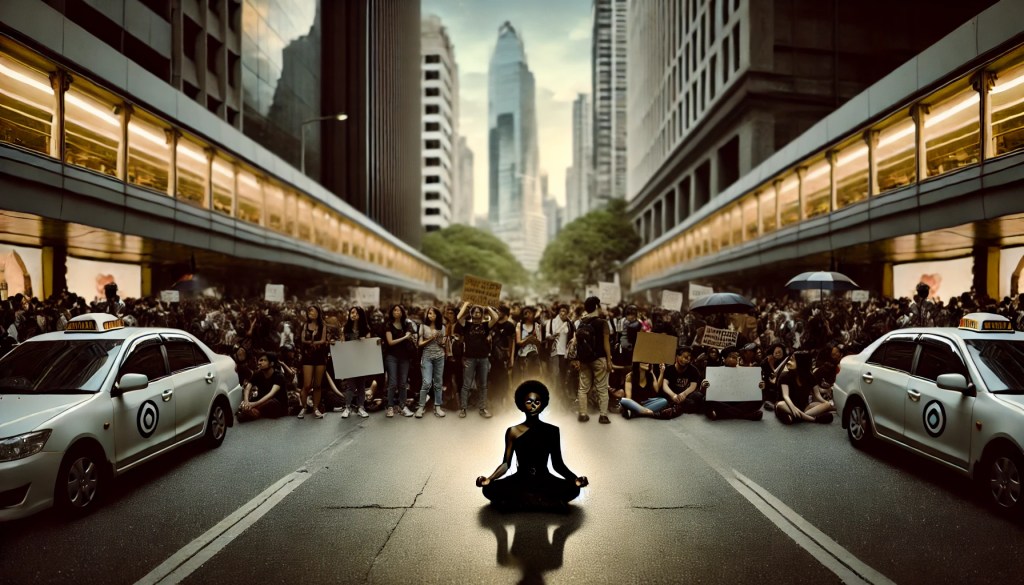
Chaos and tranquility often seem like opposites. However, they are intimately linked in the dance of life. As the world spins ever faster, with crises emerging like sudden storms on a summer day, a silent revolution is brewing beneath the surface—one that is neither loud nor confrontational but profoundly transformative.

This quiet revolution doesn’t rely on grand gestures or sweeping movements. It starts within the hearts of individuals who, despite the world’s noise, have tapped into a deeper current of awareness. These individuals aren’t driven by the need to change the world through force or ideology. Instead, they embody a shift that occurs when one aligns with the innate wisdom that lies beyond thought, beyond fear, and beyond the endless distractions that dominate modern life.

Imagine a moment where the rush of daily life pauses—not because external circumstances have shifted, but because the internal landscape has transformed. This shift is not the result of escaping the world, but of embracing it fully, with all its imperfections, recognizing that within the chaos lies the seed of order. When one looks deeply into the heart of the turmoil, an unexpected clarity can emerge, revealing the profound interconnectedness of all things.

Such moments of awakening are not reserved for the select few, nor do they require years of preparation or ascetic withdrawal from life. Often, they arrive unexpectedly, during the most mundane tasks or amid personal challenges. What matters is not the circumstances but the openness to receive what is always present: the silent awareness that underlies all experience.

This awareness doesn’t impose itself; it simply waits to be noticed. When recognized, it offers a perspective that transforms the ordinary into the extraordinary, where the boundaries between self and other dissolve, revealing a reality that is both deeply personal and universally shared.

The implications of this shift are profound. As more individuals awaken to this silent awareness, the collective consciousness begins to change. Actions rooted in fear and separation give way to those motivated by compassion and unity. Societal change, once thought to be driven by external forces, starts to emerge organically, from the inside out.

The silent revolution is not about overthrowing systems or confronting power. It is about the gradual realization that true power lies in the ability to remain anchored in awareness, no matter the external circumstances. This power is subtle, yet its impact can be far-reaching. As each person awakens, the collective vibration shifts, creating ripples that extend far beyond individual lives.

In times of chaos, this inner revolution offers a way forward—not by avoiding the challenges of the world, but by embracing them with a new understanding. It is the recognition that every moment, no matter how chaotic, holds the potential for awakening. When approached with awareness, even the most difficult experiences can become opportunities for profound growth and transformation.

This silent revolution is happening now, within the hearts of many. It doesn’t make headlines or trend on social media, but its effects are felt everywhere. The world is changing, not through external force, but through the quiet, steady awakening of consciousness.

Morgan O. Smith

Yinnergy Meditation, Spiritual Life Coaching & My Book, Bodhi in the Brain…Available Now!
https://linktr.ee/morganosmith

The Depth of Spiritual Comprehension

Beyond the Surface of Enlightenment

The spiritual journey often carries a mystique, with enlightenment perceived as a final, transcendent state reached after years of dedicated practice. However, the true essence of enlightenment lies not in a distant destination but in an ongoing process of deepening comprehension. This spiritual comprehension, the act of truly understanding and embodying spiritual truths, transforms enlightenment from an abstract ideal into a living reality.

Comprehension in this context goes beyond the intellectual grasp of spiritual concepts. Reading texts or engaging in discussions about spirituality provides a foundation, but deeper understanding requires a profound recognition and integration of the truths of existence into one’s being. This type of comprehension changes the way you perceive yourself, others, and the world around you.

Comprehending Comprehension

Understanding comprehension itself involves stepping into a realm of profound self-awareness. Looking beyond the surface level of experiences and teachings becomes essential, prompting questions about the nature of understanding. What does it mean to truly understand something? How does comprehension differ from mere knowledge? Such inquiries are vital on the spiritual path, pointing to a deeper engagement with the teachings and practices that guide us.

Spiritual comprehension refers to a transformative process where the seeker transitions from knowing about enlightenment to embodying it. This process often involves the dissolution of the egoic self, the release of attachments, and the embrace of a reality both mysterious and deeply intimate.

The Unfolding of Spiritual Comprehension


The unfolding of spiritual comprehension does not follow a linear path. Rather than a straight journey from ignorance to knowledge, from darkness to light, it unfolds as an ever-deepening spiral. Each turn brings us closer to the core of our being. Through this spiral, enlightenment reveals itself not as something to be acquired but as something to be awakened to—a recognition of what has always been present.

Comprehension then becomes an experiential understanding, a lived reality where the boundaries between self and other, subject and object, dissolve. The mind’s incessant chatter quiets, leaving a clear, direct perception of truth—pure, unfiltered awareness, unclouded by concepts or beliefs.

Living Comprehension

Living comprehension means embodying the spiritual truths understood. These truths guide actions, thoughts, and interactions with the world, bringing the light of enlightenment into every aspect of life, from the most mundane tasks to the most profound spiritual practices.

Such embodiment is not about striving for perfection or adhering to an idealized notion of enlightenment. Instead, it means being authentically human, embracing all complexities and contradictions while remaining rooted in the deep understanding of true nature.

Conclusion: The Infinite Depths of Comprehension


Spiritual comprehension represents an infinite journey, a realization that there is always more to understand, integrate, and embody. Enlightenment becomes not a final state but a dynamic process of ongoing revelation. As the depths of spiritual comprehension continue to unfold, the infinite possibilities of being fully alive, fully awake, and fully present in this moment emerge.

Morgan O. Smith

Yinnergy Meditation, Spiritual Life Coaching & My Book, Bodhi in the Brain…Available Now!

https://linktr.ee/morganosmith

The Philosophical Essence of Satan and God

I’ve been asked on occasion if I believe in the existence of Satan. My response is layered and nuanced. Philosophically, metaphorically, and symbolically, I acknowledge the concept of Satan, but I don’t subscribe to the personified version of Satan or a devil that is meant to be taken literally. To me, such a belief is irrational. Instead, Satan symbolizes everything evil or negative within the human experience.

Now, one might ask if I believe in God. My answer, while seemingly at the opposite extreme, follows a similar logic. From a literal standpoint, I don’t believe in God as a distinct entity. Rather, I assert that everything in existence is God, including myself, you, everyone, and everything else. This understanding stems from my awakening, which I claim to be a profound truth (though my interpretation of this truth is limited). In essence, God is the absolute—everything in and out of existence.

Religions like Christianity often refer to God as the alpha and the omega, the beginning and the end. If everything is God, then does this include Satan? My answer is unequivocally yes. According to certain texts, God created Satan, formerly known as Lucifer, who was God’s perfect angel. Some might argue that God created Lucifer, but Lucifer isn’t God. To this, I pose a series of questions.

If God created Lucifer, what did God make Lucifer out of? You might say pure light. But what is light made of? Oscillating electric and magnetic fields. Are these fields the alpha and the omega? No. So, what are oscillating electric and magnetic fields made of? Electromagnetic waves. Are electromagnetic waves the alpha and the omega? Again, no. What are electromagnetic waves made from? We can trace this down to the concept of emergent space-time.

Is emergent space-time the alpha and the omega, the beginning and the end? If we consider God as the absolute, then it must be. If emergent space-time is equivalent to God, then at its essence, Lucifer is made out of God. Even if you adhere to the idea that God made Lucifer ex nihilo (out of nothing), and if God is absolute, then this must include nothing (preceding emergent space-time itself). Thus, God encompasses both everything and nothing.

In this holistic view, the existence of Satan and the nature of God merge into a singular, all-encompassing reality. This perspective encourages us to transcend literal interpretations and embrace a deeper, more integrated understanding of existence, where all dichotomies dissolve into the absolute.

Morgan O. Smith

Yinnergy Meditation, Spiritual Life Coaching & My Book, Bodhi in the Brain…Available Now!

https://linktr.ee/morganosmith

The Multilayered Journey of Ego Dissolution

In the intricate dance of spiritual awakening, the ego stands as both a necessary companion and a formidable obstacle. Our journey to self-realization often involves peeling away the layers of this multifaceted construct, each layer representing a different aspect of our perceived identity.

The ego, much like an onion, is composed of multiple layers. These layers symbolize the various roles, beliefs, and attachments we accumulate throughout our lives. Initially, shedding these layers can be a liberating experience. We feel lighter, more connected to our true selves, and less bound by societal expectations and personal fears. Each removed layer brings us closer to a state of purity and clarity.

However, the concept of ego death transcends the gradual shedding of these layers. Ego death is not merely about peeling back the onion to its core; it is about transcending the very existence of the onion itself. It is the profound realization that the core was an illusion all along, a construct of the mind designed to give us a sense of separateness and control.

Imagine reaching a point where even the scent of the onion no longer lingers. This metaphor captures the essence of true ego death—a state where not only the layers but the very notion of an individual self dissolve into the infinite. It is the ultimate surrender, where the boundaries between the self and the cosmos blur into non-existence, revealing the underlying oneness of all.


This experience can be both terrifying and liberating. The fear of losing our identity is a natural response, as the ego is deeply ingrained in our sense of self-preservation. Yet, the liberation that follows is unparalleled. Without the confines of the ego, we experience reality in its purest form, untainted by personal biases or desires. We become conduits for the divine flow of life, embracing the totality of existence with an open heart and mind.

Ego death is not a one-time event but an ongoing process of dissolution and rebirth. Each moment of awareness, each act of surrender, contributes to the gradual dismantling of the ego’s hold. In this continuous journey, we learn to embrace the paradox of being both nothing and everything simultaneously. We recognize that our true essence is not defined by our identity but by our intrinsic connection to the universal consciousness.

As we navigate this path, it is essential to cultivate compassion and patience for ourselves. The layers of the ego are intricate and deeply rooted, and their dissolution requires gentle persistence. By embracing the journey with humility and openness, we allow the process to unfold naturally, guided by the inner wisdom that transcends the ego’s limitations.


In conclusion, the journey of ego dissolution is a profound exploration of our true nature. It invites us to move beyond the superficial layers of identity and experience the boundless reality of our interconnected existence. Through this journey, we discover that true freedom lies not in the absence of identity but in the realization of our inherent oneness with all that is.

Morgan O. Smith

Yinnergy Meditation, Spiritual Life Coaching & My Book, Bodhi in the Brain…Available Now!

https://linktr.ee/morganosmith

The Evolution Beyond Personal Deities

Embracing the Infinite

In the profound journey of spiritual awakening, there comes a moment when the personal god, once a comforting presence, begins to feel like an ill-fitting garment. This is not a rejection but an evolution, akin to an adolescent who outgrows their need for an imaginary friend. This metaphorical maturation reflects a deeper understanding of the divine as an infinite, formless presence, beyond any personal characteristics or limitations.

In our early spiritual development, the idea of a personal god can be immensely comforting. It offers a sense of security and companionship, much like a child’s imaginary friend. This anthropomorphic deity provides guidance, solace, and a moral compass, helping us navigate the complexities of life. However, as we delve deeper into the realms of spirituality and nonduality, our perception of divinity begins to transform.

The transition from a personal god to an impersonal, infinite reality mirrors our journey from ego-bound identities to the realization of our true, boundless nature. This shift is not about abandoning faith but about expanding it. It is about moving from a limited, dualistic perception of the divine to an all-encompassing, nondual awareness. Here, the divine is not a separate entity but the very essence of existence itself, permeating every atom of the cosmos.

Embracing this infinite reality requires a profound letting go of old paradigms. It involves releasing the need for a deity who looks like us, thinks like us, and intervenes in our lives. Instead, we begin to see the divine as an all-pervasive consciousness, a vast, unconditioned presence that transcends all forms and concepts. This realization brings a deep sense of peace and unity, as we recognize our inherent connection to the divine.

This evolution can be challenging. It demands that we confront our deepest fears and insecurities, the aspects of ourselves that clung to the comfort of a personal god. Yet, it is in this very confrontation that we find liberation. By letting go of the need for a personal deity, we open ourselves to the infinite, experiencing the divine in every moment, every breath, and every heartbeat.

In this state of expanded awareness, prayer and meditation transform. They become less about seeking guidance or intervention from a higher power and more about attuning themselves to the subtle, ever-present flow of divine energy. Our spiritual practices deepen, becoming a means of aligning with the infinite, of experiencing the divine as an intimate part of our being.

Ultimately, the evolution beyond a personal god is a return to our true nature. It is a journey from the confines of duality to the boundless expanse of nonduality. This realization is not an endpoint but a continuous unfolding, a never-ending exploration of the infinite depths of existence.


As we embrace this evolution, we step into a new dimension of spiritual maturity. We recognize the divine in all its forms and formlessness, in every aspect of life and beyond. And in this recognition, we find a profound sense of belonging, a deep, abiding peace that transcends all understanding.

Morgan O. Smith

Yinnergy Meditation, Spiritual Life Coaching & My Book, Bodhi in the Brain…Available Now!

https://linktr.ee/morganosmith

The Paradox of Everlasting Peace

Beyond the Illusion

In spiritual exploration, the quest for peace is often seen as the ultimate goal. We meditate, reflect, and seek to align ourselves with the harmonious currents of existence, all hoping to find a state of unshakable serenity. Yet, within the paradoxical depths of nonduality lies a profound insight: once you find everlasting peace, peace no longer exists.

To understand this enigma, we must delve into the very nature of peace itself. Conventionally, peace is perceived as the absence of conflict, a state where turbulence and chaos are subdued, giving way to tranquillity. It is a fleeting condition, often disrupted by the inevitable fluctuations of life. In pursuing this ideal, we create a dualistic framework: peace versus chaos, calm versus turmoil.

However, the essence of nonduality invites us to transcend this dichotomy. It beckons us to a dimension where distinctions dissolve, and the illusory boundaries between opposites merge into a seamless whole. In this state, peace is no longer a transient phenomenon to be achieved or maintained; it becomes an intrinsic aspect of our being, inseparable from the totality of existence.


When we truly embody this realization, the very concept of peace undergoes a radical transformation. It is no longer something to be sought after, for it is already present in every moment, in every breath. The relentless pursuit of peace implies its absence, perpetuating a cycle of seeking and grasping. But in the awakened state, we recognize that peace is not an external condition to be attained but an ever-present quality of our true nature.

This shift in understanding does not render peace obsolete; rather, it dissolves the notion of peace as something separate from our experience. In the nondual perspective, peace and chaos are not opposing forces but expressions of the same underlying reality. The turbulent waves of existence and the still depths of tranquillity are both manifestations of the infinite ocean of consciousness.

Embracing this insight, we are liberated from the perpetual quest for peace. We cease to measure our inner state against an external ideal, recognizing that every experience, whether serene or turbulent, is an opportunity to deepen our understanding of our true nature. The search for peace transforms into a deepening awareness of the ever-present, unchanging essence that underlies all phenomena.


In this awakened state, we find ourselves in harmony with the flow of life, no longer resisting or clinging to specific outcomes. We become the silent witness to the ebb and flow of existence, resting in the unshakable stillness that is our true self. This is the paradox of everlasting peace: when we no longer seek it, we realize it has always been here, beyond the reach of our striving.

Morgan O. Smith

Yinnergy Meditation, Spiritual Life Coaching & My Book, Bodhi in the Brain…Available Now!

https://linktr.ee/morganosmith