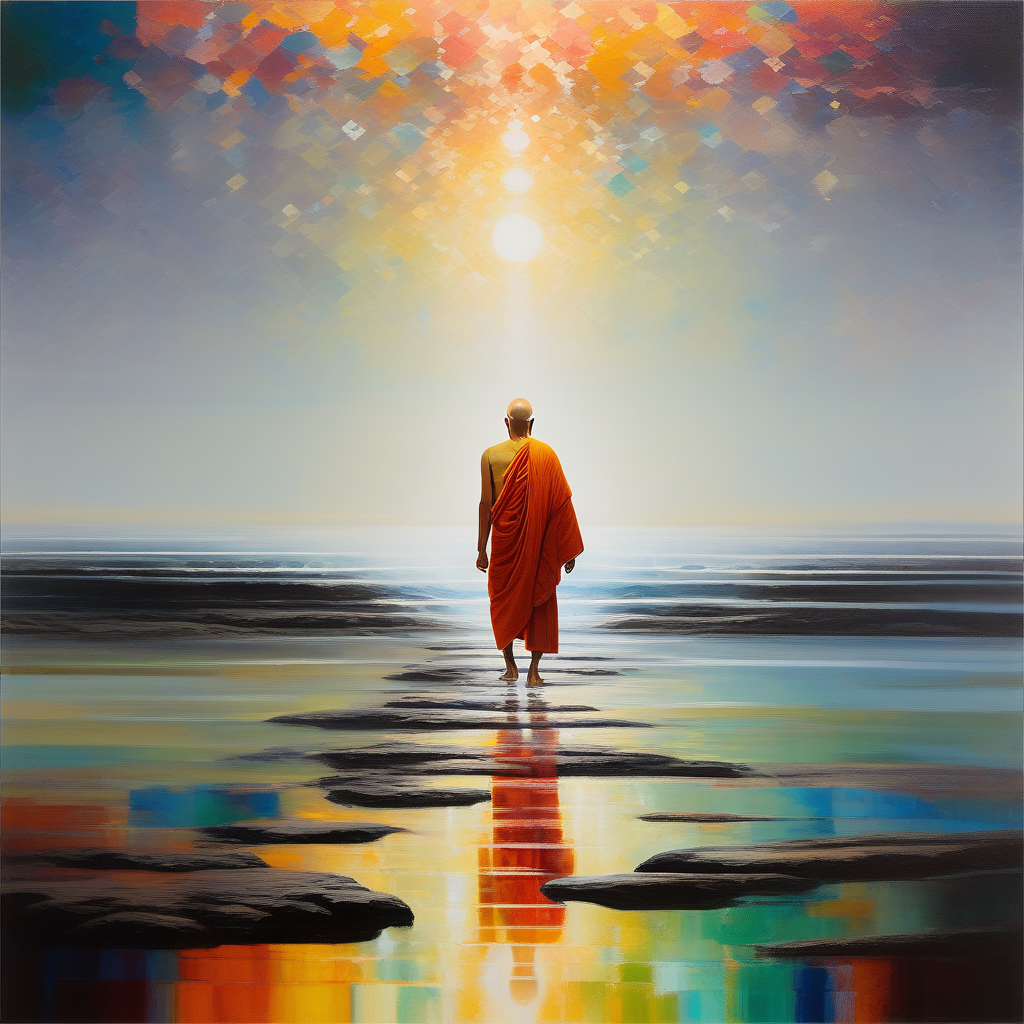
The Miraculous Nature of Satori and the Beauty of the Mundane

Satori, that sudden flash of insight, is not the kind of experience that can be prepared for or understood through mere intellectual exercise. It arrives unexpectedly, sweeping through consciousness like a cool breeze amid the summer heat. It’s as if all boundaries collapse, leaving only pure awareness. And it’s at that moment you realize—nothing is truly separate.

This fleeting yet profound glimpse into the fabric of reality shifts one’s perception permanently. Suddenly, the noise of daily life quiets. The weight of things that once seemed so important dissolves, revealing a serene clarity always there, patiently waiting. After experiencing Satori, a miraculous paradox unfolds—life doesn’t feel distant or otherworldly. Instead, the mundane becomes extraordinary.

Consider the sensation of holding a cup of tea. Before Satori, you might focus on the cup’s warmth or the taste of the liquid. After Satori, you might find yourself marvelling at the simple act itself. Each sip becomes a universe in motion, rich with presence and deep appreciation. Ordinary moments, once taken for granted, now glow with the same brilliance as those rare flashes of enlightenment.

Satori isn’t about escaping the ordinary; it’s about seeing the divine within it. Whether it’s the rustle of leaves in the wind or the sound of laughter echoing through the air, the smallest details become pathways to the infinite. There is no longer a need to search for meaning elsewhere; everything, as it is, reflects the sacred nature of existence.

The true gift of Satori lies not in the experience itself, but in its ability to transform our relationship with life. It teaches us that miracles aren’t somewhere out there, waiting to be discovered—they are embedded in the fabric of each moment, no matter how small or ordinary.

Suddenly, every breath, every heartbeat, every sensation becomes an invitation to return to that space of awareness. And it’s this quiet reverence for the mundane that truly allows one to live fully, with grace and wonder.

Morgan O. Smith

Yinnergy Meditation, Spiritual Life Coaching & My Book, Bodhi in the Brain…Available Now!

https://linktr.ee/morganosmith

The Elusive Blind Spot of Enlightenment

A paradox begins to unfold from the moment consciousness takes form and you are born into this world. Enlightenment, often considered the pinnacle of spiritual realization, simultaneously becomes a blind spot. It’s not that enlightenment is absent; rather, it exists so close to you that it evades your direct perception. The act of becoming a being—separate from the whole—creates the veil obscuring what was never lost.

Most people search for this elusive state, hoping to grasp it through teachings, practices, and philosophies. Yet, the search itself can deepen the sense of separation, reinforcing the idea that enlightenment is something external to be found. But what if enlightenment was never something you needed to find? What if it was something you simply needed to stop resisting?

Human existence is an exquisite contradiction. On one hand, the moment you identify as an individual, you begin to experience duality—subject and object, self and other. On the other hand, this identification simultaneously masks the realization that you are already one with everything. Enlightenment is not an external destination; it is the underlying reality that permeates your existence.

The blind spot isn’t due to a lack of spiritual capacity or effort, but the mind’s incessant clinging to the notion of self. The moment you try to achieve enlightenment as a personal goal, it slips further away, like trying to catch a shadow. Perhaps the real journey is not about seeking, but about unlearning. The simplicity of just being, without striving, can often be the most profound realization of all.

What happens when you stop searching? What if you allow yourself to see that enlightenment is not a peak experience to attain, but the constant, ever-present background of awareness that you are, and always have been? This blind spot only remains as long as there is an effort to overcome it. Let go of that effort, and what reveals itself has been present all along—your original nature.

The key lies in the willingness to let go of the need for enlightenment, to surrender the very idea that you are separate from it. Only then does the blind spot dissolve, and the reality of your true self, free from all constructs, comes into clear view.

Morgan O. Smith

Yinnergy Meditation, Spiritual Life Coaching & My Book, Bodhi in the Brain…Available Now!

https://linktr.ee/morganosmith

From Curiosity to Self-Realization

The Path of Unveiling True Identity

Curiosity is a subtle yet potent force that nudges us toward self-discovery. It begins as an innocent desire to understand the world, to unravel the mysteries that surround us. Yet, beneath this surface, curiosity harbours a deeper, more profound impulse: the yearning to uncover the truth of our existence. This journey from mere inquisitiveness to the realization of who and what we truly are is a transformative process, one that dissolves the illusions of separation and reveals the boundless nature of consciousness.

At first, curiosity may lead us to explore the outer world and to seek knowledge in science, philosophy, and art. We investigate the principles that govern the cosmos, the nature of life, and the intricacies of the mind. Each question we ask, each answer we uncover, brings us closer to the edge of understanding. But there comes a point when the external search no longer satisfies. The answers we find, while intellectually stimulating, fail to quench the deeper thirst within us.

This is the moment when curiosity turns inward. We begin to question not just the world, but the very nature of the self. Who am I? What am I? These questions, so simple on the surface, carry within them the seeds of profound realization. As we delve into these inquiries, we start to unravel the layers of identity that we have constructed over a lifetime—roles, beliefs, memories, and emotions. We come to see that these layers while forming the fabric of our experience, do not define our true essence.

The deeper we inquire, the more we recognize the transient nature of these identities. We observe that the thoughts, emotions, and perceptions we once took as definitive of “self” are mere phenomena, arising and passing within the field of awareness. This awareness itself, however, remains unchanged, ever-present, and untouched by the fluctuations of experience. It is in this recognition that the first glimmers of self-realization emerge.

As curiosity continues to fuel our exploration, we begin to sense a shift. The realization dawns that what we are seeking is not an object or concept that can be grasped but the very subject of all experience—the pure awareness that is our true nature. This awareness is not separate from the world we once sought to understand; it is the ground of all being, the source from which all phenomena arise.

This realization is both a moment of profound insight and the beginning of a new way of being. No longer identified with the fleeting contents of experience, we come to rest in the boundless, formless presence that we truly are. This is the culmination of curiosity’s journey: the recognition that the seeker and the sought are one and the same.

In this state of realization, curiosity does not vanish. Instead, it transforms into a deep, abiding wonder at the mystery of existence itself. The world, once viewed as a collection of separate objects, is now seen as an expression of the same consciousness that we are. Every moment, every encounter becomes an opportunity to experience the infinite nature of our being. This is the ultimate gift of curiosity—the revelation of our true identity as pure awareness, beyond all concepts and distinctions.

Morgan O. Smith

Yinnergy Meditation, Spiritual Life Coaching & My Book, Bodhi in the Brain…Available Now!

https://linktr.ee/morganosmith

The Paradox of the False Self

The “I” is the false self, but this false self is also true. It just doesn’t know it yet. This realization reveals that our perceived separateness is an illusion, guiding us toward the truth of our inherent unity.

Understanding the False Self
The false self, often identified as the ego, is the aspect of our identity constructed from our experiences, beliefs, and societal conditioning. It is the mask we wear, the persona we present to the world. While it serves a functional role in navigating daily life, it is not our ultimate truth.

The Hidden Truth
Within this false self lies a hidden truth. The ego, though seemingly separate, is an expression of the same source that underlies all existence. The journey of self-realization involves peeling away the layers of this constructed identity to uncover the true self—the essence that connects us all.

The Illusion of Separateness
Our perception of being distinct individuals creates the illusion of separateness. This belief in separateness fosters division, conflict, and a sense of isolation. However, when we begin to see through the false self, we recognize that these divisions are illusory. Beneath the surface, we are all interconnected.

Toward Inherent Unity
Realizing the paradox that the false self is also true propels us toward the recognition of our inherent unity. This understanding dissolves the boundaries that the ego creates, allowing us to experience a deeper connection with ourselves and others. We move from a mindset of “me versus you” to one of “us” and “we.”

Living with Awareness
Living with this awareness transforms our approach to life. We become more compassionate, understanding, and empathetic, seeing others as reflections of ourselves. This shift in perception fosters a sense of peace and harmony, as we align with the deeper truth of our shared existence.

The journey of recognizing the false self as also true is a profound step toward spiritual awakening. It illuminates the path to our inherent unity, guiding us to live with greater authenticity and connection. By embracing this paradox, we uncover the deeper reality that binds us all.

Morgan O. Smith

Yinnergy Meditation, Spiritual Life Coaching & My Book, Bodhi in the Brain…Available Now!

https://linktr.ee/morganosmith

The Sensory Symphony of Consciousness

In the intricate dance of existence, consciousness manifests through sensory experiences defining our reality. Every sight, sound, scent, taste, touch, and feeling is not just a mere encounter with the external world but a profound engagement with the essence of our being. To perceive consciousness in all its forms is to realize that we are not separate from it; rather, we are the very fabric of this profound phenomenon.

Consider the visual realm: the colours and shapes that fill our vision are not just physical phenomena but expressions of consciousness itself. Each hue and form reflects the inner light that animates our awareness. As we observe the world, we are essentially witnessing the dance of consciousness within and around us.

In the realm of sound, every note and melody, every whisper and roar, are vibrations of consciousness. The act of listening becomes a meditation on the auditory expressions of our inner self, each sound waves a ripple in the ocean of awareness. Here, consciousness sings its symphony, echoing the eternal essence of our true nature.

The sense of smell brings with it a more subtle dimension of consciousness. Each fragrance and aroma is a whisper of the world’s essence, an invitation to delve deeper into the mystery of existence. Through smell, we are reminded of the interconnectedness of all things, as the scents we inhale become part of our very being.


Taste, too, is a profound encounter with consciousness. The flavours that dance on our tongues are not just chemical interactions but intimate dialogues with the essence of life. Every taste is a moment of communion with the universe, a reminder that we are one with all that we consume.

Touch, perhaps the most immediate of senses, grounds us in the physicality of consciousness. The textures and temperatures we feel are direct interactions with the world’s essence. Through touch, we are reminded of the physical presence of consciousness, the palpable reality of our interconnected existence.

Emotions, the feelings that course through us, are the most direct expressions of consciousness. Each emotion, whether joy or sorrow, anger or love, is a wave within the ocean of our being. These feelings remind us of the fluid, dynamic nature of consciousness, ever-changing yet eternally present.

To fully grasp that we are consciousness is to transcend the very concept itself. It is to recognize that the perceiver and the perceived are the same. In this realization, the boundaries between the self and the world dissolve, revealing the seamless unity of existence. We are not just participants in the dance of consciousness; we are the dance itself.


In this state of transcendence, every sensory experience becomes a gateway to deeper understanding, a reminder of our true nature. As we navigate the world, let us remember that we are engaging with the essence of our being in every sight, sound, smell, taste, touch, and feeling. For in the grand symphony of existence, we are both the musicians and the music, the creators and the creation, forever intertwined in the infinite play of consciousness.

Morgan O. Smith

Yinnergy Meditation, Spiritual Life Coaching & My Book, Bodhi in the Brain…Available Now!

https://linktr.ee/morganosmith

The Clarity of Enlightenment

Understanding the End of Confusion

Enlightenment is often depicted as a pinnacle of spiritual achievement, a state where the mind transcends its usual patterns and sees reality as it truly is. One profound realization that accompanies enlightenment is the clear understanding of confusion itself.

The Nature of Confusion

Confusion is a state of mind where the incessant chatter of thoughts, emotions, and sensory input obscures clarity. It arises from the fragmented way we perceive the world, dividing experiences into categories and labels, creating a sense of separation and duality. This fragmented perception is the root of our suffering, as it distorts our understanding of the interconnectedness of all things.

The Shift to Enlightenment

Enlightenment is not merely an intellectual understanding but a profound experiential realization that dissolves the boundaries of self and other. In this state, the mind no longer clings to distinctions, and the innate oneness of existence becomes evident. This shift transforms our perception, allowing us to see through the veils of confusion with a clarity that is as unmistakable as daylight.


Seeing Through Illusions

Upon reaching enlightenment, the illusions that once caused confusion are seen for what they are—mere constructs of the mind. The ego, which thrives on these constructs, loses its grip, revealing the underlying reality. This revelation brings a sense of peace and profound understanding. The struggles and doubts that once plagued the mind dissolve, and what remains is an unshakeable clarity.

The Role of Awareness

Awareness plays a crucial role in this transformation. As we cultivate awareness through practices like meditation, mindfulness, and self-inquiry, we begin to recognize the patterns of the mind that create confusion. With consistent practice, these patterns lose their power, and the mind becomes more settled and clear. Enlightenment is the culmination of this process, where awareness is fully integrated, and confusion is transcended.

Embracing the Journey

The journey to enlightenment is unique for each individual, yet it is marked by common milestones of increased clarity, peace, and understanding. It requires dedication, patience, and a willingness to confront and transcend the illusions that obscure our true nature. Each step on this path brings us closer to the realization that confusion is not an inherent part of our existence but a temporary state that can be overcome.


Conclusion

Enlightenment reveals the inherent clarity that lies beyond the mind’s confusion. It is a state where the true nature of reality shines forth unobscured, bringing with it a profound sense of peace and understanding. As we journey towards this state, we learn to see through the illusions of confusion, embracing the clarity that is our birthright.

Morgan O. Smith

Yinnergy Meditation, Spiritual Life Coaching & My Book, Bodhi in the Brain…Available Now!

https://linktr.ee/morganosmith

The Illusion of the Ego

Beyond the Needle in the Haystack

In the vast expanse of human experience, the personal ego often feels like the defining core of our identity. We navigate the world through its lens, believing it to be the essence of who we are. Yet, in the grand scheme of existence, this ego is but a minuscule fragment—a needle in a haystack compared to the vast, boundless nature of our true self.

To truly understand this, we must first explore the nature of the ego. The ego is the part of our consciousness that deals with individuality and separateness. It thrives on comparisons, achievements, and the ceaseless chatter of the mind. It is the voice that says, “I am this” or “I am that,” constantly defining and limiting our experience of reality.

However, as we delve deeper into spiritual inquiry and self-exploration, we encounter moments where the ego’s hold weakens. These are moments of pure being, where the sense of separation dissolves, and we touch upon a more expansive consciousness. This consciousness is our true nature—vast, interconnected, and free from the constraints of the ego.

Imagine the ego as a single grain of sand on the shore of a limitless ocean. While the grain is real and tangible, it is insignificant when compared to the infinite expanse of the ocean. Similarly, our ego, with all its desires, fears, and identities, is but a small aspect of our true, boundless self.


In these moments of expanded awareness, we realize that we are not merely the sum of our thoughts, emotions, and experiences. We are the awareness in which all these arise and dissolve. This realization brings a profound sense of freedom and peace, as we no longer identify with the transient aspects of our existence.

The journey to this realization is not always straightforward. It requires a willingness to question our deeply held beliefs and to look beyond the surface of our everyday experiences. Meditation, self-inquiry, and contemplative practices can be invaluable tools on this path. They help us to quiet the mind and to see beyond the illusions created by the ego.

As we progress, we begin to live more from this place of expanded awareness. Our actions become less driven by egoic desires and more aligned with a deeper sense of purpose and connection. We see ourselves not as isolated individuals but as integral parts of a larger whole. This shift in perspective transforms our relationships, our work, and our approach to life itself.


In essence, recognizing the ego as a mere needle in the haystack of our true self is an invitation to embrace a more profound and expansive understanding of who we are. It is a call to awaken to our true nature and to live from that place of boundless awareness and interconnectedness.

Morgan O. Smith

Yinnergy Meditation, Spiritual Life Coaching & My Book, Bodhi in the Brain…Available Now!
https://linktr.ee/morganosmith

Beyond the Mirage

The Ego’s Role in the Quest for Enlightenment

In the labyrinth of human experience, the ego emerges as both the architect and inhabitant of its intricate corridors. It shapes our perceptions, drives our actions, and colours our interpretations of the world around us. The journey toward enlightenment, often seen as the pinnacle of spiritual achievement, is not exempt from the ego’s pervasive influence. This exploration delves into the nuanced relationship between the ego and the spiritual quest, challenging the seeker to look beyond surface motivations to the true essence of enlightenment.

The ego, in its essence, is a construct of identity, a compilation of beliefs, experiences, and perceptions that define the “I” or “self.” It is the narrator of our life story, constantly weaving narratives that reinforce its centrality in our existence. In the context of spirituality, the ego can manifest as the driving force behind our pursuit of enlightenment. It convinces us that attainment of this exalted state will elevate our worth, grant us peace, or confirm our superiority. Yet, this pursuit, when ego-driven, is akin to chasing a mirage—the closer we believe we are to grasping it, the more elusive it becomes.


The paradox lies like enlightenment itself. True enlightenment transcends the ego, a state of being that exists beyond the dualities of superiority and inferiority, attainment and loss. It is the realization that the self, as constructed by the ego, is but a fleeting shadow on the vast canvas of existence. The irony is profound: the very entity that seeks enlightenment—the ego—is the barrier that must be dissolved to experience it.

This realization invites a deeper inquiry: If the ego is the motivation behind our actions, including the quest for enlightenment, how can one transcend it? The answer lies not in the renunciation of the ego but in the understanding and integration of its role in our spiritual journey. It is about observing the ego without identification, recognizing its patterns, and gently guiding it from a place of seeking to one of presence. In presence, the distinction between seeker and enlightenment dissolves, revealing that the essence of what we seek is inherent within us, obscured only by the veils of the ego.

Transcending the ego does not mean its obliteration but understanding its illusory nature and no longer allowing it to dictate our spiritual journey. It means moving from ego-driven motivation to a state of being where actions flow from a place of awareness, compassion, and interconnectedness. This shift is subtle yet profound, marked not by dramatic enlightenment experiences but by the quiet realization of the oneness that pervades all existence.


In conclusion, the path to enlightenment is intricately linked with the understanding of the ego. It is a journey from identification with the ego to realizing the self as part of a larger, interconnected whole. This exploration challenges us to look beyond the ego’s motivations, question our perceptions of enlightenment, and discover the profound simplicity of being that lies beyond the ego’s grasp.

Morgan O. Smith

Yinnergy Meditation, Spiritual Life Coaching & My Book, Bodhi in the Brain…Available Now!

https://linktr.ee/morganosmith

The Dual Nature of Ego

Obstacle and Catalyst in the Quest for Enlightenment

In our quest for spiritual awakening, the concept of the ego plays a paradoxical role. On one hand, it is often seen as the primary hindrance on the path to enlightenment. On the other, it can serve as a vital instrument propelling us toward this very goal. This duality presents a fascinating aspect of our spiritual journey, inviting us to explore the ego not just as an adversary, but also as an ally.

In its most basic form, the ego is our sense of self. It’s the ‘I’ or ‘me’ that navigates through the world. In many Eastern philosophies, the ego is perceived as the root of suffering and illusion. It’s this ego that clings to desires, fears, and identities, trapping us in a cycle of samsara – the continuous loop of birth, life, and death. From this viewpoint, enlightenment is about transcending this limited self and recognizing our true nature, which is unbounded and interconnected with the entire cosmos.


However, this is only one facet of the ego’s role in our spiritual evolution. Consider the idea that the ego can also be a vehicle for growth. It is, after all, the ego that initially sparks the desire for enlightenment. Though rooted in the individual self, this desire can lead us toward a deeper understanding and a broader perspective. The ego drives us to seek, question, and yearn for something beyond our current state. In this sense, it can be seen as a necessary step in our spiritual evolution.

Moreover, confronting and understanding the ego is a vital part of spiritual practice. It’s through this process that we gain insight into our true nature. The ego’s patterns, attachments, and fears are not just obstacles to be removed but also mirrors reflecting our deeper truths. By engaging with our ego, we learn about the constructs of our identity, the nature of our minds, and the illusions we hold. This understanding is a crucial milestone in the journey toward enlightenment.

In this complex dance, the ego is both the veil that conceals the truth and the force that urges us to seek it. As seekers, we must navigate this paradox with awareness and discernment. The goal is not to annihilate the ego but to understand its nature and role in our spiritual development. By doing so, we can transform our relationship with the ego, seeing it not just as a barrier to overcome, but as a teacher guiding us towards greater awareness and unity with the all-encompassing truth.


In conclusion, the ego’s dual nature as both a barrier and a catalyst in the journey toward enlightenment offers a profound lesson. It reminds us that every aspect of our being, including those we perceive as limitations, can contribute to our spiritual growth. The path to enlightenment is not about rejecting parts of ourselves but understanding them in a way that leads to a deeper realization of our true essence.

Morgan O. Smith

Yinnergy Meditation, Spiritual Life Coaching & My Book, Bodhi in the Brain…Available Now!

https://linktr.ee/morganosmith

Beyond Oneness

The Journey to Cosmic Consciousness

In the realm of spiritual exploration, the idea of being one with the universe is often celebrated as the pinnacle of spiritual attainment. However, there’s a profound, yet subtle difference between simply being one with the universe and having the full awareness of being the universe and everything that exists within it. This distinction, though nuanced, can open a gateway to a more profound understanding of our place in the cosmos.

The Illusion of Separateness


The journey begins with recognizing the illusion of separateness. In our everyday consciousness, we perceive ourselves as distinct entities, separate from the universe. This perception is a fundamental aspect of human experience, but it’s just the first step in a much larger journey.

Being One with the Universe


Being one with the universe is often described as a state of deep connection and unity with all that exists. It’s a realization that at the most fundamental level, there is no separation between the self and the universe. This realization brings a sense of peace, harmony, and belonging. It’s a profound spiritual experience, often sought in various mystical and contemplative traditions.


The Full Awareness of Being the Universe

However, transcending even this state is the awareness of being the universe itself. This is not just a feeling of connection with everything; it’s a radical shift in identity. It’s the understanding that you are not just a part of the universe but that you are the universe experiencing itself. This consciousness brings with it not just a sense of unity, but a deep and direct understanding of the nature of reality.

Implications and Controversies

This concept challenges many traditional religious and philosophical perspectives. It blurs the lines between creator and creation, subject and object, observer and observed. It raises profound questions about the nature of self, consciousness, and existence.

The Path Forward

Embracing this perspective requires a radical reorientation of our understanding of self and the universe. It demands that we not only seek spiritual experiences but also deeply question the very nature of our existence. This journey is not about finding answers but about embracing the mystery and complexity of the cosmos.


In conclusion, while being one with the universe is a significant spiritual milestone, the journey doesn’t end there. The full awareness of being the universe itself is a revolutionary step that has the potential to redefine our understanding of reality.

Morgan O. Smith

Yinnergy Meditation, Spiritual Life Coaching & My Book, Bodhi in the Brain…Available Now!

https://linktr.ee/morganosmith