The Paradox of Stillness

Understanding the Dynamic Tranquility of a Tree Trunk

In the heart of nature’s serene expanse, one often overlooks the profound lessons embedded in the simplest of sights. Take, for instance, the trunk of a tree. At first glance, it epitomizes stillness, an unchanging pillar in a world constantly in flux. But this apparent stillness is a mosaic crafted from countless actions and interactions, a profound manifestation of what can be termed ‘absolute stillness’.

The Dynamic World of the Stationary

To truly appreciate the stillness of a tree trunk, we must delve into the bustling world it conceals. The trunk, standing unyielding, is a hub of relentless activity. Sap courses through its veins, carrying life-sustaining nutrients and water from the roots to the leaves. Though invisible to the naked eye, this flow is a ceaseless dance of molecular interactions, a symphony of life that sustains the tree.

Absolute Stillness: A Philosophical Paradox

The concept of absolute stillness arises as a philosophical paradox when we consider the incessant activity that constitutes the tree trunk’s stillness. This paradox nudges us to rethink our understanding of stillness. Is it merely the absence of visible motion, or is it a state achieved through a balance of forces, a harmonious interplay of elements that cancel each other out, resulting in what we perceive as stillness?

A Lesson in Equilibrium and Harmony

The tree trunk, in its majestic calmness, teaches us a vital lesson about equilibrium and harmony. Just as the actions and interactions within it maintain its stillness, our lives too are a constant balancing act. Emotions, thoughts, and actions intertwine, often leading us to a state of internal equilibrium that mirrors the stillness of the tree trunk.

Embracing the Stillness Within

In our fast-paced world, embracing stillness is often challenging. Yet, the tree trunk stands as a testament to the beauty and necessity of finding balance. It reminds us that stillness is not the absence of life or motion but a peaceful coexistence of dynamic forces.

In conclusion, the stillness of a tree trunk is not a mere absence of motion but a dynamic state of balance and harmony. It invites us to explore the depths of our being, find our equilibrium, and appreciate the profound tranquillity that lies in the heart of action.

Morgan O. Smith

Yinnergy Meditation, Spiritual Life Coaching & My Book, Bodhi in the Brain…Available Now!
https://linktr.ee/morganosmith

Walking the Tightrope

A Meditation on Life, Breath, and Existence

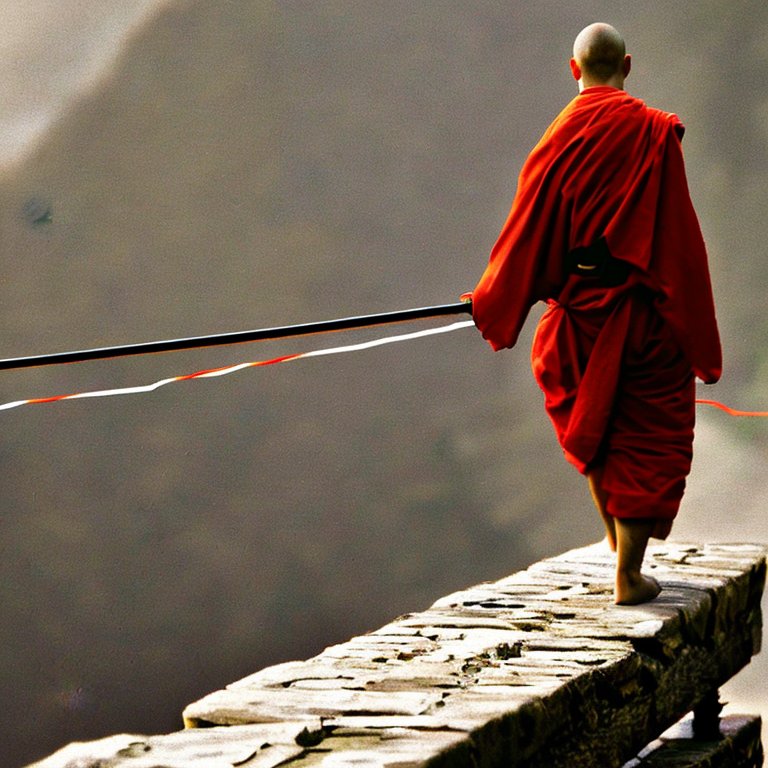
In our vast and infinite universe, there’s a remarkable dance that each living being performs, the perpetual tango between life and death. Every day, we navigate this tightrope, threading the narrow path that distinguishes the vibrant hues of existence from the void of non-existence. This intriguing equilibrium that defines our existence, balancing on the precipice of mortality, is an intricate choreography that brings to light the profundity of being alive.

Our breath, the subtle rhythm that underpins our existence, exemplifies this precarious balance. This rhythm – this continuous cycle of inhalation and exhalation – serves as the metronome of life itself. Each breath we take teeters on the edge of this existential tightrope, acting as the anchoring point in our ephemeral dance with life and death.

Delving deeper into this concept, one realizes that within every inhale and exhale, within the heart of that rhythmic balance, lies the essence of life. Every breath, an intimate connection between our body and the universe, is an affirmation of our existence, a silent declaration of life. The breath is an intimate dialogue with life, a personal narrative of our existence that is shared with the cosmos in a language as old as time.

But like any equilibrium, the delicate balance that our breath maintains requires moderation. If we linger too long on an inhale, or we dally on an exhale, we stray from the path of life. We break the cadence that ties us to life itself. We teeter, we falter, and eventually, we fall. To exist is to balance impeccably on this precipice, maintaining an impeccable rhythm in our breath that keeps us firmly planted within the domain of the living.

This concept, although simple in its description, bears profound implications. It calls us to be ever present, to appreciate the now, to be conscious of our place in the larger fabric of existence. It urges us to seek balance, to stay centered in the midst of our worldly experiences. Just as the rhythm of breath oscillates between inhale and exhale, so too should we find our balance amidst the highs and lows of life. For to be alive is not merely to exist, but to persist in this delicate dance on the existential tightrope.

In every breath, in every moment of our existence, we are called to embrace this profound balance. This realisation should provoke us to appreciate the transience of life, to value every breath as the gift it truly is. The rhythmic dance of breath is not just a biological necessity but an existential miracle that affirms our place in the grand tapestry of the universe.

Life and death. Inhale and exhale. Beginnings and endings. These dualities define the human condition. We walk the tightrope between these two extremes every day, maintaining a balance that is as delicate as it is essential. And in understanding this, we uncover a deeper appreciation of life itself, a more profound sense of our place within the cosmos, and a newfound reverence for the delicate balance that defines our existence.

Morgan O. Smith

Yinnergy Meditation & My Book, Bodhi in the Brain…Available Now!
https://linktr.ee/morganosmith

The Dance of Emptiness and Form

Unveiling the True Essence of Yoga

The philosophical underpinnings of Yoga transcend the popular perception of it as merely a physical discipline. Yoga, in its quintessence, is a union, a symbiotic dance between emptiness and form. This dance, a philosophical waltz within the vast expanses of the universe, finds a profound echo within us.

When we speak of form, we are drawn towards the tangible, quantifiable aspects of our existence—our body, the physical world around us. These are things we can touch, see, smell, hear, taste—the concrete attributes of our being. On the Yoga mat, the physical form is the obvious manifestation of our practice. Asanas are the embodiment of form, an expression of our grounded reality.

On the other hand, emptiness is an abstract concept, often considered synonymous with void or nothingness. In Eastern philosophies, emptiness does not signify a lack or absence but is regarded as the space that allows the form to exist, the silence that cradles the sound. It is the immaterial consciousness, the observer within us.

In the practice of Yoga, we cultivate the experience of both form and emptiness. Through asanas, we engage with form, enhancing our physical wellness and strength. Yet simultaneously, through meditation and breath control (Pranayama), we connect with the space of consciousness, the emptiness.

The union of emptiness and form in Yoga echoes the concept of Yin and Yang in Taoism. These seemingly opposing forces are complementary and interdependent. Similarly, in Yoga, the physical form (body) and the immaterial consciousness (emptiness) are intertwined in a dance, with neither one being superior to the other.

The realization of this union empowers us to perceive ourselves beyond the limitations of physical existence. We start to experience our oneness with the universe, recognizing that the emptiness within us is the same as the cosmic void, and the form is an expression of universal matter.

In true Yoga, we find balance and harmony between form and emptiness. We start understanding that emptiness isn’t a void but a space filled with infinite possibilities, and form is not rigid but a fluid and ever-changing phenomenon. This balance and harmonious interaction between emptiness and form illuminate the path toward self-realization and enlightenment.

Consequently, Yoga transforms from a practice into a way of life, a journey towards unveiling the veiled, harmonizing the paradox of existence and experiencing the profound unity of all creation. It’s a journey that, while dancing on the stage of duality, ultimately guides us back to unity.

In essence, Yoga teaches us to embrace the dance of life, the continuous ebb and flow between form and emptiness. In this dance, we discover our true selves, learning to live in harmony with our internal rhythms and the universal pulse. Only by acknowledging and understanding both emptiness and form can we truly unfold the potential within, ultimately experiencing the profound union that is the heart of Yoga.

Through this exploration, may we all find our unique rhythm in the cosmic dance and awaken to the truth that Yoga is not just something we do, but rather a state of being. A union of emptiness and form, a harmonious dance in the infinite canvas of existence.

Morgan O. Smith

Yinnergy Meditation & My Book, Bodhi in the Brain…Available Now!

https://linktr.ee/morganosmith

The Harmony Within

Exploring Integral Theory’s Perspectives on Nature vs. Nurture

Introduction:
In the quest to unravel the essence of human existence, the age-old debate of Nature vs. Nurture finds itself intertwined in the heart of discourse. The Integral Theory, founded by philosopher Ken Wilber, offers a unique lens to dissect this debate through its Four Quadrants. This thought-provoking analysis aims to delve into how the Integral Theory’s Four Quadrants elucidate the interplay between nature and nurture.

The Four Quadrants:
For context, Integral Theory’s Four Quadrants are a framework to understand reality. They are: Interior-Individual (Upper-Left), Exterior-Individual (Upper-Right), Interior-Collective (Lower-Left), and Exterior-Collective (Lower-Right). These quadrants reflect the inner and outer, as well as the individual and collective dimensions of existence.

1. Interior-Individual (Upper-Left) – The Subjective Self:
Here, nature manifests as the innate essence, such as genetic predispositions and temperament. Nurture, on the other hand, shapes our consciousness through personal experiences and emotions. The harmony or dissonance between one’s nature and the nurturing influences could define their subjective reality.

2. Exterior-Individual (Upper-Right) – The Observable Self:

In this quadrant, nature is viewed through the lens of biology – our brain structure, hormones, and genetic makeup. Nurture is the external stimuli that alter our biology. Understanding how the external environment (nurture) impacts our physiological being (nature) helps in comprehending the fluidity of human behaviour.

3. Interior-Collective (Lower-Left) – Shared Cultural Values:
This quadrant takes into account the collective consciousness, where nature represents the innate human desire to belong and socialize. Nurture is the culture we imbibe. It is critical to examine how societal norms and values (nurture) can either support or conflict with our innate tendencies (nature).

4. Exterior-Collective (Lower-Right) – Social Structures:

The Lower-Right quadrant emphasizes the social systems and structures. Here, nature is the evolution of societies, while nurture represents the societal systems such as education, law, and governance. The structures that societies create (nurture) can either facilitate or hinder the natural progression of human evolution.

Finding Balance:

The Integral Theory’s Four Quadrants reveal the intricate tapestry woven by the threads of nature and nurture. Recognizing the dialogues between these dimensions empowers us to find balance. Are we honoring our innate essence while being responsive to external influences? How are our societal structures and shared values nurturing our natural propensities or thwarting them?

Conclusion:
As we navigate through the currents of existence, the Integral Theory’s Four Quadrants provide us with the compass to explore the depths of Nature vs. Nurture. By seeking harmony between our inherent nature and the nurturing environments, we create a symphony that resonates with the very core of human existence. It is through this understanding that we can work towards a more holistic, compassionate, and evolved society.

Morgan O. Smith

Yinnergy Meditation & My Book, Bodhi in the Brain…Available Now!
https://linktr.ee/morganosmith