Ceasing to Exist Is Existence

What feels like disappearance is often the unveiling of what never arrived and never left.

Identity clings to continuity. It insists on narrative, on form, on something stable enough to say, “this is me.” Yet every sincere glimpse beneath that surface reveals something unsettling; there is no fixed centre holding it all together. Thoughts pass. Sensations dissolve. Emotions rise and vanish without permission. Even the sense of being a “someone” flickers in and out of awareness.

So what exactly is ceasing?

What we call existence is usually filtered through attachment to form. Body, memory, personality, history; these become the reference points for being. When any of these begin to loosen, a quiet panic can emerge. It feels like loss. It feels like the edge of annihilation. Something in us resists, because it interprets the fading of form as the fading of existence itself.

But that interpretation is flawed.

Ceasing does not touch existence. It only dismantles the illusion of containment.

Consider the moment between two thoughts. There is no identity there, no story, no personal reference point. Yet something undeniable remains. Awareness does not collapse in that gap. It stands unobstructed, without needing to announce itself. That silent interval is not absence; it is presence without definition.

The fear of ceasing arises from confusion between what appears and what is. Appearances come and go. They are meant to. Existence, however, does not operate within that cycle. It is not born when a form emerges, nor does it die when a form dissolves. It simply is, untouched by the movement it allows.

Letting go, then, is not an act of surrendering existence. It is the recognition that existence was never dependent on what you thought you were.

This is why deep realization can feel like a kind of death. The structures that once provided orientation fall away. The familiar reference points dissolve. Even the sense of being the experiencer can collapse. Yet what remains is not void in the way the mind imagines. It is fullness without boundary. Presence without identity. Being without ownership.

Ceasing reveals that nothing real was ever at risk.

Every moment already contains this truth. Each ending—of a breath, a thought, a sensation, is a quiet demonstration. Something ends, yet nothing essential is diminished. Life continues, but not as a personal possession. It unfolds as an expression of something indivisible.

Existence does not belong to you.

You belong to existence only as an appearance within it.

When this becomes clear, the resistance softens. The need to preserve a fixed self begins to lose its urgency. Ceasing is no longer feared. It is understood as a return; not to something new, but to what has always been prior to every assumption of “I am this.”

Existence does not require you to remain.

It reveals itself most clearly when you don’t.

Morgan O. Smith

What Appears Is Never What It Is

Nothing arrives as itself. What shows up as form, event, thought, or identity is already a veil; yet not a veil hiding something else. Appearance is the way the unseen speaks. Expression is not a mask placed over truth; expression is the activity of truth.

Time does not obscure reality. Time is one of its gestures. Space does not distance anything from what is real. Space is a mode of presentation. Every person, object, moment, and movement stands as a precise articulation of what cannot be isolated, possessed, or fully perceived.

What remains unseen is not absent. It is unlocatable.

The true nature does not sit behind phenomena waiting to be uncovered. It never retreats from what appears. Every disguise is complete. Every expression is equal. No hierarchy of forms exists at the level where all forms arise.

Archaic consciousness does not miss truth; it reflects truth as survival and immediacy. Magical consciousness does not distort reality; it reveals participation and symbolic power. Mythic consciousness does not fabricate meaning; it expresses coherence through story and order. Modern consciousness does not reduce the world; it articulates precision, structure, and agency. Postmodern consciousness does not fragment truth; it exposes hidden assumptions and unspoken exclusions. Integral consciousness does not transcend the earlier forms by negation; it includes them as necessary articulations. Super-integral awareness does not stand above the whole; it recognizes the whole as already complete.

No stage corrects another. Each stage speaks a different dialect of the same unspeakable source.

Egocentric, ethnocentric, worldcentric, and Kosmocentric orientations do not compete for validity. Each reflects how the whole experiences itself through scale and concern. What feels limited at one level becomes coherence at another, without contradiction.

Subjective experience does not oppose objective reality. Intersubjective meaning does not negate interior depth. Interobjective systems do not erase lived presence. These are not separate territories. They are simultaneous dimensions of one unfolding.

Qualities appear; love, fear, intelligence, inertia, clarity, confusion. Attributes seem to form; shape, duration, movement, pattern. Absence also appears; emptiness, silence, negation. None of these define the source. None of these exclude it.

The true nature cannot be seen because it never stands apart from seeing. It cannot be grasped because it never stands opposite grasping. Every attempt to point to it becomes another appearance, and that appearance is already sufficient.

Nothing is hiding. Nothing is missing. Nothing needs to be revealed.

What is appearing is exactly what reality looks like when it expresses itself without needing to explain.

Morgan O. Smith

AI for Wellness and Spirituality Summit

February 9 & 10, 2026

https://aiforwellnessandspirituality.com/mosm

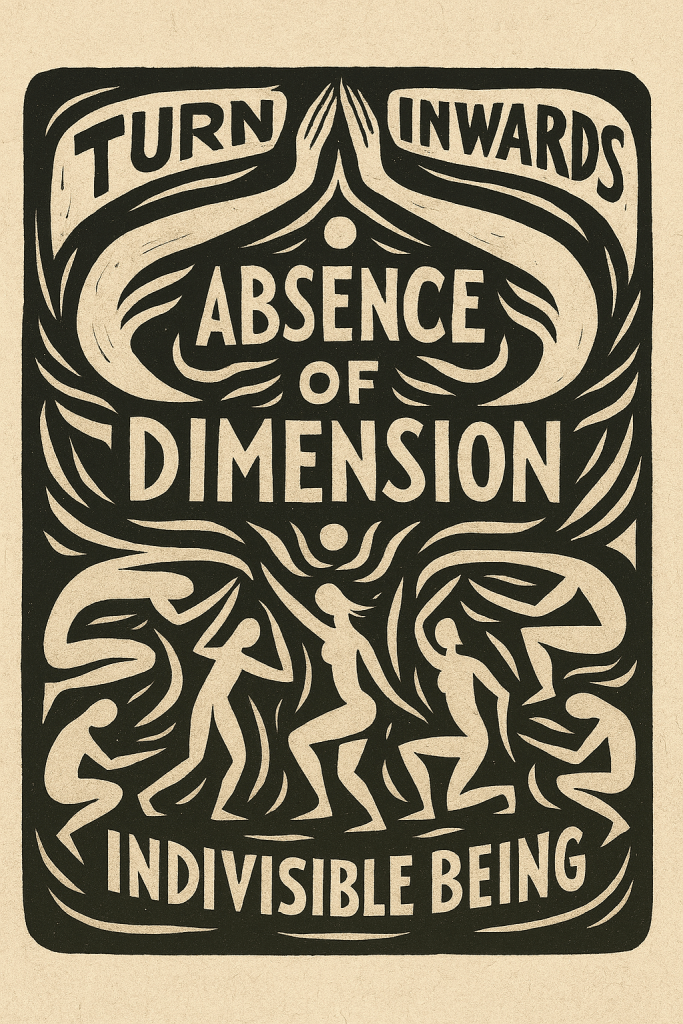
The Absence of Dimension

A Contemplation on Absolute Monism

What dimension is the experience of absolute monism?

That very question quietly collapses under its own weight.

To ask “how many” is to divide the indivisible. To quantify is to measure a mystery that can only be met in its own silence. Within the direct realization of Turiyatita—that which lies beyond even Turiya—there is no vantage point from which to count, compare, or classify. The moment dimensionality is assigned, we have already slipped back into the architecture of mind, where form assumes primacy over essence.

Still, the mind hungers for some orientation. So let’s turn the prism slowly, exploring this from a few distinct angles—not as answers, but as offerings.

1. Relative Lens: The Architecture of Experience

Certain esoteric traditions offer a gradient of consciousness: from the dense contours of the material (3D), to subtle inner time-space (4D), toward integrative fields of unity (5D and above). These serve as helpful metaphors, allowing seekers to understand how consciousness may expand or refine. Yet even the loftiest of these is still part of the dream—within the cosmic play of form.

From this lens, the direct encounter with nonduality might appear multi-dimensional, even interdimensional, because it defies the logic of linearity. It feels vast, borderless, paradoxical. But it is still being interpreted by a relative mind, even if only for a moment.

2. Transcendental Lens: The Priorness of the Real

Absolute monism is not located anywhere because it is not a location.

Dimensionality implies structure. It assumes contrast. But the Absolute is prior to all arising. It is not 1D, 5D, or 12D—it is the generative zero-point. The stillness that allows all movement. The background that isn’t separate from the foreground but holds all images without ever becoming one.

It is not empty like a void; it is empty like ungraspable fullness. The kind of emptiness that births stars and dissolves gods. Not confined to being or non-being, but transcending both.

3. Direct Realization: The Collapse of All Coordinates

No map leads here.

Direct realization is immediate and unmediated. Not because you reached a peak, but because the climber vanished. There is no experiencer—only experiencing. No mind reflecting on awareness—only awareness aware of itself.

Here, space has not been born. Time has not begun ticking. Even the concept of unity dissolves, for there is nothing to be unified. What remains is suchness—pure presence prior to presence. A silent explosion of is-ness so complete it leaves no trace.

Not a Dimension. Not Even a State.

So what do we call it?

Nothing.

And everything.

To speak of “the dimension of absolute monism” is to subtly betray it. Better to say: it is the absence of dimension in which all dimensions arise and dissolve. Not a high place, but the place before place. Not a peak, but the disappearance of altitude itself.

A Final Whisper

Absolute monism is not the highest dimension.
It is the absence of dimension,
where even “one” dissolves.
Here, all becomes what it has always been—
indivisible, unbounded, unspoken.

Morgan O. Smith

Get Your Free Copy of My Book, Bodhi in the Brain!

https://subscribepage.io/oTSZQu

The Knower and the Known

When Form Dreams of Itself

You are known by Being. Before identity could be sculpted by language, or selfhood dressed in names, something vast and wordless recognized you. Not as a separate object in the universe, but as the universe aware of itself through your eyes.

A being wished to be known. This desire was not born of lack, but of possibility—the silent joy of expressing wholeness through multiplicity. Thought stirred the stillness. From the quiet field of pure potential arose the illusion of distance between knower and known, seer and seen.

Form was the answer to a question never asked. Matter became a mirror for what could never be reflected. Consciousness, looping through itself, painted shapes on the canvas of time—not to find itself, but to taste itself.

But this story is recursive. The being that wished to be known by form was always Being itself, pretending to forget. It authored the forgetting so the rediscovery would be felt—so the dream of separation could end in the revelation of unity.

You are not a self trying to awaken. You are the awakening disguised as a self. Not a fragment, but the entirety momentarily folded into appearance. To be known by Being is to be undone by truth—not as something to gain, but as something to stop resisting.

So ask not who you are.

Ask who is asking.

And then allow the question to dissolve—until nothing remains but the Knowing itself, resting as what it has always been.

Morgan O. Smith

Get Your Free Copy of My Book, Bodhi in the Brain!

https://subscribepage.io/oTSZQu

One Heartbeat…One Thousand Thoughts

Consider the heartbeat: a steady, rhythmic pulse that carries the force of life through every cell of your being. Within each beat lies an unseen multitude, a vast array of thoughts—fleeting, overlapping, and often unnoticed. This single moment, this solitary beat contains within it the energy of a thousand thoughts, each connected to the next, creating the internal world we navigate daily.

Thoughts rush like a river, surging with desires, fears, memories, and plans. Yet, they are barely registered before the next wave crashes. The heartbeat, however, remains a constant companion, reminding us that a profound stillness exists beneath the surface of our scattered minds.

It is within this space—the pause between heartbeats—that clarity can emerge. As our awareness deepens, we recognize that the mind’s racing thoughts are but ripples on the ocean of our being. We are not the thoughts themselves but the consciousness that observes them. By aligning with the heartbeat rather than the noise of the mind, we begin to see beyond the clutter of mental activity, into the spacious awareness where thoughts dissolve and presence shines.

A single heartbeat holds the potential for transformation, for within that beat is the opportunity to disengage from the frantic movement of thought and return to the grounded essence of who we are. Thought is not the enemy, but its sheer volume often drowns out the wisdom that whispers between the beats.

This shift, from identifying with thought to residing in awareness, is subtle but profound. It reveals that while a thousand thoughts may pass through our minds, they are transient. The heartbeat, however, is the rhythm of life itself, a steady pulse guiding us toward presence. Here lies a truth often overlooked: life happens not in the storm of thoughts, but in the quiet between them.

The next time your mind feels overwhelmed, listen to your heartbeat. Allow yourself to rest in the awareness that arises in its rhythm. Watch as the thousand thoughts lose their hold, and the simplicity of being takes centre stage. This is the essence of spiritual awakening—a return to the heart, where a thousand thoughts collapse into one still, eternal presence.

Morgan O. Smith

Yinnergy Meditation, Spiritual Life Coaching & My Book, Bodhi in the Brain…Available Now!

https://linktr.ee/morganosmith