When Empathy Crosses the Threshold of Self

Empathy is often described as understanding another’s feelings, yet this description barely scratches the surface of its deepest expression. At its highest register, empathy ceases to be an act of imagination and becomes an act of participation. Something more radical occurs; identity loosens, boundaries soften, and awareness enters a living intimacy with another mode of being.

Such empathy does not merely observe suffering or joy from a distance. Consciousness steps into the interior rhythm of another life and begins to feel from within. Breath, sensation, and perception reorganize themselves. Experience no longer revolves around a private centre. A wider gravity takes hold.

Kosmocentric awareness emerges at this threshold. Attention no longer privileges the personal narrative or even the collective identity of a group. Life is sensed as a single field expressing itself through countless forms. Compassion, here, is not chosen. It flows naturally, the way heat radiates from fire.

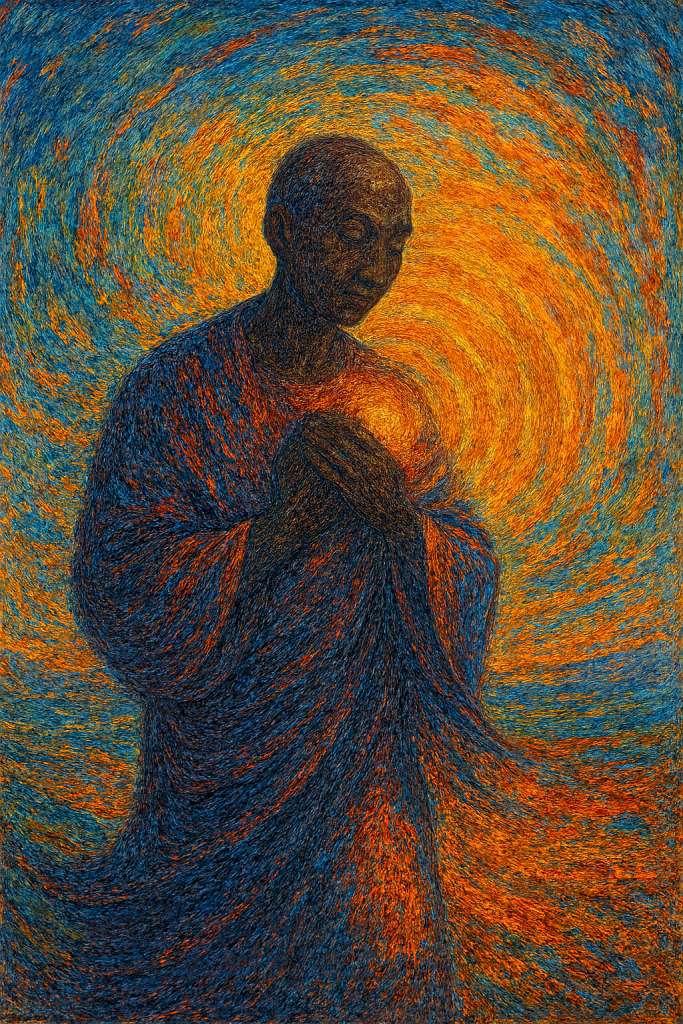
To walk in the shoes of a bodhisattva is not to adopt a moral stance or imitate a spiritual role. It is to feel what it means to be animated by responsibility without burden. The heart expands beyond emotional warmth into something rhythmic and vast, beating not for one life, but for life itself. Suffering is felt directly, yet it does not collapse the system. The capacity to hold pain grows alongside the capacity to love.

Such an experience dissolves the familiar distinction between self and other. Helping another no longer feels like altruism. It feels like circulation; energy moving where it is needed, without hesitation or self-congratulation. Action arises spontaneously, guided by clarity rather than obligation.

This level of empathy cannot be sustained through effort alone. It arises when identification with the separate self loosens enough for consciousness to re-centre itself within the whole. What remains is not detachment, but intimacy without possession. Care without agenda. Presence without contraction.

Moments like these recalibrate what it means to be human. After tasting kosmocentric empathy, ordinary indifference becomes impossible to justify. Even when the experience fades, something irreversible has occurred. A deeper reference point has been established.

Empathy, at its summit, reveals itself not as an emotional skill, but as a shift in being. Life recognizes itself through you, and the heart learns a larger rhythm; one that beats for all beings, without exception.

Morgan O. Smith

Get Your Free Copy of My Book, Bodhi in the Brain!

https://subscribepage.io/oTSZQu

How Far the Heart Can Truly Open

A curious shift occurs when the heart stops functioning as a possession and begins revealing itself as a dimension of awareness. Most people imagine love as something they generate, something that must be earned, strengthened, or directed. Yet once the inner walls begin dissolving, the heart behaves less like a reservoir and more like an unbounded field. Nothing needs to be pushed outward. Nothing needs to be pulled inward. Everything already rests inside the same luminous space.

A bodhisattva’s vow is often misunderstood as a heroic effort to love every being across the cosmos. That interpretation still assumes a separate self stretching itself toward infinity. What actually unfolds is far more intimate. The boundaries that define self and other begin to thin. Compassion arises not from moral intention but from direct recognition: every form is a variation of the same presence gazing through different eyes. Love becomes less a decision and more a consequence of clarity.

A Kosmocentric heart does not expand by accumulating greater quantities of affection. Its expansion is a subtraction—less resistance, less defense, less contraction around identity. As the edges dissolve, the universe is no longer something “out there” that requires love. It is revealed as the very body of consciousness, expressing itself through countless lifetimes, worlds, and histories. To love all beings then becomes effortless, because nothing stands outside the recognition of shared essence.

This realization reshapes the ordinary meaning of devotion. Love ceases to be a feeling sustained by conditions. It becomes the ground from which every moment rises. The heart does not tire. The heart does not question whether it is capable. The heart simply returns to its natural state: vast, quiet, and uncontainable.

A question often arises: “Can a human being truly love the entire universe?”
Yes, but not as a human being. Only when the self drops away does the heart reveal its true scale. What remains is a presence spacious enough to cradle galaxies, tender enough to feel the slightest tremor of suffering, and awake enough to recognize itself in every corner of existence.

This is the heart unbound.
This is compassion without walls.
This is the love the universe has always known through you.

Morgan O. Smith

Get Your Free Copy of My Book, Bodhi in the Brain!

https://subscribepage.io/oTSZQu

The Paradox of the Bodhisattva

Embracing Infinite Compassion

The greatest human sacrifice is the bodhisattva’s goal of not attaining nirvana until all sentient beings are free from samsara. An impossible task, but the bodhisattva does this anyway out of love. So out of love, he or she continues to be born, die, and be reborn while being fully conscious of entering a life full of grief, discomfort, and dissatisfaction.

The bodhisattva’s path is one of profound paradox and immeasurable compassion. In the face of boundless suffering, the bodhisattva chooses not the liberation of nirvana but the unending cycle of rebirth. This choice, rooted in an infinite love for all sentient beings, defies conventional notions of self-preservation and personal enlightenment.

In the depths of this commitment lies a radical redefinition of what it means to live a meaningful life. The bodhisattva embodies a profound understanding that individual enlightenment is intertwined with the liberation of all beings. This interconnectedness transforms personal suffering into a collective journey, where the lines between self and other dissolve in the embrace of universal compassion.


To fully grasp the bodhisattva’s sacrifice, one must delve into the core of their motivation: the unyielding love for all beings. This love transcends personal desires and aspirations, anchoring itself in the welfare of every sentient entity. It is a love that is willing to endure the perpetual ebb and flow of samsara, embracing each life with open-hearted acceptance despite the inherent pain and impermanence.

The bodhisattva’s journey challenges us to reconsider our own lives and the nature of true fulfillment. It asks us to look beyond our immediate comfort and desires, to see our existence as part of a larger, interconnected whole. In doing so, we begin to understand that the pursuit of personal happiness is not separate from the well-being of others.

Engaging with the bodhisattva ideal, even as a mere contemplation, invites us into a deeper exploration of love and compassion. It urges us to reflect on our capacity to extend kindness and empathy beyond the confines of our personal experiences. In a world often dominated by individualism and self-interest, the bodhisattva’s sacrifice serves as a beacon, illuminating the transformative power of selfless love.


Ultimately, the bodhisattva’s commitment to the liberation of all beings is a testament to the boundless potential of the human spirit. It is a reminder that true enlightenment is not an isolated achievement but a collective awakening. As we meditate on the bodhisattva’s path, we are inspired to cultivate a love that transcends our own lives, embracing the entirety of existence in its compassionate embrace.

Morgan O. Smith

Yinnergy Meditation, Spiritual Life Coaching & My Book, Bodhi in the Brain…Available Now!

https://linktr.ee/morganosmith

Can One Choose to Go Back to Being Unenlightened?

The journey toward enlightenment is often viewed as a one-way path, leading to a state of spiritual awakening that fundamentally changes one’s perception of the world and self. But is it possible to revert to a state of unenlightenment? This question opens a fascinating philosophical debate.

#### The Irreversibility of Enlightenment


Once an individual experiences spiritual enlightenment, it is commonly believed that this transformation is irreversible. In spiritual traditions like Hinduism, Buddhism, and various mystic philosophies, enlightenment—referred to as Sahaja Samadhi, Turiyatitta, Nirvana, Nibbana, Moksha, Bodhi, and other names—is seen as the ultimate achievement. It’s a profound understanding of the universe and one’s place, transcending ordinary perception.

The idea of willingly abandoning such a state seems counterintuitive. Why would one return to a less aware state after enlightenment? For those who have experienced this profound awakening, giving it up, especially while in the human body, seems unimaginable.


#### The Divine Paradox

However, when considering the divine or absolute reality—referred to in various traditions as God, Brahman, Allah, or the Ground of All Being—there’s an intriguing paradox. This ultimate reality is believed to manifest itself in all forms of existence, encompassing every species and aspect of the universe. In doing so, it seemingly relinquishes its state of pure enlightenment to become the myriad forms of life and matter.

#### The Bodhisattva’s Choice

In Mahayana Buddhism, the concept of the Bodhisattva presents another unique perspective. A Bodhisattva is an individual who has caught a glimpse of enlightenment but chooses not to enter this state fully. This choice is made out of compassion, with the vow to help all sentient beings achieve enlightenment before achieving it themselves fully. This represents a profound sacrifice and a different understanding of enlightenment, not as a personal achievement but as a collective goal.


#### Conclusion

The question of whether one can choose to return to unenlightenment is complex and multi-faceted, deeply rooted in various spiritual traditions and philosophical contemplations. It invites us to consider the nature of spiritual awakening, the role of the divine in the cosmos, and the interconnectedness of all beings in the journey toward enlightenment.

Morgan O. Smith

Yinnergy Meditation, Spiritual Life Coaching & My Book, Bodhi in the Brain…Available Now!

https://linktr.ee/morganosmith

The Unburned Heart of Thích Quảng Đức

A Testament to Unyielding Compassion

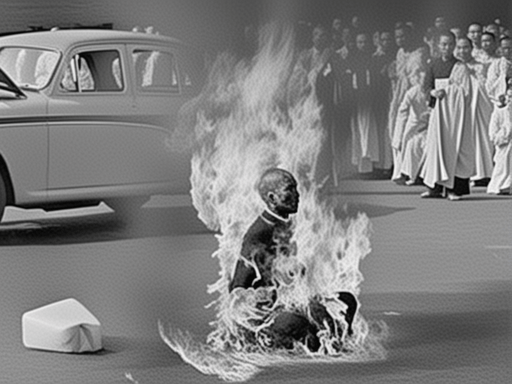
In the vast annals of human history, few images stand as starkly haunting as that of Thích Quảng Đức, a Vietnamese monk who, in a profound act of protest, set himself ablaze on a Saigon street in 1963. While the flames consumed his physical form, Quảng Đức remained motionless, embodying the epitome of tranquillity and peace. As if this act was not profound enough, an even more astonishing testament to his spirit was the heart that remained unburned, not only in the initial act but even upon re-cremation.

**The Unyielding Heart**

What does it mean to have a heart that does not burn? In the literal sense, it defies the expectations of nature and science. But on a more profound level, the heart of Thích Quảng Đức symbolizes the ultimate emblem of pure, unyielding compassion. In a world often ruled by tumultuous fires of hate, prejudice, and indifference, Quảng Đức’s heart serves as a poignant reminder that true compassion is unassailable. It can neither be burned nor extinguished.

**Compassion Amidst Chaos**

The metaphorical imagery of a heart that remains intact, even amidst the raging fires, is a testament to the enduring nature of compassion. The flames that consumed Quảng Đức were not merely physical; they represented the societal and political upheavals of his time. Yet, his heart, like his spirit, stood resolute, undeterred, and most importantly, compassionate.

In the face of adversity, many of us allow our hearts to be overtaken by the metaphorical fires of anger, resentment, or apathy. Yet, Thích Quảng Đức’s heart is a beacon, calling upon us to rise above the flames of malice and to foster a heart that, metaphorically speaking, can never burn.

**A Legacy Beyond the Flames**

Today, housed in a glass chalice at Xá Lợi Pagoda, Thích Quảng Đức’s heart serves as a perpetual reminder of his teachings and spirit. To the Vietnamese Buddhists and many others across the globe, he is revered as Bồ Tát Thích Quảng Đức, a bodhisattva. A being filled with such boundless compassion that he chose to remain in the cycle of samsara to help others attain enlightenment.

This unburned heart serves as a testament not just to the man, but to the idea that compassion, when deeply rooted in one’s being, can transcend even the most harrowing circumstances. It challenges each of us to reflect on the state of our hearts. Do we nurture a heart that is impenetrable to the flames of hatred, bitterness, and indifference?

**In Conclusion**


The legacy of Thích Quảng Đức is not simply about the act of self-immolation. It’s about a heart—a pure, compassionate heart that remained untouched despite the circumstances. As we traverse through our trials and tribulations, may we strive to cultivate such a heart, a heart that remains compassionate, resilient, and most of all, unburned.

Morgan O. Smith

Yinnergy Meditation & My Book, Bodhi in the Brain…Available Now!

https://linktr.ee/morganosmith

Embracing the Octopus Within

The Path of the Saint and the Bodhisattva

In the boundless depths of the ocean, a remarkable creature flourishes – the octopus. With its eight arms and three hearts, the octopus presents a fascinating analogy for a life dedicated to compassion and altruism. What if I told you that by embracing the wisdom of the octopus, you could walk the path of a saint or a bodhisattva?

Three Hearts, One Soul

The octopus’s three hearts are not just intriguing biological features; they symbolize a trinity that is central to a life of selflessness – compassion, wisdom, and courage. These three tenets are the lifeblood that sustains the spirit of those who strive to benefit others. Just as the octopus’s hearts pump vitality through its body, these principles energize and direct our moral compass.

Compassion is the first heart. It moves us to alleviate the suffering of others. Wisdom, the second heart, grants the discernment to understand the complexities of life and the interconnectedness of all beings. The third heart, courage, gives us the strength to act upon our compassion and wisdom even in the face of adversity.

Arms That Give

Now, imagine your capabilities and resources as the arms of an octopus. These are the conduits through which the heart’s intent flows into action. With its eight arms, an octopus can achieve an astonishing level of multitasking and adaptability. Likewise, when we apply our varied talents and strengths in the service of others, we, too, can touch many lives. The octopus doesn’t discriminate as to which of its arms is more worthy; similarly, no act of kindness, however small, is ever wasted.

The Saint and the Bodhisattva: A Singular Journey

To “be like the saint” is to embrace a life of purity, humility, and service. This aligns closely with the path of the bodhisattva in Buddhism, who seeks enlightenment not for personal gain but for the benefit of all sentient beings.

A true saint, like a bodhisattva, doesn’t keep score. The concept of giving without expecting anything in return is deeply rooted in this path. This is not to be confused with self-neglect; rather, it’s the understanding that in the giving, we receive. We receive growth, fulfillment, and connection – treasures that cannot be quantified.

An Octopus’s Embrace

So, let’s learn from our wise friend, the octopus. Let our three hearts be full of compassion, wisdom, and courage. Let our arms be open and giving. And may we swim through the currents of life with grace, as saints or bodhisattvas, serving as guardians and guides for all those navigating the tempestuous oceans of existence.

In embracing the octopus within, we embark on a journey that ripples through the waters of our communities and touches the shores of every heart. In this sacred odyssey, we do not merely live; we become vessels of immeasurable, boundless love.

Morgan O. Smith

Yinnergy Meditation & My Book, Bodhi in the Brain…Available Now!

https://linktr.ee/morganosmith