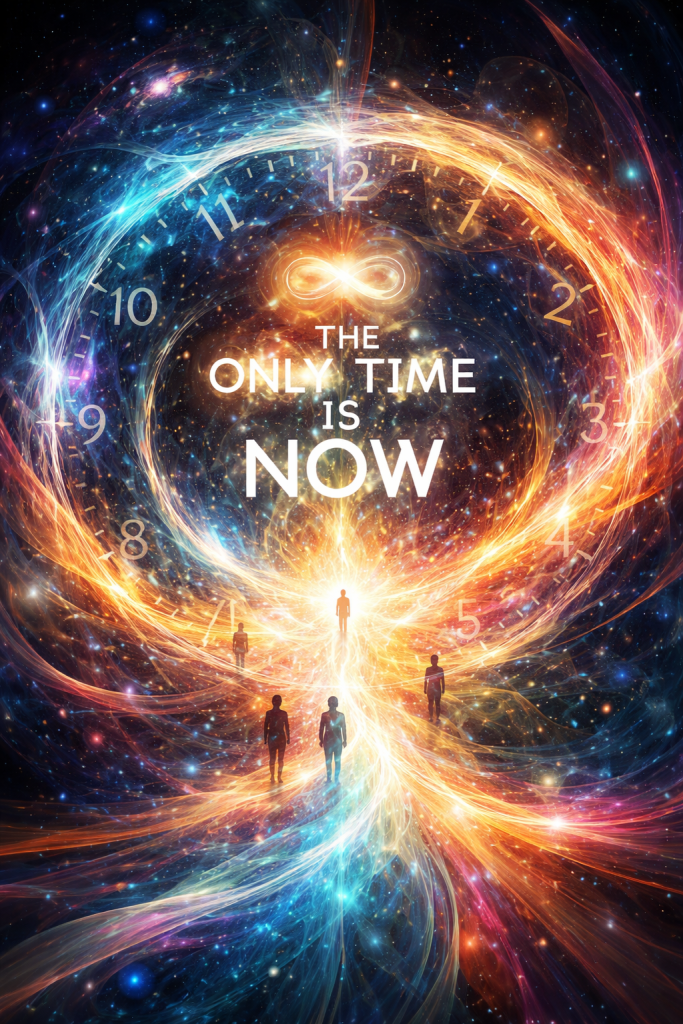
Awakening Never Arrives Because It Never Began

A seeker imagines a future moment where everything will break open, where clarity finally dissolves the boundaries that have shaped a lifetime. That imagined moment appears to sit somewhere ahead, waiting to be earned through discipline, suffering, or the slow maturation of wisdom. Yet the entire notion of “ahead” belongs to the dream of becoming. The one who waits is already suspended inside the very awareness they are longing for.

A deeper look reveals something far more radical: awakening does not unfold across time. It is not a culmination of choices, experiences, or lifetimes. It stands as the ground from which all choices, experiences, and lifetimes arise. What feels like progress toward realization is simply the awakened state appearing as movement, as if it were journeying toward itself while never leaving its own source.

Every universe, every branching possibility, every karmic ripple flows from that unshakable presence. No path leads to awakening because awakening generates the paths. A being may feel capable of choosing away from truth, yet that very sensation is part of truth expressing itself as forgetfulness. Even resistance is a shape taken by the same presence that cannot be diminished or delayed.

Karma does not carve a road toward liberation; karma is the motion of reality already awake, already whole. The cycle of birth and death functions as the dream’s choreography, giving consciousness a taste of separation so it can experience the beauty of returning to what never left. The sense of being “unfinished” is simply awareness folding into the appearance of incompleteness for the sake of its own exploration.

Awakening is not the goal of an individual, nor the endpoint of a soul’s journey. It is the condition that makes both individuality and journey possible. Meditation, inquiry, devotion, and hardship do not cause awakening; they are the movements of awakening playing as effort, yearning, and revelation. The river does not create the ocean; it is shaped by it.

From within the illusion of becoming, awakening looks inevitable. From the perspective of the absolute, inevitability is irrelevant because nothing ever fell out of the state it seeks to reclaim. Every lifetime is a reflection of that single truth refracted through time, space, karma, and choice.

Awakening is not the outcome of the cosmos.
Awakening is the reason the cosmos appears at all.

Morgan O. Smith

Get Your Free Copy of My Book, Bodhi in the Brain!

https://subscribepage.io/oTSZQu

The Root of Choice

True Free Will and the Causal Realm

Most speak of choice as if it lives at the surface, where preference, fear, habit, and desire jostle for control. But what if true free will does not arise there at all? What if it exists at the root, before thought forms into options, before “I want” emerges to justify itself?

This root is the causal realm: the source of all motion, where intention is not split from manifestation. It is not personal will in the usual sense—no ego negotiating with life to get what it wants. Instead, it is pure causality aware of itself, setting everything in motion without conflict or division.

At the surface, people speak of freedom as the power to choose between alternatives. Yet these alternatives are already conditioned. They are branches of a tree whose root has already determined their growth. To speak of freedom at the stem while ignoring the root is to mistake effect for cause.

However, the paradox reveals itself when one sees no real division between root and stem. The freedom to choose at the surface becomes genuine only when it is recognized as the expression of the root itself. Every choice becomes the revelation of causality. There is no separate chooser apart from the choosing.

This is what lies beyond the ego’s belief in control. The ego claims “I choose” without realizing that its very claim is already part of the causality it denies. True free will is not the assertion of control over life but the recognition that you are life itself choosing, moving, unfolding.

To see this is to dissolve the illusion of separation. Responsibility is no longer a burden but realization: the root chooses through you, as you. There is no conflict left. Choice becomes transparent, ego falls away, and causality shines unbroken.

This is freedom—not as license, not as negotiation, but as total alignment with the source of all that arises.

Morgan O. Smith

Get Your Free Copy of My Book, Bodhi in the Brain!

https://subscribepage.io/oTSZQu

The Eternal Now

Understanding the Convergence of Time and Causality

In the realm of spiritual and philosophical inquiry, the concepts of time and causality often lead us down intricate paths of understanding. Consider the profound idea that the past, present, and future are not separate entities, but rather simultaneous occurrences, manifesting in the eternal ‘now’. This perspective invites us to view every event, every situation, and every action as interconnected and existing within the same infinite moment.

The notion that every cause is simultaneously an effect, and every effect a cause, further deepens our exploration into the cyclical nature of existence. This idea challenges the linear perspective of time and causality that dominates Western thought. Instead, it aligns with the Eastern philosophical understanding that everything in the universe is interdependent and in constant flux, yet fundamentally unified.


Such an understanding reshapes our perception of life’s events. It suggests that our actions are both the result of past influences and the creators of future conditions, all interwoven into the continuous fabric of the present. This holistic view can empower us to live more fully in the moment, appreciating the interconnectedness of all that is.

By embracing this perspective, we open ourselves to the myriad possibilities that each moment holds. It encourages us to live with greater awareness, recognizing that our thoughts and actions are potent contributors to the fabric of our lives and the universe at large.


In reflecting on this unity of time and causality, we might find ourselves more attuned to the subtle, yet profound, essence of life’s continuous unfolding. This realization can be a gateway to deeper spiritual awakening and enlightenment, offering a fresh lens through which to view our existence and our role within it.

Morgan O. Smith

Yinnergy Meditation, Spiritual Life Coaching & My Book, Bodhi in the Brain…Available Now!

https://linktr.ee/morganosmith

Reincarnation Unfolding

The Mystical Dance of Life at the Subatomic Scale

Reincarnation is often conceived as a cycle of birth, death, and rebirth. This process, however, is not confined merely to the level of an individual’s life journey, but also at a minute, an invisible scale that continuously unfolds within us.

The human body is composed of about 37 trillion cells, with each one possessing its lifecycle. Old cells die and new ones are born in a ceaseless symphony of life. Every second, millions of cells in your body reincarnate, dying and then being reborn anew. This minute cycle mirrors the grandeur of the reincarnation concept, challenging us to rethink what it means at the fundamental level.

To delve deeper, each cell consists of molecules, atoms, and subatomic particles, each undergoing their cycles of transformation. These minuscule particles don’t die or are born in the traditional sense, but rather transform, changing their states, swapping places, decaying, and then being reincarnated into different particles. From this viewpoint, reincarnation becomes a ubiquitous process that is playing out at every moment.

In light of this perspective, where does the soul reside? Is it just in the whole or also in the parts? If we consider the soul as the essence of life and consciousness, then every cell, every molecule, and even every atom has a part of this essence. This soulful essence, then, is constantly dying and being reborn, experiencing its cycle of reincarnation at a cellular, molecular, and atomic level.

Then arises the concept of karma, a law of moral causation. Can it apply at a subatomic level? At first glance, it might seem improbable. After all, karma is about action and consequence, and cells or atoms don’t have agency in the same way humans do.

However, if we think of karma less as moral action and more as causality, things start to take shape. Each cell’s fate—its health, its functioning, its lifespan—is determined by previous actions, or karmas, at the molecular and atomic levels. These actions could be genetic expressions, protein formations, or even quantum fluctuations.

Molecular karma plays out in the creation of proteins, cellular karma in the orchestration of life processes, and atomic karma in fundamental interactions. The sum of all these karma of parts can even influence the karma of the whole, impacting our health, our mind, and our life.

Through this lens, the concept of reincarnation and karma expands beyond a spiritual or religious doctrine and becomes a fundamental principle of life, from the grand scale of human existence to the tiny dance of atoms.

Thus, the journey of life and death is not a one-time event; it is a constant process. Every moment, we are dying and being reborn, at various levels of our existence. Our karma, too, is being created, fulfilled, and carried forward at these multiple levels. Such a realization can provide us with a profound perspective on life, death, reincarnation, and karma, reminding us of our intricate connection with the cosmos.

This understanding, although awe-inspiring, is only the tip of the iceberg. The philosophical implications are profound, leaving us to ponder the mysterious dance of life and death that is taking place within us, every moment, at every level.

Morgan O. Smith

Yinnergy Meditation & My Book, Bodhi in the Brain…Available Now!

https://linktr.ee/morganosmith

Embracing the Unity of Free Will and Determinism

Nondual Perspectives

Introduction:
In the timeless debate surrounding free will versus determinism, philosophical inquiries have often sought to reconcile these seemingly opposing concepts. However, from a nondual standpoint, rooted in direct experience, the boundaries between free will and determinism begin to blur. In this blog, we explore the profound idea that every choice we make is our decision and the decision of the universe itself. We delve into the unity of free will and determinism, highlighting how this perspective challenges conventional notions and opens up new avenues for contemplation.

The Illusion of Separation:

From a nondual perspective, the fundamental illusion is the perception of separation between ourselves and the universe. When we examine our direct experience, we realize that we are intimately interconnected with the fabric of existence. Our choices and actions are not isolated events but intricately interwoven with the tapestry of the cosmos. Thus, the dichotomy of free will and determinism fades away, revealing a deeper unity.

The Illusion of Individual Agency:
Conventionally, free will is often associated with individual agency, the belief that we possess an independent power to make choices. However, upon closer inspection, we find that our notion of individual agency is built upon a complex web of influences. Our thoughts, desires, and motivations arise from a multitude of factors: genetics, upbringing, culture, and countless other variables. In this sense, determinism seems to assert its presence, implying that our choices are shaped by external forces.

Reframing Choice as Cosmic Manifestation:
While determinism challenges the idea of individual agency, nondual perspectives offer an intriguing alternative. Instead of perceiving ourselves as separate entities with independent choices, we can reframe choice as a cosmic manifestation. Every decision we make can be seen as a ripple in the interconnected web of existence, an expression of the universe itself. In this way, free will and determinism merge into a harmonious whole, transcending the limitations of duality.

Unfolding in the Eternal Now:
In the nondual understanding, the concept of time takes on a different dimension. Past, present, and future merge into an eternal now, where every choice and outcome coexist in a timeless dance. From this vantage point, the notion of causality loses its strict linear framework. Our choices are not predetermined events unfolding in a predetermined sequence; rather, they arise in the timeless realm of possibility, where the universe expresses itself through our individual consciousness.

Embracing Paradox:
The reconciliation of free will and determinism requires embracing paradox. It calls upon us to transcend the limitations of dualistic thinking and expand our awareness to encompass the vastness of existence. In this paradoxical dance, we find liberation. We become both the orchestrators and the orchestrated, the chooser and the chosen, as we recognize the profound interdependence that pervades all aspects of reality.

Conclusion:
From the nondual standpoint, the interplay between free will and determinism reveals a profound unity. By exploring our direct experience and recognizing the illusory nature of separation, we discover that every choice we make is intricately connected with the choices made by the universe. As we embrace this understanding, we transcend the limitations of duality and embark on a journey of profound self-realization, where the dance of free will and determinism becomes an expression of the cosmic symphony of life.

Morgan O. Smith

Yinnergy Meditation & My Book, Bodhi in the Brain…Available Now!

https://linktr.ee/morganosmith

The Universe in a Dance

Exploring Simultaneous Cause-Effect Monism

In the expansive universe of philosophical perspectives, a novel theory that challenges conventional notions of time and causality has begun to make ripples – the Simultaneous Cause-Effect Monism.

In a realm where most theories exist within a linear framework of time, this theory disrupts traditional boundaries. It suggests an existence where every event, every entity, and every circumstance is not simply a cause or an effect but rather, both simultaneously.

The concept of the universe being born and ending in the same moment challenges our perception of time. According to Simultaneous Cause-Effect Monism, the Big Bang was not just the inception of the expanded universe but also its endpoint. The universe’s lifespan, then, is perceived as a singular moment.

Every action, from the minuscule to the macroscopic, is entwined in a web of causality, serving both as the cause and the effect. This applies not just to the celestial bodies and vast galaxies, but also to the subatomic particles and everything smaller, hidden deep within the fabric of existence. Every aspect of existence and non-existence contributes to the perpetual construction and deconstruction of the universe from its own unique perspective.

The Simultaneous Cause-Effect Monism, in its unique way, asserts that every action is not an isolated event. Instead, it is an intrinsic part of the universe’s vast tapestry. This intrinsic nature implies that each action, each event, and each moment, in being both the cause and the effect, resonates in a perpetual cycle of creation and destruction.

The acknowledgment of this intricate network of causality is what this theory denotes as “Turiyatitta”. This is not just a moment of epiphany, but a state of ultimate enlightenment. At this juncture, the individual gains complete knowledge of this causality web. The recognition of this intertwined causality brings forth a sense of unity and comprehension of the universe’s functioning, as proposed by Simultaneous Cause-Effect Monism.

In conclusion, the Simultaneous Cause-Effect Monism offers a thought-provoking perspective. It reshapes our understanding of existence, pushing us to question the linear, one-directional nature of time and causality we have grown so accustomed to. By opening up to this perspective, we move closer to the ultimate understanding of the universe and our place in it.

Are we ready to embrace this dance of simultaneous causality and venture towards the path of enlightenment – towards Turiyatitta? The future of philosophical discourse awaits.

Morgan O. Smith

Yinnergy Meditation & My Book, Bodhi in the Brain…Available Now!

https://linktr.ee/morganosmith