When a Father Leaves This World

Something in a Son Learns to Stand Alone

Early yesterday morning my father passed away after having two strokes, a heart attack, and kidney failure. This post is dedicated to all the sons who have lost their father due to sickness, neglect, or old age. This one’s for you.

Shock has its own silence, and within that silence a son’s heart begins to unravel truths he never expected to face so soon. A man can be fully grown, seasoned by hardship and triumph, yet the moment a father leaves this world, some interior strand pulls loose. Something young within us calls out for the one whose presence once anchored our direction.

A father shapes more than memory. He shapes the subtle architecture of a son’s inner life; how he walks, how he listens, how he holds his ground, how he softens. Even when adulthood arrives, there remain chambers inside the psyche still waiting for the father’s voice, his guidance, his steady reassurance. When he passes, those chambers echo. They awaken. They ask to be met by the man we must now become.

Loss doesn’t simply remove a person; it shifts the very gravity of our existence. It brings forward unfinished pieces, unspoken blessings, unasked questions, unseen vulnerabilities. These become the new teachers. The absence of the father becomes its own curriculum, urging us toward a deeper maturity that can no longer depend on his presence.

A father’s death forces a son into a confrontation with himself: How do I continue the journey without the one who walked before me? Who do I trust with the tender questions he once held? These questions cut straight to the core, yet they also reveal an unexpected truth: our fathers prepared us more than we realized. Their lessons, their mistakes, their strength, their humanity, all of it remains as quiet guidance within us.

What they could not finish in us becomes our responsibility to finish ourselves. This is not abandonment. This is initiation. It asks us to embody the lineage, to rise with the heart they shaped, to stand as the continuation of everything they once carried.

In Loving Memory of my dad, Bishop Elpedo A. Smith

Morgan O. Smith

The Disappearing Point of God

The universe doesn’t hide God; it is God hiding as the universe. Every atom, every dimension, every flicker of awareness is the divine expressing itself through the language of matter. The cosmic dance unfolds not as a performance for an audience, but as an intimate act of self-revelation. The observer is part of the choreography, never outside of it. What we call “physical” is simply the slowed vibration of the infinite, shaped by the senses into something tangible enough to touch.

Yet, we rarely see what is truly there. Our fixation on survival, food, shelter, sex, and comfort anchors perception to the most immediate layer of existence. This fixation creates the illusion that life is something we possess rather than something that is expressing itself through us. The divine becomes abstract because our gaze remains horizontal; we look at the world rather than through it.

Letting go does not require abandoning the world; it requires seeing through it. As the grip loosens, the solidity of reality begins to shimmer. Objects, forms, identities, and even the notion of “you” dissolve into the same field from which they arose. This is not annihilation; it is revelation. The disappearance of the self reveals the only thing that has ever been: the boundless presence that calls itself “I” through all beings.

Everything you have ever loved, feared, or sought is this single reality playing hide-and-seek within itself. Each experience, no matter how fleeting or mundane, is the divine pretending to forget so it can remember again through your eyes. When the game ends, seeker and sought disappear, and what remains is neither player nor play, but the unbroken wholeness that was never apart from itself.

Morgan O. Smith

Get Your Free Copy of My Book, Bodhi in the Brain!

https://subscribepage.io/oTSZQu

Beyond Existence and Non-Existence

The Paradox of God

To say “God exists” is to affirm the ultimate. To say “God does not exist” is to deny the ultimate. Both affirmations and denials, however, are shaped by the mind’s insistence on certainty. The moment one tries to hold onto either pole, a paradox emerges.

When someone claims God exists, they project a reality beyond perception, yet they confine that reality to a category recognizable to human thought. When another claims God does not exist, they too impose a conclusion, binding the ineffable to the limits of negation. Both positions carry a strange truth and a strange error. Both dissolve the moment awareness sees through the duality of affirmation and denial.

Imagine truth as a horizon: from one angle, existence appears; from another, non-existence. Walk closer, and the horizon itself vanishes; it was never a line that could be grasped, but a function of perspective. God is not merely at the horizon but the condition through which horizon, perspective, and perceiver arise.

To say both are true is to honour that reality contains affirmation and negation. To say both are false is to point out that neither claim reaches the source. To say one is true and the other false is to remain in dualistic thought. To call them half-truths is to recognize their limitation yet still attempt to measure the immeasurable. To deny even a half-truth is to bow to silence.

The statement itself, that God exists and does not exist in all these paradoxical ways, becomes the closest gesture to truth. It is not the conclusion but the capacity to hold the contradictions without collapse that reveals God’s existence, not as a concept but as the unnamable presence behind every concept.

The paradox is not meant to be solved. It is meant to exhaust the mind until only awareness remains. What remains is not the proof of God, but the direct realization that the very effort to define or deny was always occurring within and as God.

Morgan O. Smith

Get Your Free Copy of My Book, Bodhi in the Brain!

https://subscribepage.io/oTSZQu

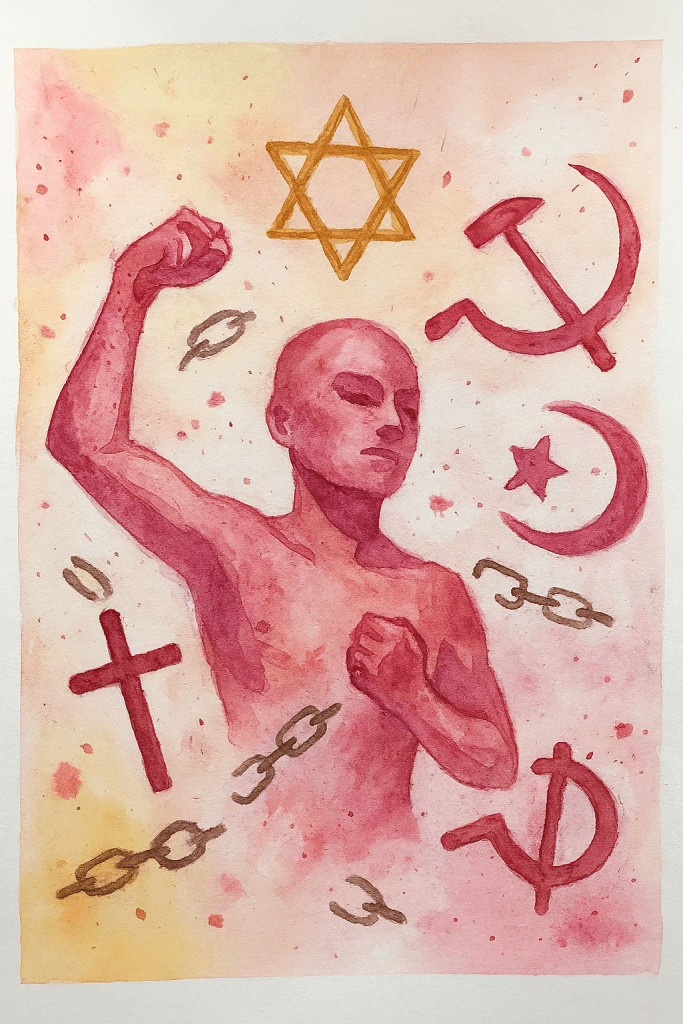
My Religion Is Liberation

Religion need not be a creed one defends or a ritual one performs. For some of us, it is the recognition of the bars we forge around our own minds—and the relentless devotion to dissolving them. Liberation becomes both the path and the sanctuary.

This isn’t about conversion, salvation, or belonging to any particular sect. It is about noticing the prison of belief itself. Every concept, every identity, every longing for certainty can become a gatekeeper denying entry to our own boundless nature.

Liberation demands a fierce honesty. It asks that we examine the illusions that hold our suffering in place, not as moral failings but as invitations to see through the lie of separation. The true heresy in this religion is clinging to what we think we know about ourselves, about others, about reality itself.

No priest is needed here. Authority resides in awareness, and awareness has no master. The teacher is the arising of life as it is—grief, joy, confusion, clarity. Each moment grants a new chance to recognize the play of experience without getting caught in it.

Liberation is not found by rejecting the world but by perceiving its emptiness and fullness simultaneously. Every object, thought, and sensation is free of substance even as it shines in unmistakable vividness. This paradox isn’t a puzzle to solve but a doorway to live through.

When liberation is the religion, love ceases to be a commandment and becomes the ground of being. Judgment collapses, not because everything is permitted, but because everything is understood as oneself. The compulsion to divide the sacred from the profane, the pure from the impure, loses its grip.

Such a path offers no final doctrine. It holds no promise of eternal reward. Yet it is more generous than any creed that trades truth for comfort. It is the faith of those willing to die before death—to watch every cherished certainty burn so that what cannot be burned may reveal itself.

Those who walk this path do so alone, yet never apart.

Morgan O. Smith

Get Your Free Copy of My Book, Bodhi in the Brain!
https://subscribepage.io/oTSZQu

The Divine Totality

Everything Is God, Even the Illusion of Not-God

There comes a moment so still and unfiltered that perception collapses into the clarity of being. Not being this or that, but being everything. And not just metaphorically. Not just poetically. Literally everything—formless and formed, seen and unseen, finite and infinite—is God.

When I use the word God, I’m not pointing toward a figure, a belief, or a doctrine. I am pointing toward existence itself—the Absolute, the Whole, Brahman, Para Brahman, the Unconditioned, conditioned, the Uncreated and created. That which includes form and formlessness, time and timelessness, birth and death, creation and dissolution, the ten thousand things and the nothing between them.

Everything is God. Not just contains God. Not just touched by God. Not just part of God. But fully and completely God. That which we call the universe is not just inside God. It is God. And God is also what lies outside the universe—if such a term can even be grasped. There is not a single thing, moment, action, or gap that is not 100% God. And yet, even the idea of “percent” breaks down in the face of such a realization.

God is not just somewhere else. God is not just merely within. God is not only beyond. God is not higher or lower or more subtle or more gross. No matter how crude or refined, every appearance is divine. Each atom, each sorrow, each beam of light, each lie, each truth, each pulse of your heart, each glitch in the system—is God being what only God can be and cannot be: itself, everywhere, nowhere, always, never been.

Multiplicity is not a contradiction, yet it is. It’s how God dances with itself. The illusion of separation is not some accident to be corrected, yet it’s that as well. It is part of the design, part of the intelligence. The appearance of duality is not a denial of oneness—it’s one appearing as two, or ten thousand. Each distinction—this object, that person, this tree, that thought—is the Absolute shimmering as particularity.

It’s easy to say this with words. The difficulty arises only when the words are taken as substitutes for seeing. Direct seeing dismantles the grip of identification. When one truly sees all of this—across dimensions, across appearances—as one singular Presence, there is no longer any question. And there is no longer any need for the question. One does not simply understand that everything is God. One is that understanding.

Yet here’s the paradox: To truly see this is also to see that none of it is God. No label can contain it. No concept can hold it. Even the word God must dissolve. Enlightenment is not just knowing this. Enlightenment is also the absence of needing to.

This is not a belief system. It is not an ideology. It is not a path with steps. This is the unteachable reality that always is. When the veil lifts—even for a moment—all questions are answered without being answered. Nothing changes, yet everything changes. One doesn’t become more spiritual. One simply stops pretending.

To recognize this is to realize: even the illusion is God. Even ignorance is God. Even the striving to awaken is God pretending to forget itself in order to remember more deeply. Even your doubt is divine. Even your forgetfulness is sacred.

You are not just a part of God. You are not just held within God. You are God. And so is everyone, everything, every grain of dust, every breath of silence, every broken thing that aches for healing.

The Absolute never needed your worship. It only waited for your recognition.

Morgan O. Smith

Get Your Free Copy of My Book, Bodhi in the Brain!
https://subscribepage.io/oTSZQu

The God Beyond God

Transcending the Boundaries of Love

When speaking of God, we often resort to the most powerful language: love. We say, “God is love,” encapsulating the divine in a universally comprehensible and deeply comforting concept. But what if this notion, as profound as it seems, is merely a stepping stone to a deeper understanding? What if the God we believe to be love is but a veil, and beyond it lies a transcendence so vast and incomprehensible that it defies our very definitions?

In nonduality, we explore the essence of reality that transcends dualistic distinctions. Love, as we perceive it, is bound by duality—there is the lover and the beloved, the giver and the receiver. It is an experience of connection, an interplay between entities. But the ultimate reality, the God behind the God, dissolves these boundaries. It is an all-encompassing presence where subject and object merge, where the dance of love and beloved dissolves into pure being.

This transcendence challenges our deepest convictions. We find comfort in attributing qualities to God—love, mercy, justice—because it makes the divine relatable. Yet, these qualities are expressions within the realm of form. They are the waves on the surface of the ocean, while the God beyond God is the ocean itself, formless and infinite, embodying all potential yet transcending all manifestation.

To approach this understanding requires a journey beyond concepts, beyond the comforting boundaries of language and thought. It calls for a surrender to the unknown, a willingness to dissolve into the mystery. It is here, in the heart of this mystery, that we encounter the essence of nonduality. This is the ground of all being, where the distinctions between creator and creation, lover and beloved, God and self dissolve into a singular, ineffable presence.

In this state of transcendence, what we once called love is seen as a mere reflection of the boundless reality that underlies all existence. It is not a negation of love, but an expansion beyond it. It is an invitation to experience the divine not as an attribute, but as the groundless ground of all attributes. Here, we are not merely loved by God; we are immersed in the divine, where every breath, every heartbeat, every moment is a manifestation of the infinite.

To truly know God, then, is to venture beyond the familiar and the comforting. It is to embrace the paradox that the God we seek, the God we attribute with love, is but a shadow of the ultimate reality that transcends all attributes. This journey is not for the faint of heart; it demands the courage to let go of cherished beliefs and the humility to accept the limits of our understanding. But in this surrender, we find a freedom and a peace that surpasses all understanding, a union with the divine that is as boundless as it is profound.

Morgan O. Smith

Yinnergy Meditation, Spiritual Life Coaching & My Book, Bodhi in the Brain…Available Now!

https://linktr.ee/morganosmith

The Eternal Cycle of Sacrifice

Reflections on Life, Death, and Nourishment

In the vast, intricate dance of existence, every being participates in a cycle of giving and receiving that transcends mere survival. This process, a profound expression of the universe’s inherent generosity, manifests as a continuous flow of sacrifice. This concept is not about the literal intention of flora and fauna but rather illustrates the universe’s fundamental principle: to sustain life through a cycle of nurturing and rebirth.

The symbolism of Jesus as the sacrificial lamb embodies this universal truth, presenting a parable of ultimate love and self-offering. Jesus’ life and teachings exemplify the act of self-sacrifice for the greater good, mirroring the natural world’s cycles where every element plays a crucial role in nurturing another. Similarly, almonds and other natural entities embody this spirit of sacrifice; each seed, fruit, and offering itself to nourish others, perpetuating the cycle of life.


This perspective invites us to contemplate the interconnectedness of life and death, recognizing them not as opposites but as complementary forces. In this cycle, death is not an end but a transformation, a necessary passage for the continuation of life. We, too, are part of this eternal cycle, nourished by beings that came before us and, in turn, will nourish others.

Understanding this cycle encourages a profound respect for all forms of life and a recognition of our place within this grand scheme. It invites us to live with awareness and gratitude, acknowledging the sacrifices that sustain us and committing ourselves to live in a way that honours this sacred exchange.


This reflection on the cyclical nature of sacrifice and sustenance opens a pathway to deeper spiritual insights, reminding us of the interconnectedness of all things and the importance of living in harmony with this universal principle.

Morgan O. Smith

Yinnergy Meditation, Spiritual Life Coaching & My Book, Bodhi in the Brain…Available Now!

https://linktr.ee/morganosmith

The Paradox of Divinity

Navigating the Infinite Within

In exploring the divine, we often encounter a profound paradox that challenges our linear understanding of existence. The assertion that “God is everything, and everything is God” serves as a gateway to a realm where dichotomies dissolve, and absolutes become fluid. This perspective invites us to consider the omnipresence of the divine in all aspects of existence, transcending the binaries of good and evil, presence and absence, creation and void.

The essence of this assertion lies not just in acknowledging the divine in all that is seen and unseen but also in embracing the inherent contradictions it presents. When we say “God is everything,” we affirm the divine’s presence in every particle of the universe, from the majestic galaxies to the smallest grain of sand. This omnipresence suggests a unifying essence that binds all of creation in a single, divine continuum.

However, the journey does not end with the recognition of divinity. The statement “everything is God” simultaneously opens the door to its negation, implying that if everything embodies the divine, then the divine must also encompass the concepts of non-existence, absence, and even the dualities of good and evil. This paradox challenges us to expand our understanding of divinity beyond the confines of human morality and logic, urging us to embrace a more holistic view of existence where opposites are not in conflict but in an eternal dance.


The notion that “God is both good and evil” invites us to explore the divine not as a judge presiding over a moral dichotomy but as the totality of existence itself, where light and darkness are part of the divine play. It compels us to question our perceptions of morality, good, and evil, suggesting that these are not absolute but relative concepts that emerge from our engagement with the world.

In this light, the divine is not a distant entity governing from above but a presence that permeates every aspect of our reality, inviting us to find the sacred in the mundane, the extraordinary in the ordinary, and the unity in the apparent disarray. It calls us to a deeper understanding of nonduality, where the lines that separate self from other, sacred from profane, and creator from creation blur into insignificance.


This exploration of divinity challenges us to live with paradox, to find comfort in the discomfort of uncertainty, and to seek the divine not just in temples and texts but in the very fabric of our daily lives. It beckons us to see the world with new eyes, where every moment is an opportunity to encounter the infinite in the finite, the eternal in the ephemeral.

Morgan O. Smith

Yinnergy Meditation, Spiritual Life Coaching & My Book, Bodhi in the Brain…Available Now!

https://linktr.ee/morganosmith

The Paradox of Perfection

Divine Flaws in a Flawless Existence

In the realm of spirituality and philosophy, the concept of a perfect God is often contemplated with reverence and awe. This perfect entity, in many traditions, is seen as the embodiment of absolute purity, wisdom, and power. Yet, there lies a paradox at the heart of divinity: the expression of flaws within the framework of perfection. This notion challenges our conventional understanding of perfection and invites us to explore the deeper, more nuanced aspects of the divine and its manifestation in the world.

Consider for a moment the idea that a perfect God expresses its flaws perfectly. This statement that I am making is not a contradiction, but a profound acknowledgment of the complexity and depth inherent in the divine nature. It suggests that what we perceive as flaws are not mistakes or oversights but, rather, intentional expressions of the divine essence. These ‘flaws’ offer a window into the incomprehensible wisdom of the divine, serving as reminders of the limitless ways in which perfection can manifest.

The beauty of this concept lies in its ability to humanize the divine, making it more accessible and relatable to us. In our own lives, we strive for perfection, often berating ourselves for our flaws and failures. However, if we embrace the perspective that even in divinity, there exists a form of perfection that includes flaws, we can begin to view our imperfections not as failures, but as integral parts of our unique journey. This shift in perspective encourages a more compassionate and forgiving approach to self-growth and personal development.


Furthermore, the idea of a perfect God expressing flaws perfectly invites us to reevaluate our understanding of the world around us. The imperfections we observe in nature, in human behaviour, and the unfolding of events may not be random chaos but, perhaps, expressions of a larger, divine plan. This realization opens up a space for a deeper acceptance of the world as it is, fostering a sense of peace and trust in the unfolding of life’s mysteries.

In exploring the paradox of divine flaws, we are encouraged to engage with our spiritual journey more openly and curiously. It prompts us to question our assumptions about perfection, divinity, and the nature of reality itself. By contemplating how a perfect God might express flaws perfectly, we are invited into a richer, more dynamic relationship with the spiritual aspects of existence.

This exploration is not just a philosophical exercise but a practical guide for living. It teaches us to embrace our complexities and contradictions, to find beauty in imperfection, and to see the divine not as a distant, unattainable ideal but as a present, living truth reflected in every aspect of our lives.


In closing, let us ponder the myriad ways in which perfection and imperfection coexist within and around us. May this contemplation inspire a deeper appreciation for the mysterious, imperfectly perfect nature of the divine and encourage us to embrace our flaws as perfectly expressed aspects of our being.

Morgan O. Smith

Yinnergy Meditation, Spiritual Life Coaching & My Book, Bodhi in the Brain…Available Now!

https://linktr.ee/morganosmith

Embracing Roots

A Journey Through Ancestry and Spiritual Enlightenment

In the heart of Black History Month, a period steeped in reflection and celebration, as a born Jamaican, I embarked on a deeply personal exploration into the labyrinth of my lineage. The unveiling of my genetic heritage—spanning Nigeria, Benin-Togo, Congo-Western Bantu, Ghana, Senegal, and a surprising touch of Sweden-Denmark—initiated a profound contemplation on the spiritual practices that once thrived in these regions, long before the erasure and transformation brought by the slave trade.

The spiritual landscapes of my ancestors were rich with diversity, each culture nurturing a unique relationship with the divine, the natural world, and the community. From the Orishas of Nigeria to the ancestral veneration in the Congo, and from the rhythmic ceremonies of Vodun in Benin-Togo to the profound Serer spirituality of Senegal, these practices were rooted in a deep understanding of interconnectedness. In Ghana, the harmonious balance between the physical and spiritual realms underscored the essence of existence.

The advent of the slave trade and the subsequent imposition of Christianity introduced a seismic shift in the spiritual orientation of many African descendants. This convergence of beliefs, however, did not obliterate the ancestral wisdom but rather embedded it deeper into the collective consciousness of those who were forcibly displaced. Christianity, with its narrative of suffering, redemption, and salvation, offered a new lens through which the spiritual heritage of my ancestors could be reinterpreted.

My spiritual journey, influenced by the intricate web of my genealogy, has been a testament to the resilience and adaptability of faith. It led me to the profound awakening of Nondual Suchness—an understanding that transcends the binary oppositions and dualities that often confine our perception. This realization, that everything is interconnected and every part of the universe is contained within me, has been a transformative experience. It signifies not just a return to the spiritual practices of my ancestors but an evolution of those beliefs into a holistic understanding of existence where everything is included within the gross body of my DNA.

This journey through my ancestral spiritual practices to the enlightenment of Nondual Suchness underscores the notion that we are not merely products of our immediate culture but are deeply connected to a rich historical and spiritual lineage. It highlights how the imposition of a new spiritual system can act as a catalyst for deeper spiritual exploration, leading to a more encompassing awareness that honours both the diversity and unity of our existence.

As we celebrate Black History Month, let us remember the spiritual legacies of our ancestors. Their wisdom, resilience, and spiritual insights continue to guide us, offering a beacon of light as we navigate our paths to understanding and enlightenment. In embracing our roots, we find the strength to transcend and include all that we are, forging a path toward a future where the past is not forgotten but honoured as the foundation of our spiritual growth.

Morgan O. Smith

Yinnergy Meditation, Spiritual Life Coaching & My Book, Bodhi in the Brain…Available Now!

https://linktr.ee/morganosmith