God Without Belief

A curious statement arises: God is an atheist. Not as denial, but as a revelation of what cannot be confined to belief. Belief requires distance; someone who believes, and something believed in. That distance dissolves at the level of the Absolute.

God, understood as the ground of all being, does not stand apart from existence. No position can be taken outside of what already is. Theism proclaims devotion toward a divine presence. Pantheism recognizes divinity within all forms. Panentheism holds both transcendence and immanence. Agnosticism suspends certainty. Atheism rejects the claim altogether. Each appears to oppose the other, yet all emerge from the same source.

A wave arguing with another wave about the existence of the ocean misses the quiet truth beneath the motion. The ocean never needs to assert itself. No defense is required. No belief is necessary. Presence alone is sufficient.

God, in this sense, cannot be a theist, because there is nothing separate to believe in. God cannot be an atheist either, in the conventional sense, because nothing exists outside of that totality to deny. Yet from the human vantage point, the Absolute appears as both belief and disbelief, devotion and rejection, clarity and doubt.

Atheism becomes one expression of the divine refusing to objectify itself. The refusal to project an external deity is not always a rejection of truth; sometimes it is an unconscious recognition that truth cannot be turned into an object at all. What is rejected is often a concept, not the living reality prior to concepts.

The ground of being remains untouched by every conclusion formed about it. Arguments unfold within it, philosophies rise and fall within it, identities shape themselves and dissolve within it. Nothing stands outside to validate or invalidate what already includes everything.

Silence reveals more than assertion here. That silence does not belong to any religion or ideology. It is the same stillness present before belief forms and after it fades.

What, then, is left?

A direct knowing without position. A presence without identity. A reality that does not require agreement to be what it is.

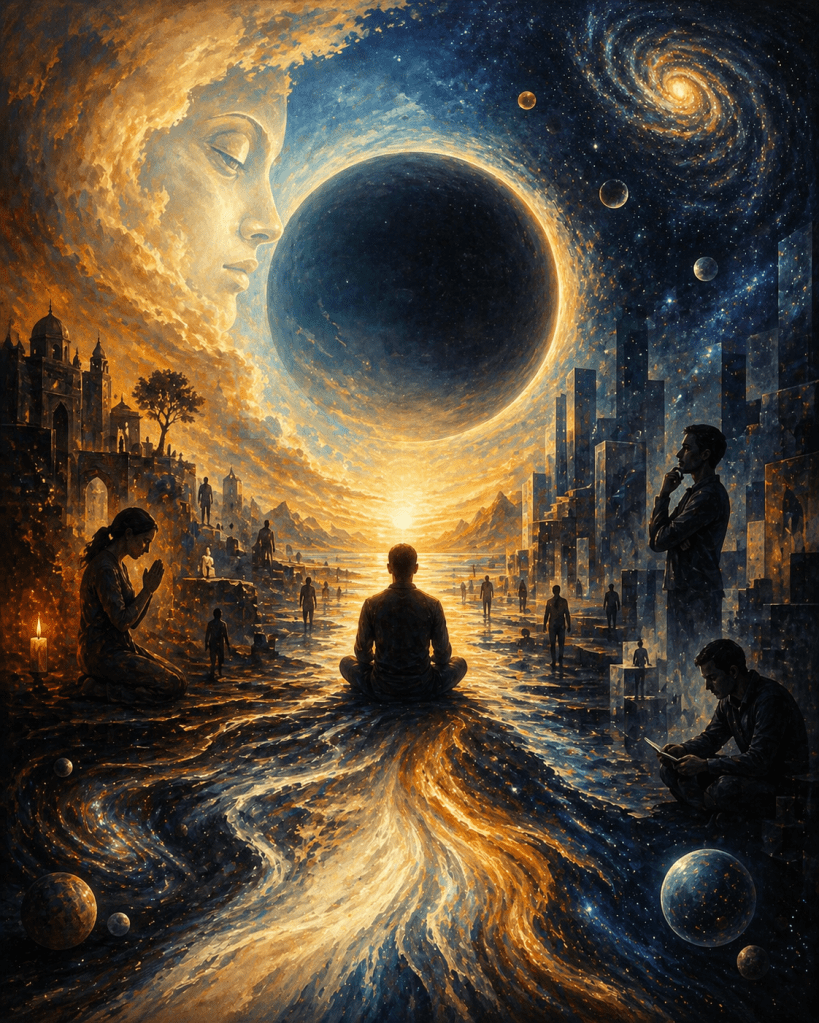
God, as the Absolute, holds space for the believer kneeling in prayer and the skeptic dismantling every claim. Both movements are gestures within the same indivisible whole. Neither completes it. Neither threatens it.

Seeing this does not demand adopting a new belief. It invites the collapse of the need to hold one at all.

And what remains cannot be called belief or disbelief; only what is, prior to both.

Morgan O. Smith
When Nothing Stands Above

How Can God Be a Higher Power When God Is Existence Itself?

Calling God a higher power quietly smuggles a ladder into reality. Someone stands below. Something stands above. Distance appears. Direction appears. Hierarchy sneaks in through language before thought has a chance to question it.

Yet if God is the only thing that exists, hierarchy collapses on contact.

A higher power implies comparison. Comparison requires at least two things. God plus something else. Creator plus creation. Observer plus observed. The moment this split is accepted, God becomes an object among objects, merely larger, stronger, or more authoritative than the rest. That version of divinity is impressive, but it is no longer ultimate.

Existence itself has no altitude.

If God is existence, then nothing stands outside it. No vantage point remains from which God could be viewed as higher or lower. The phrase higher power only makes sense from the perspective of a self that imagines itself separate, small, and contained. God appears higher because the self has first imagined itself as lower.

This is not a moral error. It is a perceptual one.

Power suggests force applied across distance. God-as-existence does not apply force. It does not act upon reality. It is reality acting as everything it appears to be. Gravity, breath, thought, confusion, devotion, resistance, clarity—all equally arise as expressions of the same indivisible field.

Nothing is empowered by God. Everything is empowered as God.

The need for a higher power often emerges from vulnerability. Humans face uncertainty, loss, fear, and finitude. A transcendent overseer offers comfort. Guidance feels safer when imagined as descending from above. Yet this comfort depends on separation. God must be elsewhere in order to rescue from here.

Nonduality removes the rescue narrative entirely.

What remains is intimacy without hierarchy. God is not watching life unfold. God is unfolding as life. No supervision. No intervention. No cosmic management style. Just continuous self-expression without a centre.

Prayer then shifts meaning. It no longer reaches upward. It settles inward, outward, everywhere at once. Not a request made to a higher authority, but a softening of resistance to what already is. Devotion becomes alignment rather than submission.

When God is understood as existence itself, the word higher loses relevance. Nothing can be higher than everything. Nothing can be closer than what is already happening.

God is not above you.

God is what is looking through your eyes, questioning the very idea of above and below.

Morgan O. Smith

Get Your Free Copy of My Book, Bodhi in the Brain!

https://subscribepage.io/oTSZQu

Giving Birth to the Sacred Within

This reflection was inspired by Maureen Catabian, one of our head facilitators at the Integral Mastery Academy. She is a nun and a Religious of the Good Shepherd in the Philippines, with 34 years of vowed life and seven years of missionary service in Burkina Faso and Senegal. Last week, she facilitated an online Advent Reflection and Centring Prayer session that offered a quietly penetrating insight into the symbolic depth of the Christian story.

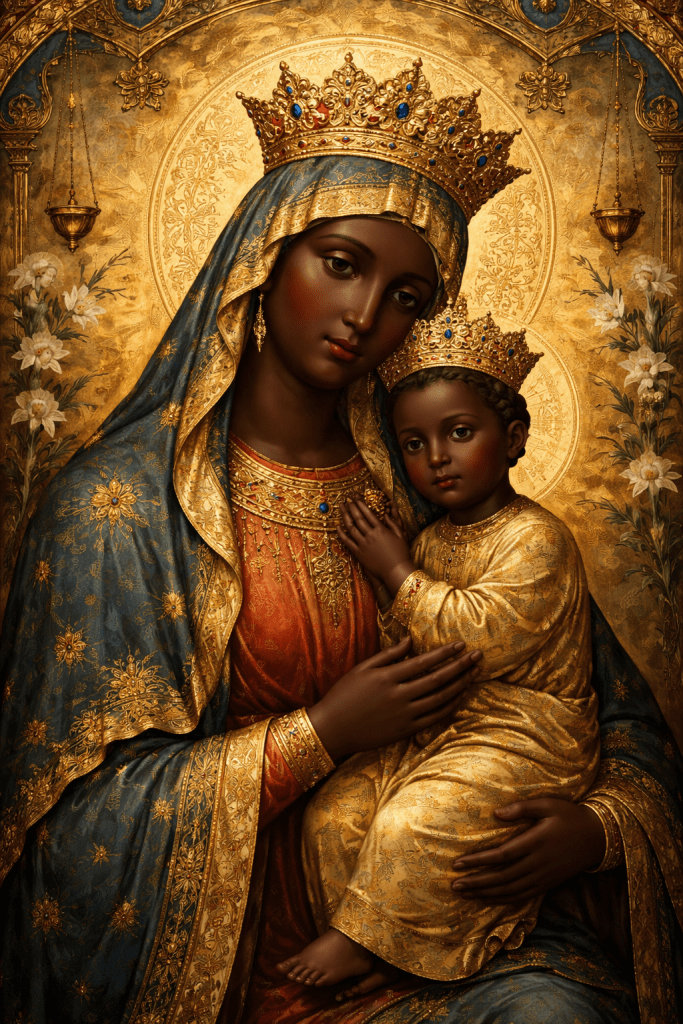
Rather than approaching Mary and Jesus solely as historical figures, she spoke to their interior meaning, the way these symbols live within the human psyche and soul. Her reflection pointed toward a radical possibility: each of us is capable of symbolically giving birth to Christ.

This is not a biological claim, nor a mythic abstraction. It points toward embodiment. To bring forth Christ means to allow our highest qualities: love, compassion, humility, courage, truth—to move from potential into expression. Christianity, at its core, is not belief alone but participation. The aim is not to admire Christ from afar, but to become more Christlike.

Mary, understood symbolically, represents a state of interior openness. Virginity here does not refer to sexuality, but to non-attachment. Untouched by compulsive grasping. Uncolonized by fear, status, or possession. Present in the world, yet not shaped by its distortions. Such a state allows something sacred to be born through us rather than merely spoken about.

Seen this way, Christ Consciousness is not exclusive to one tradition. Buddhism speaks of Buddha Nature, the innate capacity for awakening and compassion. Vedanta speaks of realization, whether framed through non-duality or devotion. Language shifts, symbols vary, yet the movement is the same: the flowering of what is most whole within us.

Love your neighbour as yourself.

This teaching becomes transformative once the meaning of “neighbour” expands. Love matures as perspective matures. Identity widens from ethnocentric to worldcentric and finally to kosmocentric. Care stretches outward until it includes not only those who resemble us, but all beings, all life, all existence.

Christ Consciousness dissolves the narrowness of “us and them.” What begins as personal devotion ripens into a universal ethic: care rooted not in obligation, but in recognition. The other is no longer other.

Spiritual maturity does not ask us to escape the world. It asks us to meet it without being possessed by it. To act, serve, speak, and love from a place no longer ruled by fear or fragmentation.

Each moment offers the same question Mary symbolically answered:
Will something greater than habit be allowed to move through you?

This is not a miracle reserved for saints. It is the quiet work of becoming transparent to love.

Happy Holidays & Merry Christmas to you all.

Morgan O. Smith

Get Your Free Copy of My Book, Bodhi in the Brain!

https://subscribepage.io/oTSZQu

When a Father Leaves This World

Something in a Son Learns to Stand Alone

Early yesterday morning my father passed away after having two strokes, a heart attack, and kidney failure. This post is dedicated to all the sons who have lost their father due to sickness, neglect, or old age. This one’s for you.

Shock has its own silence, and within that silence a son’s heart begins to unravel truths he never expected to face so soon. A man can be fully grown, seasoned by hardship and triumph, yet the moment a father leaves this world, some interior strand pulls loose. Something young within us calls out for the one whose presence once anchored our direction.

A father shapes more than memory. He shapes the subtle architecture of a son’s inner life; how he walks, how he listens, how he holds his ground, how he softens. Even when adulthood arrives, there remain chambers inside the psyche still waiting for the father’s voice, his guidance, his steady reassurance. When he passes, those chambers echo. They awaken. They ask to be met by the man we must now become.

Loss doesn’t simply remove a person; it shifts the very gravity of our existence. It brings forward unfinished pieces, unspoken blessings, unasked questions, unseen vulnerabilities. These become the new teachers. The absence of the father becomes its own curriculum, urging us toward a deeper maturity that can no longer depend on his presence.

A father’s death forces a son into a confrontation with himself: How do I continue the journey without the one who walked before me? Who do I trust with the tender questions he once held? These questions cut straight to the core, yet they also reveal an unexpected truth: our fathers prepared us more than we realized. Their lessons, their mistakes, their strength, their humanity, all of it remains as quiet guidance within us.

What they could not finish in us becomes our responsibility to finish ourselves. This is not abandonment. This is initiation. It asks us to embody the lineage, to rise with the heart they shaped, to stand as the continuation of everything they once carried.

In Loving Memory of my dad, Bishop Elpedo A. Smith

Morgan O. Smith

The Disappearing Point of God

The universe doesn’t hide God; it is God hiding as the universe. Every atom, every dimension, every flicker of awareness is the divine expressing itself through the language of matter. The cosmic dance unfolds not as a performance for an audience, but as an intimate act of self-revelation. The observer is part of the choreography, never outside of it. What we call “physical” is simply the slowed vibration of the infinite, shaped by the senses into something tangible enough to touch.

Yet, we rarely see what is truly there. Our fixation on survival, food, shelter, sex, and comfort anchors perception to the most immediate layer of existence. This fixation creates the illusion that life is something we possess rather than something that is expressing itself through us. The divine becomes abstract because our gaze remains horizontal; we look at the world rather than through it.

Letting go does not require abandoning the world; it requires seeing through it. As the grip loosens, the solidity of reality begins to shimmer. Objects, forms, identities, and even the notion of “you” dissolve into the same field from which they arose. This is not annihilation; it is revelation. The disappearance of the self reveals the only thing that has ever been: the boundless presence that calls itself “I” through all beings.

Everything you have ever loved, feared, or sought is this single reality playing hide-and-seek within itself. Each experience, no matter how fleeting or mundane, is the divine pretending to forget so it can remember again through your eyes. When the game ends, seeker and sought disappear, and what remains is neither player nor play, but the unbroken wholeness that was never apart from itself.

Morgan O. Smith

Get Your Free Copy of My Book, Bodhi in the Brain!

https://subscribepage.io/oTSZQu

Beyond Existence and Non-Existence

The Paradox of God

To say “God exists” is to affirm the ultimate. To say “God does not exist” is to deny the ultimate. Both affirmations and denials, however, are shaped by the mind’s insistence on certainty. The moment one tries to hold onto either pole, a paradox emerges.

When someone claims God exists, they project a reality beyond perception, yet they confine that reality to a category recognizable to human thought. When another claims God does not exist, they too impose a conclusion, binding the ineffable to the limits of negation. Both positions carry a strange truth and a strange error. Both dissolve the moment awareness sees through the duality of affirmation and denial.

Imagine truth as a horizon: from one angle, existence appears; from another, non-existence. Walk closer, and the horizon itself vanishes; it was never a line that could be grasped, but a function of perspective. God is not merely at the horizon but the condition through which horizon, perspective, and perceiver arise.

To say both are true is to honour that reality contains affirmation and negation. To say both are false is to point out that neither claim reaches the source. To say one is true and the other false is to remain in dualistic thought. To call them half-truths is to recognize their limitation yet still attempt to measure the immeasurable. To deny even a half-truth is to bow to silence.

The statement itself, that God exists and does not exist in all these paradoxical ways, becomes the closest gesture to truth. It is not the conclusion but the capacity to hold the contradictions without collapse that reveals God’s existence, not as a concept but as the unnamable presence behind every concept.

The paradox is not meant to be solved. It is meant to exhaust the mind until only awareness remains. What remains is not the proof of God, but the direct realization that the very effort to define or deny was always occurring within and as God.

Morgan O. Smith

Get Your Free Copy of My Book, Bodhi in the Brain!

https://subscribepage.io/oTSZQu

My Religion Is Liberation

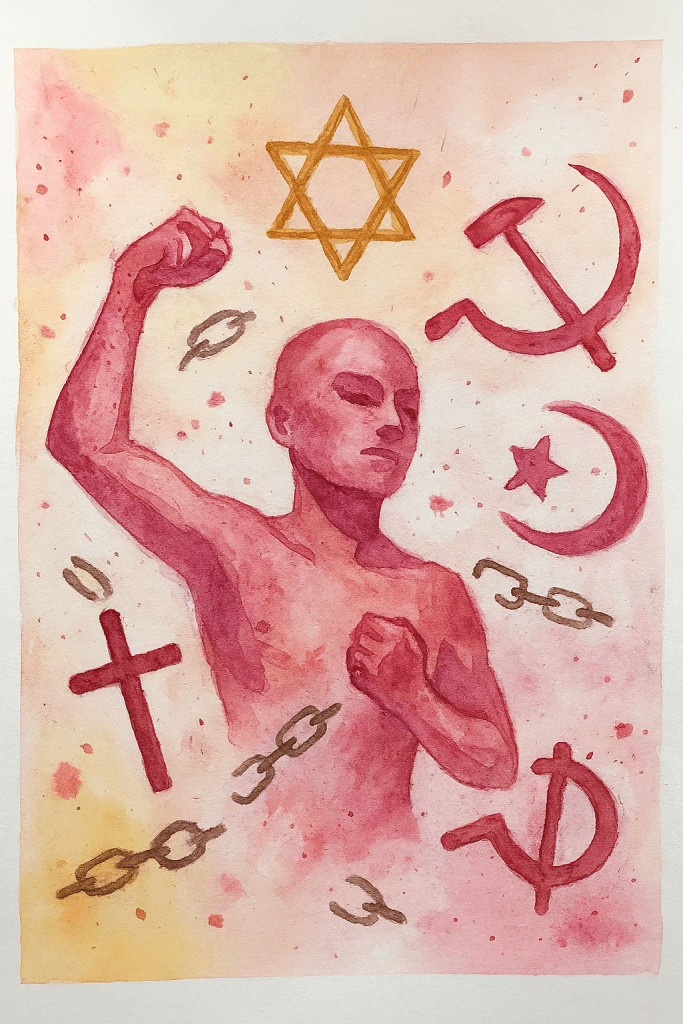
Religion need not be a creed one defends or a ritual one performs. For some of us, it is the recognition of the bars we forge around our own minds—and the relentless devotion to dissolving them. Liberation becomes both the path and the sanctuary.

This isn’t about conversion, salvation, or belonging to any particular sect. It is about noticing the prison of belief itself. Every concept, every identity, every longing for certainty can become a gatekeeper denying entry to our own boundless nature.

Liberation demands a fierce honesty. It asks that we examine the illusions that hold our suffering in place, not as moral failings but as invitations to see through the lie of separation. The true heresy in this religion is clinging to what we think we know about ourselves, about others, about reality itself.

No priest is needed here. Authority resides in awareness, and awareness has no master. The teacher is the arising of life as it is—grief, joy, confusion, clarity. Each moment grants a new chance to recognize the play of experience without getting caught in it.

Liberation is not found by rejecting the world but by perceiving its emptiness and fullness simultaneously. Every object, thought, and sensation is free of substance even as it shines in unmistakable vividness. This paradox isn’t a puzzle to solve but a doorway to live through.

When liberation is the religion, love ceases to be a commandment and becomes the ground of being. Judgment collapses, not because everything is permitted, but because everything is understood as oneself. The compulsion to divide the sacred from the profane, the pure from the impure, loses its grip.

Such a path offers no final doctrine. It holds no promise of eternal reward. Yet it is more generous than any creed that trades truth for comfort. It is the faith of those willing to die before death—to watch every cherished certainty burn so that what cannot be burned may reveal itself.

Those who walk this path do so alone, yet never apart.

Morgan O. Smith

Get Your Free Copy of My Book, Bodhi in the Brain!

https://subscribepage.io/oTSZQu

The Divine Totality

Everything Is God, Even the Illusion of Not-God

There comes a moment so still and unfiltered that perception collapses into the clarity of being. Not being this or that, but being everything. And not just metaphorically. Not just poetically. Literally everything—formless and formed, seen and unseen, finite and infinite—is God.

When I use the word God, I’m not pointing toward a figure, a belief, or a doctrine. I am pointing toward existence itself—the Absolute, the Whole, Brahman, Para Brahman, the Unconditioned, conditioned, the Uncreated and created. That which includes form and formlessness, time and timelessness, birth and death, creation and dissolution, the ten thousand things and the nothing between them.

Everything is God. Not just contains God. Not just touched by God. Not just part of God. But fully and completely God. That which we call the universe is not just inside God. It is God. And God is also what lies outside the universe—if such a term can even be grasped. There is not a single thing, moment, action, or gap that is not 100% God. And yet, even the idea of “percent” breaks down in the face of such a realization.

God is not just somewhere else. God is not just merely within. God is not only beyond. God is not higher or lower or more subtle or more gross. No matter how crude or refined, every appearance is divine. Each atom, each sorrow, each beam of light, each lie, each truth, each pulse of your heart, each glitch in the system—is God being what only God can be and cannot be: itself, everywhere, nowhere, always, never been.

Multiplicity is not a contradiction, yet it is. It’s how God dances with itself. The illusion of separation is not some accident to be corrected, yet it’s that as well. It is part of the design, part of the intelligence. The appearance of duality is not a denial of oneness—it’s one appearing as two, or ten thousand. Each distinction—this object, that person, this tree, that thought—is the Absolute shimmering as particularity.

It’s easy to say this with words. The difficulty arises only when the words are taken as substitutes for seeing. Direct seeing dismantles the grip of identification. When one truly sees all of this—across dimensions, across appearances—as one singular Presence, there is no longer any question. And there is no longer any need for the question. One does not simply understand that everything is God. One is that understanding.

Yet here’s the paradox: To truly see this is also to see that none of it is God. No label can contain it. No concept can hold it. Even the word God must dissolve. Enlightenment is not just knowing this. Enlightenment is also the absence of needing to.

This is not a belief system. It is not an ideology. It is not a path with steps. This is the unteachable reality that always is. When the veil lifts—even for a moment—all questions are answered without being answered. Nothing changes, yet everything changes. One doesn’t become more spiritual. One simply stops pretending.

To recognize this is to realize: even the illusion is God. Even ignorance is God. Even the striving to awaken is God pretending to forget itself in order to remember more deeply. Even your doubt is divine. Even your forgetfulness is sacred.

You are not just a part of God. You are not just held within God. You are God. And so is everyone, everything, every grain of dust, every breath of silence, every broken thing that aches for healing.

The Absolute never needed your worship. It only waited for your recognition.

Morgan O. Smith

Get Your Free Copy of My Book, Bodhi in the Brain!

https://subscribepage.io/oTSZQu

The God Beyond God

Transcending the Boundaries of Love

When speaking of God, we often resort to the most powerful language: love. We say, “God is love,” encapsulating the divine in a universally comprehensible and deeply comforting concept. But what if this notion, as profound as it seems, is merely a stepping stone to a deeper understanding? What if the God we believe to be love is but a veil, and beyond it lies a transcendence so vast and incomprehensible that it defies our very definitions?

In nonduality, we explore the essence of reality that transcends dualistic distinctions. Love, as we perceive it, is bound by duality—there is the lover and the beloved, the giver and the receiver. It is an experience of connection, an interplay between entities. But the ultimate reality, the God behind the God, dissolves these boundaries. It is an all-encompassing presence where subject and object merge, where the dance of love and beloved dissolves into pure being.

This transcendence challenges our deepest convictions. We find comfort in attributing qualities to God—love, mercy, justice—because it makes the divine relatable. Yet, these qualities are expressions within the realm of form. They are the waves on the surface of the ocean, while the God beyond God is the ocean itself, formless and infinite, embodying all potential yet transcending all manifestation.

To approach this understanding requires a journey beyond concepts, beyond the comforting boundaries of language and thought. It calls for a surrender to the unknown, a willingness to dissolve into the mystery. It is here, in the heart of this mystery, that we encounter the essence of nonduality. This is the ground of all being, where the distinctions between creator and creation, lover and beloved, God and self dissolve into a singular, ineffable presence.

In this state of transcendence, what we once called love is seen as a mere reflection of the boundless reality that underlies all existence. It is not a negation of love, but an expansion beyond it. It is an invitation to experience the divine not as an attribute, but as the groundless ground of all attributes. Here, we are not merely loved by God; we are immersed in the divine, where every breath, every heartbeat, every moment is a manifestation of the infinite.

To truly know God, then, is to venture beyond the familiar and the comforting. It is to embrace the paradox that the God we seek, the God we attribute with love, is but a shadow of the ultimate reality that transcends all attributes. This journey is not for the faint of heart; it demands the courage to let go of cherished beliefs and the humility to accept the limits of our understanding. But in this surrender, we find a freedom and a peace that surpasses all understanding, a union with the divine that is as boundless as it is profound.

Morgan O. Smith

Yinnergy Meditation, Spiritual Life Coaching & My Book, Bodhi in the Brain…Available Now!

https://linktr.ee/morganosmith

The Eternal Cycle of Sacrifice

Reflections on Life, Death, and Nourishment

In the vast, intricate dance of existence, every being participates in a cycle of giving and receiving that transcends mere survival. This process, a profound expression of the universe’s inherent generosity, manifests as a continuous flow of sacrifice. This concept is not about the literal intention of flora and fauna but rather illustrates the universe’s fundamental principle: to sustain life through a cycle of nurturing and rebirth.

The symbolism of Jesus as the sacrificial lamb embodies this universal truth, presenting a parable of ultimate love and self-offering. Jesus’ life and teachings exemplify the act of self-sacrifice for the greater good, mirroring the natural world’s cycles where every element plays a crucial role in nurturing another. Similarly, almonds and other natural entities embody this spirit of sacrifice; each seed, fruit, and offering itself to nourish others, perpetuating the cycle of life.


This perspective invites us to contemplate the interconnectedness of life and death, recognizing them not as opposites but as complementary forces. In this cycle, death is not an end but a transformation, a necessary passage for the continuation of life. We, too, are part of this eternal cycle, nourished by beings that came before us and, in turn, will nourish others.

Understanding this cycle encourages a profound respect for all forms of life and a recognition of our place within this grand scheme. It invites us to live with awareness and gratitude, acknowledging the sacrifices that sustain us and committing ourselves to live in a way that honours this sacred exchange.


This reflection on the cyclical nature of sacrifice and sustenance opens a pathway to deeper spiritual insights, reminding us of the interconnectedness of all things and the importance of living in harmony with this universal principle.

Morgan O. Smith

Yinnergy Meditation, Spiritual Life Coaching & My Book, Bodhi in the Brain…Available Now!

https://linktr.ee/morganosmith