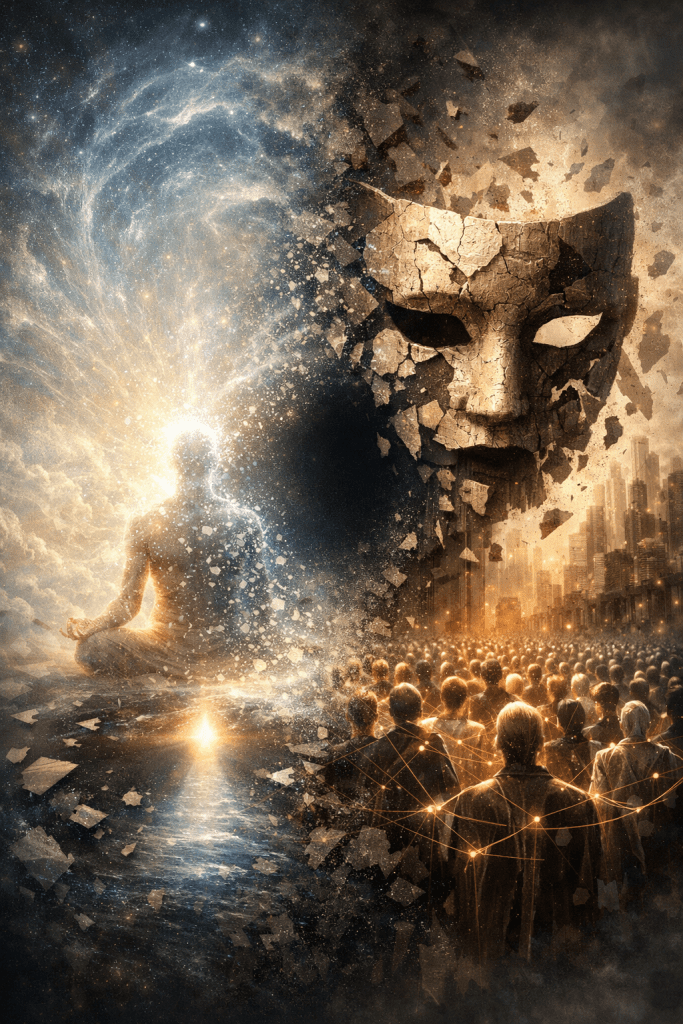
When individuality dissolves—and when the collective mask collapses
Ego death has become familiar language within spiritual circles. It often refers to the collapse of the personal story; the felt sense of “me” as a separate centre of control, identity, and continuity. Thoughts still arise, sensations still move, yet the claim of ownership quietly disappears. Experience continues without a narrator insisting it belongs to someone.
This event can feel absolute. Many report vastness, silence, love without an object, or a direct recognition of being awareness itself. The personal mask falls away, and with it the emotional gravity of self-protection, shame, pride, and comparison. Life continues, yet it is no longer filtered through the need to defend or improve a fictional self.
Still, something subtle often remains.
Beneath the personal ego sits another structure, far less discussed and far more persistent: the super-ego of the collective. This is not merely morality or social conditioning. It is the internalized voice of humanity itself; the inherited myths, hierarchies, spiritual ideals, political narratives, and cultural agreements that define what counts as real, good, awakened, successful, or worthy.
Ego death removes the personal actor. Super-ego death removes the stage.
Super-ego death is not about becoming rebellious or rejecting society. It is the dissolution of the unseen authority that claims reality must conform to shared agreements. This includes spiritual identities just as much as material ones. The enlightened persona, the wise teacher, the healed one, the awakened exemplar, all of these belong to the collective ego, even when the personal ego has already fallen.
This is why some awakenings still feel constrained. Freedom is tasted, yet behavior unconsciously bends to invisible rules. One no longer needs approval as an individual, yet still seeks legitimacy through lineage, doctrine, community, or role. Silence is known, yet language is chosen carefully to avoid exile from the group.
Super-ego death arrives when even the collective lens loses its authority.
No tradition holds the final word. No framework owns truth. No spiritual map is mistaken for the territory it points toward. Morality is no longer outsourced to consensus. Meaning no longer depends on agreement. What remains is not isolation, but radical intimacy; life meeting itself without mediation.
This does not produce chaos. It produces clarity.
Action becomes responsive rather than obedient. Compassion arises without ideology. Ethics emerge organically, shaped by direct contact rather than inherited commandments. One may still participate in society, teach, lead, love, and create, but without the invisible pressure to represent anything.
Personal ego death says, “I am not who I thought I was.”
Super-ego death says, “Reality is not what we collectively agreed it must be.”
Very few speak from this territory because it offers no badge. Nothing can be claimed. No position can be stabilized. Language points, then dissolves. Authority evaporates.
What remains cannot be organized, branded, or defended.
Life continues, unowned, unruled, uncontained, expressing itself freely, without asking permission from the individual or the crowd.
Morgan O. Smith
Get Your Free Copy of My Book, Bodhi in the Brain!
 Morgan O. Smith