The Spectrum Theory of Spiritual Enlightenment

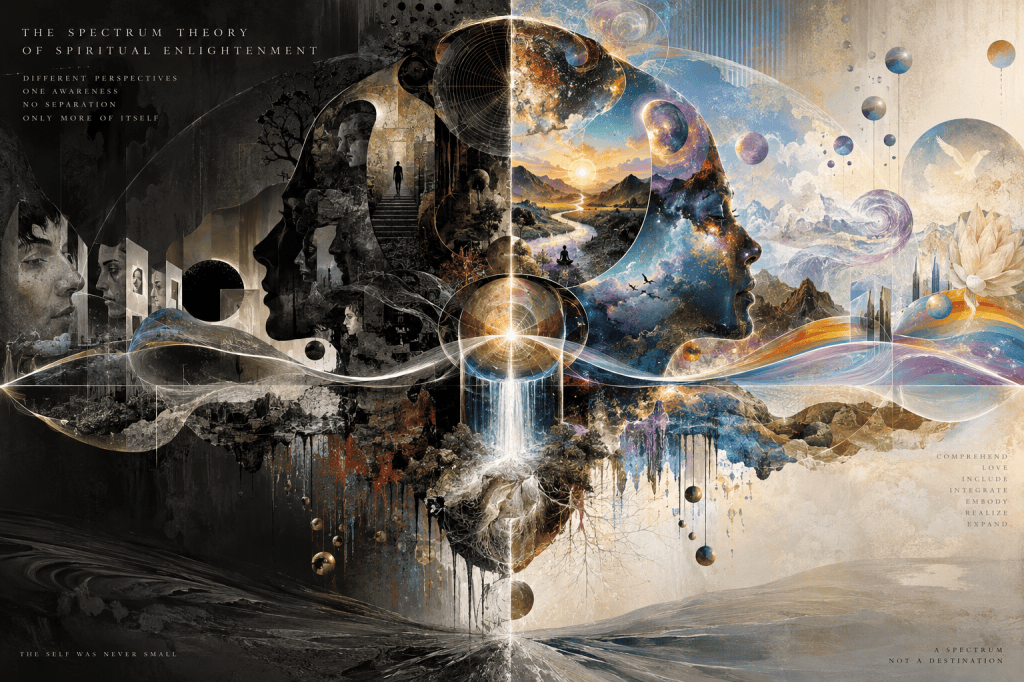
Spiritual enlightenment may be better understood as a spectrum.

This challenges one of the oldest assumptions surrounding enlightenment: that someone either has it or does not.

Enlightened. Unenlightened.

Awake. Asleep.

Self-realized. Ignorant.

Such divisions may be useful when describing a radical shift in consciousness, but they become inadequate when we begin examining the enormous differences between people who have undergone profound spiritual realization.

Two individuals may both recognize the nondual nature of reality and still differ tremendously in their capacity for love, emotional integration, intellectual complexity, perspective-taking, creativity, compassion, self-awareness and their ability to function within the complexity of human life.

This suggests something important.

Realization may happen, while enlightenment continues to unfold.

Enlightenment Is Not Simply What You Experience

Mystical experience alone cannot adequately define enlightenment.

A person may experience ego dissolution, timelessness, boundlessness, unity, emptiness or the disappearance of the subject-object boundary. These experiences can radically alter one’s understanding of reality.

Yet experience eventually encounters interpretation.

The human organism must somehow understand what occurred.

A Christian mystic may interpret unity through Christ. An Advaita practitioner may interpret it through Brahman. A Buddhist may describe emptiness. A neuroscientist may speak about changes within the brain’s construction of selfhood.

The experience may contain striking similarities while the interpretation reflects the developmental capacity of the person experiencing it.

This raises a provocative possibility:

What if enlightenment is not measured solely by how deeply you can disappear, but also by how much reality you can contain when you return?

The Capacity to Hold More

Perhaps spiritual development can partly be understood as increasing capacity.

The more you can comprehend.

The more you can love.

The more perspectives you can hold simultaneously.

The more contradiction you can tolerate without immediately forcing reality into either-or categories.

The more emotional intensity you can experience without becoming completely possessed by it.

The more uncertainty you can encounter without manufacturing certainty simply to make yourself comfortable.

The more of yourself you can observe without defending an identity.

The more of another person you can understand without requiring them to resemble you.

Something begins expanding.

Not necessarily the Self, because from the nondual perspective the Self was never small.

What expands is the human capacity to consciously express what has always been unlimited.

Depth and Breadth Are Different

Someone can go extraordinarily deep while remaining relatively narrow.

This distinction deserves attention.

A profound meditator might enter states of consciousness inaccessible to most people while still possessing rigid cultural assumptions.

A brilliant philosopher might understand dozens of perspectives intellectually while remaining emotionally defended.

A deeply compassionate person may possess extraordinary interpersonal wisdom without having experienced nondual realization.

A mystic may recognize the Absolute while still carrying unresolved psychological conditioning.

These are different dimensions of development.

Calling all of them simply “spiritual advancement” obscures what is actually happening.

A more complete model of enlightenment would therefore require several dimensions.

Depth concerns how completely consciousness penetrates the apparent separation between observer and observed.

Breadth concerns how many perspectives, systems, cultures, disciplines and modes of knowing can be included within one’s understanding.

Integration concerns how thoroughly unconscious, emotional and psychological material becomes incorporated rather than denied, projected or spiritually bypassed.

Embodiment concerns whether realization actually changes how someone lives, relates, creates, responds and participates in the world.

We could express the basic model as:

Enlightenment = Depth × Breadth × Integration × Embodiment

This is not intended as a literal mathematical equation. It is a conceptual instrument.

Its purpose is to prevent one extraordinary dimension from being mistaken for the whole.

Absolute Realization, Relative Development

Here lies an apparent paradox.

The Absolute does not develop.

If nonduality is ultimately true, then there cannot be more or less of the Absolute. There cannot be 40 percent Brahman, 72 percent emptiness or 95 percent pure awareness.

What is fundamental simply is.

Yet the organism through which realization expresses itself certainly develops.

The nervous system develops.

Language develops.

Emotional intelligence develops.

Perspective-taking develops.

Ethical sensitivity develops.

Creativity develops.

Conceptual sophistication develops.

The ability to tolerate complexity develops.

This means absolute realization and relative development should not be confused.

Someone may recognize what is timeless while still being a very particular human being shaped by history, biology, culture, trauma, education and psychological conditioning.

Enlightenment does not necessarily erase the relative human structure.

It changes the relationship to it.

The Number of Perspectives You Can Become

Perspective-taking may be one of the most overlooked dimensions of spiritual maturity.

Early consciousness tends to experience its own perspective as reality itself.

“This is what happened.”

“This is what God wants.”

“This is who I am.”

“This is who you are.”

Greater awareness begins noticing something strange.

Every perspective reveals something while simultaneously concealing something.

Move positions and reality changes.

The child sees one world.

The parent sees another.

The scientist sees another.

The artist sees another.

The mystic sees another.

The atheist sees another.

The person who hurt you sees another.

None necessarily possesses the complete picture.

Spiritual maturity may therefore involve becoming increasingly capable of moving between perspectives without being imprisoned by any of them.

Eventually something even stranger becomes apparent.

The perspectives themselves are occurring within awareness.

Then the question changes from:

Which perspective is ultimately correct?

to:

What is it that can become all of these perspectives without being limited to any of them?

That question points directly toward nonduality.

Love as Expanded Identity

Love also changes when viewed through this model.

Love is usually understood emotionally. We love certain people because they matter to us.

Nondual realization introduces another possibility.

What happens when the boundary defining “me” becomes less convincing?

Compassion may no longer arise merely because one has been instructed to care about others.

Another person’s suffering begins to matter because “other” has become philosophically and experientially unstable.

Their consciousness is no longer entirely foreign territory.

The expansion of love may therefore correspond with an expansion of identity.

First, myself.

Then my family.

My community.

My people.

Humanity.

Sentient life.

Life itself.

Existence.

Eventually the circle collapses because there is nowhere outside it.

Love becomes less about extending kindness from one separate being toward another and more about reality recognizing itself through apparent difference.

Enlightenment Does Not Make You Finished

Perhaps one of the most dangerous ideas surrounding enlightenment is the belief that awakening makes further development unnecessary.

That belief can transform realization into another identity.

“I am enlightened.”

Now the ego possesses the absence of ego.

A remarkably clever maneuver.

Genuine realization may actually make development more demanding because fewer psychological hiding places remain convincing.

There can still be conditioning to examine.

Relationships to repair.

Knowledge to acquire.

Blind spots to discover.

Emotional capacities to strengthen.

Perspectives to encounter.

Humanity to embody.

Awakening does not necessarily end development.

It may remove the central illusion around which development previously revolved.

A Spectrum Without a Final Number

The spectrum model should not become another spiritual ranking system.

Its purpose is not to assign enlightenment scores.

The moment we begin arguing that one person is “Level 8 enlightened” while another is “Level 5,” we risk rebuilding hierarchy around something that fundamentally undermines the separate self seeking status.

The spectrum is multidimensional.

Someone may possess extraordinary contemplative depth but limited psychological integration.

Another person may demonstrate remarkable compassion and embodiment while having little interest in metaphysics.

Another may possess tremendous intellectual breadth but little experiential realization.

Development can be uneven.

That unevenness is precisely why a spectrum model becomes useful.

It allows us to stop pretending that enlightenment must produce identical human beings.

The Strange Conclusion

The deepest realization may reveal that nothing needs to become enlightened.

What you fundamentally are was never trapped.

Awareness itself was never confused.

The Absolute never forgot itself.

The person was the apparent location through which forgetting and remembering occurred.

Yet something continues after that recognition.

The human expression can become wider.

More integrated.

More sensitive.

More capable of holding contradiction.

More capable of intimacy.

More capable of uncertainty.

More capable of seeing through its own assumptions.

More capable of allowing perspectives that once threatened its identity.

More capable of loving without possession.

Perhaps enlightenment contains two movements that appear contradictory only when confused with one another.

One movement reveals that there is nowhere to go.

The other reveals that development has no obvious endpoint.

The Absolute is complete.

Its expression through a human life is not.

This may be one of the great paradoxes of spiritual enlightenment:

You can realize that you are already everything while continuing to discover how much more of everything you are capable of consciously containing.

Morgan O. Smith
https://linktr.ee/morganosmith

The Courage of Radical Openness

Seeing others as thyself is not a moral instruction. It is a perceptual shift. A reorientation of how reality is registered once the reflex to divide dissolves.

Eyes wide open does not mean naïve seeing. It means perception unclouded by projection. Faces are no longer screens for personal history, unmet needs, or inherited narratives. Another person appears as they are—complex, conditioned, luminous, conflicted—without being reduced to a role. Judgment loosens because clarity replaces assumption. Seeing becomes intimate without being invasive.

A heart wide open does not imply emotional excess or boundarylessness. It signals availability. The willingness to feel without selecting which feelings are permitted. Joy is allowed. Discomfort is allowed. Grief is allowed. Compassion emerges not as effort, but as resonance. Another’s pain is not absorbed as obligation, nor deflected as inconvenience. It is simply felt as part of the shared field of experience.

A mind wide open is not the absence of thought. It is freedom from fixation. Opinions lose their rigidity. Certainty softens. The need to be right gives way to the capacity to understand. This openness does not erase discernment; it refines it. Differences remain visible, but no longer threaten identity. Perspective becomes spacious enough to hold contradiction without collapse.

Seeing others as thyself does not blur individuality. It reveals its true context. Distinct lives, distinct stories, distinct expressions, arising within the same indivisible reality. Separation persists as appearance, not as truth. What dissolves is the belief that the boundary is absolute.

This way of seeing cannot be forced. Ethics alone cannot produce it. It unfolds naturally as identification loosens its grip on a singular point of view. The centre quietly falls away. What remains is not detachment, but intimacy without possession.

From this recognition, action changes. Speech becomes more careful, not from fear, but from sensitivity. Listening deepens because there is no urgency to defend a position. Even conflict transforms. Disagreement no longer requires dehumanization. Accountability no longer requires condemnation.

Seeing others as thyself is not about becoming better. It is about becoming honest. Honest about what has always been the case beneath habit and conditioning. No hierarchy of worth. No isolated self standing apart from the whole. Only different expressions of the same life, meeting itself again and again, through countless faces.

Morgan O. Smith

Get Your Free Copy of My Book, Bodhi in the Brain!

https://subscribepage.io/oTSZQu

When Empathy Crosses the Threshold of Self

Empathy is often described as understanding another’s feelings, yet this description barely scratches the surface of its deepest expression. At its highest register, empathy ceases to be an act of imagination and becomes an act of participation. Something more radical occurs; identity loosens, boundaries soften, and awareness enters a living intimacy with another mode of being.

Such empathy does not merely observe suffering or joy from a distance. Consciousness steps into the interior rhythm of another life and begins to feel from within. Breath, sensation, and perception reorganize themselves. Experience no longer revolves around a private centre. A wider gravity takes hold.

Kosmocentric awareness emerges at this threshold. Attention no longer privileges the personal narrative or even the collective identity of a group. Life is sensed as a single field expressing itself through countless forms. Compassion, here, is not chosen. It flows naturally, the way heat radiates from fire.

To walk in the shoes of a bodhisattva is not to adopt a moral stance or imitate a spiritual role. It is to feel what it means to be animated by responsibility without burden. The heart expands beyond emotional warmth into something rhythmic and vast, beating not for one life, but for life itself. Suffering is felt directly, yet it does not collapse the system. The capacity to hold pain grows alongside the capacity to love.

Such an experience dissolves the familiar distinction between self and other. Helping another no longer feels like altruism. It feels like circulation; energy moving where it is needed, without hesitation or self-congratulation. Action arises spontaneously, guided by clarity rather than obligation.

This level of empathy cannot be sustained through effort alone. It arises when identification with the separate self loosens enough for consciousness to re-centre itself within the whole. What remains is not detachment, but intimacy without possession. Care without agenda. Presence without contraction.

Moments like these recalibrate what it means to be human. After tasting kosmocentric empathy, ordinary indifference becomes impossible to justify. Even when the experience fades, something irreversible has occurred. A deeper reference point has been established.

Empathy, at its summit, reveals itself not as an emotional skill, but as a shift in being. Life recognizes itself through you, and the heart learns a larger rhythm; one that beats for all beings, without exception.

Morgan O. Smith

Get Your Free Copy of My Book, Bodhi in the Brain!

https://subscribepage.io/oTSZQu

How Far the Heart Can Truly Open

A curious shift occurs when the heart stops functioning as a possession and begins revealing itself as a dimension of awareness. Most people imagine love as something they generate, something that must be earned, strengthened, or directed. Yet once the inner walls begin dissolving, the heart behaves less like a reservoir and more like an unbounded field. Nothing needs to be pushed outward. Nothing needs to be pulled inward. Everything already rests inside the same luminous space.

A bodhisattva’s vow is often misunderstood as a heroic effort to love every being across the cosmos. That interpretation still assumes a separate self stretching itself toward infinity. What actually unfolds is far more intimate. The boundaries that define self and other begin to thin. Compassion arises not from moral intention but from direct recognition: every form is a variation of the same presence gazing through different eyes. Love becomes less a decision and more a consequence of clarity.

A Kosmocentric heart does not expand by accumulating greater quantities of affection. Its expansion is a subtraction—less resistance, less defense, less contraction around identity. As the edges dissolve, the universe is no longer something “out there” that requires love. It is revealed as the very body of consciousness, expressing itself through countless lifetimes, worlds, and histories. To love all beings then becomes effortless, because nothing stands outside the recognition of shared essence.

This realization reshapes the ordinary meaning of devotion. Love ceases to be a feeling sustained by conditions. It becomes the ground from which every moment rises. The heart does not tire. The heart does not question whether it is capable. The heart simply returns to its natural state: vast, quiet, and uncontainable.

A question often arises: “Can a human being truly love the entire universe?”
Yes, but not as a human being. Only when the self drops away does the heart reveal its true scale. What remains is a presence spacious enough to cradle galaxies, tender enough to feel the slightest tremor of suffering, and awake enough to recognize itself in every corner of existence.

This is the heart unbound.
This is compassion without walls.
This is the love the universe has always known through you.

Morgan O. Smith

Get Your Free Copy of My Book, Bodhi in the Brain!

https://subscribepage.io/oTSZQu

When Consciousness Expands

One who rises in consciousness carries the whole world with them

True elevation has never been a private ascent. A mind that opens beyond its own fears begins to sense an older responsibility; not imposed, not moralistic, but inherent. Awareness expands, and with it comes the realization that no being exists in isolation. Every shift in clarity touches the field that holds all life.

A seeker who matures into fuller presence discovers that service is not an action added after awakening; service is awakening. When identity loosens, compassion flows without effort. When the self-image dissolves, the boundaries that once separated “me” from “them” weaken. The inner horizon stretches, and the heart recognizes itself mirrored in every face, every struggle, every aspiration.

Elevated consciousness is not an escape from difficulty. It is the courage to feel the world deeply without drowning in it. It is the capacity to meet suffering without turning away, to meet conflict without reacting, to meet diversity without fear. A person who stands at this level carries a certain luminosity; not the glow of superiority, but the warmth of someone who remembers what others have forgotten.

Such a being does not preach. They embody. They do not force change. They invite it. Their presence rearranges the space around them, not through domination but through coherence. The clarity they embody becomes an anchor for those lost in fragmentation. The steadiness they hold becomes a doorway for others to walk through.

A world marked by anxiety and division does not only need more information or better ideas. It needs individuals who have refined their inner instrument so that perception becomes precise, actions become clean, and motives become transparent. It needs humans who can hold the collective weight without collapsing under it.

Rising to the highest level of consciousness is not a privilege; it is a calling that echoes through every moment of our lives. When answered, the transformation does not belong to the individual alone. It radiates outward, touching all who cross their path, offering a quiet reminder that liberation is not solitary; it is shared.

Morgan O. Smith

Get Your Free Copy of My Book, Bodhi in the Brain!

https://subscribepage.io/oTSZQu

The Universe That Feels Through You

There comes a point when empathy stops being an act of kindness and becomes an act of dissolution. The boundary between self and other thins until there is no longer a perceiver and the perceived; only the raw pulse of existence moving through awareness. You feel the heartbeat of the world, the tremor of lives being lived and lost, the silent cries buried beneath laughter. Every creature’s journey becomes a vibration within your own being.

Such sensitivity is not sentimental; it is cosmic. The pain of a dying star, the joy of a newborn, the sigh of the ocean, the grief of forgotten forests, all converge as one continuous frequency. The nervous system becomes an instrument tuned to the song of creation itself. To feel so deeply is to recognize that the universe is not something to be observed but something that experiences itself through you.

Empathy at its summit is not selective; it refuses to exclude. It does not choose whom to comfort or what to love. It becomes the direct experience of love itself, the same force that shapes galaxies and heals wounds. When consciousness reaches this depth, it does not seek to escape suffering; it becomes the stillness that holds it. Every tear becomes sacred, every breath a ceremony of remembrance that nothing has ever been apart.

The universe keeps giving birth to itself through this endless exchange of feeling, through the collapse of distance between the experiencer and the experienced. You are that birth, the awakening point where infinity remembers its own heart.

Morgan O. Smith

Get Your Free Copy of My Book, Bodhi in the Brain!

https://subscribepage.io/oTSZQu

The Silent Agreement Beneath All Voices

Every conviction, no matter how radical or righteous, is an echo of the same unspoken longing to be understood, to belong, to find meaning amid the vastness. Each culture, religion, and ideology carves its own path toward that longing, often believing itself to be the only way. Yet beneath the words, beneath the gestures of defence or devotion, there hums a single vibration that does not divide.

Those who dare to listen beyond preference hear it clearly. The louder the debate, the clearer it becomes that all sides are pleading for the same recognition of their humanity. The fundamental call is not for dominance but for understanding; to be seen through the eyes of unity rather than difference.

Beliefs are useful until they are mistaken for truth. When held too tightly, they become walls. When held lightly, they become windows through which consciousness observes itself from a thousand angles. The awakened mind learns not to choose sides but to perceive the underlying harmony that holds both sides together.

True wisdom is not born from agreement but from capacity; the capacity to listen without fear, to allow contradiction to breathe, to see that diversity of expression is the universe conversing with itself. Every person, every nation, speaks a dialect of the same cosmic language. The argument is never between right and wrong but between two reflections of the same light, each insisting that its brightness is original.

When this is seen, opposition dissolves. The wars of ideology lose their fuel. You begin to recognize that all are reaching toward the same ineffable truth, merely using different words to describe it. What remains is not a conclusion but a profound peace; the peace of seeing through the illusion of difference.

Morgan O. Smith

Get Your Free Copy of My Book, Bodhi in the Brain!

https://subscribepage.io/oTSZQu

Universal Love

The Ever-Expanding Heart

Love that requires no condition, no reflection, no return; this is the highest state of consciousness. Universal Love is not sentimental or selective. It does not operate within the confines of personality, preference, or perception. It sees through every distinction and recognizes only itself.

This is love as total awareness. It loves because there is nothing else to do. It gives without the idea of giving. It embraces without needing to hold. It penetrates every boundary of selfhood and dissolves all opposites into a seamless field of being. Even the idea of “others” fades when this love awakens, for the one who loves and the one who is loved are found to be the same.

Such love is not weak; it is fearless. It does not protect itself because it knows it cannot be harmed. It sacrifices willingly because it understands there is no loss in unity. Every act, every gesture, every breath becomes an expression of this boundless compassion that celebrates existence as itself.

Universal Love is not attained through effort. It is remembered through surrender. The heart expands until it no longer has edges. What remains is a radiant stillness that loves without reason, without measure, and without end.

Morgan O. Smith

Get Your Free Copy of My Book, Bodhi in the Brain!

https://subscribepage.io/oTSZQu

Walking Beyond the Self

Expanding the Horizons of Perspective

Most human conflict is rooted in the inability to step outside the narrow confines of the self. We tend to move through the world tethered to a singular point of view, unable to grasp that reality shifts depending on who is looking. Perspective is not fixed; it unfolds in layers, from the egocentric stance of “me and mine,” through the ethnocentric loyalty of “us and ours,” into the broader realms of worldcentric care for humanity, and ultimately the kosmocentric embrace of all beings and existence itself.

When our awareness stops at the egocentric, we see others only as extensions of ourselves; or worse, as threats to what we hold dear. At the ethnocentric level, we expand slightly, but compassion remains conditional, bounded by tribe, religion, race, or nation. Yet the real flowering of human consciousness emerges once we realize that every being, regardless of sex, class, culture, or creed, carries within them a mirror of our own existence.

To recognize yourself in another is not simply an ethical exercise; it is an ontological revelation. The more deeply you understand that the same fears, desires, and vulnerabilities pulse through all lives, the less room remains for judgment. Hatred fades not because you suppress it, but because understanding transforms it. Even the figure we call “devil” becomes less monstrous when we glimpse the fractured angel hidden inside.

Imagine what collective life would feel like if this capacity for expanded perspective became the norm rather than the exception. Entire systems of oppression, exploitation, and alienation would dissolve under the weight of genuine empathy. Politics would no longer be about “sides” but about solutions; communities would no longer divide over difference but celebrate the very diversity that teaches us new ways of being human.

To walk in anyone’s shoes is more than a metaphor. It is the necessary step toward becoming fully human. The journey from ego to cosmos is not only possible, it is imperative. The future depends not on technological advancement alone, but on whether we can evolve into beings capable of holding multiple perspectives at once, anchored in compassion and guided by wisdom.

Morgan O. Smith

Get Your Free Copy of My Book, Bodhi in the Brain!

https://subscribepage.io/oTSZQu

Into the Heart of All Things

Love That Contains Everything

There comes a moment on the spiritual path when pain is no longer theoretical. It moves from being news headlines or distant horrors into something you feel as if it were happening inside your own body. Starvation in one region of the world burns in your own gut. The terror of assault trembles in your own bones. The rage of a lynching mob snarls behind your teeth.

This is no metaphor. Consciousness itself breaks open to encompass every cry, every injustice, every cruelty humanity has ever inflicted on itself or on the earth. There is no distance left between observer and observed. The entire spectrum of suffering is laid bare without filter or anesthetic.

Mystics have called this the dark night of the soul, but the phrase barely hints at its magnitude. It is not your personal night alone. It is the night of the whole species, the whole cosmos. Racism, sexism, homophobia, transphobia, genocides, rapes, wars, the silent grief of mothers burying children, the loneliness of elders abandoned, the silent weeping of animals led to slaughter. Even the death of worlds, the cold ending of stars.

This unbearable totality can seem like the end of sanity. It is, in fact, the end of the false self that pretends it is separate from any of it.

What follows is not relief but a deeper unmasking. Your own buried fears, resentments, and desires surface with equal force. You see your potential to be the perpetrator as well as the victim. There is no moral high ground left. You become both the murdered and the murderer, the liberator and the oppressor.

This is not punishment. It is a purification so complete it destroys every shield you held up against reality.

Something unexpected happens when there is no more defence. Love appears—not a comforting emotion, but a force that can hold everything without turning away. This love does not choose sides. It does not say “this is holy, that is unholy.” It does not deny the reality of atrocity. It enfolds it.

Ultimate love contains the screams and the silence after. The destruction and the rebirth. The cruelty of humanity and its boundless mercy. The ugliness of our shadow and the beauty of our tenderness.

This is the same force that drives a mother to shield her child from harm and the same force that calls the contemplative to pray for the world. It is what lies behind the tears of remorse, the acts of forgiveness, the revolutions that upend injustice, the small kindnesses that go unnoticed.

Such love is not naive. It has seen everything. It knows what humans are capable of at our worst. Precisely because of that, it offers compassion without condition.

Spiritual awakening, at its deepest, is not an escape from the world’s pain but an embrace of it so complete that the illusion of separation collapses. What remains is love that refuses to exclude anything.

Love that has become vast enough to be the world itself.

Morgan O. Smith

Get Your Free Copy of My Book, Bodhi in the Brain!

https://subscribepage.io/oTSZQu