Turiyatitta

Exploring the Vast Mosaic of Life’s Perspectives

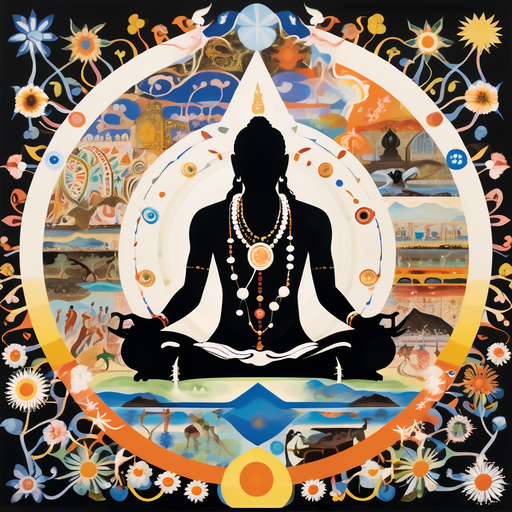
The concept of Turiyatitta, deeply embedded in spiritual philosophy, suggests a state where one can momentarily comprehend the perspectives of trillions of different life forms. This transcendent state goes beyond regular consciousness to a domain where the line between the individual and the collective blurs. Imagine perceiving the world not only from a human viewpoint but also through the experiences of animals, insects, microorganisms, fungi, and plants. This idea, daunting yet enlightening, pushes the boundaries of our understanding of consciousness and interconnectedness.

Consider the human perspective first, with its vast diversity, including various cultures, beliefs, and life experiences. Now, add to this the animal kingdom, each species with its unique way of engaging with the world. For instance, a bat navigates its environment using echolocation, a sensory experience vastly different from human perception.

Then there are insects, whose world of pheromones and ultraviolet vision offers a radically different understanding of existence. Microorganisms, invisible to our eyes, play a critical role in sustaining life, offering a perspective that could reveal the intricate workings of cellular life and the basics of existence.


Fungi, straddling the realms of the known and unknown, challenge our perceptions of individuality and community. Their networks, akin to a natural internet, show a level of connectivity that human technology aspires to reach.

Finally, contemplate the plant perspective. Recent research suggests that plants not only react to their surroundings but also communicate and remember. Imagine the view of the world from a centuries-old tree, silently observing the gradual flow of time.


Turiyatitta is more than a concept; it’s an invitation to broaden our consciousness and empathy. It reminds us that every form of life, no matter its size or perceived insignificance, plays a part in the grand scheme of things. This understanding could be crucial in fostering a more compassionate, empathetic, and connected world.

By embracing Turiyatitta, we recognize our role not as mere onlookers but as integral components of the universe’s vast mosaic. Each life form, each perspective, contributes to this mosaic, making it more vibrant and dynamic. This realization is humbling and empowering, urging us towards greater responsibility and deeper insight.


To experience Turiyatitta is to briefly touch the infinite, to connect with the essence of life itself. It’s a journey that involves not just the mind but also the heart and soul, moving us towards a deeper bond with all forms of life.

Morgan O. Smith

Yinnergy Meditation, Spiritual Life Coaching & My Book, Bodhi in the Brain…Available Now!

https://linktr.ee/morganosmith

Embracing the Moment of Nondual Suchness

Beyond the Realm of Experience

In the intricate journey of understanding consciousness and existence, we often stumble upon a profound concept: the moment of nondual suchness. This concept, deeply rooted in Eastern philosophies, especially in Zen Buddhism, transcends the conventional boundaries of experience and knowledge. It presents a paradox that challenges our fundamental understanding of reality: at the moment of nondual suchness, direct experience cannot be experienced.

What does this mean, and why is it significant? To explore this, we must delve into the nature of nonduality. Nonduality refers to a state of consciousness where the distinction between the subject and object dissolves. It is a realization that there is no ‘me’ separate from the rest of existence. In this state, the usual dualistic framework of perceiver and perceived, experiencer and experienced, falls away.

This leads us to the crux: if there is no separation between the experiencer and the experience, can we truly say that an experience is happening? The moment of nondual suchness suggests that in its purest form, experience transcends the dichotomy of subject and object. You do not experience the moment; you become the moment. There is no ‘you’ observing, feeling, or thinking about the experience; there is just the undifferentiated reality of what is.


This notion can be controversial and thought-provoking because it contradicts our everyday experience where we are constantly distinguishing ourselves from our experiences. We are taught to value our perceptions, emotions, and thoughts as what defines us. Yet, the concept of nondual suchness invites us to consider a state of being where these personal distinctions are not just irrelevant, but nonexistent.

Why is this perspective important? It encourages a radical shift in how we perceive ourselves and the world around us. It challenges us to let go of our habitual patterns of thought, our constant categorization, and our deep-seated need to analyze and differentiate. By contemplating nondual suchness, we open ourselves to a more holistic understanding of existence, one that is not confined by the limits of individual perspective.

In practical terms, embracing this concept can lead to a profound sense of peace and connectedness. When the illusion of separateness falls away, so do the conflicts and struggles born from it. What remains is a state of pure being, unburdened by the complexities of dualistic thinking.


To conclude, the moment of nondual suchness presents a radical and transformative viewpoint that challenges our conventional understanding of experience. It invites us to question the very nature of our existence and to explore a realm of consciousness beyond the limitations of individual perception.

Morgan O. Smith

Yinnergy Meditation, Spiritual Life Coaching & My Book, Bodhi in the Brain…Available Now!
https://linktr.ee/morganosmith

Beyond Labels

A Journey Through the Essence of Nonduality

In a world quick to cast judgment and affix labels, my exploration of nonduality has often been met with skepticism and disdain. Accusations of being “crazy,” “insane,” and “delusional” are hurled at me through social media, texts, and even face-to-face encounters. Yet, such reactions prompt me to question the very foundation of belief and perception in our society.

Consider for a moment the myriad of beliefs that have shaped human history and consciousness. How many individuals hold steadfast to the notion that the earth was crafted in seven days? Or that Eve emerged from Adam’s rib? Legends of Moses parting the Red Sea, Elijah ascending to heaven in a chariot of fire, Jonah’s survival within a whale, and the virgin birth and resurrection of Jesus Christ are not merely stories but are cornerstones of faith for countless people. These narratives, alongside the belief in entities like Satan or the practice of praying to an unseen force, might seem irrational or imaginary to some, yet they are deeply ingrained in the spiritual fabric of many cultures.


The juxtaposition of such beliefs against the skepticism faced by nonduality advocates raises a compelling question: Who, indeed, is the “crazy” one? This is not to disparage or belittle any set of beliefs but to highlight the subjective nature of sanity and rationality in the context of spiritual understanding. Nonduality, at its core, transcends the dichotomies of belief and disbelief, inviting a profound engagement with the essence of existence beyond the confines of conventional narratives.

Nonduality does not seek to undermine or replace traditional religious beliefs; instead, it offers a lens through which we might perceive unity in apparent diversity, seeing the interconnectedness of all things beyond the superficial separations imposed by language, culture, and individual perspective. It beckons us to explore the depth of our being, to recognize the intrinsic nature that we share with the universe itself.


The resistance faced by nondual perspectives is not a sign of their invalidity but a testament to their power to challenge and expand our understanding of reality. It is an invitation to dialogue, to introspection, and ultimately, to a more inclusive comprehension of the spiritual journey that encompasses all of humanity.

In embracing nonduality, we are not discarding the richness of diverse spiritual traditions but are deepening our engagement with the mystery that lies at the heart of existence. We are invited to witness the unfolding of life with an openness that transcends labels and judgments, recognizing that the true essence of spirituality cannot be confined to words or concepts.

So, as we navigate the waters of belief and skepticism, let us do so with a sense of curiosity and wonder, acknowledging that the quest for understanding is a path shared by all, regardless of the labels we may encounter along the way.

Morgan O. Smith

Yinnergy Meditation, Spiritual Life Coaching & My Book, Bodhi in the Brain…Available Now!
https://linktr.ee/morganosmith

Self-Actualization vs. Self-Realization

A Deep Dive into the Psyche and Soul

In the journey of self-discovery and personal growth, two concepts often emerge as beacons: self-actualization and self-realization. While they may appear similar at first glance, each represents a distinct path in the quest for understanding oneself. This post delves into the nuances of these concepts, exploring how they differ and intersect in the human experience.

#### Self-Actualization: The Psyche’s Reflection

Self-actualization is a term popularized by psychologist Abraham Maslow, best known for his hierarchy of needs. It sits at the apex of his pyramid, symbolizing the highest level of psychological development. At its core, self-actualization is about realizing and fulfilling one’s potential and capabilities. It’s a process where the psyche chooses to see its reflection when ready.

This journey is characterized by:

– **Growth-motivated behaviour**: Pursuing goals that lead to personal growth and fulfillment.
– **Realism**: Having an accurate perception of oneself, others, and the external world.
– **Autonomy**: Being independent and resistant to enculturation, but not oblivious to the opinions of others.
– **Peak experiences**: Transcendent moments of joy, creativity, and deep understanding.


#### Self-Realization: The Soul’s Inner Knowing

In contrast, self-realization is often rooted in spiritual or philosophical traditions. It’s about understanding one’s true nature at the deepest level. Unlike self-actualization, which is more about the individual’s capabilities and achievements, self-realization is about the soul choosing to know itself as itself when ready, even when the conscious mind isn’t.

Key aspects include:

– **Inner wisdom**: Tapping into the innermost essence of one’s being.
– **Non-attachment**: Letting go of material and ego-driven desires to focus on spiritual enlightenment.
– **Oneness**: Feeling a profound connection with the universe and all living beings.
– **Intuitive understanding**: Beyond logical reasoning, it’s an intrinsic knowing of one’s true self.

#### Intersecting Paths

While self-actualization and self-realization seem different, they can intersect. Both paths involve a deep understanding of oneself and a commitment to personal growth. They also require readiness – an openness to embark on these transformative journeys.

In practice, one might find elements of self-actualization within their spiritual pursuit of self-realization, or vice versa. It’s a reminder that self-discovery is deeply personal and unique to each individual.


#### Conclusion

Understanding the distinction between self-actualization and self-realization can provide valuable insights into our growth journey. While self-actualization focuses on realizing one’s potential and abilities, self-realization dives into understanding the true essence of one’s soul. Both paths, though different, offer rich opportunities for profound personal transformation.

Morgan O. Smith

Yinnergy Meditation, Spiritual Life Coaching & My Book, Bodhi in the Brain…Available Now!

https://linktr.ee/morganosmith

The Paradox of Enlightenment

Embracing the Limitless Self

In the quest for enlightenment, a paradox often emerges. We strive to reach a state of higher understanding, yet the moment we claim to have achieved enlightenment, we inadvertently confine ourselves within the very boundaries we sought to transcend. This pursuit reveals a fundamental truth about our nature and existence: what we truly are is inherently free from all limitations.

When we label ourselves as ‘enlightened,’ we inadvertently create a new identity, another cage for our boundless spirit. This declaration is a subtle form of ego, a self-imposed limitation that contradicts the essence of enlightenment itself. True enlightenment is not about attaining a label or reaching a destination; it’s an ongoing journey of self-discovery and liberation from all forms of identification.

Consider the concepts of ‘The Self’ and ‘No Self.’ These are often seen as opposing philosophies in spiritual and philosophical discourse. ‘The Self’ suggests a profound connection with a universal, eternal essence, while ‘No Self’ leans towards the idea of emptiness, the absence of a permanent, unchanging self. However, to define oneself as either is to miss the point entirely.


The essence of our being transcends these concepts. It’s not about being one or the other but encompassing and moving beyond both. We are neither solely ‘The Self’ nor ‘No Self.’ Instead, we exist in a state that includes both yet is not limited by either. This state is not a static endpoint but a dynamic, ever-evolving understanding of our true nature.

In this space, we recognize that labels, identities, and even the concept of enlightenment itself are mere tools for understanding, not the ultimate truth. Our true essence is like the sky—vast, boundless, and untouched by the clouds that drift through it. We are the silent observers, the consciousness that witnesses thoughts, emotions, and sensations without becoming them.

To truly embrace this state of being, one must continuously practice letting go of all attachments, identities, and beliefs. It’s a journey of unbecoming, peeling away layers of conditioned thought and societal constructs to reveal the pure, unadulterated essence of our being.


In conclusion, the journey to understanding what we truly are is not about acquiring a new label or reaching a definitive state of being. It’s about the continuous process of freeing ourselves from all limitations, labels, and identities. It’s about recognizing and embracing the boundless nature of our existence, which includes and transcends all dualities.

Morgan O. Smith

Yinnergy Meditation, Spiritual Life Coaching & My Book, Bodhi in the Brain…Available Now!
https://linktr.ee/morganosmith

Nonduality

The Unspoken Reality

In the realm of spirituality and philosophy, few concepts are as intriguing and paradoxical as nonduality. Nonduality, often associated with Eastern philosophies like Vedanta and Buddhism, refers to the idea that the dualistic distinctions we make between self and other, subject and object, mind and matter, are ultimately illusory or not fundamentally real.

The profound irony of nonduality is that any attempt to discuss or conceptualize it inherently contradicts its very essence. Speaking or thinking about nonduality is, by its nature, a dualistic activity. This is because language and thought are tools that rely on differentiation and distinction. They are the media through which we carve out the ‘self’ from the ‘other’, the ‘this’ from the ‘that’. In doing so, they perpetuate the illusion of duality – the very illusion that nonduality seeks to transcend.


This paradox highlights a fundamental challenge in human cognition: our reliance on dualistic frameworks to make sense of the world. From the moment we are born, our minds are trained to categorize and differentiate. This cognitive structuring is crucial for our survival and functioning in the world, yet it also confines us within the boundaries of dualistic thinking.

Nonduality suggests a state of consciousness where these dualistic distinctions dissolve. It points to an experiential understanding where the division between subject and object, observer and observed, ceases to exist. In this state, the egoic self expands into a boundless, undifferentiated whole.

Yet, the path to realizing nonduality is not through intellectual understanding. Since it is beyond the grasp of dualistic thought and language, nonduality is often approached through practices that transcend rational thinking, such as meditation, mindfulness, or other forms of spiritual contemplation. These practices aim to quiet the mind and dissolve the ego, allowing for a direct, non-conceptual experience of reality, unfiltered by the distorting lens of dualistic thought.


In conclusion, nonduality remains an enigmatic yet profoundly significant concept. It challenges us to look beyond the apparent separateness and fragmentation of our experiences and to question the very foundations of our understanding of reality. While it may never be fully captured in words or thoughts, it stands as a powerful reminder of the limitations of our dualistic perspectives and invites us to explore the depths of our consciousness.

Morgan O. Smith

Yinnergy Meditation, Spiritual Life Coaching & My Book, Bodhi in the Brain…Available Now!
https://linktr.ee/morganosmith

Embracing the Infinite

Understanding Para Brahman

In the realm of spiritual exploration and philosophical contemplation, the concept of Para Brahman stands as a profound enigma. It is a term that transcends the limits of our typical understanding, pushing us into the depths of what might be considered the ultimate reality.

Para Brahman, in its essence, is the embodiment of the formless and the infinite. It is not confined by the physical dimensions we are accustomed to, such as length, height, depth, or width. This absence of form extends beyond the physical, into the realms of emotion, thought, and even the metaphysical. It is devoid of texture, distance, time, space, feelings, emotions, senses, attachments, desires, thoughts, memories, anticipation, smell, temperature, relationships, distinctions, wants, needs, and regrets. This extensive list, however, is not exhaustive but indicative of the boundless nature of Para Brahman.

What makes this concept both intriguing and challenging is the paradox it presents. Para Brahman, while being beyond all these attributes and perceptions, simultaneously encompasses everything that has been mentioned. It is not just the absence but also the presence of all. This paradox forces us to rethink our understanding of existence and non-existence, presence and absence, form and formlessness.


How can something be everything and nothing at the same time? This question lies at the heart of understanding Para Brahman. It compels us to look beyond the dualities that dominate our everyday experiences. In this sense, Para Brahman is not just a concept but an invitation to experience reality in its most unadulterated form.

This exploration is not just an intellectual exercise but a journey toward self-realization. It challenges our deeply ingrained notions of what is real and what is illusion. By contemplating Para Brahman, we delve into a state of consciousness where the distinctions that define our usual experiences dissolve. In this state, we are neither bound by our desires nor limited by our perceptions.

The understanding of Para Brahman brings us to the cusp of spiritual awakening, where the individual self merges with the universal self. It is a state of being that many spiritual traditions aim to realize – a state of pure consciousness, unmarred by the transient nature of physical existence.


In conclusion, the concept of Para Brahman invites us to embark on a journey beyond the confines of our material and psychological limitations. It encourages us to experience the world not just through our senses and thoughts but through a profound understanding of the interconnectedness and the boundlessness of all existence.

Morgan O. Smith

Yinnergy Meditation, Spiritual Life Coaching & My Book, Bodhi in the Brain…Available Now!

https://linktr.ee/morganosmith

Everyone Falls Back Asleep After Awakening, But No One Falls Asleep After Enlightenment

In the journey of self-awareness and understanding, there’s a profound adage that resonates deeply: “Everyone falls back asleep after awakening, but no one falls asleep after enlightenment.” This statement, while seemingly simple, carries with it a world of meaning and depth, particularly in the context of spiritual and personal growth.

#### The Paradox of Awakening and Enlightenment

At first glance, the idea of “falling back asleep after awakening” seems counterintuitive. Isn’t awakening supposed to be a permanent shift in consciousness? The truth, however, lies in the subtle difference between temporary awakenings and true enlightenment. Many of us experience moments of awakening — brief glimpses into a deeper reality or a sudden awareness of a profound truth. These moments can be sparked by various experiences: a beautiful sunset, a piece of art, or a moment of deep connection with another person. However, these are often transient, and we find ourselves slipping back into our habitual patterns of thought and behaviour.

Enlightenment, on the other hand, represents a fundamental and irreversible shift. It’s akin to a door that, once opened, cannot be closed again. In enlightenment, there is a permanent transformation of perspective, a sustained awareness that transcends the ordinary consciousness. This state is often described as a deep, unshakable understanding of the nature of reality, self, and existence.


#### The Role of Meditation in Enlightenment

This statement emphasizes the necessity of years of meditation for true enlightenment. Meditation, in its various forms, is more than just a practice of calming the mind. It’s a tool for deep introspection, for peeling away the layers of illusion and ego that cloud our true nature. Through persistent meditation, one can gradually dissolve these barriers, fostering a greater connection with the inner self and the universe.

Meditation teaches patience, discipline, and, most importantly, the ability to observe without attachment. These qualities are essential in moving from fleeting moments of awakening to a sustained state of enlightenment. It’s a journey of continuous growth and learning, where each meditative experience builds upon the last, gradually leading to a profound understanding and acceptance of what is.


#### Conclusion

In conclusion, the journey from awakening to enlightenment is not a straight path. It involves many cycles of falling back into unconsciousness and rising again with a deeper understanding. This process is necessary and valuable, as each fall and rise polishes the soul, preparing it for the ultimate state of enlightenment. The years of meditation are not just a discipline but a devotion to the inner journey, a commitment to uncovering and living one’s truth.

Morgan O. Smith

Yinnergy Meditation, Spiritual Life Coaching & My Book, Bodhi in the Brain…Available Now!

https://linktr.ee/morganosmith

The Ground of All Beings vs. The Ground of All Being

In the realm of philosophy, the concepts of “the ground of all beings” and “the ground of all being” often emerge as central themes in discussions about existence, consciousness, and the nature of reality. These concepts, while seemingly similar, offer distinct perspectives on how we understand the universe and our place within it.

**The Ground of All Beings**


“The ground of all beings” refers to the idea that the foundation of reality is the multitude of individual entities that exist. This perspective sees the universe as a collection of distinct beings, each with its essence and characteristics. According to this view, the diversity of objects, organisms, and entities contributes to the fabric of reality. It emphasizes plurality, acknowledging the unique qualities and experiences of each being. This approach often aligns with perspectives that value individuality and the richness that comes from varied existences.

**The Ground of All Being**

On the other hand, “the ground of all being” suggests a more unified view of existence. Here, the focus is on the underlying reality that connects all things, rather than the things themselves. This concept points to a fundamental source or essence that underpins everything. It’s often associated with ideas of oneness or the belief in a universal substance or consciousness that permeates all. This perspective is prominent in various spiritual and metaphysical beliefs, where the unity of existence is emphasized over individual differences.

**Philosophical Implications**


The debate between these two views is significant in philosophy as it shapes our understanding of the world. If we lean towards “the ground of all beings,” we might focus on the differences and separateness of things, leading to a worldview that celebrates diversity and individuality. Conversely, embracing “the ground of all being” could lead to a more holistic view of life, where interconnectedness and unity are fundamental.


**Conclusion**

Ultimately, these concepts are not just abstract philosophical ideas but are also reflective of our everyday experiences and how we perceive our relationship with the world. Whether we see the universe as a tapestry of distinct threads or as a single, interconnected whole, these views shape our beliefs, values, and actions. As such, the exploration of these concepts is not just a philosophical exercise but a journey into understanding the very nature of existence itself.

Morgan O. Smith

Yinnergy Meditation, Spiritual Life Coaching & My Book, Bodhi in the Brain…Available Now!

https://linktr.ee/morganosmith

Exploring the Nondual State of Turiyatitta

Beyond the Ego’s Realm

In the journey of spiritual awakening, particularly during the Enlightenment period, we encounter profound concepts that challenge our understanding of self and existence. Among these concepts is the intriguing idea of the nondual state known as Turiyatitta. This state signifies a pivotal transformation where the individual transcends ordinary consciousness, reaching a realm beyond the ego’s grasp.

### The Death of the Ego


At the heart of this transformation lies the “death of the ego.” This term, often shrouded in mysticism, refers to a significant shift in one’s perception of self. In our usual state, we identify strongly with our ego, which is essentially our constructed self-image, replete with our personal history, beliefs, and idiosyncrasies. The ego thrives on differentiation, seeing the self as separate from others and the world at large.


### Turiyatitta: The Nondual Experience

However, in the state of Turiyatitta, this differentiation dissolves. It is a state where the boundaries that separate the individual from the experience are no longer present. In simpler terms, the experiencer (the individual) and the experience become indistinguishable. This is a profound realization, where one no longer views themselves as an isolated entity navigating through an external world, but rather as an integral part of a unified whole.

### Implications of Nonduality

This nondual perspective offers a radical shift in understanding the nature of existence. It challenges the deeply ingrained notion of individualism that pervades many cultures. In Turiyatitta, the sense of separation, which is the root cause of much of our suffering – be it in the form of loneliness, competition, or conflict – dissolves. What remains is a sense of oneness, a deep connection with all that is.


### The Journey to Enlightenment

Reaching this state is often described as the pinnacle of the spiritual journey, a key milestone in the path to Enlightenment. It requires deep introspection, meditation, and often, guidance from spiritual teachings and mentors. It’s not merely an intellectual understanding but a lived, experiential reality.

### Conclusion


The concept of Turiyatitta, and the experience of nondual awareness it describes, presents a fascinating and potentially transformative perspective on life and existence. It invites us to reconsider our relationship with ourselves, others, and the world around us, promising a path toward greater harmony, peace, and understanding.

Morgan O. Smith

Yinnergy Meditation, Spiritual Life Coaching & My Book, Bodhi in the Brain…Available Now!

https://linktr.ee/morganosmith