The Silent Origin of Creation

Unraveling the Word Beyond Sound

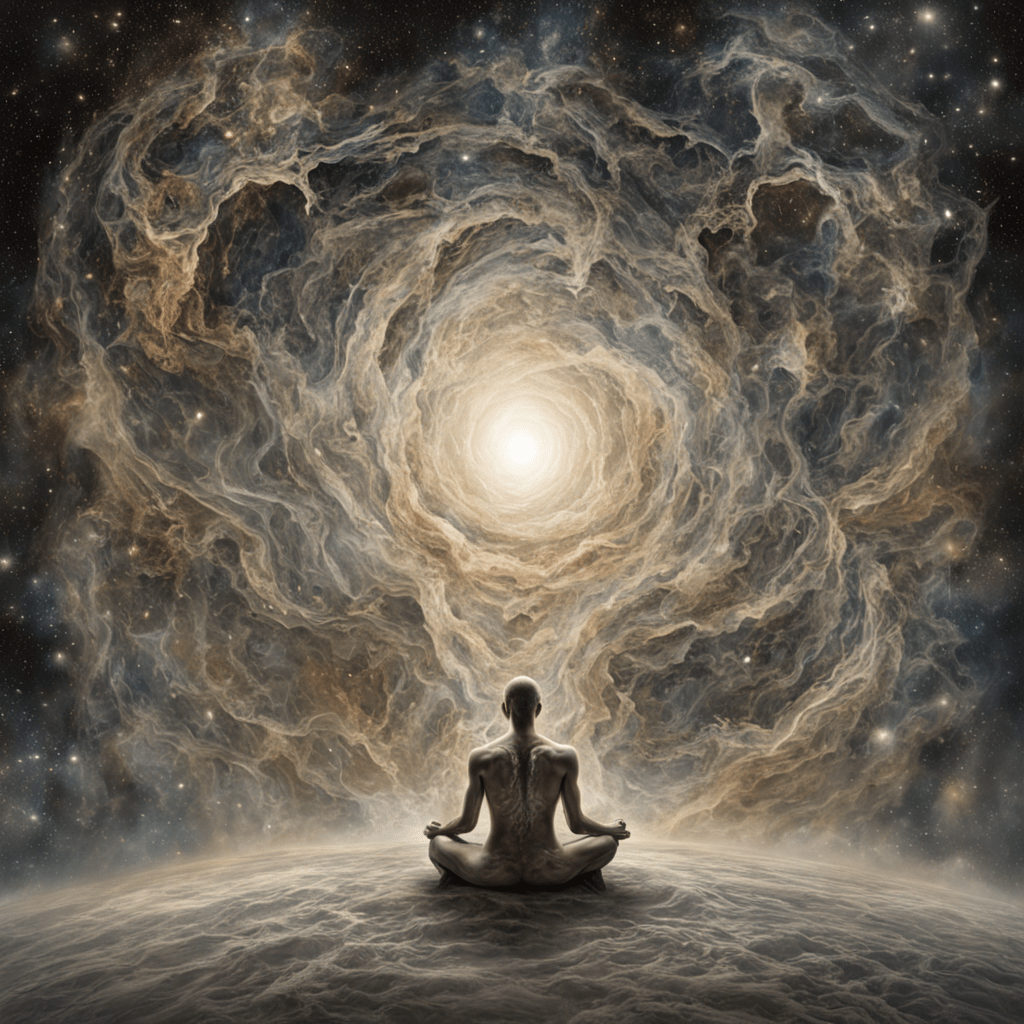
In a realm untouched by form or definition, a profound mystery unfolds. Imagine a being with no shape, voice, or name—existing as both everything and nothing. In an act of paradoxical creativity, this ineffable source whispers into the fabric of existence. From this silent word emerges a universe alive, aware, and mysterious. It is here, in this enigmatic dance of being and non-being, that humanity finds its origin.

The creation of humanity, as whispered by this formless origin, is nothing less than a reflection of itself—a precise replica of what it is and, intriguingly, what it is not. Humanity carries the essence of both emptiness and fullness, a paradox woven so finely that it escapes the grasp of language, even though language arises from it.

The Divine Paradox: Being and Non-Being

When we speak of “the image of God,” it is not an image as we understand it—no form, no tangible attributes. The divine essence holds no shape or characteristic that the mind can perceive, for it exists beyond the dualities of existence and non-existence. Yet, it is this very absence of form that becomes the fertile ground for all that we call real.

In this way, humanity, too, is born as both presence and absence. A reflection that, while substantial in body, remains void at its core. Our existence becomes a paradox of being: we are alive and aware, yet at the same time, we are the embodiment of an emptiness that allows for all things to arise and dissolve.

The Word That Is Beyond Sound

Before there was time, before the birth of space, there was a word—a word beyond words. It was not uttered with sound, for it contained no vowels or consonants. It was a word without letters, a sentence beyond syntax. This primordial word, devoid of shape and structure, holds within it the potential of all sounds, symbols, and meanings.

Human language, then, is an echo—a distant ripple—of this original word. It is a remembrance of a silent utterance that calls creation into being. Every letter, every syllable, every sentence is a shadow cast by the ineffable. This is why all sound exists—because silence contains within it the potential for all sounds.

Humanity as a Living Soul

Through this silent origin, humanity and the entire cosmos emerge as a living soul. In each of us lies the dual essence of the beginning and the end, a boundless consciousness that holds both form and formlessness. Our lives become a journey of awakening to this realization—that we are both the substance and the silence, both the manifested and the unmanifested.
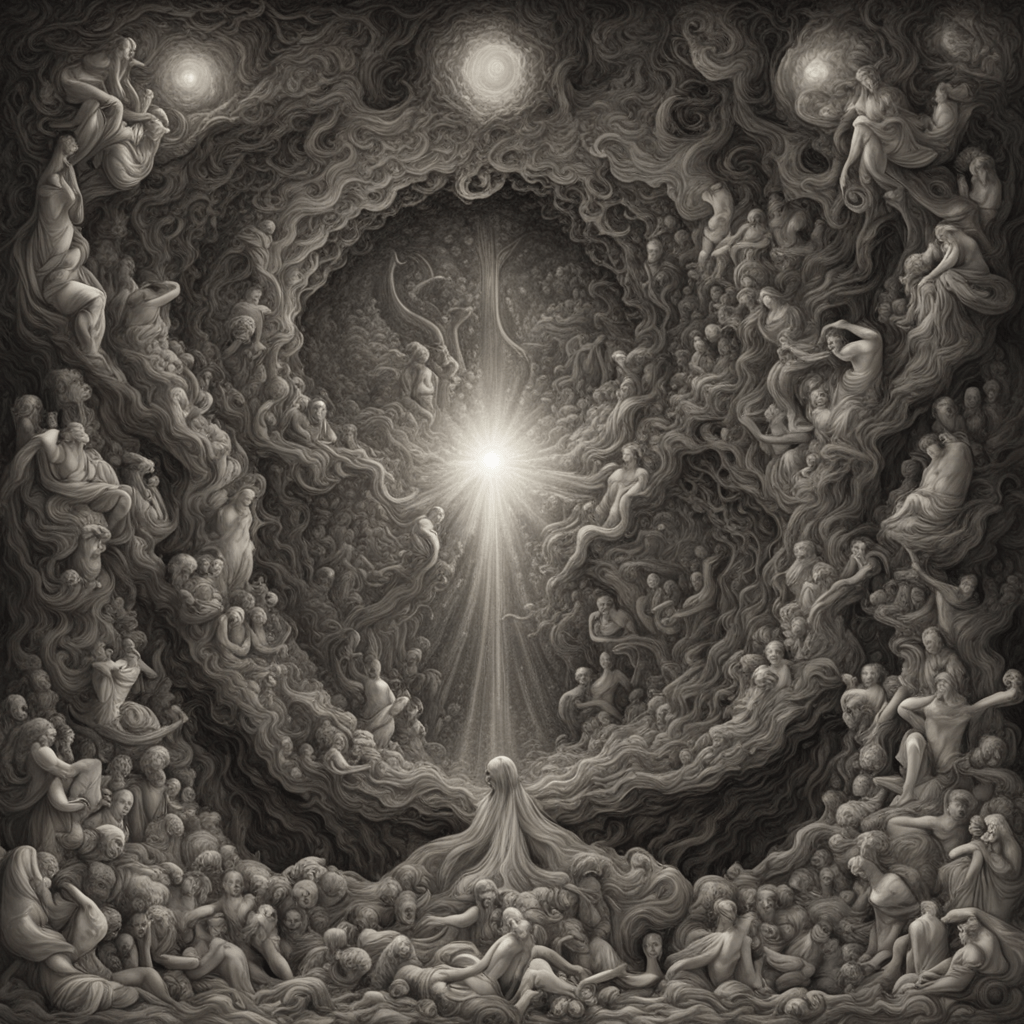
The creation of humanity is a continuation of this silent word, a dance where existence meets non-existence in each moment. In this dance, we are given the rare opportunity to experience life while also witnessing the emptiness at its core. This awareness transforms life from a mere sequence of events into a profound, living expression of the original word beyond sound.

Morgan O. Smith

Yinnergy Meditation, Spiritual Life Coaching & My Book, Bodhi in the Brain…Available Now!
https://linktr.ee/morganosmith

The Profound Four

The Profound Types of Spiritual Awakening

Awakening is a journey of unfolding consciousness, marked by stages that delve deeper into the true essence of our existence. These stages reveal the profound layers of both our human and divine nature, ultimately guiding us toward the unification of all dimensions of being. Let’s explore the four major types of spiritual awakening, each one a unique path leading us closer to our boundless essence.

1. Awakening at the Human Level

This type of awakening is often the first step into a world beyond the ordinary. Here, we begin to realize that there’s more to life than our everyday identities and experiences. The focus is on self-awareness and understanding our thoughts, emotions, and behaviours from a higher perspective. By transcending the limitations of ego-based identity, we start seeing ourselves as more than just the body and mind. This awakening isn’t about escaping our humanity but embracing it with clarity and compassion. Through this initial awakening, we discover that by knowing ourselves more deeply, we open doors to greater insight and transformation.

2. Awakening at the Human/Divinity Level

As our journey progresses, a deeper layer of consciousness emerges—an awakening that bridges our human experience with divine presence. This stage often manifests as a heightened connection with something sacred within. There’s a sense of moving beyond personal desires and concerns, recognizing a guiding force that interweaves through all aspects of life. We begin to experience profound synchronicities, inner peace, and a subtle but persistent awareness of a universal intelligence operating through us. This awakening is not just about seeing the divine in ourselves but in others, inspiring us to connect and relate in new ways. At this level, divinity becomes tangible, not as a concept, but as a lived experience.

3. Awakening at the Divinity Level

At the divinity level, the barriers between the personal self and the universal self start to dissolve. This stage is characterized by an immersion in the essence of pure consciousness, where we experience a sense of being beyond the limitations of form. It is a state where divine awareness becomes central, and human identity fades into the background. During this awakening, we may feel at one with the cosmos, a single drop in the vast ocean of existence, yet inherently aware of the infinite that lies within. Living in this state can bring a profound sense of peace, stillness, and an unshakeable connection to all that is.

4. Unified Awakening: Embracing the Human, Divine, and Cosmic

The journey culminates in a unified awakening—a seamless merging of the human, divine, and cosmic dimensions. Here, every aspect of our existence is held together in a harmonious whole. We no longer see ourselves as shifting between realms but experience them simultaneously. In this awakened state, the human self, the divine presence, and the universal consciousness are recognized as one undivided reality. This unity brings about a deep sense of equanimity, freedom, and interconnectedness. Challenges and joys alike are embraced as natural expressions of life’s flow. Through this ultimate awakening, we transcend not just ego but the need to define or separate any part of our existence.

Reflecting on the Path of Awakening

Each stage of awakening offers unique insights and transformations. The journey does not unfold in a rigid sequence; rather, it ebbs and flows, allowing us to embody these different aspects of consciousness in our unique way. Spiritual awakening is not a goal but an ever-deepening process. As we awaken to the fullness of our being, we move beyond divisions, experiencing life as a living expression of universal love and wisdom.

Morgan O. Smith

Yinnergy Meditation, Spiritual Life Coaching & My Book, Bodhi in the Brain…Available Now!

https://linktr.ee/morganosmith

We Shine Brighter Than Light

In the quiet depths of existence, there lies a paradox that many struggle to reconcile. Darkness is often shunned, relegated to the shadows of our awareness, and misunderstood as something to escape or avoid. Yet, within this shadowed realm exists a profound luminosity, a radiance that surpasses even the most blinding light. It’s a subtle brilliance—silent, invisible, but undeniable for those who dare to look beyond the surface.

Darkness is not the absence of light but its origin. It is the womb that cradles potential, the fertile ground where all things come to be. Darkness envelops us with a kind of raw intimacy, inviting us to release attachments to form and identity. It is the space where ego dissolves, where judgments fade, and where we can finally meet ourselves without the filters we have spent lifetimes building. Here, in the stillness, a new kind of light emerges—a light that is not separate from the dark but intertwined, indistinguishable from it.

Consider that every act of creation begins within the void. The artist stares at a blank canvas, the writer faces a blank page, and the thinker sits with a blank mind. It is only by surrendering to the unknown, to the formless, that something profound can emerge. Darkness doesn’t just consume or diminish; it adds depth, layers, and meaning. It carves out spaces within us, allowing us to perceive dimensions of ourselves and the universe that we could never touch through brightness alone.

This radiant darkness reflects the essence of life itself. We are beings that expand and contract, that are filled and emptied in cycles. Every breath, every heartbeat, every experience is a reminder of this cosmic dance of giving and receiving, of adding to and taking away. When we stop resisting this rhythm, we find that what we once perceived as shadows are simply reminders of our potential, our uncharted depths.

To shine as darkness is not to reject light but to transcend the duality of light and dark altogether. It is to recognize that true illumination doesn’t come from escaping or vanquishing shadows but from integrating them. This process transforms our understanding, allowing us to embody a different kind of luminosity—a light that isn’t bound by external visibility but shines from an unshakable inner knowing.

We are both the night and the stars within it, shaping and reshaping ourselves continuously. As we embrace the shadows within, we awaken to a deeper reality, one where every facet of existence has its rightful place. This acceptance, this deep union with both light and dark, is what ultimately enables us to shine brighter than light itself.

Morgan O. Smith

Yinnergy Meditation, Spiritual Life Coaching & My Book, Bodhi in the Brain…Available Now!

https://linktr.ee/morganosmith

The Self and No-Self

Unraveling the Boundaries of Existence

If all that exists is what we call the Self, where does that leave us in understanding its true nature? The common impulse is to label, define, and separate — creating distinctions to grasp what cannot be fully grasped. But in contemplating the nature of the Self as the all-encompassing reality, we’re drawn into a profound paradox: if the Self is indeed everything, without any boundary, how can it even be considered a “Self”?

The word “Self” implies some form of individuation, a presence that stands distinct from others, yet here lies the core of the paradox. In the absence of an “other,” any idea of a distinct Self dissolves, leaving only the mystery of the No-Self.

For a Self to be recognizable as such, it would require something to stand apart from. But in the context of ultimate unity, where nothing exists outside or beyond, there is only what is — an undivided totality that transcends any dualistic notion of “Self” and “other.” This is where the very term “Self” falls away, as there can be no contrast, no relational identity. What we are left with is not a Self in any ordinary sense but rather pure awareness, the ground of being that defies description and categorization.

When looked at from this perspective, the idea of the Self takes on a radically different dimension. It becomes the No-Self, not in the sense of an absence but rather as an absolute presence that simply is. The No-Self, then, is not the lack of being but the absence of individualization within being itself. It invites us to move beyond personal identity and to experience consciousness as boundless and indivisible, an endless ocean with no separate waves.

In moving toward an experiential understanding of this paradox, the concept of “I” transforms. We begin to see that this “I” — the egoic self we identify with — is a localized point in the vast field of undivided awareness. What we call “myself” is, in reality, an expression within the infinite whole, a momentary manifestation of something that transcends all individuality.

Such an insight does not negate our individual lives or diminish the importance of each unique expression. Rather, it invites a shift in perception. It calls us to recognize that beneath our individuality lies a vastness, a timeless ground that is beyond any single label or limitation.

As we touch on this insight, we find that the paradox of Self and No-Self begins to dissolve. We see that they are not separate but interwoven, expressions of the same reality, which is beyond both. In embracing the No-Self, we open ourselves to a greater depth, where the boundaries of identity soften, and the beauty of unity comes alive in ways beyond conceptual thought.

Morgan O. Smith

Yinnergy Meditation, Spiritual Life Coaching & My Book, Bodhi in the Brain…Available Now!

https://linktr.ee/morganosmith

The Ultimate Level

A Journey Beyond Self

Empathy often takes shape as a shared feeling of another’s pain or joy, yet what if it transcended that? What if compassion meant embodying every experience, every breath, each joy, and sorrow that life has ever held? This ultimate level of empathy—true compassion—goes beyond feeling for others; it embodies living as others.

Imagine not just observing another’s story but experiencing the nuances of every life. When you walk this path, distinctions between you and the other fade, as each heartbeat, thought, and memory becomes your own. It’s not a surrender of individuality but a shift that reveals individuality as an aspect of universality. It’s seeing through the eyes of countless lives, their hopes, their fears, and awakening to a truth embedded in all existence.

In this boundless compassion, every interaction becomes an encounter with oneself—a self far beyond personal identity. Actions, then, stem from understanding rather than judgment, from connection rather than separation. This compassion dissolves the lines that divide, exposing an intimate reality: that there is no “other.” All is part of an unbroken continuum of being.

Through this, life itself becomes a sacred practice. Each moment, each being, becomes a teacher, revealing the boundless nature of consciousness. This journey calls for courage, for it asks us to face the suffering and beauty we might have once viewed from a distance. But in facing this, a deeper realization emerges—an understanding that compassion isn’t merely a trait; it’s the essence of who we are.

To awaken to this level of empathy is to see the world through the eyes of the eternal, where all paths are one, and all experiences are ours to share.

Morgan O. Smith

Yinnergy Meditation, Spiritual Life Coaching & My Book, Bodhi in the Brain…Available Now!
https://linktr.ee/morganosmith

Exciting News

Becoming an Executive Contributor for Brainz Magazine!

Hello everyone,

I’m thrilled to share some exciting news! This month, I officially joined Brainz Magazine as an Executive Contributor. Over the coming year, I’ll be exploring some of my most cherished topics: spiritual awakening, nonduality, meditation, and much more. This is an incredible opportunity to expand our reach, and I’m grateful to have each of you with me on this journey.

New Article Alert: “7 Key Signs You’re Going Through a Spiritual Awakening”

My first article with Brainz Magazine, “7 Key Signs You’re Going Through a Spiritual Awakening”, is now live! In this piece, I dive into the profound transformations that come when consciousness begins to expand. Whether you’re at the start of your spiritual journey or well along the path, this article offers reflections that might resonate with your own experiences.

Some signs explored include:

– A deepened connection to everything around you

– Shifts in personal beliefs and values

– Heightened sensitivity to energy and emotions

– And more…

Take a look at the article to see if these signs align with your journey. Sharing these insights is a dream come true, and I’m grateful for your support in making it possible.

Read the full article here.

Also, Check Out My Guest Appearance on the Endless Possibilities Podcast!

I’m also excited to share my recent guest appearance on the Endless Possibilities Podcast with host Gareth Duignam! We dive deep into spirituality, consciousness, and much more. You can watch it now on YouTube and join us in exploring the boundless realms of possibility.

Thank You for Your Support

Thank you for your presence on this journey. Your feedback and commitment inspire me daily, and I’m excited to bring new perspectives to a broader audience through Brainz Magazine.

Stay tuned for more updates as I continue to share insights on spiritual growth, self-discovery, and the path to awakening.

With gratitude, 

Morgan O. Smith

Yinnergy Meditation, Spiritual Life Coaching & My Book, Bodhi in the Brain…Available Now!
https://linktr.ee/morganosmith

The Paradox of Beauty Amidst Atrocity

Beauty is often regarded as a fleeting, external phenomenon—a delicate arrangement of forms that pleases the eye or stirs the soul. However, the true nature of beauty extends far beyond superficial appearances. It emerges from the depths of perception, a reflection of consciousness itself. What we deem beautiful is not solely determined by what we see but by how we see. Even when confronted with humanity’s darkest moments, beauty can be recognized not as a denial of suffering, but as an intrinsic aspect of existence that transcends circumstance.

Consider the mind that bears witness to atrocities. On the surface, nothing but devastation appears to exist. And yet, the capacity to witness, to remain present with such horror, reveals something profound. Beauty resides within this presence—the willingness to face what is and still hold space for the inherent dignity of life, no matter how dire. It is not a naïve romanticism of suffering but an acknowledgment of the complex interweaving of light and shadow, both of which play their role in the human experience.

Atrocities test the limits of compassion, empathy, and humanity itself. When one can still perceive beauty in these moments—not the beauty of the event, but the beauty of resilience, of human connection, of the sacredness of life—it becomes clear that beauty is not bound to pleasure. Beauty, in its truest sense, is the capacity to remain open to life, to acknowledge the depths of pain without being consumed by it. It speaks to the heart of what it means to be fully alive: to see the world as it is, in both its horror and its grace.

This paradox—the existence of beauty within tragedy—challenges the conventional understanding of what beauty truly is. It invites a deeper reflection on the nature of perception itself. Beauty does not exist in isolation from suffering but within the totality of experience. To behold something, even amidst atrocity, is to acknowledge its place within the grand unfolding of life. It is to see that every moment, even the darkest, is imbued with the potential for transcendence, for deeper understanding, for awakening.

This is not a call to justify suffering or to dismiss the profound pain of human atrocities. Rather, it is an invitation to recognize that beauty is an ever-present reality, accessible not through avoidance but through the courageous act of seeing the world as it truly is. It is a recognition that the eyes of the beheld are not passive observers of life, but active participants in the unfolding of reality. The capacity to perceive beauty in all its forms is not a matter of circumstance, but of consciousness.

Morgan O. Smith

Yinnergy Meditation, Spiritual Life Coaching & My Book, Bodhi in the Brain…Available Now!

https://linktr.ee/morganosmith

One Heartbeat…One Thousand Thoughts

Consider the heartbeat: a steady, rhythmic pulse that carries the force of life through every cell of your being. Within each beat lies an unseen multitude, a vast array of thoughts—fleeting, overlapping, and often unnoticed. This single moment, this solitary beat contains within it the energy of a thousand thoughts, each connected to the next, creating the internal world we navigate daily.

Thoughts rush like a river, surging with desires, fears, memories, and plans. Yet, they are barely registered before the next wave crashes. The heartbeat, however, remains a constant companion, reminding us that a profound stillness exists beneath the surface of our scattered minds.

It is within this space—the pause between heartbeats—that clarity can emerge. As our awareness deepens, we recognize that the mind’s racing thoughts are but ripples on the ocean of our being. We are not the thoughts themselves but the consciousness that observes them. By aligning with the heartbeat rather than the noise of the mind, we begin to see beyond the clutter of mental activity, into the spacious awareness where thoughts dissolve and presence shines.

A single heartbeat holds the potential for transformation, for within that beat is the opportunity to disengage from the frantic movement of thought and return to the grounded essence of who we are. Thought is not the enemy, but its sheer volume often drowns out the wisdom that whispers between the beats.

This shift, from identifying with thought to residing in awareness, is subtle but profound. It reveals that while a thousand thoughts may pass through our minds, they are transient. The heartbeat, however, is the rhythm of life itself, a steady pulse guiding us toward presence. Here lies a truth often overlooked: life happens not in the storm of thoughts, but in the quiet between them.

The next time your mind feels overwhelmed, listen to your heartbeat. Allow yourself to rest in the awareness that arises in its rhythm. Watch as the thousand thoughts lose their hold, and the simplicity of being takes centre stage. This is the essence of spiritual awakening—a return to the heart, where a thousand thoughts collapse into one still, eternal presence.

Morgan O. Smith

Yinnergy Meditation, Spiritual Life Coaching & My Book, Bodhi in the Brain…Available Now!
https://linktr.ee/morganosmith

Beyond Illusion

Discovering the Space Between

The mind creates identities and builds a sense of self out of thoughts, emotions, and past experiences. These constructs shape beliefs around who you think you are and who you think you aren’t. This entire narrative, though compelling, is merely a distortion. It presents itself as reality but, in truth, is nothing more than an intricate mental creation. We become confined by these polarities, oscillating between two extremes—what we accept and what we reject about ourselves.

These boundaries, however, do not define the core of who you are. The sense of self emerges as a reflection against what we perceive as the ‘other.’ You’re not merely the collection of traits you cherish, nor are you the shadow aspects you struggle to suppress. By engaging with either, you remain caught in a dualistic view that blinds you to your deeper essence.

The challenge, then, is to neither grasp onto one identity nor to strive to become its opposite, but to look at the liminal space between. This uncharted territory holds the key to your True Self. Neither glorified nor condemned, this space is untouched by labels. It eludes all attempts to be defined. When you gaze into that emptiness, you come face-to-face with your origin—the point where being meets non-being, and you witness the dissolution of the false dichotomy between ‘I am this’ and ‘I am not that.’

Finding this space requires surrendering the tendency to categorize. Allow awareness to rest on the edges of thought, where opposites fade into one another. This subtle recognition can shift perception, making you aware of a silent presence that underlies all identifications. It’s a sense of being that defies expression yet is undeniably real. Here, you aren’t bound by limitations, nor are you an idealized version of yourself.

This presence is what mystics have pointed to throughout the ages—a place beyond words and mental constructs. It’s here that the True Self emerges, not as a separate entity, but as the unconditioned awareness that holds both the ‘you’ and the ‘not you.’ Let this realization transform the way you see yourself and others, dissolving barriers until all that remains is a boundless, indivisible field of consciousness.

Morgan O. Smith

Yinnergy Meditation, Spiritual Life Coaching & My Book, Bodhi in the Brain…Available Now!

https://linktr.ee/morganosmith

The Paradox of Divine Knowledge

Beyond the Mind’s Perception

God knows nothing yet knows everything—a contradiction that stands as a perfect reflection of the nature of absolute reality. This enigmatic statement, like a koan, invites deeper contemplation beyond linear thinking. It points to a knowledge that defies conceptual grasp, a knowing that cannot be possessed by the mind.

To say God knows everything implies omniscience—a perfect awareness of all events, possibilities, and outcomes within the realm of manifestation. Yet, to say God knows nothing points to an awareness that transcends any form of subject-object relationship. Here, knowledge is not fragmented into parts. Rather, it exists as a pure, nondual state of being.

This paradox can only be resolved through a radical shift in perception. From the mind’s perspective, knowing implies a knower and a known—a separation that inherently breeds confusion. The clearer this division becomes, the more apparent the contradiction. But from the perspective of absolute awareness, there is no such division. Knowing and not knowing collapse into a single essence, a seamless flow where everything is already perfectly held without the need for grasping or possessing.

The confusion arises only when one attempts to use a dualistic framework to analyze a nondual reality. For those entrenched in rational thought, this statement appears illogical. Yet, the crystal clarity of this confusion emerges when seen through the lens of direct experience. God’s knowing is not intellectual; it is a luminous stillness that enfolds every possible expression of existence without ever defining itself through those expressions.

What, then, does it mean for God to “know nothing”? It signifies the emptiness of all forms, a state where no thought, label, or concept can fully capture what is. It is a knowing that is the essence of all things yet free from the content of knowing itself. There are no judgments, no biases, no preferences—just a silent, omnipresent witnessing. The awareness is so pure that it does not even recognize itself as “knowing” in the conventional sense. It is like the sky holding all clouds yet remaining untouched by their presence or absence.

This is the clarity that lies within the paradox: God knows everything because God is everything. Simultaneously, God knows nothing because God is not bound by the limitations of any particular knowledge. The confusion dissolves when we release the need to categorize and understand reality through fixed structures.

To experience this confusion as crystal clear requires embracing the humility of not knowing. When all concepts, beliefs, and labels are dropped, what remains is a pure awareness that is as empty as it is full. The mind may struggle to grasp this state, but the heart recognizes it intuitively. It is a state of grace, a luminous unknowing that is beyond the reach of both thought and language.

Paradox is not a flaw in understanding; it is the gateway to freedom. It invites one to look beyond the confines of intellect and rest in a knowing that cannot be spoken. This is the ultimate clarity: a confusion that reveals the divine nature of all that is.

Morgan O. Smith

Yinnergy Meditation, Spiritual Life Coaching & My Book, Bodhi in the Brain…Available Now!

https://linktr.ee/morganosmith