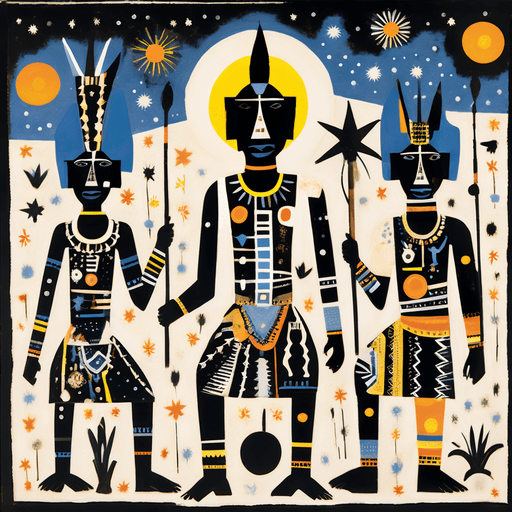
Celebrating Black History Month

The Metaphysical and Spiritual Contributions of the Dogon Tribe

As we immerse ourselves in the rich observance of Black History Month, it is essential to explore not only the historical and cultural milestones achieved by African descendants but also the profound spiritual and metaphysical insights they have offered to the world. Among these contributions, the Dogon Tribe of Mali stands out, offering a unique perspective on the cosmos that intertwines with both spirituality and advanced astronomical understanding.

The Dogon people, with their intricate cosmology, have fascinated scholars and spiritual seekers alike. Their knowledge of the stars, particularly Sirius, and its companion stars, predates modern astronomical discoveries, suggesting a deep connection between their spiritual practices and a sophisticated understanding of the cosmos. This alignment between the heavens and the human spirit is not just a matter of intellectual curiosity; it serves as a bridge to the profound, illustrating how spirituality and empirical knowledge can coexist and enrich one another.
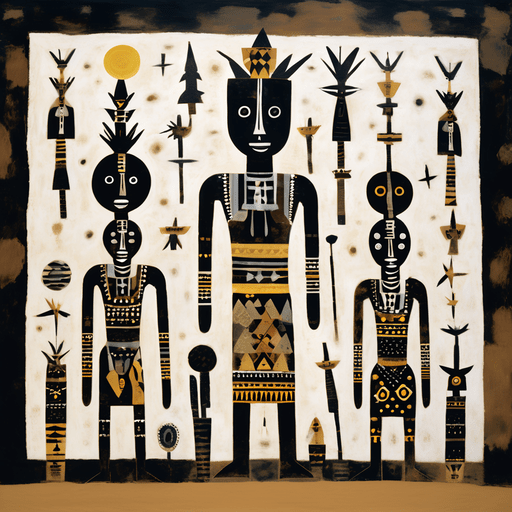

One of the most striking aspects of Dogon spirituality is their myth of creation, which is imbued with metaphysical significance. The Dogon describes the universe’s creation in terms that resonate with quantum physics and cosmology, speaking of a primordial egg from which all existence emerged in a resonant explosion of sound. This narrative parallels modern scientific theories about the Big Bang, suggesting that the Dogon had insights into the nature of the universe that science has only recently begun to understand.

Moreover, the Dogon’s spiritual practices, including their rituals and ceremonies, are deeply symbolic and offer insights into the nature of reality, consciousness, and the interconnectedness of all life. Their masked dances and sacred rituals are not merely cultural performances but are imbued with a deeper meaning, serving as a conduit to the ancestral and the divine. These practices offer a window into how the Dogon perceive the universe and their place within it, embodying a holistic view that sees the spiritual and the material worlds as interconnected and interdependent.
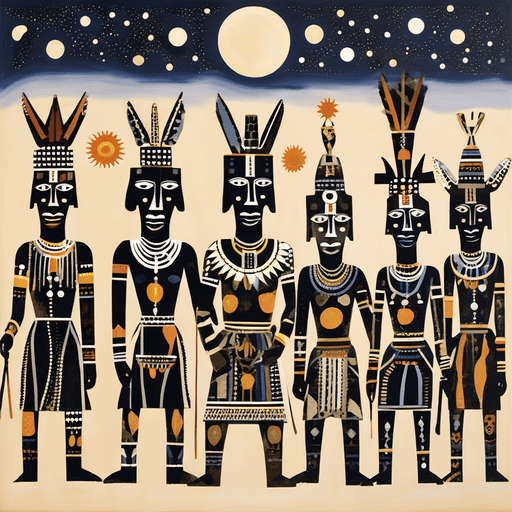

The significance of the Dogon’s contributions to metaphysics and spirituality cannot be overstated. Their understanding of the cosmos challenges the dichotomy often drawn between science and spirituality, suggesting a more integrated approach to understanding the universe and our place within it. As we celebrate Black History Month, reflecting on the Dogon Tribe’s legacy invites us to expand our perspectives and appreciate the profound ways in which African spirituality has enriched the global mosaic of knowledge and belief.

In recognizing the Dogon Tribe’s contributions, we not only honour their legacy but also affirm the value of integrating diverse perspectives into our understanding of the universe. This celebration is a reminder of the rich spiritual heritage that African cultures offer to the world, a heritage that deepens our understanding of the cosmos, spirituality, and ourselves.


As we continue to explore and celebrate the contributions of African descendants during Black History Month, let us remember the Dogon Tribe’s remarkable insights into the metaphysical and spiritual realms. Their legacy is a beacon that guides us toward a more integrated and holistic understanding of the universe, encouraging us to embrace the wisdom found in the unity of science and spirituality.

Morgan O. Smith

Yinnergy Meditation, Spiritual Life Coaching & My Book, Bodhi in the Brain…Available Now!
https://linktr.ee/morganosmith

The Paradox of the Universe

When we gaze into the vast expanse of the universe, a fundamental question arises: What is the universe made of? It seems like a straightforward inquiry, one that science could answer with theories of matter, energy, particles, and forces. However, upon deeper reflection, the answer becomes less about physics and more about philosophy. The universe, in its most enigmatic form, is made of itself, which paradoxically, is nothing.

This concept, while initially sounding absurd, invites us to explore the nature of existence and the fabric of reality. The universe isn’t just a collection of galaxies, stars, and planets; it’s an intricate tapestry of existence, interwoven with the threads of time, space, and consciousness. To say the universe is made of itself is to acknowledge that it is a self-contained entity, not requiring an external creator or an outside source of substance.


Delving deeper, the idea of the universe being ‘nothing’ challenges our understanding of ‘nothingness’. In philosophy, ‘nothing’ is often considered a state of non-existence, an absence of everything. Yet, in the context of the universe, ‘nothing’ transforms into a concept of boundless potential. This ‘nothing’ is not an emptiness (not in the traditional sense) but a source of all creation, a primordial state from which everything emerged.

This perspective aligns with some interpretations of quantum physics, where the vacuum of space is not empty but teeming with energy and potentiality. It’s in this ‘nothingness’ that particles pop in and out of existence, creating the fabric of reality as we perceive it. Therefore, the universe is made of itself and nothing is not a contradiction but a profound insight into the nature of reality.


The implications of this thought are vast and deeply philosophical. It suggests that the universe, and by extension, our existence, is a self-generated, self-sustaining phenomenon. We are not just in the universe; we are of the universe – an integral part of this grand, incomprehensible entity that is both everything and nothing.

In conclusion, the question of what the universe is made of leads us down a path of deep philosophical contemplation. It reveals that the universe, in its essence, is a paradox, defying the conventional understanding of existence and non-existence. It’s a reminder of the mystery and wonder that surrounds us, an invitation to ponder the unfathomable depths of reality.

Morgan O. Smith

Yinnergy Meditation, Spiritual Life Coaching & My Book, Bodhi in the Brain…Available Now!
https://linktr.ee/morganosmith

Absolute Monism

Unraveling the Tapestry of Oneness

The vast universe, with its manifold entities and infinite complexities, often bewilders human minds. Philosophers and thinkers from time immemorial have grappled with questions about the nature of existence and the ultimate reality. One profound idea that surfaces recurrently is that of Absolute Monism: the belief that beneath the apparent multiplicity, there is but one undivided reality. Let’s take a deeper look into this captivating worldview.

### A Universe from One Thread


At the heart of Absolute Monism lies the assertion that all differences and diversities we perceive are mere illusions. This assertion may seem contradictory to our daily experiences. After all, isn’t the world teeming with diversity?

Yet, this is where Eastern and Western philosophies converge. Ancient Hindu scriptures speak of *Brahman* as the ultimate, undifferentiated reality. The Hindu philosophy of Advaita Vedanta encapsulates this belief by stating that the world’s multiplicity, driven by *Maya*, is an illusion. Meanwhile, in the West, the philosopher Spinoza proposed that God and Nature are two names for the same reality, implying a singular, infinite substance. These ideas, separated by continents, come together to champion a singular reality beneath the apparent diversity.

### Seeing Beyond the Illusion

The concept of illusion is integral to understanding monism. In life, appearances can often be deceiving. A mirage in the desert, a rainbow after the rain, and even our reflection in the water are all illusions. If such simple things can deceive our senses, might it be possible that our entire perception of diverse reality is similarly mistaken?

*Mysticism* has been one avenue through which individuals across cultures have described experiences consistent with Absolute Monism. The interconnectedness of all things, a theme found in the tapestry of monism, speaks to the heart, nudging us to see beyond divisions and differences.

### Implications for Modern Times

If Absolute Monism holds that all is one, then what does this mean for us in the present age, surrounded by divisive forces and fragmented views?

Firstly, on an ethical plane, it implies that harm inflicted upon one is harm to the entirety. This perspective could drastically alter how we approach interpersonal relationships, environmental concerns, and global crises. If we truly internalize this philosophy, then every act of kindness and harm has far-reaching consequences.

Secondly, it brings to the fore the importance of self-realization. In many monistic traditions, the realization of this singular truth is the end goal, bringing about an end to suffering.

Lastly, it sparks curiosity about the nature of our universe. With advancements in modern physics and cosmology, we find theories that echo monistic thoughts. The Big Bang, for instance, suggests that everything we see, touch, and experience emerges from a singular point.

### Embracing Diversity within Unity

Absolute Monism does not negate the value of diversity. Rather, it calls for a deeper understanding. Imagine a tapestry. Up close, one can see the myriad of colours, textures, and patterns. But from a distance, it’s one cohesive artwork. Similarly, monism asks us to appreciate the individual threads while recognizing the grand design.

In an age teeming with division, perhaps the idea of Absolute Monism can be the bridge that reminds us of our interconnectedness. As we stand at the cusp of profound global challenges, this ancient philosophy might just hold the key to a unified, harmonious future.


Embracing the ideas of Absolute Monism requires introspection and openness. Whether you fully resonate with its tenets or not, it undoubtedly serves as a beacon, guiding us toward unity, understanding, and profound interconnectedness.

Morgan O. Smith

Yinnergy Meditation & My Book, Bodhi in the Brain…Available Now!
https://linktr.ee/morganosmith

The Time Nexus Enlightenment

When Time Transcends Itself

Introduction

In the perennial quest to understand our place in the universe, the concept of time has bewildered both scientists and spiritual seekers alike. What if, at the pinnacle of spiritual enlightenment, all the disparate facets of time could be understood as a single, unified whole? In this thought-provoking journey, we explore the speculative “Time Nexus Enlightenment Theory” that merges science with spirituality, and proposes an enlightening experience where time transcends itself.

The State of Turiyatita

To set the stage, let us first understand Turiyatita. A term from Hindu philosophy, Turiyatita refers to a state beyond Turiya, the fourth state of consciousness, and is often described as the ultimate realization or enlightenment. It is believed that in Turiyatita, the veil of physical reality is lifted and one’s consciousness expands into a universal scale.

Multidimensional Synchronicity

As the seeker reaches the state of Turiyatita, a symphony of timescales and dimensions unravels. Solar, sidereal, atomic, universal, and dynamical times converge into a multifaceted present moment. This synchronization implies an experiential unity where the past, present, and future cease to be separate.

Relativistic Unity

Einstein’s relativity tells us that time is relative. In Turiyatita, the relativistic variations in time due to motion and gravity unify. The enlightened experiences an eternal now, where every moment is both infinitesimal and everlasting.

Quantum Temporal Oscillation

On the quantum scale, time dances in its most fundamental form. Within Turiyatita, one perceives the quantum oscillations of time, facilitating an understanding of the genesis and potential conclusion of time itself.

Cosmological Comprehension

Imagine the ability to perceive the entire timeline of the universe, from the Big Bang to the far future. Turiyatita allows a person’s consciousness to expand across cosmological timescales, as they witness the birth and evolution of galaxies, stars, and planets.

Psychological and Biological Harmonization

At Turiyatita, the internal clocks that govern perception and biological rhythms harmonize with external time. This alignment leads to heightened awareness, innate wisdom, and an intrinsic connection to all life.

Time as a Conscious Entity

Perhaps most profound is the experience of time as a living, conscious fabric. The seeker realizes that time is not merely a measure, but a form of consciousness, intimately intertwined with existence.

Acausal Connection

Beyond the constraints of causality, the enlightened comprehends the acausal links that transcend time. This insight illuminates the profound interconnectedness of all events, regardless of temporal sequence.

Conclusion

The Time Nexus Enlightenment Theory proposes a transcendent state where the fragmented notions of time merge into a unified, living continuum. While this theory is speculative and creatively integrates science with spirituality, it invites us to ponder the mysteries of time and the boundless potential of human consciousness.

Morgan O. Smith

Yinnergy Meditation & My Book, Bodhi in the Brain…Available Now!
https://linktr.ee/morganosmith