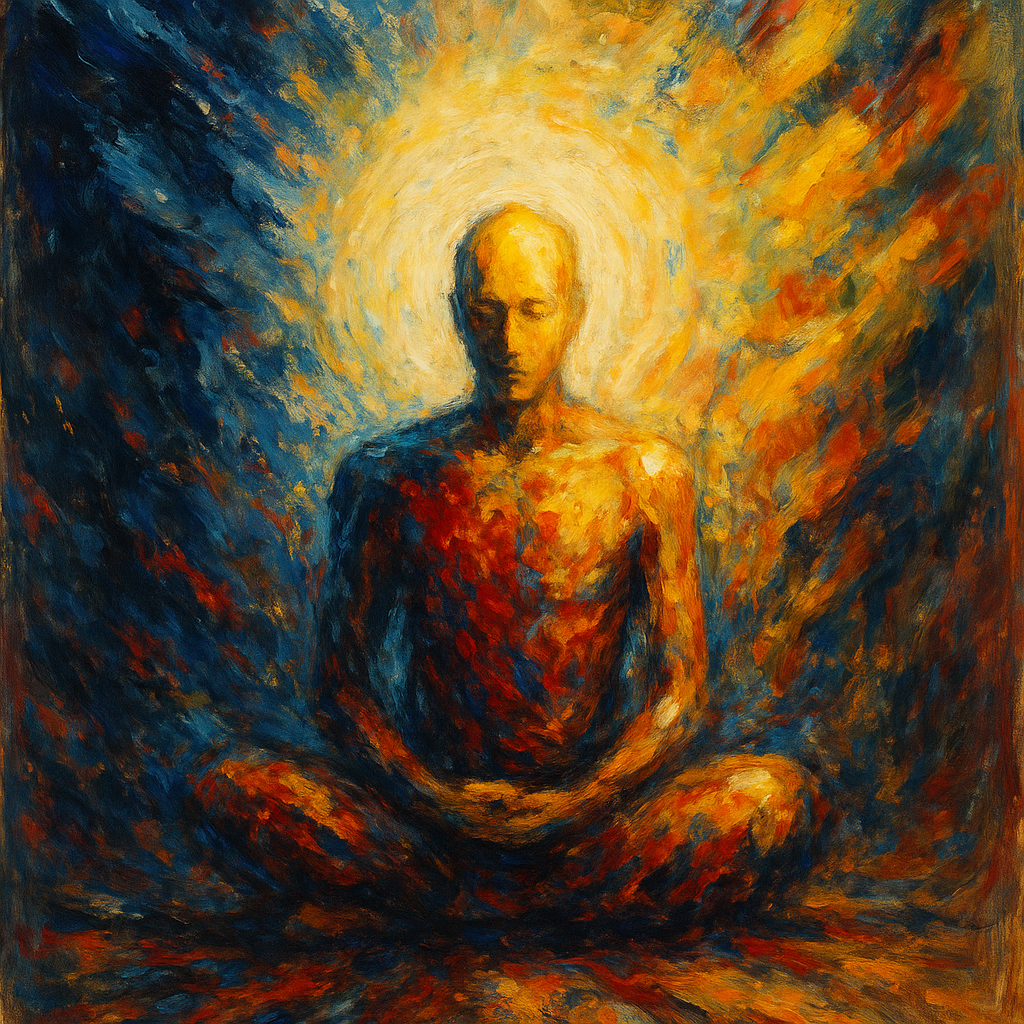
The Final Disappearance

What happens at the moment of death?

Not from the standpoint of biochemistry or theology, but from the lived silence of awakened seeing—the vantage where death and self are no longer two.

At the summit of awakening—whether called Moksha, Nirvana, Turiyatitta, or Nirvikalpa Samadhi—the idea of death unthreads itself. What dies never truly lived, and what lives has never been touched by time. The dissolution of the body is not the end, nor is it a doorway. It is the falling away of questions that were never yours.

There is no climactic revelation at that edge. There is only this. The suchness that never began, never moved, and never faded. At peak realization, death ceases to be an event. It is not an exit. It is the unspeaking of form—a gentle vanishing into what was always here.

This is not metaphor.

Consciousness, unfragmented and clear, neither resists death nor awaits it. It has already passed through it, endlessly. Not as a journey from point A to point B, but as a revelation that neither point exists.

You don’t meet death. You realize you were never separate from it.

At this depth, what we call life no longer hangs from a timeline. What we call death no longer casts a shadow. No more witness is watching the last breath. Only the unnameable recognizes itself through the temporary flicker of form.

The body may fall away, but the body was never the one who knew. The breath may stop, but the breath was never yours. That which remains doesn’t remain—it is. Before and after mean nothing to it.

Some call this realization peace. Others call it extinction. But it’s neither stillness nor silence nor bliss. It’s before all that. It’s the absence of absence. The presence of presence. Not two.

When the last ripple of self dissolves, what’s left is not a person merging with eternity. There is no one to merge. There is only what was always whole.

This is death at the level of freedom. This is life without division.

Not a conclusion.

A cessation of seeking.

Morgan O. Smith

Get Your Free Copy of My Book, Bodhi in the Brain!

https://subscribepage.io/oTSZQu

The Ouroboros of Samsara

An Endless Cycle of Self-Inflicted Suffering

The universe is filled with symbols that describe the cyclical nature of existence. One of the most captivating is the concept of ‘Samsara’ from Eastern traditions and ‘Ouroboros’ from ancient civilizations. While they emerge from different cultural contexts, they bear striking resemblances, encapsulating the endless cycle of birth, death, and rebirth and the continuous loop of life-consuming itself.

### Samsara: The Wheel of Existence

Samsara, derived from Sanskrit, signifies the cyclical process of birth, death, and rebirth. It’s a fundamental concept in Buddhism, Hinduism, and Jainism. Many Eastern spiritual practices aim to break free from this relentless cycle and attain enlightenment or Moksha. Why? Because Samsara is not just about rebirth – it’s about suffering. Every birth brings with it aging, sickness, and ultimately, death. The attachments, desires, and ignorance in life lead to actions (karma) that bind us to this wheel, causing endless suffering.

### Ouroboros: The Eternal Circle


The Ouroboros is an ancient symbol depicting a serpent or dragon eating its own tail. Found in many cultures, from ancient Egypt to the indigenous traditions of the Americas, it’s emblematic of the eternal cyclical nature of the universe. Creation out of destruction, life out of death. Just as the snake sheds its skin only to be reborn, life continually renews itself even as it ends.

### Biting One’s Tail: The Self-Caused Suffering


The fascinating aspect of the Ouroboros is the act of the snake biting its own tail. It’s a voluntary act of self-consumption, symbolizing self-reflection and the cyclical nature of things. But what if we viewed this act as a representation of self-inflicted suffering, much like the karmic traps in Samsara?

Every time we hold onto grudges, indulge in harmful habits, or remain ignorant of our true nature, we bite our own tail. We become both the cause and the recipient of our suffering. And just like the snake cannot see beyond its circular path, we often find it challenging to envision a life beyond our self-inflicted pain.

### Breaking the Cycle

While these symbols might paint a bleak picture of existence, they also offer hope. Just as the cycle of Samsara can be broken through enlightenment, the Ouroboros signifies rebirth and renewal. But this requires self-awareness.

By recognizing the patterns of our actions, understanding the roots of our desires, and embracing self-reflection, we can begin to release our grip on our own tails. This doesn’t mean the cessation of life’s challenges, but rather an enlightened approach to them, devoid of self-inflicted suffering.

In conclusion, Samsara and the Ouroboros serve as profound reminders of the cyclical nature of existence and the potential pitfalls of living unconsciously. They beckon us to awaken, to understand our role in our suffering, and to seek paths that transcend these ancient cycles. As we navigate the journey of life, may we always strive to understand the deeper meaning behind these symbols and find the courage to let go of our tail.

Morgan O. Smith

Yinnergy Meditation & My Book, Bodhi in the Brain…Available Now!

https://linktr.ee/morganosmith