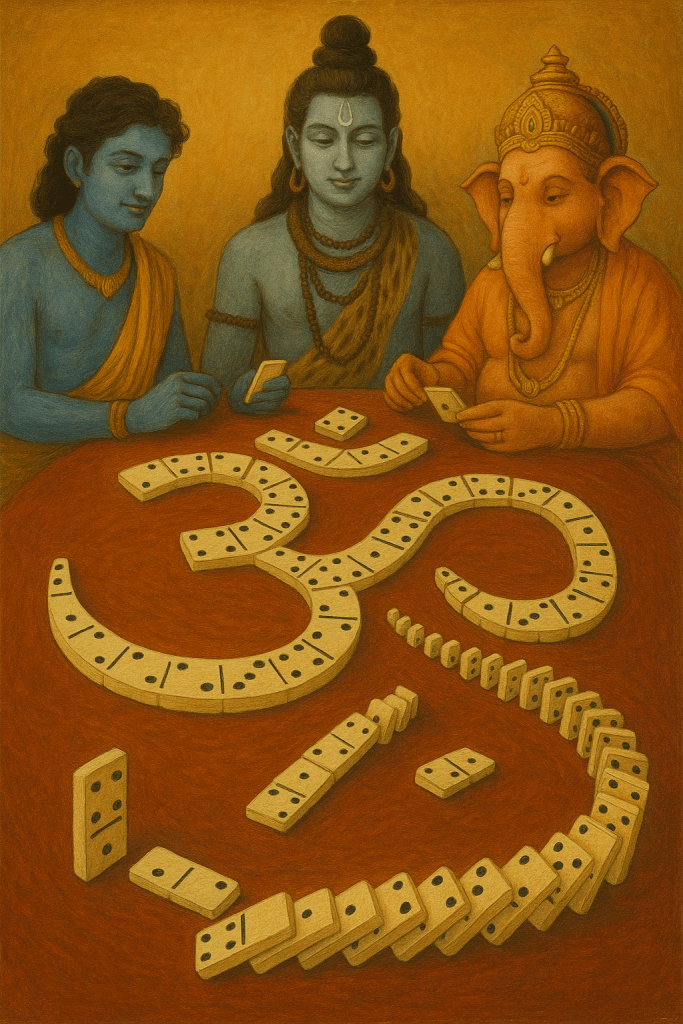
The Fiction of Randomness

If every effect has a cause, what room remains for the idea of “random”? Strip away the assumptions and peer into the structure of unfolding—what appears arbitrary may only be the limit of our perception, not the limit of reality.

What we call random is simply what we cannot trace. A roll of dice seems disorderly, but beneath it is a network of variables: velocity, angle, friction, momentum, density of the table, even micro-vibrations in the air. Were we to measure all these with precision, we would predict the outcome every time. The surprise we feel isn’t due to chaos, but to ignorance.

This is not about turning life into a mechanical calculation. Quite the opposite. It’s about bowing to a deeper intelligence that is so vast, so precise, it weaves galaxies from the quantum breath of atoms. When nothing is out of place, even disorder is part of a symmetry too subtle for the linear mind to grasp.

Events that seem unexplainable—miracles, tragedies, synchronicities—often get dumped into the “random” pile because they defy our narratives. Yet each thread is embedded in a continuum of unfolding, stretching far beyond memory, culture, or even lifetime.

To say life is random is to deny the sacred choreography of emergence. Every moment is connected, not as dominoes collapsing mindlessly, but as a living mandala of causes so intricately interlaced they cannot be undone or simplified.

When one begins to see this—really see it—the need to explain, justify, or control begins to fall away. What replaces it is not fatalism, but participation. There is no randomness, only the undetected curvature of deeper causality. And when that is recognized, trust becomes more than a spiritual concept. It becomes a way of being.

Morgan O. Smith

Get Your Free Copy of My Book, Bodhi in the Brain!

https://subscribepage.io/oTSZQu

Choice as Cosmic Manifestation

In a world often bound by the chains of determinism, where every event is seen as a mere consequence of a prior one, the concept of choice emerges as a beacon of freedom, a testament to the transcendental nature of human consciousness. This perspective offers a radical, yet profound alternative: choices are not just personal expressions or random occurrences; they are, in essence, expressions of the universe itself.

The fabric of our universe is intricately woven with the threads of time, space, and matter. Yet, within this complex tapestry lies a deeper truth, one that transcends the apparent duality of cause and effect. In this view, every choice we make is not simply a product of past influences or future aspirations; it is an immediate and direct expression of the universe’s ever-unfolding narrative.


This notion brings us to the concept of the ‘eternal now.’ Unlike the linear progression of time as we perceive it, the eternal now posits a realm where past, present, and future coalesce into a singular, timeless existence. In this realm, every choice is an act of creation, a moment where the universe expresses itself through our consciousness. It is in these moments that we are not merely individuals making isolated decisions; we are the universe experiencing itself, exploring its infinite possibilities.

The implications of this perspective are both liberating and daunting. It suggests that our choices are far more significant than personal preferences or responses to external stimuli. They are cosmic in scale, contributing to the grand narrative of existence itself. It invites us to view our decisions not just as personal crossroads but as contributions to the ongoing creation of reality.


In conclusion, viewing choice as a cosmic manifestation offers a new dimension to our understanding of free will and determinism. It proposes that our choices are neither predestined nor random, but are integral parts of the universe’s continuous journey through time and existence. It’s an invitation to embrace the profound interconnectedness of all things and to recognize our role as the creator itself in the magnificent tapestry of life.

Morgan O. Smith

Yinnergy Meditation, Spiritual Life Coaching & My Book, Bodhi in the Brain…Available Now!

https://linktr.ee/morganosmith

Embracing the Unity of Free Will and Determinism

Nondual Perspectives

Introduction:
In the timeless debate surrounding free will versus determinism, philosophical inquiries have often sought to reconcile these seemingly opposing concepts. However, from a nondual standpoint, rooted in direct experience, the boundaries between free will and determinism begin to blur. In this blog, we explore the profound idea that every choice we make is our decision and the decision of the universe itself. We delve into the unity of free will and determinism, highlighting how this perspective challenges conventional notions and opens up new avenues for contemplation.

The Illusion of Separation:

From a nondual perspective, the fundamental illusion is the perception of separation between ourselves and the universe. When we examine our direct experience, we realize that we are intimately interconnected with the fabric of existence. Our choices and actions are not isolated events but intricately interwoven with the tapestry of the cosmos. Thus, the dichotomy of free will and determinism fades away, revealing a deeper unity.

The Illusion of Individual Agency:
Conventionally, free will is often associated with individual agency, the belief that we possess an independent power to make choices. However, upon closer inspection, we find that our notion of individual agency is built upon a complex web of influences. Our thoughts, desires, and motivations arise from a multitude of factors: genetics, upbringing, culture, and countless other variables. In this sense, determinism seems to assert its presence, implying that our choices are shaped by external forces.

Reframing Choice as Cosmic Manifestation:
While determinism challenges the idea of individual agency, nondual perspectives offer an intriguing alternative. Instead of perceiving ourselves as separate entities with independent choices, we can reframe choice as a cosmic manifestation. Every decision we make can be seen as a ripple in the interconnected web of existence, an expression of the universe itself. In this way, free will and determinism merge into a harmonious whole, transcending the limitations of duality.

Unfolding in the Eternal Now:
In the nondual understanding, the concept of time takes on a different dimension. Past, present, and future merge into an eternal now, where every choice and outcome coexist in a timeless dance. From this vantage point, the notion of causality loses its strict linear framework. Our choices are not predetermined events unfolding in a predetermined sequence; rather, they arise in the timeless realm of possibility, where the universe expresses itself through our individual consciousness.

Embracing Paradox:
The reconciliation of free will and determinism requires embracing paradox. It calls upon us to transcend the limitations of dualistic thinking and expand our awareness to encompass the vastness of existence. In this paradoxical dance, we find liberation. We become both the orchestrators and the orchestrated, the chooser and the chosen, as we recognize the profound interdependence that pervades all aspects of reality.

Conclusion:
From the nondual standpoint, the interplay between free will and determinism reveals a profound unity. By exploring our direct experience and recognizing the illusory nature of separation, we discover that every choice we make is intricately connected with the choices made by the universe. As we embrace this understanding, we transcend the limitations of duality and embark on a journey of profound self-realization, where the dance of free will and determinism becomes an expression of the cosmic symphony of life.

Morgan O. Smith

Yinnergy Meditation & My Book, Bodhi in the Brain…Available Now!

https://linktr.ee/morganosmith