The Parrot Syndrome

Echoing Beliefs vs. Experiencing Truth

In a world inundated with information, “The Parrot Syndrome” has become increasingly prevalent, especially in the realm of spiritual enlightenment. This syndrome refers to the tendency to repeat information regarding spiritual enlightenment without genuinely experiencing or understanding it. It raises a crucial question: can true wisdom be imparted through mere repetition of beliefs, or does it necessitate direct, personal experience?

#### The Echo Chamber of Beliefs

The Parrot Syndrome manifests predominantly in spiritual circles where teachings are often passed down from one individual to another without critical examination or personal introspection. Teachers, motivated by a genuine desire to spread wisdom, might inadvertently become mere conduits for these teachings, echoing the beliefs of others rather than sharing insights from their journey. This second-hand knowledge, while it can be informative, often lacks the depth and transformative power of firsthand experience.


#### The Depth of Direct Experience

Contrastingly, spiritual enlightenment that stems from direct experience carries a different quality. It is not just understood intellectually but felt deeply and integrated into one’s being. This experiential wisdom is often more relatable and impactful because it comes from a place of authenticity and personal transformation. It transcends theoretical knowledge and enters the realm of lived truth.

#### The Path to Authentic Understanding


Breaking free from the Parrot Syndrome involves a shift from passive reception of information to active, experiential learning. It requires questioning, exploring, and most importantly, experiencing. When teachers and seekers alike embark on a journey of personal discovery, the wisdom they share is not just borrowed but born out of their life experiences and realizations. This authenticity not only enriches their spiritual journey but also inspires others to seek their truth.


#### Embracing a New Paradigm

As we move forward, spiritual communities need to foster environments where experiential learning is valued over rote repetition. Encouraging personal exploration and valuing diverse experiences over uniform doctrine can lead to a more profound and inclusive understanding of spiritual truths.

#### Conclusion


The Parrot Syndrome, while a common pitfall in the pursuit of spiritual enlightenment, also offers an opportunity for deeper, more authentic engagement with spiritual truths. By prioritizing personal experience over second-hand knowledge, we open the door to a more genuine and transformative understanding of spirituality.

Morgan O. Smith

Yinnergy Meditation, Spiritual Life Coaching & My Book, Bodhi in the Brain…Available Now!

https://linktr.ee/morganosmith

The Paradox of Enlightenment

The Trap Within Belief

The quest for enlightenment is as old as human consciousness itself. Philosophers, mystics, and seekers from all walks of life have grappled with the concept, attempting to pin it down, describe it, and ultimately attain it. However, the journey toward enlightenment presents an inherent paradox: the more we try to define and understand it using fixed terms, the further we may be pushing ourselves away from its true essence.

Imagine a bird in flight. If we try to describe its movement using a series of static images, we will inevitably fail to capture the fluidity and grace of its motion. Similarly, when we attempt to describe enlightenment using fixed terms and concepts, we risk reducing it to a mere idea, devoid of its living, breathing essence.

Many spiritual traditions caution against becoming overly attached to words and concepts. This is because language, while a powerful tool for communication, is inherently limiting. Words can only describe what we already know, and they are often inadequate when it comes to capturing the depth and breadth of profound spiritual experiences.

In our desire to understand enlightenment, we may fall into the trap of believing too strongly in the terms we use. Once we form a fixed idea of what enlightenment is or should be, we inadvertently place a barrier between ourselves and the experience. Instead of being open to the infinite possibilities of spiritual growth, we become confined within the walls of our own beliefs.

It’s essential to remember that the true nature of enlightenment cannot be grasped by the intellect alone. It is something that must be experienced directly, beyond the limitations of language and thought. While words can point us in the right direction, they can never fully encapsulate the experience itself.

So, the next time you find yourself pondering the nature of enlightenment, consider letting go of your preconceived notions and beliefs. Embrace the unknown, and allow yourself to dive into the deep waters of direct experience. For it is only when we move beyond the confines of language that we can truly begin to touch the infinite.

Morgan O.  Smith

Yinnergy Meditation & My Book, Bodhi in the Brain…Available Now!

https://linktr.ee/morganosmith

Disciplined Stoners (Episode 155) – Bodhi in the Brain

My Journey with Meditation, Consciousness, and Awakening

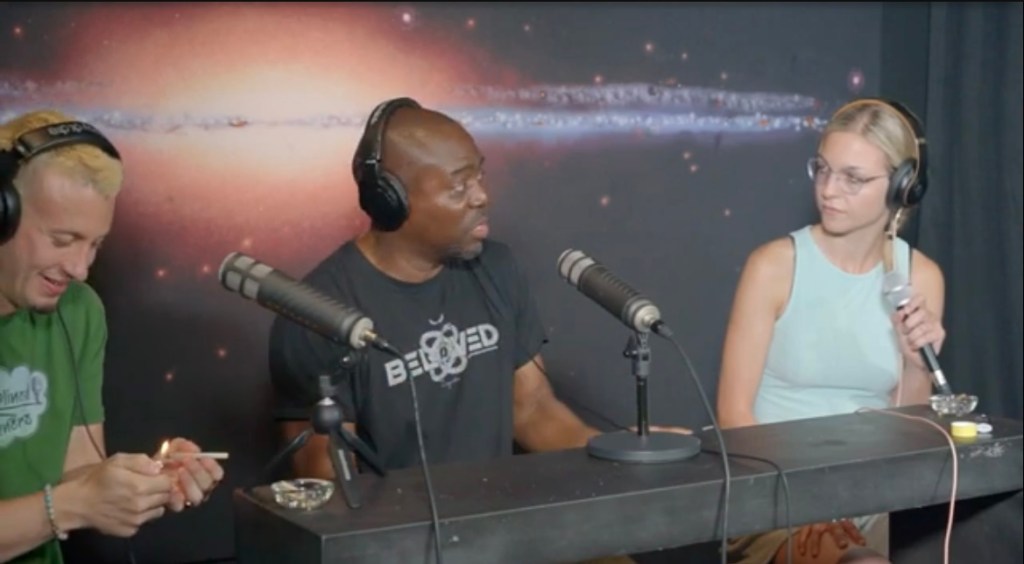
Exploring the intricate facets of consciousness and the enigma of meditation has been a lifelong quest for me. This week, I had the privilege to join Ellevan & Winny Clarke on the “Disciplined Stoners” podcast, sharing my insights, experiences, and discoveries.

I’m not just here as a meditation enthusiast; I introduced them to my creation, Yinnergy, a program born from my years of exploring and understanding the depths of inner peace and mental clarity. We also delved into the themes of my latest book, “Bodhi in the Brain,” embarking on a thrilling discourse on states of consciousness, spiritual awakenings, and the fascinating world of psychological development.

It was a transformative conversation, touching upon the delicate line between mere understanding and direct experience – a distinction that’s been pivotal in my personal and spiritual journey.

For those of you intrigued to dive deeper into my Yinnergy meditation or to navigate the pages of “Bodhi in the Brain,” you can explore them here at https://linktr.ee/morganosmith

Join us in this episode, where we venture beyond mere conversation, stepping into a realm of true transformation!


Embracing Paradox and Nonduality

Exploring the Paths to Spiritual Awakening

Introduction:
In the realm of philosophy and spirituality, two captivating concepts often spark profound contemplation and open doors to expanded understanding: paradox and nonduality. Both concepts challenge our conventional modes of thinking and invite us to explore the nature of reality and consciousness. In this thought-provoking blog, we will delve into the differences and similarities between paradox and nonduality, and delve into their roles in the context of spiritual awakening.

Paradox: Illuminating the Mystery Within
Paradoxes are enigmatic statements or situations that defy our logical expectations and challenge our understanding of reality. They present us with apparent contradictions, forcing us to question our assumptions and explore deeper layers of truth. Paradoxes are often the gateways to expanded consciousness, as they push the boundaries of our thinking and invite us to embrace the complexities and mysteries of existence. They are the mind’s playground, a fertile ground for philosophical inquiry and intellectual growth.

Nonduality: Beyond Duality, Towards Unity

Nonduality, on the other hand, transcends the realm of paradox by recognizing the illusory nature of dualistic distinctions altogether. It is a profound philosophical and spiritual concept that asserts the fundamental unity of all things, beyond conventional boundaries. Nonduality suggests that the apparent separation between self and other, subject and object, is an illusion that obscures the deeper truth of interconnectedness. It invites us to explore the essence of oneness that lies at the heart of existence, beyond the limitations of dualistic thinking.

Differences and Similarities:
While paradox and nonduality are distinct in their approaches, they share some intriguing similarities. Both concepts challenge our preconceived notions and invite us to embrace uncertainty. Paradoxes expose the limitations of linear thinking and expand our intellectual horizons, while nonduality goes beyond the realm of paradox by embracing a holistic view of reality. They both foster an open-mindedness that allows for new perspectives and insights to emerge.

In the realm of spiritual awakening, both paradox and nonduality play crucial roles. Paradoxes serve as catalysts, shaking us out of our complacency and inviting us to question our deeply held beliefs. They disrupt our habitual patterns of thinking and awaken us to the inherent mystery and wonder of existence. Nonduality, on the other hand, offers a framework for understanding the ultimate truth of interconnectedness. It guides us towards a direct experience of unity and helps dissolve the illusory boundaries that separate us from the world and others.

Conclusion:
Paradox and nonduality are two fascinating concepts that contribute to our philosophical and spiritual growth. Paradoxes challenge our intellect and expand our understanding, while nonduality transcends dualistic thinking and reveals the profound interconnectedness of all things. By embracing both paradox and nonduality, we can embark on a transformative journey of self-discovery and spiritual awakening. They invite us to explore the depths of our consciousness and contemplate the profound mysteries of existence. Let us embrace the paradoxes that confront us and open our hearts to the boundless unity that nonduality reveals. In this harmonious dance, we find the keys to unlocking the doors of awakening and embracing the vastness of our being.

Morgan O. Smith

Yinnergy Meditation & My Book, Bodhi in the Brain…Available Now!
https://linktr.ee/morganosmith

Embracing the Unity of Free Will and Determinism

Nondual Perspectives

Introduction:
In the timeless debate surrounding free will versus determinism, philosophical inquiries have often sought to reconcile these seemingly opposing concepts. However, from a nondual standpoint, rooted in direct experience, the boundaries between free will and determinism begin to blur. In this blog, we explore the profound idea that every choice we make is our decision and the decision of the universe itself. We delve into the unity of free will and determinism, highlighting how this perspective challenges conventional notions and opens up new avenues for contemplation.

The Illusion of Separation:

From a nondual perspective, the fundamental illusion is the perception of separation between ourselves and the universe. When we examine our direct experience, we realize that we are intimately interconnected with the fabric of existence. Our choices and actions are not isolated events but intricately interwoven with the tapestry of the cosmos. Thus, the dichotomy of free will and determinism fades away, revealing a deeper unity.

The Illusion of Individual Agency:
Conventionally, free will is often associated with individual agency, the belief that we possess an independent power to make choices. However, upon closer inspection, we find that our notion of individual agency is built upon a complex web of influences. Our thoughts, desires, and motivations arise from a multitude of factors: genetics, upbringing, culture, and countless other variables. In this sense, determinism seems to assert its presence, implying that our choices are shaped by external forces.

Reframing Choice as Cosmic Manifestation:
While determinism challenges the idea of individual agency, nondual perspectives offer an intriguing alternative. Instead of perceiving ourselves as separate entities with independent choices, we can reframe choice as a cosmic manifestation. Every decision we make can be seen as a ripple in the interconnected web of existence, an expression of the universe itself. In this way, free will and determinism merge into a harmonious whole, transcending the limitations of duality.

Unfolding in the Eternal Now:
In the nondual understanding, the concept of time takes on a different dimension. Past, present, and future merge into an eternal now, where every choice and outcome coexist in a timeless dance. From this vantage point, the notion of causality loses its strict linear framework. Our choices are not predetermined events unfolding in a predetermined sequence; rather, they arise in the timeless realm of possibility, where the universe expresses itself through our individual consciousness.

Embracing Paradox:
The reconciliation of free will and determinism requires embracing paradox. It calls upon us to transcend the limitations of dualistic thinking and expand our awareness to encompass the vastness of existence. In this paradoxical dance, we find liberation. We become both the orchestrators and the orchestrated, the chooser and the chosen, as we recognize the profound interdependence that pervades all aspects of reality.

Conclusion:
From the nondual standpoint, the interplay between free will and determinism reveals a profound unity. By exploring our direct experience and recognizing the illusory nature of separation, we discover that every choice we make is intricately connected with the choices made by the universe. As we embrace this understanding, we transcend the limitations of duality and embark on a journey of profound self-realization, where the dance of free will and determinism becomes an expression of the cosmic symphony of life.

Morgan O. Smith

Yinnergy Meditation & My Book, Bodhi in the Brain…Available Now!

https://linktr.ee/morganosmith