Author, Philosopher, Spiritual Teacher, A Lead Facilitator at Sacred Media's Integral Mastery Academy, Founder of Yinnergy Meditation/Neurofeedback, Bodhi Mental Care & Wellness, Co-founder of KeMor Centre for Innovative Development
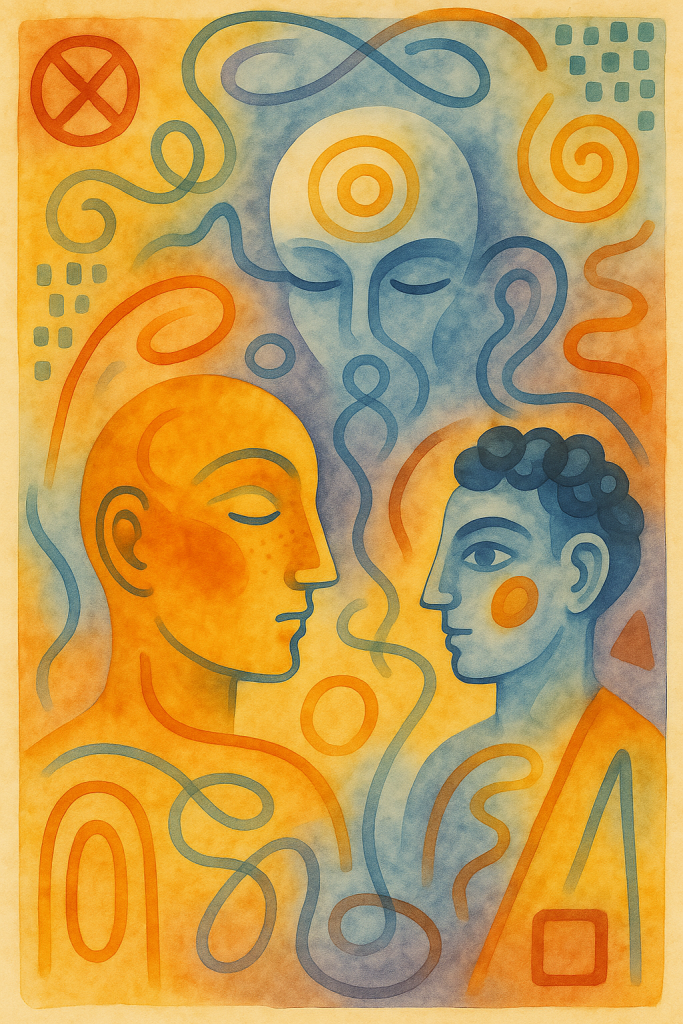
Spirit does not need a mirror, yet it gazes anyway—projecting forms into the formless, assigning names to the unnamed. What we call the world is not something separate from Spirit, but a spontaneous gesture of its own imagination, experienced as if it were other.
This is the paradox.
There is no true division between creator and creation. What appears as the external world is not a stage for a lost soul to find its way back, but Spirit animated—forgetting itself to taste the illusion of separation. Not as punishment or accident, but as a dance, a play, a sacred hallucination.
To believe the imagination is real is not error. It is the very means by which Spirit hides and finds itself. Each identity clung to, each role performed, each belief defended—these are costumes worn by the formless to remember itself as form.
Awakening doesn’t arrive like a conclusion; it dissolves the argument. You do not awaken from the dream by force or by will, but by remembering that it was always Spirit dreaming. The character fades, but not as death—more like laughter that remains after the joke has dissolved.
What changes when you see this?
Nothing. Everything. The world continues. You walk, eat, speak. But there’s an intimacy now. A recognition that what you once took to be real is neither unreal nor merely imagined—it is Spirit, playing with itself through light and shadow.
The one who seeks is the sought. The one who prays is the prayed to. Spirit folds into its own image, not to be found, but to be felt. That is the point. Not escape. Not transcendence. But the sacred absurdity of being itself.
Morgan O. Smith
Get Your Free Copy of My Book, Bodhi in the Brain!
Many have longed to grasp the mystery of existence, to touch the essence of something vast, limitless, and wholly beyond the conditioned intellect. Some wander outward, chasing knowledge across lifetimes, while others, weary of the chase, turn inward and dissolve into the revelation that the answer was never elsewhere.
There is a being who awakens, eyes once sealed now open, untethered from the weight of what was once mistaken for reality. This one recognizes that what they sought as God was never separate from themselves. Not a distant deity reigning above, nor a dogmatic construct built to cage the mind, but a living essence radiating through all things. They once believed this ideal self was an unreachable mirage, an aspiration always slipping beyond the grasp of physicality. But upon awakening, they no longer chase it—they become it.
What is this awakening? It is nothing more and nothing less than remembering how to imagine with the boundless wonder of a child. And not imagination as the mind toys with, but an intelligence so refined that it gives birth to worlds, perceives the invisible, and dances in the paradox of what is and what is not. The one who awakens does not strive to merge with God, for they see that this very merging is the illusion. There was never a separation to begin with.
Yet, alongside them walks another—one who clings tightly to a framework set in place long before their arrival. They follow the lines drawn by those who feared their depths, mistaking doctrine for truth and control for salvation. Their mind, fortified with walls of certainty, rejects the fluidity of growth. Anything that threatens their inherited beliefs is cast aside as danger, as corruption, as false prophecy.
The awakened one embraces their shadows, understanding that transformation does not come by denying the full range of human experience but by walking through the fire of it, unafraid to be burned. Shame is not an enemy to be conquered, nor is desire a force to be chained. They do not rush to crucify what it means to be fully human. Instead, they enter the chaos willingly, knowing that only by standing at the center of their own storm can they emerge as the calm itself.
Something miraculous happens in that surrender. The one who awakens watches their unfolding with wonder, like an artist witnessing a masterpiece take form in real time. Each step is both the path and the arrival, a self-created adventure where the destination remains unimportant. The act of movement itself—the curiosity, the play, the willingness to jump without knowing where they will land—is the divine act. The shimmering glow of their being is not a thing to be achieved but something they always were, now recognized at last.
Meanwhile, the fundamentalist stands still, mistaking their immobility for stability. Their beliefs, rigid and unyielding, have encased them in a fortress. To them, water is dangerous—too unpredictable, too wild. The awakened one drinks deeply from this same stream, intoxicated by its endlessness, while the fundamentalist sees it as a force of destruction, something to be feared and avoided at all costs.
Yet, both are children of the same source, actors within the same unfolding story. Neither is greater than the other, for both play their roles in the grand theater of existence. But only one of them has chosen to create the map of their becoming. Only one has dared to build a bridge where others have built walls.
So, the question arises: who would you rather be? The keeper of walls, or the architect of the infinite?
Morgan O. Smith
Yinnergy Meditation/Neurofeedback, Spiritual Life Coaching & My Book, Bodhi in the Brain…Available Now!
The idea of God having a purpose evokes a curious paradox. Purpose, as we understand it, requires time. There’s a beginning, an intention, and an outcome. Yet, God exists beyond time and space, transcending all dimensions that human minds perceive. How, then, can the ultimate transcendence have a purpose when both purpose and fulfillment rely on the passage of time?
God, in the most absolute sense, is timeless. Purpose implies movement from one state to another, a process that cannot apply to something that exists beyond time. God, as the eternal presence, neither moves nor changes. Yet, this same timeless God includes time and space as aspects of reality. Everything exists within God, and time is simply one of the infinite expressions of that existence.
From our limited perspective within time and space, purpose appears necessary and real. The flow of cause and effect shapes our understanding of meaning. Thus, we perceive God as having a purpose, as if the universe itself was an unfolding plan. But this perception only holds because we exist within the constraints of time. In truth, God’s purpose is as illusory as time itself—a projection of human understanding onto a reality that transcends all conceptual boundaries.
God, being everything, includes the illusion of purpose, yet remains untouched by it. In this sense, what we view as God’s purpose is simply an expression of the unfolding of existence within the framework of time. This divine play, known as *lila* in some traditions, is neither driven by need nor aimed at fulfillment. It is simply the unfolding of what is, without beginning or end.
The purpose we attribute to God is an attempt to understand the unfathomable. But ultimately, God’s true nature exists beyond purpose, beyond time, beyond any duality that our minds attempt to impose. To realize this is to recognize that the essence of existence is purposeless in the most profound sense—not in a nihilistic way, but as a reflection of absolute freedom, where nothing needs to be done because all is already complete.
Morgan O. Smith
Yinnergy Meditation, Spiritual Life Coaching & My Book, Bodhi in the Brain…Available Now!
The labyrinthine nature of existence, adorned with its pleasures and pitfalls, has been a subject of deep contemplation for ages. At the heart of many philosophical inquiries in Hinduism lies the enigmatic concept of ‘Maya’. Far from being a mere illusion, Maya reveals layers of truth, each pointing towards an understanding of the universe and our place in it. **The Cosmic Dance of Prakriti and the Three Gunas**
Imagine the universe as a grand stage, with Prakriti, the primal nature, as the backdrop. From this vast expanse springs forth everything we see, feel, and experience. Yet, what gives rhythm to this cosmic dance?
Enter the Three Gunas – Sattva, Rajas, and Tamas. These are not just passive qualities but dynamic forces shaping our experiences. The serenity of a tranquil lake embodies Sattva, the turbulence of a storm epitomizes Rajas, and the still darkness of the night echoes Tamas. Together, they create a spectrum of experiences in our lives. **The Individual’s Tryst with Ignorance**
Closer to our personal experience is Avidya, the fog of ignorance clouding our perception. Under its influence, we misidentify with our transient selves, overlooking the eternal essence within. It’s like mistaking the waves for the vast ocean.
In this state, we are ensnared by Karma, the ever-entwining web of action and consequence. The Kleshas, those tormenting afflictions, further deepen our entanglement. Desires and aversions play tug-of-war, with the ego stoking the flames.
**The Divine Masquerade**
But is Maya merely a cosmic error or a deceptive trap? Not necessarily. Maya, when seen as the divine power or Shakti, becomes the grand choreographer of the universe’s dance. It’s a divine play, a Leela, where the One chooses to manifest as many, experiencing itself through myriad forms. **Beyond Duality: The Advaita Perspective**
The school of Advaita Vedanta offers a profound insight. It suggests that beneath the multiplicity lies a singular truth, the Brahman. Maya, in this view, is the sublime artist crafting the many from the one, making the undivided appear divided.
**Conclusion: The Play and Beyond**
Maya, far from being a mere illusion to discard, becomes a lens to navigate our existence. It offers lessons, challenges, and experiences, pushing us to question, understand, and ultimately transcend.
In the dance of Maya, we are both the dancer and the audience. The key lies in recognizing the play, enjoying its beauty, and seeking the truth beyond the performance. In this quest, we don’t just find answers about the universe, but also about ourselves.
Morgan O. Smith
Yinnergy Meditation & My Book, Bodhi in the Brain…Available Now!

 Morgan O. Smith