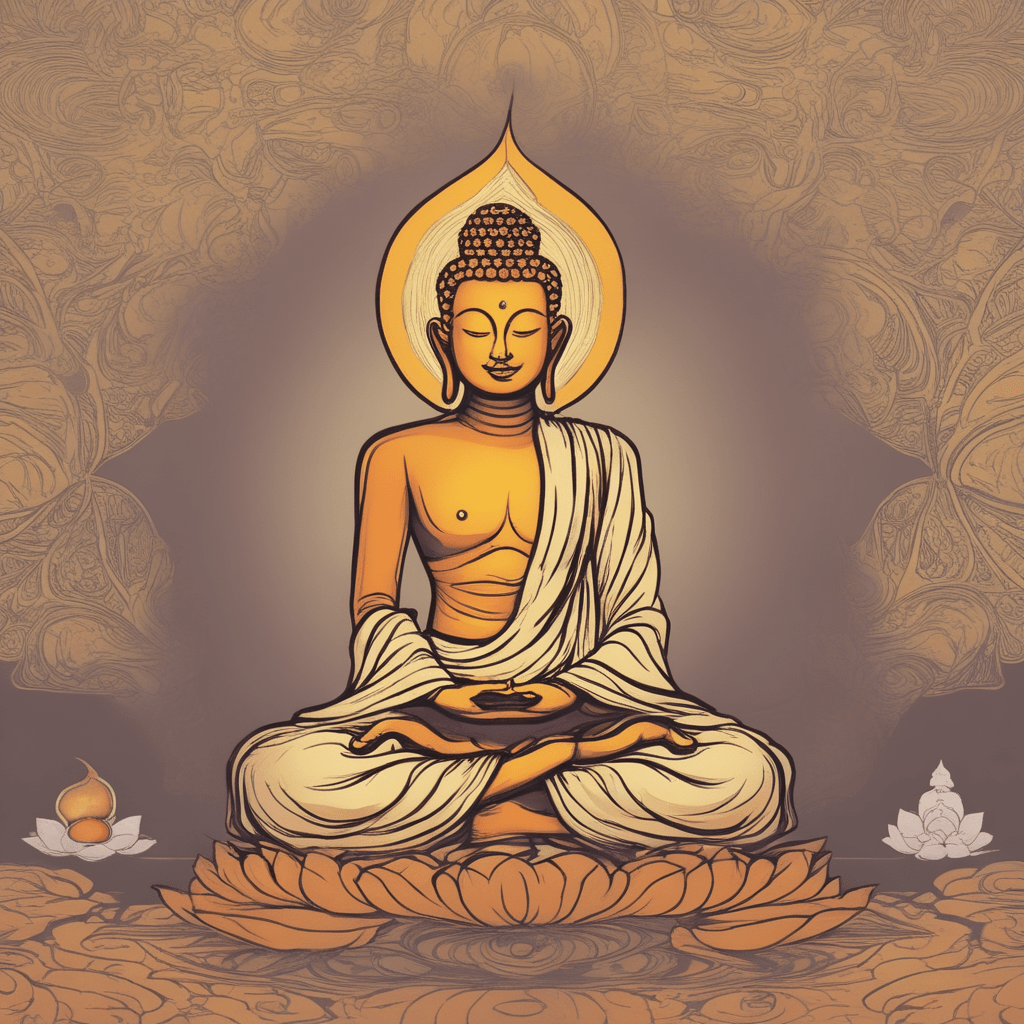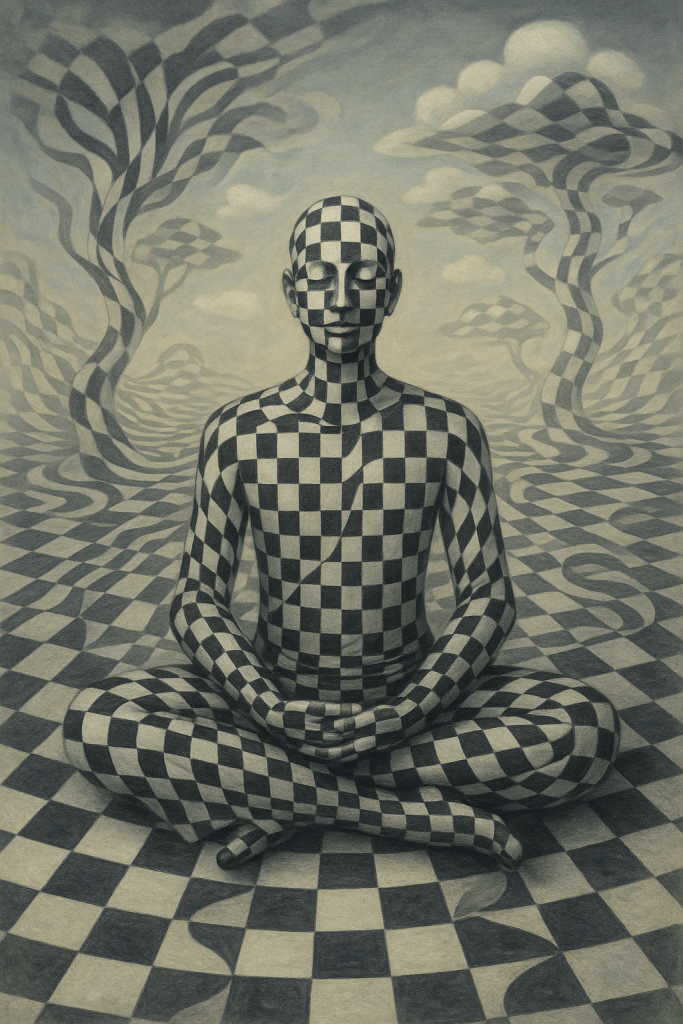
The Game of Black & White

How You Play the Game of Black & White Reveals Your Level of Spiritual Maturity

He doesn’t avoid the black squares. He just stops thinking they’re cursed.

You can tell how spiritually mature someone is by how they engage with contrast—not by how they escape it. The game of black and white is always being played. Light falls beside shadow, certainty walks with doubt, and gain is never far from loss. But while most are trying to land only on the white tiles, the one who has seen beyond duality walks freely across the whole board.

Spiritual growth doesn’t mean becoming invulnerable to darkness; it means seeing the darkness without contracting around it. A child in awareness recoils from discomfort and seeks the promise of the ‘light.’ A grown soul knows that neither is final, and neither needs to be resisted. The black square isn’t a punishment. The white square isn’t a reward. They are moves in the same dance.

The one who awakens learns to stop chasing symmetry. No longer obsessed with winning, they realize it was never about domination of light over dark, nor rising above contradiction. It was about presence through all of it. About meeting each moment with equanimity, whether wrapped in sorrow or shining in joy.

Some play to avoid pain. Others play to seek pleasure. But the wise one plays to see. And seeing, they cease to play as a someone at all.

They simply move.

Morgan O. Smith

Get Your Free Copy of My Book, Bodhi in the Brain!

https://subscribepage.io/oTSZQu

The Great I AM

The Great I AM Cannot Be Uttered by the Chattering Tongue

The essence of “I AM” defies articulation. Language, though beautiful, often becomes a noisy river of concepts, attempting to capture something that simply cannot be grasped. The chattering tongue thrives on duality, building walls between subject and object, speaker and listener, self and other. Yet, the Great I AM stands outside this dualistic framework, unbounded, whole, and utterly silent.

“I AM” is not a statement. It is the root of being itself, preceding thought, identity, and all constructs of the mind. To utter it is to already veil its truth. Words can point to the presence of the I AM, but they are shadows trying to explain the light. The moment you speak, it slips through the cracks of description, retreating into the stillness from which it arises.

Why, then, does the tongue chatter? It chatters because it fears the void—the stillness where the mind dissolves, and the self is no more. The ego’s survival depends on noise, distraction, and the endless creation of stories. In silence, it falters, confronted by the stark and undeniable simplicity of being.

To encounter the Great I AM is not to think about it but to dissolve into it. It is to rest in the awareness that observes the thoughts, the feelings, the words, and even the idea of “I.” This awareness has no form, no beginning or end. It is neither here nor there, neither this nor that. It is simply what is—timeless, spaceless, and unchanging.

When the tongue is still, the mind quiets, and the veil of separation thins. There, in that profound stillness, lies the Great I AM. It cannot be possessed, named, or claimed. It is the ground of all existence and yet entirely untouched by it. It is not yours or mine, yet it is undeniably the essence of what we are.

To live in the awareness of the Great I AM is to recognize that all the noise, all the chatter, is simply a dance of form arising within the formless. It is to see that even the ego, with all its stories, is just a fleeting ripple in the infinite ocean of being.

Silence does not mean the absence of sound; it means the absence of resistance. It is the acceptance of all that is, without judgment or clinging. In this silence, the Great I AM reveals itself—not as a word, a concept, or a thought, but as the ever-present reality of existence itself.

The chattering tongue will never grasp this truth, but the silent heart already knows.

Morgan O. Smith

Yinnergy Meditation, Spiritual Life Coaching & My Book, Bodhi in the Brain…Available Now!

https://linktr.ee/morganosmith

The Dance of Suchness

Nonduality in Search of Itself

Nondual suchness, the ground of all being, appears as duality—not as a mistake, but as an exquisite unfolding of its nature. This dynamic play of form and formlessness is not a separation, but a movement within unity, a way for the infinite to experience itself through the finite. This paradox, where oneness expresses itself as multiplicity, invites profound contemplation.

Duality arises as the perceivable world of contrasts: light and shadow, self and other, birth and death. Yet, these distinctions are mere appearances, like waves on the ocean. Beneath them lies the seamless nondual reality, unmoving and eternal. Why, then, does suchness manifest itself in this manner?

The answer lies not in concepts but in direct experience. Suchness manifests as duality to embark on a journey of rediscovery. The world of form becomes a mirror in which the formless can witness itself. This is the essence of the human experience: a seeming separation that eventually dissolves into the realization that the observer and the observed, the seeker and the sought, are one.

This process is neither linear nor bound by time. It is an eternal play, where the unmanifest takes form and, through the constraints of duality, rediscovers its boundless nature. This unfolding is the essence of life itself—an ongoing revelation of unity within multiplicity.

The search for self is not a problem to be solved but a mystery to be embraced. Each moment offers an opportunity to dissolve the illusion of separation and recognize the timeless reality of suchness. The ordinary becomes extraordinary when seen through the lens of nonduality, where the play of duality is understood as a dance of wholeness seeking itself.

Recognizing this truth liberates the mind from its grasping and aversion. The journey of duality becomes an exploration, not a burden. Life, with all its joys and sorrows, becomes a sacred expression of the infinite exploring itself.

To awaken to this is to realize that the search itself was never necessary, for what was sought was always present, always whole. The seeker dissolves, leaving only the suchness that was always there—silent, infinite, complete.

Morgan O. Smith

Yinnergy Meditation, Spiritual Life Coaching & My Book, Bodhi in the Brain…Available Now!

https://linktr.ee/morganosmith

The Illusion of Maya

Seeing Beyond the Show

Everything we perceive—the people, places, and events around us—is, at its core, a show. This is not a dismissal of life’s value but an invitation to explore its deeper essence. What we call “reality” is Maya, a veil of illusion that covers the truth. Maya is the great play of forms, the endless dance of opposites, and the theatre of duality where all things appear separate.

Yet, behind the scenes of this elaborate show lies something far more profound. Maya is the stage, but consciousness is the ever-present witness. The mind, with all its perceptions, attachments, and desires, keeps us captivated by the performance. We become so engrossed in the unfolding drama of our lives that we forget we are not the characters, but the awareness watching it all unfold.

Understanding Maya isn’t about rejecting the world or treating life as insignificant. Rather, it’s about seeing through the illusion. The key is not to escape Maya but to recognize it for what it is—a fleeting projection of the eternal. Once the illusion is seen for what it truly is, everything shifts. Life no longer feels like a weight to carry or a puzzle to solve. It becomes a dance, a cosmic play where each movement, no matter how dramatic, is infused with a deeper stillness.

Consider the waves of the ocean. They rise and fall, each one unique, yet they are never separate from the ocean itself. The wave may take shape, crash, and disappear, but the ocean remains constant. So, too, with Maya—forms come and go, experiences rise and fall, but consciousness remains unchanging, ever-present, and infinite.

To see beyond the illusion of Maya is to live with a lightness of being, recognizing that while everything is part of the grand show, none of it defines the true self. The self that watches, silently aware, is the only constant. When this is realized, life becomes a paradoxical blend of deep engagement and effortless detachment. You play your role in the world, knowing full well that it is all a divine drama, yet you remain untouched by its outcomes.

Maya invites us to enjoy the show while remembering we are not bound by it. Behind every illusion lies the vastness of truth, waiting to be uncovered by the silent observer within.

Morgan O. Smith

Yinnergy Meditation, Spiritual Life Coaching & My Book, Bodhi in the Brain…Available Now!

https://linktr.ee/morganosmith

A-Dual to Dual to Nondual

The Evolution of Consciousness

The evolution of consciousness from a-dual to dual to nondual mirrors the profound journey of human development and spiritual awakening. This path reflects the unfolding of awareness from the pure, undifferentiated state of infancy, through the complexities of duality, and ultimately to the profound realization of nonduality.

The A-Dual State: The Innocence of a Newborn

A newborn baby embodies the a-dual state—a condition of pure, undivided awareness. In this state, there is no sense of separation; the infant exists in a realm of unity where distinctions between self and other, subject and object, have not yet formed. The newborn’s consciousness is a reflection of the primal unity of existence, an experience of pure presence and potential.

The Emergence of Duality: The World of Distinctions

As the child grows, the consciousness transitions into the dual state. This is the realm where the distinctions and separations that characterize our daily lives begin to emerge. The child starts to recognize the difference between self and other, experiencing the world as a collection of distinct objects and entities. This dualistic perception is essential for navigating and understanding the complexities of life.

In the dual state, we develop our sense of identity and individuality. We learn to interact with the world, to differentiate between pleasure and pain, success and failure, love and fear. However, this separation can also lead to feelings of isolation, conflict, and a sense of being incomplete.

The Nondual Realization: The Return to Unity

A full spiritual awakening marks the transition from dual to nondual consciousness. This realization transcends the distinctions of duality, revealing the underlying unity of all existence. In the nondual state, the boundaries between self and other dissolve, and we perceive the interconnectedness of all things.

Nondual awareness is the recognition that the multiplicity of forms and phenomena are expressions of a single, boundless reality. It is an experience of profound unity where the apparent separations of duality are seen as illusory. This realization brings a deep sense of peace, compassion, and unconditional love, as we understand that we are part of a greater whole.

Embracing the Journey

The journey from a-dual to dual to nondual is not a linear path but a continuous unfolding of consciousness. It invites us to embrace the innocence of the a-dual state, navigate the complexities of duality, and ultimately awaken to the nondual realization. This journey encourages us to live with mindfulness, recognizing the sacredness in every moment and every experience.

By understanding and embracing this evolutionary process, we can navigate life with greater wisdom and grace. We learn to hold the paradoxes of existence, finding harmony in the interplay of opposites. This path is not about escaping the world but engaging with it more deeply, with an open heart and a clear mind.

The evolution of consciousness from a-dual to dual to nondual offers a profound framework for understanding our spiritual journey. It reminds us that beyond the apparent separations lies a deeper truth—a truth that can transform our perception and inspire us to live with greater compassion, wisdom, and love.

Morgan O. Smith

Yinnergy Meditation, Spiritual Life Coaching & My Book, Bodhi in the Brain…Available Now!

https://linktr.ee/morganosmith

The Journey from Singularity to Advaita

A Deep Dive into Absolute Monism

In the realm of spiritual exploration, the concepts of Nirguna Brahman and Saguna Brahman offer profound insights into the nature of existence and the essence of reality. At the heart of this journey is understanding absolute monism and its manifestations through various dimensions of being.

Absolute Monism: The Unchanging Reality

Absolute Monism posits that there is a singular, omnipresent source from which everything emanates. This source, often called Nirguna Brahman, lacks qualities or attributes. It transcends all forms and distinctions beyond the dualities of hot and cold, good and evil, or masculine and feminine. This state has no concept of time, space, or location. It is the purest form of potentiality, embodying existence and nonexistence, and serves as the ground of all being.

Nirguna Brahman: The Formless Absolute

Nirguna Brahman is the ultimate reality without form or qualities. It represents the infinite potentiality that precedes all manifestations. In this state, distinctions such as up or down, north, west, east, south, inside or outside, and time or space dissolve into a singular, undifferentiated whole. This formless absolute is the source from which all probable and improbable possibilities arise.

Saguna Brahman: The Manifestation of Qualities

From the infinite potentiality of Nirguna Brahman emerges Saguna Brahman, the aspect of the divine with qualities. This is where evolution, shape, and form come into play. It encompasses all persons, places, and things, embodying the diverse polarities that characterize the physical and metaphysical realms. Through Saguna Brahman, the infinite takes on finite forms, giving rise to the rich diversity of existence.


The Path to Advaita: Non-Dual Awareness

The journey from Nirguna to Saguna Brahman is a transition from the formless to the form. However, the ultimate realization in this journey is Advaita, the recognition of non-duality. Advaita reveals the underlying oneness of all existence, where distinctions between self and other, subject and object, dissolve. It is an awareness that transcends the dualities of Saguna Brahman, bringing one back to the infinite potentiality of Nirguna Brahman.

Exploring Other Realms and Frequencies

In the context of Advaita, other realms and frequencies are understood as different expressions of the same underlying reality. Matter and consciousness are seen as different frequencies of the same essence. This holistic perspective invites us to explore the interconnectedness of all things, recognizing the unity within the diversity.


Para Brahman: Beyond the Beyond

Beyond both Nirguna and Saguna Brahman lies Para Brahman, the supreme reality that encompasses and transcends all. It is the ultimate source of all that is and does not exist beyond all concepts and categories. Para Brahman is the final frontier of spiritual exploration, inviting us to surrender to the mystery of the absolute.

Morgan O. Smith

Yinnergy Meditation, Spiritual Life Coaching & My Book, Bodhi in the Brain…Available Now!

https://linktr.ee/morganosmith

Absolute Monism

Unraveling the Tapestry of Oneness

The vast universe, with its manifold entities and infinite complexities, often bewilders human minds. Philosophers and thinkers from time immemorial have grappled with questions about the nature of existence and the ultimate reality. One profound idea that surfaces recurrently is that of Absolute Monism: the belief that beneath the apparent multiplicity, there is but one undivided reality. Let’s take a deeper look into this captivating worldview.

### A Universe from One Thread


At the heart of Absolute Monism lies the assertion that all differences and diversities we perceive are mere illusions. This assertion may seem contradictory to our daily experiences. After all, isn’t the world teeming with diversity?

Yet, this is where Eastern and Western philosophies converge. Ancient Hindu scriptures speak of *Brahman* as the ultimate, undifferentiated reality. The Hindu philosophy of Advaita Vedanta encapsulates this belief by stating that the world’s multiplicity, driven by *Maya*, is an illusion. Meanwhile, in the West, the philosopher Spinoza proposed that God and Nature are two names for the same reality, implying a singular, infinite substance. These ideas, separated by continents, come together to champion a singular reality beneath the apparent diversity.

### Seeing Beyond the Illusion

The concept of illusion is integral to understanding monism. In life, appearances can often be deceiving. A mirage in the desert, a rainbow after the rain, and even our reflection in the water are all illusions. If such simple things can deceive our senses, might it be possible that our entire perception of diverse reality is similarly mistaken?

*Mysticism* has been one avenue through which individuals across cultures have described experiences consistent with Absolute Monism. The interconnectedness of all things, a theme found in the tapestry of monism, speaks to the heart, nudging us to see beyond divisions and differences.

### Implications for Modern Times

If Absolute Monism holds that all is one, then what does this mean for us in the present age, surrounded by divisive forces and fragmented views?

Firstly, on an ethical plane, it implies that harm inflicted upon one is harm to the entirety. This perspective could drastically alter how we approach interpersonal relationships, environmental concerns, and global crises. If we truly internalize this philosophy, then every act of kindness and harm has far-reaching consequences.

Secondly, it brings to the fore the importance of self-realization. In many monistic traditions, the realization of this singular truth is the end goal, bringing about an end to suffering.

Lastly, it sparks curiosity about the nature of our universe. With advancements in modern physics and cosmology, we find theories that echo monistic thoughts. The Big Bang, for instance, suggests that everything we see, touch, and experience emerges from a singular point.

### Embracing Diversity within Unity

Absolute Monism does not negate the value of diversity. Rather, it calls for a deeper understanding. Imagine a tapestry. Up close, one can see the myriad of colours, textures, and patterns. But from a distance, it’s one cohesive artwork. Similarly, monism asks us to appreciate the individual threads while recognizing the grand design.

In an age teeming with division, perhaps the idea of Absolute Monism can be the bridge that reminds us of our interconnectedness. As we stand at the cusp of profound global challenges, this ancient philosophy might just hold the key to a unified, harmonious future.


Embracing the ideas of Absolute Monism requires introspection and openness. Whether you fully resonate with its tenets or not, it undoubtedly serves as a beacon, guiding us toward unity, understanding, and profound interconnectedness.

Morgan O. Smith

Yinnergy Meditation & My Book, Bodhi in the Brain…Available Now!

https://linktr.ee/morganosmith

Nonduality

Delving into the First Ten Meanings

**Introduction:**   
The term ‘nonduality’ has ancient roots, spanning across spiritual, philosophical, and scientific landscapes. Its depth is immense, often challenging the linguistic boundaries we’ve set. In this first of a three-part series, we’ll explore the initial ten meanings of nonduality.

**1. The Interconnectedness of All Things:** 
 
Everything in existence is interwoven, suggesting a universe that functions as one organism. This hints at a cosmic web where every action ripples across the vast expanse of existence.

**2. The Unbroken Wholeness of Existence:**   
No part of the universe is truly separate. We’re all fragments of an unbroken wholeness, seamlessly flowing into one another.

**3. Beyond the Concepts of Subject and Object:** 
 
In true realization, the perceived barrier between the observer and the observed fades, inviting a unified experience.

**4. Absence of Separation Between Self and Other:**   

The ego-driven distinction between “me” and “you” is an illusion. At our core, we arise from the same source.

**5. Reality Undivided by Conceptual Distinctions:**   

Our minds love categorizing, but reality, in its pure form, remains undisturbed by these conceptual labels.

**6. The Ground of Being Where Opposites Merge:**   

Contradictions and polarities find their reconciliation in this primordial ground, pointing towards a harmonious existence.

**7. A State Where Observer and Observed are One:** 
 
Pure awareness doesn’t differentiate. In moments of profound insight, the duality of perceiver and perceived collapses.

**8. The Essence That Remains When Duality Dissolves:**   
When the mind’s dualistic tendencies dissolve, what remains is pure, undifferentiated essence.

**9. The Primordial Nature of Consciousness:** 
 
Consciousness is the foundational fabric from which all dualities emerge and into which they dissolve.

**10. A Unified Field Transcending Dualistic Notions:**   
Beyond the quantum and cosmic scales, there might exist a unified field that transcends our dualistic understanding of reality.

**Conclusion:**   
These initial ten meanings provide a gateway into the vast landscape of nonduality. They beckon us to question our perceptions, beliefs, and understandings of the universe and our place in it.

Morgan O. Smith

Yinnergy Meditation & My Book, Bodhi in the Brain…Available Now!

https://linktr.ee/morganosmith

The Veils of Maya

Navigating Illusion in the Quest for Truth

The labyrinthine nature of existence, adorned with its pleasures and pitfalls, has been a subject of deep contemplation for ages. At the heart of many philosophical inquiries in Hinduism lies the enigmatic concept of ‘Maya’. Far from being a mere illusion, Maya reveals layers of truth, each pointing towards an understanding of the universe and our place in it.

**The Cosmic Dance of Prakriti and the Three Gunas**


Imagine the universe as a grand stage, with Prakriti, the primal nature, as the backdrop. From this vast expanse springs forth everything we see, feel, and experience. Yet, what gives rhythm to this cosmic dance?

Enter the Three Gunas – Sattva, Rajas, and Tamas. These are not just passive qualities but dynamic forces shaping our experiences. The serenity of a tranquil lake embodies Sattva, the turbulence of a storm epitomizes Rajas, and the still darkness of the night echoes Tamas. Together, they create a spectrum of experiences in our lives.

**The Individual’s Tryst with Ignorance**


Closer to our personal experience is Avidya, the fog of ignorance clouding our perception. Under its influence, we misidentify with our transient selves, overlooking the eternal essence within. It’s like mistaking the waves for the vast ocean.

In this state, we are ensnared by Karma, the ever-entwining web of action and consequence. The Kleshas, those tormenting afflictions, further deepen our entanglement. Desires and aversions play tug-of-war, with the ego stoking the flames.

**The Divine Masquerade**

But is Maya merely a cosmic error or a deceptive trap? Not necessarily. Maya, when seen as the divine power or Shakti, becomes the grand choreographer of the universe’s dance. It’s a divine play, a Leela, where the One chooses to manifest as many, experiencing itself through myriad forms.

**Beyond Duality: The Advaita Perspective**


The school of Advaita Vedanta offers a profound insight. It suggests that beneath the multiplicity lies a singular truth, the Brahman. Maya, in this view, is the sublime artist crafting the many from the one, making the undivided appear divided.

**Conclusion: The Play and Beyond**

Maya, far from being a mere illusion to discard, becomes a lens to navigate our existence. It offers lessons, challenges, and experiences, pushing us to question, understand, and ultimately transcend.

In the dance of Maya, we are both the dancer and the audience. The key lies in recognizing the play, enjoying its beauty, and seeking the truth beyond the performance. In this quest, we don’t just find answers about the universe, but also about ourselves.

Morgan O. Smith

Yinnergy Meditation & My Book, Bodhi in the Brain…Available Now!

https://linktr.ee/morganosmith

Embracing Anatta and Sunyata

A Buddhist Exploration of Spiritual Enlightenment

In the rich and intricate fabric of Buddhist philosophy, two profound concepts stand out: anatta, or the principle of no-self, and sunyata, or the notion of emptiness. These ideas challenge our conventional understanding of self and reality, offering a transformative path to spiritual enlightenment.

This blog post delves into the fascinating journey of embracing anatta and sunyata and what changes might occur in a person as a result.

Anatta: The Principle of No-Self

Anatta challenges the notion of a fixed and permanent self, a radical idea that has profound implications on how we perceive ourselves and the world. Upon realizing anatta, an individual may undergo the following transformations:

– **Loss of Attachment to Self-Identity**: Labels, roles, and personal narratives lose their grip, allowing for a more fluid and adaptable understanding of self.
– **Decrease in Ego-Driven Desires**: The pursuit of personal gain or recognition may fade, replaced by selfless compassion and loving-kindness.
– **Deepened Interconnectedness with Others**: Seeing beyond the illusion of separate selves fosters a profound connection with all beings.

Sunyata: Embracing the Emptiness

Sunyata refers to the empty nature of all phenomena, a state where things are devoid of inherent existence. The realization of sunyata leads to:

– **Transcending Dualities**: Ordinary distinctions such as good and bad, self and other, become irrelevant, replaced by an all-encompassing view of reality.
– **Detachment from Material Pursuits**: Recognizing the empty nature of material things may lead to a detachment from worldly desires and a more mindful way of living.
– **Harmony with the Present Moment**: Seeing things as they are, empty of inherent existence, nurtures a profound connection with the present moment.

The Journey Toward Enlightenment


Understanding anatta and sunyata is not an intellectual exercise but a profound experiential realization. The individual may engage in various practices such as meditation, mindfulness, and ethical living to cultivate this understanding.

The Impact on Relationships and Society

Embracing these principles fosters compassion, empathy, and altruism, reshaping relationships and offering a model of social harmony. It moves us towards a society rooted in wisdom and compassion, rather than division and selfishness.

Conclusion

The realization of anatta and sunyata is a transformative and enlightening experience that shifts our perception of self and reality. It dissolves the barriers that separate us and leads to a more compassionate and interconnected way of living.

In a world filled with complexity and conflict, these age-old Buddhist principles offer timeless wisdom and a path to inner peace. They invite us to let go of rigid self-identities and material pursuits, to see beyond the surface, and to embrace a more profound and holistic view of existence.

May the teachings of Anatta and Sunyata guide us towards a more awakened and compassionate life, where we recognize the interconnectedness of all beings and live in harmony with ourselves and the world.

Morgan O. Smith

Yinnergy Meditation & My Book, Bodhi in the Brain…Available Now!

https://linktr.ee/morganosmith