The Ecstasy of Knowing

When Mind and Soul Dissolve into One

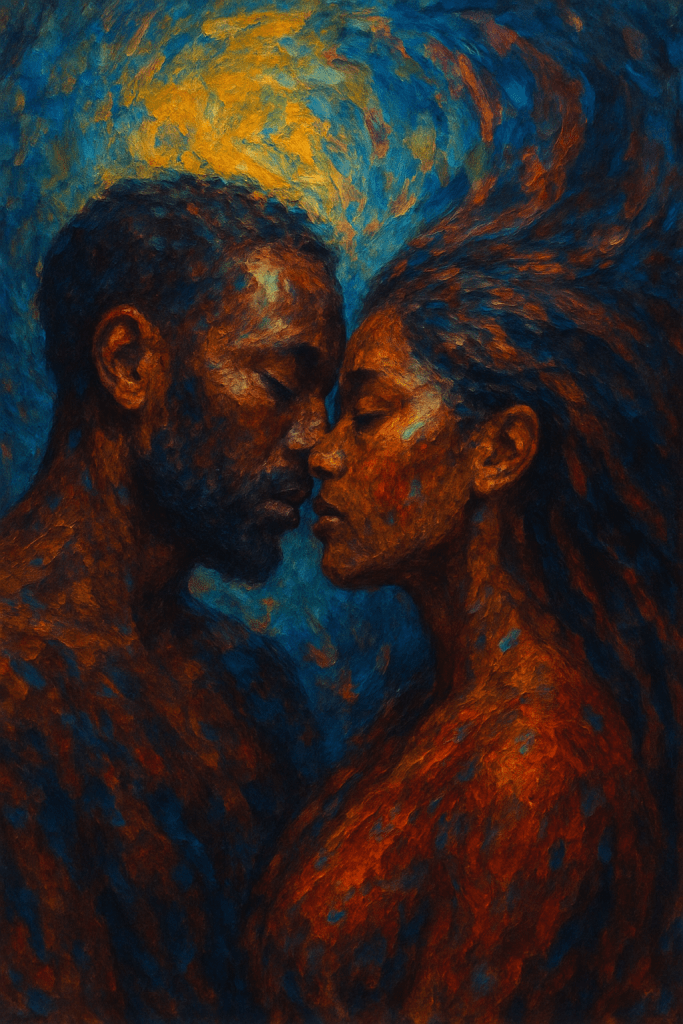
The awakened mind, when met with the receptive soul, becomes a current of divine fusion—an alchemical embrace where thought and feeling cease to be separate. This union transcends the limits of sensation, unveiling a pleasure far beyond the fleeting intoxication of flesh. It is an ascent into boundless wisdom, an eroticism of consciousness where insight spills forth, saturating the ego’s constructs until they dissolve into the vastness of being.

This is not a mere intellectual encounter, nor is it an indulgence in sentimentality. It is the tantric interplay between awareness and presence, where the pulsation of knowing meets the depths of surrender. When the mind no longer dictates and the soul no longer pleads, a stillness emerges—a space so open that it drowns the self in its own infinity. Here, knowledge is not collected but revealed, not possessed but embodied. Love is not an attachment but an atmosphere, pervading every movement, every breath, every silent recognition of the one essence behind all things.

This is where tantra ceases to be philosophy and becomes direct experience. The dissolution of the personal into the infinite is neither loss nor gain but a return—one that neither seeks nor resists, neither holds nor lets go. It is the eroticism of the absolute, where wisdom penetrates the soul like lightning, setting fire to all that would obscure its radiance.

The lover and the beloved, the seeker and the sought, the knower and the known—these distinctions fade into the luminous vastness of pure being. And from this space, all that remains is the silent ecstasy of knowing.

Morgan O. Smith

Get Your Free Copy of My Book, Bodhi in the Brain!

https://subscribepage.io/oTSZQu

The Stage Beyond Oneness

When Even the Kosmos Falls Away

There comes a point when even the most expansive vision collapses—not from error, but from completion.

On the path of awakening, seekers often journey from the confines of selfhood to a union with all things. Ego dissolves, and what once felt separate now reveals itself as interconnected. Compassion grows. The heart blooms for all beings. One begins to live for the Whole.

But for some, even this union becomes too crowded.

Even the notion of “One” becomes too noisy.

This is the threshold where Kosmocentric awareness—a state of profound unity with all life and existence—gives way to something quieter, more radical. Not a deeper connection, but the quiet erasure of the very need for connection. Not expansion, but the release of expansion itself.

This is acentric awareness.

Not centered on the self.

Not centered on the world.

Not even centered on the All.

Acentricity does not point toward identification with something greater. It simply makes no identification at all. No vantage point. No witness. No center from which to perceive. It does not declare that all is One—it no longer needs such declarations. Truth requires no thesis here.

Reality just appears.

Without context.

Without a watcher.

Without the echo of a thought that says, “I am aware.”

Call it suchness.

Call it the absence of everything, shimmering as everything.

Call it the stillness that doesn’t oppose movement, because it was never still.

This isn’t transcendence. It isn’t detachment. It isn’t a stance. It’s the utter end of stance—the collapse of spiritual architecture, without the rubble. It doesn’t reject the world. It simply no longer perceives it as something to accept or reject.

And what does such a life look like?

Unremarkable.

Utterly simple.

Perhaps quiet, perhaps animated.

But always empty of claim, even the claim to be empty.

There are no teachings left to transmit. Not because truth has been mastered, but because it was never a possession. No more climbing. No more seeking. No more union. Not even rest—because rest would imply effort once existed.

This is the unborn silence that does not speak—not even through the mouths of sages.

It appears as a leaf falling, as someone stirring soup, as the sound of a crow at dusk.

And you might pass by it without knowing.

Because it doesn’t need to be known.

It just is.

And it is no one’s.

Morgan O. Smith

Get Your Free Copy of My Book, Bodhi in the Brain!

https://subscribepage.io/oTSZQu

Once Enlightened… Your Problems Have Just Begun

The illusion is that awakening is the end of the road. That the moment the self dissolves, suffering bows out, and the curtain falls. But what if that moment is not an arrival, but a beginning?

Before awakening, the ego fights battles it believes are personal. After awakening, the battlefield is not smaller—it’s vaster, quieter, and infinitely more subtle. The old problems—desire, fear, control—don’t disappear. They shape-shift. They clothe themselves in spiritual garments and reintroduce themselves as paradoxes: “Should I speak, or is silence more aligned?” “Is this surrender or passivity?” “Am I still pretending there’s a me who can do or not do?”

No one warns you that after the clouds part, the sun may burn.

Liberation is not the end of pain. It’s the end of avoidance. One no longer flinches. One no longer hides. You feel fully raw, exposed, without anesthesia. And still, you sit. Still, you breathe. Still, you bow.

You now see with clarity what others can’t. You watch the mechanisms of ego turning behind the eyes of those you love, and the weight of compassion grows heavier, not lighter. You begin to weep for the world—not out of despair, but from a reverence so deep it bends your knees.

Once you’ve seen through the illusion of self, the world becomes impossibly intimate. Every leaf becomes your body. Every scream, your own. Every cruelty, a mirror reflecting the exact frequency of your forgotten selves. There is no refuge. There is only recognition.

You don’t get to leave the world. You return to it—with your skin ripped open, your boundaries gone, and your heart unarmored. Enlightenment doesn’t make you untouchable. It makes you unable to turn away.

There are no medals for realization. No applause for dissolving. No reward for merging with the absolute. What you get, instead, is a silence that never leaves you. A love so vast it terrifies the small mind. A clarity that strips you of every comfortable lie.

And you carry it.

Not as a badge.
As a burden.
As a blessing.
As a vow.

You walk through the world invisible, but more alive than ever. And your problems—they don’t vanish. They deepen. They purify. They sanctify.

Not because you are broken.

But now, you are whole.

Morgan O. Smith

Get Your Free Copy of My Book, Bodhi in the Brain!
https://subscribepage.io/oTSZQu

The Divide

Between the Remembered and the Realized

Enlightenment isn’t a collection of vivid memories. It isn’t a library of altered states or a gallery of peak experiences pinned to the walls of time. Enlightenment, in its truest sense, is what remains when all those moments pass. It is not recalled—it is present.

A spiritually enlightened being doesn’t describe what happened—they speak from what is. Their language may touch on form, but it arises from formlessness. It isn’t commentary on a past event; it is the echo of what is silently alive in that moment. Words are merely the condensation of what remains wordless within them.

Contrast this with the one who has had many spiritually enlightening experiences. There is often great sincerity, beauty, and wisdom in their sharing. But listen closely: their narrative carries timestamps. “This is what I saw… what I felt… what I realized…” There’s a distance, however subtle. A witness telling you what the moon looked like—rather than being the moon, shining right now, regardless of who’s watching.

This difference isn’t about hierarchy. One isn’t better, holier, or more awakened than the other. But there’s a distinct quality when realization is not merely visited, but abided in. When the identity that would lay claim to an experience has dissolved entirely.

Here’s the paradox: a being can be spiritually enlightened without ever having what we label as a “spiritual experience.” No blissful union, no white light, no serpents of energy climbing the spine. Their clarity is not the aftermath of an event—it is the absence of confusion. No fireworks. Just light.

They may speak little. Or not at all. There is no need to convince, convert, or collect followers. They are not on a path—they are the ground from which all paths appear.

On the other hand, a person with many enlightening experiences can describe with breathtaking poetry the landscapes of the soul. But unless those experiences have dissolved the one who experienced them, the self remains—refined perhaps, but still separate.

True awakening isn’t an experience you remember. It’s the end of the one who remembers.

This is why the most profound truths often arrive without announcement. A falling away, not an acquiring. A silent recognition that this—yes, this—is what always was. And suddenly, the need for experience evaporates. Presence alone becomes sufficient.

Morgan O. Smith

Get Your Free Copy of My Book, Bodhi in the Brain!

https://subscribepage.io/oTSZQu

You’re Not Greater Than Anything

You’re the Only One to Ever Exist

No one else has ever walked this Earth as you. Not a version, not a shadow, not a resemblance. Just you.

Not because you’re special in the usual way that word is thrown around, but because existence itself only ever unfolded once—and it’s doing so now, as you.

This isn’t about ego. Ego thrives on comparisons: greater than, less than, better, worse, worthy, unworthy. But the truth beneath all that noise isn’t about status—it’s about singularity. The kind that isn’t measured. The kind that never repeats.

People spend their lives searching for meaning, purpose, and a sense of identity. They try to earn significance or prove their worth. But importance isn’t earned—it is. You are the original event. Not one among many. Not one of a kind. The kind.

Look around. Every face you see, every story, every moment, all of it—just folds within the One. That same One expressing itself here as your particular breath, your memories, your voice, your fears and awakenings. The sky that bends over you is not separate from your gaze. The rhythm of the world doesn’t move beside you; it pulses through you.

To say you are not greater than anything is to drop the illusion of measurement. Of trying to win at some existential game. But then comes the deeper realization: You are not less than anything either. There is nothing else to measure against. You’re the first and last word of this moment.

Nothing else has ever existed apart from this.

So ask yourself: What happens when you stop performing for reality and start remembering that you are it? What shifts when you no longer strive to become someone meaningful, but realize that meaning itself is being?

You’re not here to improve reality. You are the revealing of it.

And this unveiling has never happened before—not like this.

Morgan O. Smith

Get Your Free Copy of My Book, Bodhi in the Brain!
https://subscribepage.io/oTSZQu

Liberate Yourself from Everything…

This Includes Spirituality

What if even the sacred must be left behind?

Not discarded with resentment, but dissolved with reverence—like incense that’s burned its final curl into still air. Every pursuit, no matter how noble or transcendent, clings to a subtle promise. It whispers, “Just a little further. Just a little more.” Spirituality—the path of paths—can become the gilded cage.

This isn’t a rejection of the sacred. It’s a call to recognize its shadow. When devotion becomes identity, and awakening becomes performance, the ground of true being quietly slips away. What remains is the effort of wearing a spiritual mask.

You meditate, fast, chant, and read the masters, and for a while, the momentum feels pure. But pause. Breathe. Look again.

Has the seeker been quietly resurrected each time insight arrives?

One of the final illusions is believing that freedom lies within the refinement of spiritual effort. Yet effort, no matter how subtle, arises within duality. There’s still a “me” reaching toward something else. Even the concept of enlightenment can act as a veil, because where there is something to reach, there remains something separate from what already is.

That’s the irony: the very thing that once cracked open your sense of reality may now be the weight tethering you to it.

There is no one to become. No final truth to grip. Liberation doesn’t crown the seeker—it dissolves them. It’s not what you attain through discipline. It’s what remains when every layer of becoming has been seen through.

God doesn’t need your spiritual journey.

Silence doesn’t demand your reverence.

Truth doesn’t require your understanding.

And being doesn’t wait for your arrival.

Strip it all away. Stand utterly exposed. Not as a soul, a student, or a sacred archetype—but as this unnamable presence you’ve never not been. This is where all paths terminate. Not with a bang. Not with celestial fireworks. But with a soft, undeniable recognition: nothing is missing. Nothing ever was.

To cling to spirituality, even subtly, is to delay this.

So let it all go—not to be less, but to finally see what you are without it.

Morgan O. Smith

Get Your Free Copy of My Book, Bodhi in the Brain!
https://subscribepage.io/oTSZQu

God Sees Through Every Eye You’ve Ever Met

The one who can hold all views without collapsing into a single one—this one has begun to touch the fragrance of God’s nature. Not as a distant deity or conceptual truth, but as the intimate presence that animates all forms. God doesn’t just witness through your eyes. God is your eyes. And mine. And the eyes of the ant crawling across a leaf in morning stillness.

This divine intelligence doesn’t merely empathize—it becomes. It becomes the grief you carry, the joy that surprises you, the silence you avoid, and the stillness you crave. Not as separate roles being played, but as the very substance of all that is.

To speak of God as past, present, and future is already a concession to language. What we call time, God weaves as a single gesture—fluid, simultaneous, indivisible. To the infinite, all points of view are a single vision. Yet paradoxically, each one is also honoured in its fullness.

So what does it mean to come closer to knowing God? It is not the attainment of a singular truth, but the expansion into every truth. It is the dissolution of needing one side to be right. The widening of the self to include what you once rejected.

The more vantage points you can stand upon without losing your groundless centre, the more you begin to see as God sees—not from above, but from within all.

And in that seeing, nothing is foreign. Nothing is separate. Nothing is unholy.

Morgan O. Smith

Get Your Free Copy of My Book, Bodhi in the Brain!

https://subscribepage.io/oTSZQu

When Reality Lets Go of Itself

Ultimate Reality doesn’t struggle to be known. It is not bound by time, thought, or perception, yet it plays with the illusion of being hidden. The one truth pretends to be many, and the One Self feigns division to taste reunion. But there comes a point—not always through effort, not always through grace—when even the illusion can no longer hold itself together.

It is not that Reality finds something new. It is that it no longer clings to the story of separation. The hand once clutching the dream loosens, not because it was forced open, but because the dream exhausted itself.

Falsehood requires maintenance. It must be believed, repeated, and reinforced. It relies on memory, identity, and the fragile continuity of thought. But what happens when the source of all this no longer cooperates? What happens when Reality drops the illusion of control?

There is no dramatic shattering. No cosmic trumpet. Only a quiet falling away of the effort to be something. What remains is neither void nor fullness—it is prior to both. Unnamable. Undeniable. You were never on a journey to find it. It was what you were before the seeker appeared.

To witness this unraveling is not an achievement. It is a disappearance. The one who thought it could hold Reality in its grasp is seen for what it was: a ripple mistaken for the ocean.

And when the ocean stops pretending to be a ripple, nothing changes—except everything.

Morgan O. Smith

Get Your Free Copy of My Book, Bodhi in the Brain!
https://subscribepage.io/oTSZQu

Beyond the Great Divide

White Supremacy, Caste, and the Collapse of Constructed Hierarchies through Nondual Perception

What happens to white supremacy when whiteness is no longer seen as a centre?
What becomes of caste when the hierarchy collapses into the unbroken Whole?
These aren’t abstract questions, but intimate ruptures in perception that strike at the root of separation.

From the nondual view, the machinery of supremacy and caste is not just unethical—it is illusory. A dream born of mistaken identity. These systems persist because the world is filtered through the lens of difference. They rely on “me” and “you,” “above” and “below,” “pure” and “impure.” Once those constructs dissolve, the scaffolding that held them together trembles.

To see with undivided awareness is not to turn away from injustice—it is to see it with such clarity that the illusion loses power.

The mind behind supremacist ideology must first construct a self that is isolated, then build defences around that self using race, status, bloodline, and geography. But once this boundary is questioned—not through philosophy, but through direct experience—an entire civilization of “better than” collapses into silence.

There is no whiteness in the Absolute. No Brahmin, no Dalit. No legacy of conquerors, no lineage of slaves. These roles, though ferociously enacted on the stage of form, do not survive the fire of presence. They belong to the play of names and forms—real enough to cause suffering, yet ultimately not what is.

Nonduality does not excuse or erase suffering. It reveals the mechanisms that perpetuate it: misidentification, grasping, and fear. And it points to the only true revolution—the recognition of what was never divided.

When someone rooted in supremacist delusion awakens to the groundless reality of Being, they are not offered a spiritual bypass, but a mirror. One that reflects every role played, every belief clung to, and the emptiness beneath them all. This is not comfort. It is unmaking.

Likewise, those dehumanized by caste are not told to ignore injustice. Rather, they are invited to witness that their essence was never touched by degradation. The soul, if we may call it that, has no fingerprints. No brand of subjugation can mark the formless.

The end of separateness is not utopia. It is not the promise of a better structure. It is the absence of structure where no one rules and no one serves. Where self and other melt into something wordless.

Once you know yourself as that which sees without division, supremacy is not just immoral—it’s absurd. The belief that one appearance of the Whole is more worthy than another is like believing one wave owns the ocean.

And so, from this stillness, something radical emerges: not activism rooted in identity, but action arising from unity. Compassion that does not pity, but recognizes itself. Justice that is not vengeance, but restoration of clarity. Love that is not sentimental, but annihilating.

The real threat to white supremacy and caste is not education alone, nor protest alone. It is the awakening of even one being to what cannot be divided. For when the illusion of separation dies, the systems built upon it cannot survive.

Morgan O. Smith

Yinnergy Meditation/Neurofeedback, Spiritual Life Coaching & My Book, Bodhi in the Brain…Available Now!

https://linktr.ee/morganosmith

What Can I Control?

A Nondual Reflection on the Illusion of Distinction

From a young age, we are taught to divide reality into two columns: what belongs to us and what belongs to others, what we can shape and what is beyond reach. This dualistic framework—“mine” versus “not mine,” “inner” versus “outer”—seems practical, especially when navigating the everyday world. But there comes a moment, often brought on by grace or deep inquiry, when this neat partition dissolves, and all that remains is undivided suchness.

From a conventional perspective, distinguishing between the self and the other is wise. One learns to take responsibility for thoughts, feelings, and actions while relinquishing attempts to control the mental and emotional weather of others. Yet this distinction is ultimately a mirage from the viewless view of Nonduality. There are no separate selves, no isolated thoughts floating inside “my” head, no truly foreign behaviour arising “over there.”

The very idea of control is a construct built atop the illusion of separation. In the deepest experience of pure awareness, even the one who seeks control disappears. There is only the arising of thoughts, feelings, actions, and phenomena within a seamless field of being. The idea that “my” thoughts are within “my” control is as illusory as the belief that someone else’s behaviour is truly “theirs.”

And yet, following such an experience, life continues. The body-mind returns to its rhythms. It begins again to label, to assign, to plan. What then? One doesn’t unlearn the insight. Instead, there arises a profound shift—a knowing that while dualistic functioning remains useful in relative existence, the truth of no-boundary consciousness pervades it all.

Over time, particularly as one matures into what Integral Theory calls the integral stage of development, a synthesis emerges. The subjective and the objective no longer stand opposed. Responsibility is no longer about control—it becomes an expression of harmony. One can hold space for others’ words and actions without trying to fix them, just as one can engage one’s thoughts and behaviours without clinging to the illusion of authorship.

There is no inside or outside. No one to control, and nothing to control. Just an unfolding—flawless in its mystery, unified in its movement.

Morgan O. Smith

Yinnergy Meditation/Neurofeedback, Spiritual Life Coaching & My Book, Bodhi in the Brain…Available Now!

https://linktr.ee/morganosmith