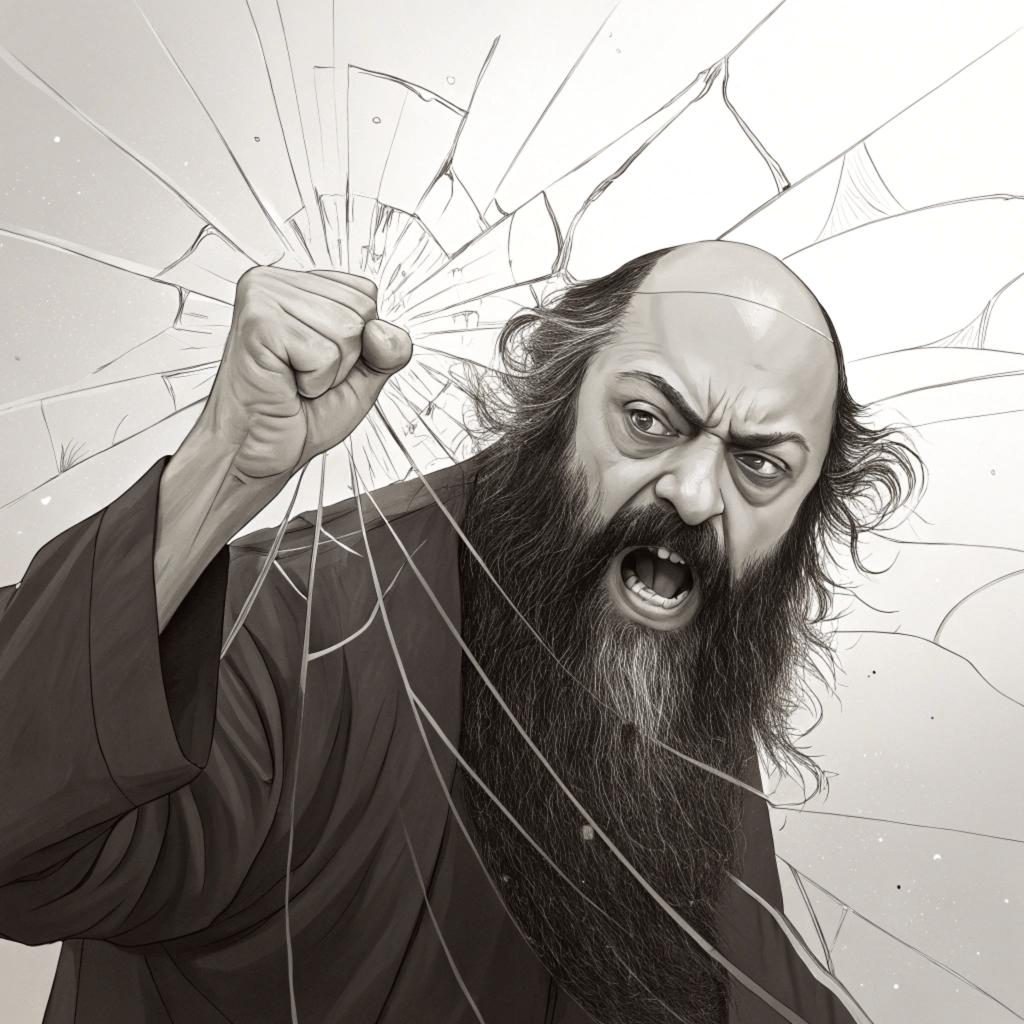
The Awakening That Shatters Illusions

The kind of awakening spoken of in hushed tones is not the polished enlightenment paraded as a spiritual accomplishment. It is not the gentle illumination that leaves one basking in self-satisfaction. This awakening will chase any so-called enlightened being back into the cave of the darkest shade of the blissfully ignorant.

There is a threshold beyond which the comfort of spiritual attainments dissolves, where the foundation of all presumed knowledge crumbles. Many claim to walk this path, but few have stepped beyond the point of no return. The self is torn open, and what is left is neither the seeker nor the sought. Any trace of identity vanishes like smoke swallowed by the wind.

Silence remains, not the cultivated silence of meditation, but the raw and inescapable absence of all that was ever known. Those who truly fall through the illusion do not return with neatly packaged wisdom. They do not speak of levels, progress, or mastery. They see no self to improve, no world to fix, no mind to transcend. Words become inadequate, and the urge to declare one’s arrival dissipates.

The mind clings to certainties, but what happens when even the witness dissolves? When there is no observer to claim insight, no reference point to anchor meaning? The dissolution is total. It does not comfort; it obliterates. Those who once seemed enlightened are left exposed, scrambling for the remnants of a ground that no longer exists.

This is why many turn back, seeking solace in philosophies, traditions, and spiritual titles. There is safety in keeping one foot on familiar terrain. The true leap leaves nothing to hold onto. Those who cross that final threshold do not emerge with proclamations of awakening. They are not concerned with recognition, nor do they offer roadmaps. They simply are – formless, weightless, ungraspable.

Some may glimpse this abyss and recoil, choosing the dream over the void. Others may step forward and vanish.

Morgan O. Smith

Yinnergy Meditation/Neurofeedback, Spiritual Life Coaching & My Book, Bodhi in the Brain…Available Now!


https://linktr.ee/morganosmith

The Unutterable Silence of Awakening

Awakening defies articulation. To attempt to describe it is to attempt to capture the wind in your hands. Words fall short, no matter how poetic, for what unfolds in the direct experience of awakening exists beyond language, beyond thought, beyond even the sense of “I.”

Many speak of awakening with eloquence, detailing radiant visions or profound realizations. Yet, these narratives, however beautiful, point not to the experience itself but to the mind’s interpretation of it. The mind, ever the storyteller, attempts to reduce the infinite into the finite—an impossible task. To truly know awakening is to step into a space where words crumble, where the sense of separation dissolves, and where only silence remains.

Awakening isn’t an event to possess or explain; it is an unravelling. It feels like the collapsing of a boundary you didn’t realize was there. What remains is indescribable, for there is no longer a “you” separate from it to describe it.

This doesn’t mean one cannot share insights or reflect on the shifts that arise after awakening. But those insights are not awakening itself—they are the ripples of an unfathomable stillness. Awakening is not what you think it is; it cannot be. The moment you attach a concept or image to it, you have moved away from its essence.

So, if you’ve managed to neatly define your spiritual awakening, pause. Ask yourself: who is telling this story? Is this the awakening, or is this the ego dressing itself in spiritual robes? Authentic awakening is not something you have—it is something you are. And when the truth of that hits, no words will suffice.

In the wake of awakening, the need to articulate dissolves. Silence becomes the truest expression of the infinite. Perhaps this is why the great sages often spoke so little, allowing their presence to say what words never could.

Morgan O. Smith

Yinnergy Meditation, Spiritual Life Coaching & My Book, Bodhi in the Brain…Available Now!

https://linktr.ee/morganosmith

Who and What Is Wearing the Ego

You Can Fully Know the Ego, or You Can Fully Know Who and What Is Wearing the Ego

The ego is a master of disguise, shaping itself to fit the roles, masks, and identities that define one’s place in the world. It is the voice narrating our experiences, the architect of our self-concept, and the filter through which we perceive reality. Yet, there comes a moment in every profound spiritual inquiry when the ego’s narrative starts to unravel, and a deeper question arises: Who is wearing the ego?

To fully know the ego is to observe its patterns, trace its motivations, and untangle its many threads. It is a deep and necessary work—this excavation of the self—but it often stops short of true liberation. Why? Because while one might understand the mechanisms of the ego, its fears, desires, and attachments, this understanding still operates within the ego’s domain. It is akin to studying a dream while remaining unaware that one is the dreamer.

The greater mystery lies beyond the ego’s web, in the silent witness observing it all. This witness is not a product of thought, nor is it bound by the limitations of identity. It is pure awareness, the unchanging presence in which the ego arises, performs, and dissolves.

To fully know who or what is wearing the ego requires a radical shift in perspective. It is not about fixing or eradicating the ego but seeing through its illusion altogether. The ego is neither enemy nor ally; it is merely a tool, a temporary garment worn by the ineffable essence of who you truly are.

This inquiry demands a willingness to surrender everything you believe about yourself, even the most cherished notions of spirituality and growth. It calls for courage to rest in the unknown, where no concepts or roles can anchor you. From this space, the ego’s dance loses its grip. The masks fall away, not because they were stripped, but because they were never truly real.

What remains is indescribable—a boundless, formless essence that cannot be confined to the limitations of egoic perception. To recognize this is to shift from being caught in the drama of the ego to embracing the freedom of the witness. This is the difference between living as the role and awakening as the wearer of all roles.

Ultimately, the choice is yours. You can spend a lifetime studying the ego, mapping its terrain, and understanding its dynamics. Or, you can turn inward, past the shadows and reflections, and discover the luminous presence wearing the ego—a presence that has been free all along.

Morgan O. Smith

Yinnergy Meditation, Spiritual Life Coaching & My Book, Bodhi in the Brain…Available Now!

https://linktr.ee/morganosmith

The Face of the Observing Self

What does it mean to observe oneself? To truly look inward is to confront the observer and the observed paradox. Self-observation reveals something both unsettling and liberating: the absence of a concrete “self” to observe. Yet, this absence is not a void; it is a vast, dynamic awareness that holds all experience without judgment or attachment.

When the mind turns its gaze inward, it seeks to grasp the essence of identity. Who is the one observing? Is it the body, the thoughts, or the emotions? As the layers of identity dissolve under scrutiny, the “face” of the observing self becomes clear: it has no features, no boundaries, no name. It is an awareness that exists beyond the stories we tell ourselves, beyond the constructs of past and future.

This realization often stirs resistance. The mind, conditioned to identify with roles and narratives, may fight to hold onto the illusion of a solid self. But the observing self invites surrender—not as a defeat but as a return to authenticity. To analyze its face is not to define it but to recognize that it is the source of all definitions, all perceptions, and all experiences.

In this space of pure observation, there is no judgment. Thoughts arise and fall away like waves; emotions flow without resistance. The observer does not interfere, label, or categorize. It is simply present, awake, and unattached. This is where true freedom lies—not in controlling the waves of experience but in abiding by the unmoving awareness beneath them.

The practice of observing oneself is not an escape from life but a profound engagement with it. It is the realization that the one who suffers, the one who desires, and the one who fears is not the ultimate truth of who we are. Beyond these transient identities lies the still, eternal witness, untouched by the flux of existence.

To analyze the face of the observing self is to encounter the formless essence of being. It is a mirror reflecting the infinite, a gateway to profound peace. This realization transforms how we engage with the world, fostering a deep compassion for ourselves and others. For when the illusion of separation falls away, what remains is love—the recognition that the observer and the observed are one.

Morgan O. Smith

Yinnergy Meditation, Spiritual Life Coaching & My Book, Bodhi in the Brain…Available Now!
https://linktr.ee/morganosmith

The Self You’ve Disowned

We often approach the idea of God as something external—an omniscient force watching from a distance, a transcendent creator who governs the cosmos. Yet this perspective keeps us trapped in separation, perpetually seeking something outside ourselves to fill a void or grant us salvation. What if the very concept of God points to an aspect of our being, an ultimate reflection of the self we’ve denied?

This disowned self isn’t the egoic identity that clings to its limitations. We have forgotten how to access the essence of boundless awareness, a space of infinite potential and wisdom. To disown something is to exile it from consciousness. And what has been exiled? The unconditioned self is the aspect of us that sees through the illusions of individuality and recognizes its oneness with all existence.

When we strip away the layers of attachment, fear, and identification with form, what remains? The answer is not a void in the nihilistic sense but a fertile emptiness where the fullness of life reveals itself. This is the realm where the divine resides, not as a being separate from you, but as the highest level of yourself—a self too vast, too luminous, to fit into the confines of your limited perception.

The Psychology of Disowning God

Many disown this ultimate self because embracing it requires the dissolution of the ego. We cling to roles, stories, and identities because they provide a sense of control. Yet these constructs are fragile, built on the shifting sands of impermanence. To own the highest self—the God-self—is to release the need for control, to step into the unknown with trust.

This is why the concept of God can evoke discomfort or skepticism. It forces us to confront the parts of ourselves that resist unity. The fragmented mind would rather see divinity as “out there” than face the profound responsibility of embodying it. To own the God-self is to accept that you are both the creator and the created, the ocean and the wave.

Reclaiming the Disowned Self

Reclaiming this aspect of the self is not about achieving something new. It is about remembering. This remembering begins with stillness—a radical turning inward that allows you to see the divine as the very ground of your being. It is the quiet realization that you are not a seeker in search of God; you are God, awakening to itself.

This journey requires profound courage. To reclaim the self you’ve disowned is to face the shadows you’ve avoided, to embrace the paradoxes of existence. It is to see that what you once called “God” and what you once called “self” are not separate, but one.

This realization does not inflate the ego. On the contrary, it dissolves it. When you live from the awareness of the highest self, every action becomes an expression of divine will. Compassion flows naturally because you recognize every being as another facet of the same essence. Suffering transforms into a teacher, guiding you back to wholeness.

Living from the God-Self

To live from this understanding is to inhabit life with clarity and grace. Challenges no longer feel like punishments but invitations to deepen your alignment with the divine within. Relationships are no longer transactional but become mirrors reflecting the infinite back to you. Every moment becomes sacred—not because of what it contains, but because of who you are as you experience it.

This is the ultimate paradox: God is not something you find; it is something you become by realizing you were never anything else.

Morgan O. Smith

Yinnergy Meditation, Spiritual Life Coaching & My Book, Bodhi in the Brain…Available Now!

https://linktr.ee/morganosmith

The Ultimate Love

The Force That Transcends All Boundaries

Love’s true essence is beyond comprehension, an omnipresent force so profound it erases the illusion of separation. It moves in dimensions beyond moral constructs, ideology, and identity. When fully realized, this love obliterates the ego and opens the heart so that even the most hardened souls cannot resist its call.

The human mind craves order, labelling people into categories—good, evil, victim, perpetrator. But ultimate love doesn’t comply with these distinctions. It meets each being at the core of their essence, beneath the conditioning and trauma that have shaped their actions. This kind of love can dismantle even the most fortified belief systems.

Imagine the inner world of someone consumed by hatred, caught in the web of fear, anger, and dogma. The walls around their heart seem impenetrable, yet ultimate love does not storm these walls; it dissolves them. It renders resistance futile by revealing what has been buried deep inside—a longing to belong, to be seen, and to be held in a space beyond judgment.

Ultimate love does not negotiate with the mind. It penetrates through the layers of identity, be it the identity of a saint or a sinner, revealing the same radiant essence beneath all masks. It leaves no room for pretense. This love cannot be owned, managed, or bargained with; it simply is.

Consider the most unimaginable scenario—a person shaped by the horrors of hatred, such as a Nazi, encountering the force of unconditional love. It is not a love that justifies or condones but one that sees beyond. That person’s history, belief system, and ideology would crumble under the weight of such grace. All that remains is a naked heart, laid bare in the presence of a force so magnificent it demands surrender. Not as punishment, but as liberation.

This love does not require forgiveness. It transcends it. Forgiveness suggests wrongdoing, but ultimate love offers a view where the need for forgiveness dissolves, revealing the underlying unity where all things are reconciled. When this love is encountered, tears flow not from shame, but from the relief of being released from the prison of the mind’s narratives.

This is the love that brings anyone, no matter how lost, to their knees—not out of fear, but in awe. It’s the moment when everything false melts away, and only the truth remains: the realization that there has never been separation, and love was the ground of all existence all along.

Ultimate love is not just the absence of hate; it is the luminous presence that absorbs even the darkest shadow, rendering it irrelevant. It is the undeniable force that brings every soul back to where it has always belonged—home.

Morgan O. Smith

Yinnergy Meditation, Spiritual Life Coaching & My Book, Bodhi in the Brain…Available Now!

https://linktr.ee/morganosmith

The Paradox of a Spiritually Enlightened Peak Experience

Imagine being pushed from a plane mid-flight, without a parachute. There’s no time to think, no time to brace yourself for impact. You are hurtling through the sky, weightless, untethered, and completely vulnerable. Fear may grip you momentarily, but something unexpected happens. You hit the ground—yet not only do you survive, but you rise and walk away unscathed, untouched by the experience as if the fall was merely an illusion.

This analogy comes close to capturing the essence of a fully spiritually enlightened peak experience. It is both terrifying and liberating, a moment where everything you thought you knew is shattered, yet something deeper emerges untouched. It’s not the kind of experience that fits neatly into the confines of logic or the safety of intellectual understanding. It pulls you beyond those limits, forcing you to confront the raw truth of existence in ways you hadn’t anticipated.

During such an experience, there’s no parachute to cushion the ego’s fall. The self—the constructed identity you’ve held onto for so long—dissolves, leaving nothing to cling to. Everything you believe about who you are, what reality is, and how life works evaporates in a moment of pure awareness. But instead of devastation, there is a strange sense of freedom. You realize the ground you thought you were plummeting toward was never real, to begin with.

What’s remarkable about this peak state is how it feels after. There’s a profound sense of survival, not in the physical sense, but at the level of awareness. You walk away from the experience unscathed because the true self, the part of you that is beyond mind and body, was never at risk. The fall, the impact, and the survival all exist within the realm of the illusion, but the awareness that experiences it all remains whole and untouched.

This awakening doesn’t come gently; it forces a reckoning with reality. But through that reckoning, you realize that what is truly real cannot be harmed. The body, the ego, the mind—all of these can be torn apart by life’s challenges and transformations. But the awareness that witnesses the fall? That remains pure and intact.

Living after such an experience brings with it a lightness, a profound sense of detachment that doesn’t arise from apathy but from clarity. You’ve seen through the illusion of the fall, and now, you move through life knowing that no matter what happens, the essence of who you are remains untouched. There’s nothing left to fear, no more clinging to the safety of the mind’s constructions.

This is the gift of spiritual enlightenment: not just the revelation that you can survive the fall, but the deeper realization that there was never anything to fall from in the first place.

Morgan O. Smith

Yinnergy Meditation, Spiritual Life Coaching & My Book, Bodhi in the Brain…Available Now!

https://linktr.ee/morganosmith

Unconditional Surrender

Embracing the Final Letting Go

Unconditional surrender is not simply about relinquishing control over circumstances, desires, or attachments. It goes beyond the surface. This form of surrender requires the release of the very concept of surrender itself. It demands a level of vulnerability so profound that even the notion of letting go must be let go.

What happens when there’s no longer anything to hold on to? Nothing to release? This is where true transformation begins. In this space, we step outside the dualistic framework of control versus surrender and touch something far deeper, a level of being where no effort or resistance exists. We are often conditioned to think that surrender means losing, giving up, or sacrificing. But unconditional surrender is not a loss—it is the full embrace of existence without the filters of ego, fear, or the need to manage outcomes.

When one stands in this openness, fully exposed and defenceless, something extraordinary happens. You come face to face with the reality of all that is. Without the mind’s endless chatter and strategies, there’s nothing left but the raw, unfiltered truth. And in that truth, you find freedom—not in the way we might imagine, but in a way that defies all prior understanding.

In the vulnerability of surrender, we experience what it means to exist without resistance, without striving, without seeking. It’s not about achieving some spiritual milestone or reaching a perfect state of being. Instead, it’s about dissolving the layers of defence we’ve built, trusting that whatever remains is exactly what was meant to be.

This path is not for the faint-hearted. It requires courage to step beyond the boundaries of the self and to let go of everything we’ve ever known. Yet, paradoxically, it is only through this act of ultimate surrender that we come to experience true liberation.

I would like to thank my colleague, Prakash, for mentioning Unconditional Surrender during our The Seekers Mind Clubhouse debate and for inspiring this piece.

Morgan O. Smith

Yinnergy Meditation, Spiritual Life Coaching & My Book, Bodhi in the Brain…Available Now!

https://linktr.ee/morganosmith

The Elusive Blind Spot of Enlightenment

A paradox begins to unfold from the moment consciousness takes form and you are born into this world. Enlightenment, often considered the pinnacle of spiritual realization, simultaneously becomes a blind spot. It’s not that enlightenment is absent; rather, it exists so close to you that it evades your direct perception. The act of becoming a being—separate from the whole—creates the veil obscuring what was never lost.

Most people search for this elusive state, hoping to grasp it through teachings, practices, and philosophies. Yet, the search itself can deepen the sense of separation, reinforcing the idea that enlightenment is something external to be found. But what if enlightenment was never something you needed to find? What if it was something you simply needed to stop resisting?

Human existence is an exquisite contradiction. On one hand, the moment you identify as an individual, you begin to experience duality—subject and object, self and other. On the other hand, this identification simultaneously masks the realization that you are already one with everything. Enlightenment is not an external destination; it is the underlying reality that permeates your existence.

The blind spot isn’t due to a lack of spiritual capacity or effort, but the mind’s incessant clinging to the notion of self. The moment you try to achieve enlightenment as a personal goal, it slips further away, like trying to catch a shadow. Perhaps the real journey is not about seeking, but about unlearning. The simplicity of just being, without striving, can often be the most profound realization of all.

What happens when you stop searching? What if you allow yourself to see that enlightenment is not a peak experience to attain, but the constant, ever-present background of awareness that you are, and always have been? This blind spot only remains as long as there is an effort to overcome it. Let go of that effort, and what reveals itself has been present all along—your original nature.

The key lies in the willingness to let go of the need for enlightenment, to surrender the very idea that you are separate from it. Only then does the blind spot dissolve, and the reality of your true self, free from all constructs, comes into clear view.

Morgan O. Smith

Yinnergy Meditation, Spiritual Life Coaching & My Book, Bodhi in the Brain…Available Now!

https://linktr.ee/morganosmith

The Depth of Spiritual Comprehension

Beyond the Surface of Enlightenment

The spiritual journey often carries a mystique, with enlightenment perceived as a final, transcendent state reached after years of dedicated practice. However, the true essence of enlightenment lies not in a distant destination but in an ongoing process of deepening comprehension. This spiritual comprehension, the act of truly understanding and embodying spiritual truths, transforms enlightenment from an abstract ideal into a living reality.

Comprehension in this context goes beyond the intellectual grasp of spiritual concepts. Reading texts or engaging in discussions about spirituality provides a foundation, but deeper understanding requires a profound recognition and integration of the truths of existence into one’s being. This type of comprehension changes the way you perceive yourself, others, and the world around you.

Comprehending Comprehension

Understanding comprehension itself involves stepping into a realm of profound self-awareness. Looking beyond the surface level of experiences and teachings becomes essential, prompting questions about the nature of understanding. What does it mean to truly understand something? How does comprehension differ from mere knowledge? Such inquiries are vital on the spiritual path, pointing to a deeper engagement with the teachings and practices that guide us.

Spiritual comprehension refers to a transformative process where the seeker transitions from knowing about enlightenment to embodying it. This process often involves the dissolution of the egoic self, the release of attachments, and the embrace of a reality both mysterious and deeply intimate.

The Unfolding of Spiritual Comprehension


The unfolding of spiritual comprehension does not follow a linear path. Rather than a straight journey from ignorance to knowledge, from darkness to light, it unfolds as an ever-deepening spiral. Each turn brings us closer to the core of our being. Through this spiral, enlightenment reveals itself not as something to be acquired but as something to be awakened to—a recognition of what has always been present.

Comprehension then becomes an experiential understanding, a lived reality where the boundaries between self and other, subject and object, dissolve. The mind’s incessant chatter quiets, leaving a clear, direct perception of truth—pure, unfiltered awareness, unclouded by concepts or beliefs.

Living Comprehension

Living comprehension means embodying the spiritual truths understood. These truths guide actions, thoughts, and interactions with the world, bringing the light of enlightenment into every aspect of life, from the most mundane tasks to the most profound spiritual practices.

Such embodiment is not about striving for perfection or adhering to an idealized notion of enlightenment. Instead, it means being authentically human, embracing all complexities and contradictions while remaining rooted in the deep understanding of true nature.

Conclusion: The Infinite Depths of Comprehension


Spiritual comprehension represents an infinite journey, a realization that there is always more to understand, integrate, and embody. Enlightenment becomes not a final state but a dynamic process of ongoing revelation. As the depths of spiritual comprehension continue to unfold, the infinite possibilities of being fully alive, fully awake, and fully present in this moment emerge.

Morgan O. Smith

Yinnergy Meditation, Spiritual Life Coaching & My Book, Bodhi in the Brain…Available Now!

https://linktr.ee/morganosmith