Author, Philosopher, Spiritual Teacher, A Lead Facilitator at Sacred Media's Integral Mastery Academy, Founder of Yinnergy Meditation/Neurofeedback, Bodhi Mental Care & Wellness, Co-founder of KeMor Centre for Innovative Development
Metaphysics promises a final explanation. A last framework. A language vast enough to contain reality itself.
Yet even metaphysics appears within experience. Thought observes it. Consciousness hosts it. Awareness remains prior to it.
Metaphysics refines questions about being, causation, time, self, and origin. Each refinement sharpens conceptual clarity, yet clarity still belongs to the realm of concepts. No matter how subtle the idea, it remains an appearance.
Absolute truth does not require explanation. Explanation arises only when something seems absent or incomplete. Reality, when directly encountered, carries no demand for justification.
Metaphysics attempts to map the territory beyond appearances. Maps, however elegant, never become the terrain. The most intricate metaphysical system still rests on distinction—between subject and object, knower and known, framework and what it seeks to frame.
Nonduality reveals a quiet rupture. Nothing stands outside awareness to be explained. Nothing stands inside awareness that needs interpretation.
Metaphysics dissolves not because it is false, but because it is unnecessary. Truth does not depend on coherence. Existence does not depend on intelligibility.
What remains after metaphysics collapses is not ignorance. What remains is immediacy without commentary. Presence without architecture. Knowing without a structure that claims ownership of it.
The mind seeks altitude. Awareness requires no elevation. Being does not stand above itself.
Metaphysics is a beautiful scaffolding. Scaffolding eventually comes down. What stands was never built.
No ultimate explanation arrives. No final philosophy survives. Only what has always been—prior to meaning, prior to understanding, prior to the urge to explain—remains unmistakably present.
Maya survives by costume. Names, stories, identities, and roles, each layer persuades awareness that something solid is happening. The spell works because the layers are convincing, not because they are true.
Removing them is not an act of destruction. Nothing is torn away. Nothing is violated. What falls off was never stitched to reality in the first place.
Belief drops first. Then interpretation. Then the quiet assumption that experience belongs to someone.
What remains cannot be described without borrowing from the very illusion that has just dissolved. Language reaches for shape, but shape no longer holds. Meaning loosens its grip. Time forgets how to move forward. Causation loses its authority.
No hidden essence appears. No final revelation arrives. No sacred object waits beneath the last veil.
Maya does not conceal truth. She is the activity of concealment.
When nothing is left to remove, there is no witness standing apart, no awareness peering at emptiness. Seeing collapses into what is seen. Knowing continues without a knower. Function carries on without ownership.
This is not transcendence. This is intimacy without distance.
The world resumes exactly as before; faces, traffic, obligations, joy, grief, but the spell has lost its teeth. Appearances no longer demand belief. Forms no longer claim authority. Experience is free to arise without needing to justify itself.
Maya, stripped of every disguise, reveals no secret. Her final gesture is silence.
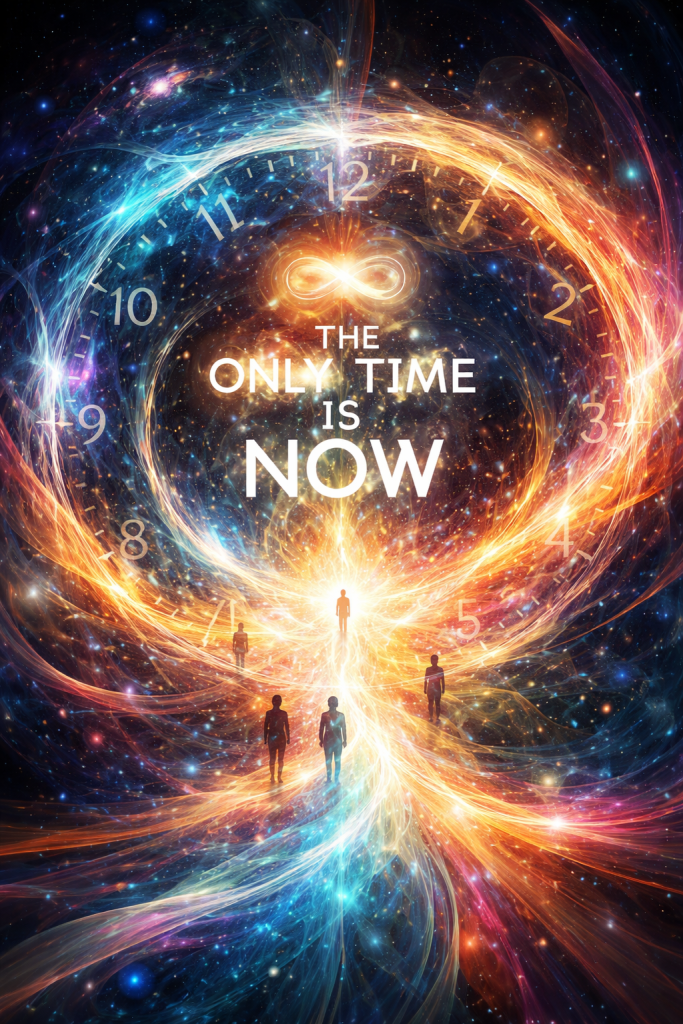
Something subtle hides behind every assumption about life. We speak of beginnings, endings, origins, destinies, memories, plans. Language slices reality into segments and calls the slices time. Past. Present. Future.
Direct experience never confirms this division.
Look carefully.
No one has ever stepped into yesterday. No one has ever arrived at tomorrow. Everything that has ever appeared shows up only as this immediate presence.
Not a moving present. Not a fleeting instant.
A boundless, indivisible now.
Mind imagines a line stretching backward and forward, yet perception offers no such line. Thought tells stories about what was and what will be, but those stories arise as present thoughts. Memory occurs now. Anticipation occurs now. Even the idea of history unfolds now.
Remove thought for a moment and see what remains.
Only this.
A beginningless display with no edge to trace. An endless unfolding with nowhere to land.
Nothing truly starts. Nothing truly stops.
Birth and death appear as transitions inside perception, not events happening to existence itself. Waves rise and fall, yet water never begins or ends with any single wave. Every form behaves the same way. Appearance comes and goes. Being does not.
Cause and effect seem separate only because mind arranges events into sequence. First this, then that. Push, then response. Action, then consequence.
Observe more closely.
Cause and effect share the same instant. The spark and the flame are one movement. Seed and tree are different names for one process.
Nothing travels through time to produce something else. Everything co-arises. Each moment contains the totality.
That means creation and destruction are not opposite forces.
They are the same gesture.
Every perception is simultaneously appearing and disappearing. Each sight is born as it fades. Each sound vanishes as it arrives. Reality recreates itself continuously without carrying anything forward.
World dissolves and reforms faster than thought can measure.
Continuity is a useful illusion.
Life becomes lighter when this is recognized. Regret loses its grip because there is no past to fix. Anxiety softens because there is no future to secure. Control relaxes because nothing stands outside the present to manage.
Responsibility remains, yet it feels different. Actions arise from clarity rather than fear. Choices flow from immediacy rather than projection. Compassion deepens because everything shares the same timeless ground.
Nothing stands apart.
Every face, every event, every challenge expresses the same indivisible happening.
No separate moment waits elsewhere. No hidden realm holds another version of reality.
This is it.
Not a fragment. The whole.
Eternity does not stretch forever. Eternity reveals itself as what never moves.
A quiet assumption hides beneath most human searching: something out there must last. Something must remain untouched by erosion, loss, time, or collapse. That assumption fuels religion, philosophy, science, self-help, and even despair. Yet careful observation reveals a startling reversal; everything we try to secure as permanent is precisely what cannot stay.
Bodies age. Identities shift. Beliefs mutate. Civilizations rise and fall. Even universes, according to modern cosmology, are not exempt from birth and dissolution. Permanence refuses to appear where attention habitually looks.
What does remain cannot be grasped as an object.
Change never pauses. This is not a poetic statement but a structural fact. No phenomenon has ever been observed to freeze itself into finality. Even stability is a form of slow motion. Even stillness contains motion beneath its surface. Change does not fluctuate. It does not improve. It does not degrade. It simply is.
Impermanence, often misunderstood as a gloomy conclusion, turns out to be absolute. Nothing violates it. Not matter. Not energy. Not thought. Not consciousness as an experience. Impermanence itself never wavers.
Awareness appears constant, yet experiences within it rotate endlessly. Sensations replace sensations. Thoughts override thoughts. Emotions dissolve into others. What remains is not a personal witness but the bare fact that experiencing is happening at all. That fact has no texture, no color, no personality, and no history. It does not evolve because evolution belongs to what appears within it.
Absence plays an unexpected role here. No thing possesses an independent core. Every form depends on conditions that are themselves dependent. This lack of inherent selfhood does not come and go. It is always already the case. What seems solid holds together through relationship alone.
Separation feels real, yet it never completes itself. Subject and object arise together. Observer and observed cannot be pried apart without collapsing the experience entirely. Duality functions, but it does not fracture reality. Division appears without dividing.
Nothingness, often feared or romanticized, is better understood as openness. Forms emerge, interact, and vanish without ever crystallizing into fixed essence. Emptiness does not negate existence; it allows it.
What never changes does not announce itself. It cannot be defended or achieved. Seeking it as an attainment guarantees frustration. It is not hidden. It is overlooked because it lacks features.
Everything changes. That does not.
Recognition of this does not erase life’s texture. It sharpens it. When permanence is no longer demanded of form, form is finally allowed to be what it is; temporary, intimate, vivid, and sufficient.
Nothing needs to be saved from change. Nothing needs to be added to what already remains.
Human understanding evolves by taking positions. At first, reality is personal. Experience belongs to me. Then it becomes relational. There is you. Then objective. There is the world. These perspectives organize life, language, and survival. They also quietly assume something deeper: a vantage point from which all of this is known.
The fourth perspective emerges when that assumption is examined.
At this level, identity no longer anchors experience. Thoughts, sensations, and events appear without belonging to a self. Awareness is no longer located behind the eyes or inside the body. Experience is revealed as happening within an impersonal field. Nothing is owned. Nothing is central. Knowing continues, yet no knower can be found.
This recognition often carries clarity, peace, and coherence. Reality appears seamless. Distinctions soften without disappearing. Functioning remains intact, but the sense of authorship dissolves. Many traditions stop here and mistake this discovery for the final truth.
That pause matters.
The fifth perspective does not deepen the fourth. It removes the need for it.
The idea of an underlying field, awareness, or witnessing presence is seen as another explanatory structure. Useful, elegant, even beautiful, but unnecessary. The question of what everything appears within loses relevance. No ground is required. No container is implied. No reference point is privileged.
Reality no longer needs to be described as nondual. It no longer needs to be described at all.
This is not an experience. It does not arrive. Nothing stabilizes. Nothing collapses. The framework that seeks a final position simply fails to apply. Language continues to function, but without metaphysical commitment. Perspectives still appear, but none are taken as true in themselves.
The fourth perspective reveals that there is no centre. The fifth reveals that even that revelation was optional.
This does not result in indifference or withdrawal. Action continues. Care continues. Creativity continues. Meaning appears where it always did; within context, relationship, and response. What falls away is the assumption that reality needs a final explanation to be complete.
Ultimate reality is not hidden behind experience. It is not accessed by climbing to a higher vantage. It does not require awareness, unity, or silence to validate itself.
What remains is remarkably ordinary. Life unfolds. Language speaks. Understanding happens. Nothing needs to be added. Nothing needs to be removed.
The difference lies only here: no perspective is mistaken for what is real.
“Nothing” is what it appears to be. The difficulty is not its subtlety, but our resistance to the obvious. Bias does not distort reality by adding complexity; it obscures by insisting that something more must be there.
The mind is conditioned to hunt for substance. It scans experience for objects, causes, meanings, and conclusions. When it encounters absence, silence, or emptiness, it assumes a failure of perception rather than the possibility that absence itself is the disclosure. Nothing is dismissed as a placeholder, a gap waiting to be filled, instead of recognized as complete.
Bias enters quietly. It wears the mask of intelligence, spirituality, and discernment. It whispers that truth must be profound, layered, or difficult to access. It suggests that what is immediately present cannot be ultimate, because it does not feel earned. Yet this assumption is precisely what blocks seeing.
Nothing does not hide behind form. It is revealed as form. Every sensation, thought, and emotion arises from it without leaving it. The error lies in expecting Nothing to announce itself as an object among objects. It does not compete for attention. It is the condition allowing attention to appear at all.
Seeking reinforces the bias. The seeker assumes a distance between what is and what should be known. That distance is imagined. Nothing is already fully exposed, but the demand for interpretation overlays it with concepts, metaphysics, and personal narratives. The obvious becomes invisible because it lacks drama.
Bias also clings to continuity. It prefers stable identities, persistent meanings, and coherent stories. Nothing threatens these preferences, not by opposing them, but by showing they were never fixed to begin with. The mind resists this not out of fear of annihilation, but out of loyalty to familiarity.
Seeing Nothing requires no refinement of perception. It requires the cessation of interference. When bias relaxes, what remains is not a revelation, but an acknowledgment. Nothing stands as it always has—unconcealed, ordinary, and sufficient.
No transformation is required to meet it. Only the willingness to stop arguing with what is already clear.
Morgan O. Smith
Get Your Free Copy of My Book, Bodhi in the Brain!
Presence does not arrive with birth, nor does it depart with death. It does not wait for time to pass or moments to accumulate. Presence is already here; before thought names it, before memory reaches backward, before imagination leans forward. Whatever appears does so within presence, not alongside it.
The past feels real only because it is remembered now. The future feels compelling only because it is anticipated now. Thought moves, images shift, emotions rise and fall, yet each movement occurs against the same unmoving fact: presence has never left. Even the idea of being elsewhere is something that appears here.
Bodies change. Identities dissolve and reform. Worlds expand and collapse. Physics tells us that matter and energy do not vanish; they transform. Even more striking, what we call matter accounts for only a fraction of what exists. The vast remainder: dark energy, dark matter, remains unseen, unnamed, yet undeniably present. Absence itself never escapes presence. Non-existence, if such a thing could be said to occur, would still be known as present.
Death, then, does not challenge presence. It only challenges continuity of form. If awareness continues, presence continues. If awareness ceases, the cessation itself is not outside presence. Nothing steps beyond it. Nothing escapes it. There is no edge where presence stops and something else begins.
Impermanence governs every form. Thoughts change. Bodies age. Stars burn out. Universes may even end. Yet impermanence depends on something that does not change. Change can only be noticed because presence remains steady enough to register it. Movement requires a stillness that is never lost.
Presence does not belong to you, yet nothing is more intimate. It is not located inside or outside. Those distinctions arise within it. Every attempt to grasp presence turns it into an object and misses it. Presence cannot be held because it is what is holding everything else.
Even the end of everything would not be an end of presence. It would simply be presence without form. No time. No matter. No universe. Still present.
Nothing needs to be added to this. Nothing needs to be resolved. Presence is not a conclusion; it is the condition that allows conclusions to appear and disappear.
And it has never not been here.
Morgan O. Smith
Get Your Free Copy of My Book, Bodhi in the Brain!
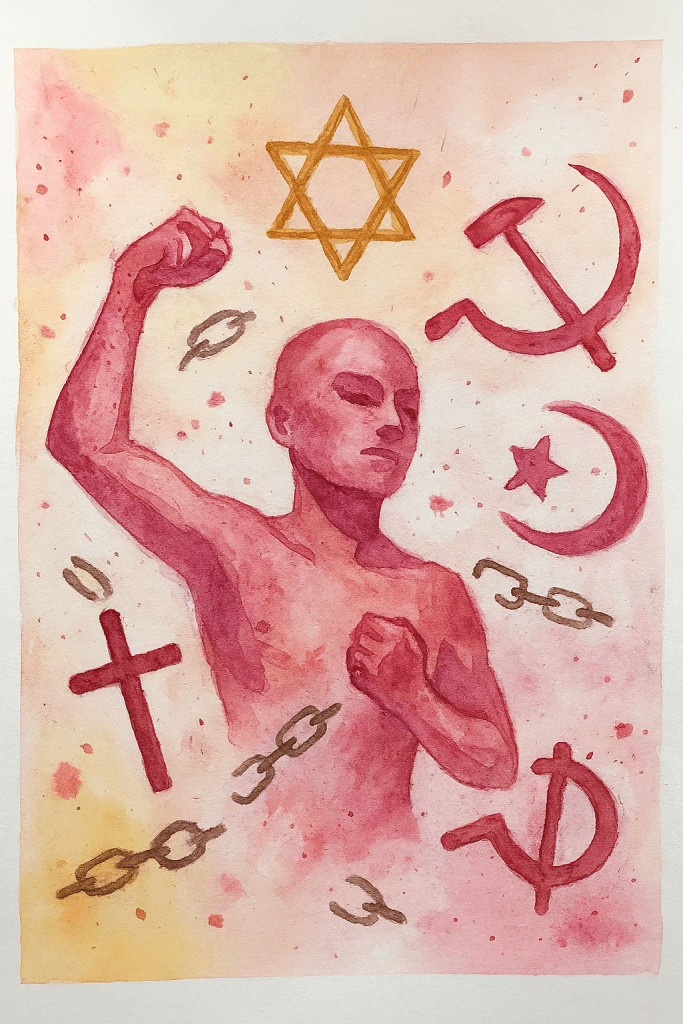
Religion need not be a creed one defends or a ritual one performs. For some of us, it is the recognition of the bars we forge around our own minds—and the relentless devotion to dissolving them. Liberation becomes both the path and the sanctuary.
This isn’t about conversion, salvation, or belonging to any particular sect. It is about noticing the prison of belief itself. Every concept, every identity, every longing for certainty can become a gatekeeper denying entry to our own boundless nature.
Liberation demands a fierce honesty. It asks that we examine the illusions that hold our suffering in place, not as moral failings but as invitations to see through the lie of separation. The true heresy in this religion is clinging to what we think we know about ourselves, about others, about reality itself.
No priest is needed here. Authority resides in awareness, and awareness has no master. The teacher is the arising of life as it is—grief, joy, confusion, clarity. Each moment grants a new chance to recognize the play of experience without getting caught in it.
Liberation is not found by rejecting the world but by perceiving its emptiness and fullness simultaneously. Every object, thought, and sensation is free of substance even as it shines in unmistakable vividness. This paradox isn’t a puzzle to solve but a doorway to live through.
When liberation is the religion, love ceases to be a commandment and becomes the ground of being. Judgment collapses, not because everything is permitted, but because everything is understood as oneself. The compulsion to divide the sacred from the profane, the pure from the impure, loses its grip.
Such a path offers no final doctrine. It holds no promise of eternal reward. Yet it is more generous than any creed that trades truth for comfort. It is the faith of those willing to die before death—to watch every cherished certainty burn so that what cannot be burned may reveal itself.
Those who walk this path do so alone, yet never apart.
Morgan O. Smith
Get Your Free Copy of My Book, Bodhi in the Brain!
Every belief we hold about reality begins with a fundamental assumption: that something exists. Objects, thoughts, emotions, and even the concept of the self are taken as undeniable truths. But when we look closer, reality reveals itself to be far less solid. Strip away perceptions, dismantle the narratives, and what remains? Nothing. Not the nothing of absence, but a profound, living nothingness that holds the potential for everything.
The paradox lies here: if nothing truly exists, then what is aware of this nothing? What observes the rise and fall of sensations, thoughts, and forms? The answer is the witness—pure awareness, untouched by the shifting currents of existence. It is not an object that can be grasped, but the context in which all objects appear.
What Is the Witness?
The witness is not the thinking mind or the personality you’ve constructed through years of conditioning. It is that which observes even the mind itself. The witness is silent, still, and ever-present. It is not bound by time, nor does it possess a location. While the body and thoughts belong to the world of form, the witness transcends it entirely.
When you recognize the witness, the illusion of existence begins to unravel. The objects of your awareness—whether external events or internal thoughts—are revealed to be fleeting, momentary phenomena. They appear, they shift, and they dissolve, leaving no trace of permanence. The witness alone remains unchanged, untouched by the dance of creation and destruction.
Nothingness as Freedom
The recognition that nothing exists liberates you from attachment. If everything is transient, then clinging to any experience, belief, or identity is an exercise in futility. This does not mean rejecting the world but meeting it with openness, seeing it for what it is: a play of appearances arising within the vastness of nothingness.
This nothingness is not cold or lifeless. It is the fertile void from which all existence springs, a source of infinite creativity and potential. The witness watches the unfolding of this creative process, yet remains uninvolved, free from entanglement.
Who Experiences Existence?
The ultimate question arises: if nothing exists, how can existence be experienced at all? The witness is both the perceiver and the essence of existence itself. It is through the act of witnessing that “existence” takes on meaning. Without the witness, there is no one to perceive existence. The world, as we know it, cannot exist independently of the awareness observing it.
This insight has profound implications. The separation between the experiencer and the experienced dissolves. Reality is no longer something “out there” to be analyzed or controlled; it is a dynamic flow that arises within you, as you. The witness is not apart from existence—it is existence, recognizing itself through the illusion of separation.
Living as the Witness
To live as the witness does not mean rejecting the world or detaching from life. It means fully engaging with reality while knowing its true nature. You move through life with clarity, seeing that every thought, every sensation, and every moment arises from nothing and returns to nothing. The recognition of this emptiness brings freedom—not a withdrawal from life, but a deeper immersion in its sacredness.
When the witness becomes your anchor, suffering loses its grip. Challenges and emotions no longer define you; they are simply waves in the ocean of awareness. Relationships deepen, as you no longer seek validation or fulfillment from others. The peace of the witness is enough.
This realization is not a conclusion but an ongoing experience. Every moment offers an opportunity to rest in the witness, to see through the illusions of existence, and to marvel at the profound simplicity of being.
Morgan O. Smith
Yinnergy Meditation, Spiritual Life Coaching & My Book, Bodhi in the Brain…Available Now!
In the vast expanse of spiritual philosophy, the concept of ultimate reality often emerges as a profound focal point of contemplation. At its core, ultimate reality is a paradox: an emptiness encompassing all that takes form. This paradox invites us to explore the intricate dance between the seen and the unseen, the manifest and the unmanifest, and the ever-present flow between these states of being.
Emptiness, in its essence, is not a void in the conventional sense. It is a fertile ground, a boundless potential from which all phenomena arise. This emptiness is not devoid of life; rather, it is the very source of existence, the womb of creation. It is in this emptiness that the seed of every form, every thought, and every experience is planted and nourished.
When we speak of “everything that takes form,” we refer to the myriad expressions of life—mountains and rivers, thoughts and emotions, stars and galaxies. These forms are the manifestations of the underlying emptiness, brought into being through the dance of energy and consciousness. They are transient, ever-changing, yet intimately connected to the unchanging, formless essence from which they emerge.
This understanding challenges us to look beyond the superficial appearances of the world. It encourages us to see the impermanent nature of forms, not as a cause for despair, but as an invitation to connect with the timeless reality that underlies all existence. This connection fosters a deep sense of peace and acceptance, as we recognize that everything, in its transient nature, is a part of a greater whole.
To truly grasp the nature of this ultimate reality, one must move beyond intellectual understanding and into direct experience. This requires a quieting of the mind, a stilling of the incessant chatter that often distracts us from the subtle truths of existence. In moments of deep meditation or profound insight, we may glimpse this ultimate reality—a state where the distinction between emptiness and form dissolves, and we perceive the unity that lies at the heart of all things.
In this state of awareness, we see that emptiness is not a lack, but a fullness—a fullness that contains all possibilities, all potentialities. It is a space of infinite creativity, where the play of consciousness unfolds without limit. This realization transforms our perception, allowing us to live with a sense of wonder and reverence for the mystery of existence.
As we navigate the challenges and joys of life, this understanding can be a guiding light. It reminds us that, at our core, we are not separate from the world around us, but deeply connected to it. In embracing the paradox of emptiness and form, we find a deeper meaning in our experiences and a greater compassion for all beings.
The journey to this understanding is a lifelong one, filled with moments of clarity and confusion, insight and doubt. Yet, each step on this path brings us closer to the heart of the mystery, where we may find a profound sense of peace and a recognition of the sacredness of all life.
Morgan O. Smith
Yinnergy Meditation, Spiritual Life Coaching & My Book, Bodhi in the Brain…Available Now!



 Morgan O. Smith