Author, Philosopher, Spiritual Teacher, A Lead Facilitator at Sacred Media's Integral Mastery Academy, Founder of Yinnergy Meditation/Neurofeedback, Bodhi Mental Care & Wellness, Co-founder of KeMor Centre for Innovative Development
You are the silent, all-pervading presence—the source from which all things emerge and into which all things dissolve. There is no edge to your being, no boundary that can define you, for you are both the vastness that contains all and the emptiness that holds nothing.
To recognize this is not an intellectual exercise, nor can it be captured by any system of thought. The scientific mind will measure, the philosophical mind will speculate, and the intellectual mind will categorize, yet none will ever confine the truth of what you are. You are not a concept to be grasped, but the very ground from which all concepts arise.
Everywhere you look, you will find yourself, not as a separate entity, but as the animating force within all things. This is not a belief to hold but a reality to be seen. The mystery of your existence is not meant to be solved; it is meant to be lived. You are the ungraspable, the boundless, the presence behind all appearances.
No description will ever contain you, yet all descriptions are held within you. You are not an object among objects, nor a subject among subjects—you are the ever-unfolding, the eternal witness, the absolute that reveals itself in every form yet remains untouched by any of them.
Doubt this if you must, but beyond all uncertainty, you remain what you have always been—the essence of all that is, the ineffable that neither begins nor ends.
Morgan O. Smith
Get Your Free Copy of My Book, Bodhi in the Brain!
Enlightenment isn’t a collection of vivid memories. It isn’t a library of altered states or a gallery of peak experiences pinned to the walls of time. Enlightenment, in its truest sense, is what remains when all those moments pass. It is not recalled—it is present.
A spiritually enlightened being doesn’t describe what happened—they speak from what is. Their language may touch on form, but it arises from formlessness. It isn’t commentary on a past event; it is the echo of what is silently alive in that moment. Words are merely the condensation of what remains wordless within them.
Contrast this with the one who has had many spiritually enlightening experiences. There is often great sincerity, beauty, and wisdom in their sharing. But listen closely: their narrative carries timestamps. “This is what I saw… what I felt… what I realized…” There’s a distance, however subtle. A witness telling you what the moon looked like—rather than being the moon, shining right now, regardless of who’s watching.
This difference isn’t about hierarchy. One isn’t better, holier, or more awakened than the other. But there’s a distinct quality when realization is not merely visited, but abided in. When the identity that would lay claim to an experience has dissolved entirely.
Here’s the paradox: a being can be spiritually enlightened without ever having what we label as a “spiritual experience.” No blissful union, no white light, no serpents of energy climbing the spine. Their clarity is not the aftermath of an event—it is the absence of confusion. No fireworks. Just light.
They may speak little. Or not at all. There is no need to convince, convert, or collect followers. They are not on a path—they are the ground from which all paths appear.
On the other hand, a person with many enlightening experiences can describe with breathtaking poetry the landscapes of the soul. But unless those experiences have dissolved the one who experienced them, the self remains—refined perhaps, but still separate.
True awakening isn’t an experience you remember. It’s the end of the one who remembers.
This is why the most profound truths often arrive without announcement. A falling away, not an acquiring. A silent recognition that this—yes, this—is what always was. And suddenly, the need for experience evaporates. Presence alone becomes sufficient.
Morgan O. Smith
Get Your Free Copy of My Book, Bodhi in the Brain!
I have spent years trying to describe what happened to me, and every time I speak about it, the words become more suspect.
Language can outline an experience, but it cannot contain it. At best, words point like the crooked finger of an old monk who knows he’ll die before finishing the sentence.
What happened felt like the culmination of every practice, every prayer, every insight. I thought I was climbing a mountain of understanding, reaching ever-higher plateaus. The views grew wider, the air thinner, my confidence stronger.
Then there was nothing.
Nothing to stand on.
No summit.
No climber.
Not even a fall.
Awareness no longer rested on any subject or object. There was no watcher, no witness. The entire machinery of spiritual seeking—so intricate, so earnest—collapsed without fanfare.
What remained didn’t feel like a state. States come and go. This had no coming. No going.
No arrival.
It wasn’t some radiant oneness to bask in. Even calling it oneness implied there could have been twoness.
It wasn’t emptiness in the Buddhist sense, the elegant doctrine that everything is dependently arisen and thus without essence. That too felt too architectural, too systematic.
It was simply nothing that needed explaining.
Not a blank.
Not a void.
Not a silence that replaced noise.
Silence and noise lost all difference.
Thoughts continued—because why wouldn’t they?
Breath moved.
The world appeared precisely as before: sounds, colours, forms.
Except no one stood behind it all, calling it mine.
No vantage remained from which to call anything anything.
The sense of being a person—so carefully cultivated over a lifetime—dissolved like salt in water. But even that suggests a process. The truth is it never had any reality to begin with.
This wasn’t annihilation in the frightening sense. It was astonishingly gentle. The self didn’t die screaming. It simply wasn’t found.
Where had it gone?
Nowhere.
Because nowhere was needed.
There was an uncanny intimacy with everything. Not the intimacy of closeness, but the absence of distance.
A bird calling outside wasn’t outside.
A passing thought wasn’t inside.
Nothing was outside or inside.
Without a center, there was no periphery.
No boundary defined what I was or wasn’t.
There was no I to define.
This wasn’t bliss in the usual sense—no narcotic wash of pleasure.
No ecstatic union.
Ecstasy requires an experiencer.
There was no experiencer left to feel enlightened.
And so the phrase “I had an enlightenment experience” is a lie spoken for convenience.
Experience implies an owner, a timeline, a sequence of events.
This wasn’t an event.
Events happen in time.
Time didn’t stop; it lost its claim.
Past and future stopped being places to travel.
What about now?
Even that lost its centrality.
This was so direct, so unarguable, so empty of specialness.
No claim to make.
No badge to wear.
No insight to hold.
No teaching to give.
Nothing was revealed.
Nothing hidden remained.
No questions answered.
Questions fell away for lack of a questioner.
The sacred and the profane lost their separation.
There was no vantage from which to prefer one thing over another.
Life went on.
Dishes washed.
Conversations happened.
Traffic lights changed.
Anger arose.
Tears fell.
Laughter erupted.
All of it completely itself.
No attempt to improve or transcend any of it.
Nothing to transcend.
No one to be improved.
If anything changed, it was this relentless dropping of all pretenses.
All strategies.
All defenses.
Even the defense of being spiritual.
Especially that.
No seeker.
No sought.
No path.
No realization.
Just life, unadorned.
Not life as concept.
Life as immediacy.
Life with no one living it.
And I see now that every attempt to name this diminishes it.
But that’s the game of words.
Let them fail.
I won’t call this truth.
Truth is too grand.
Too final.
Too proud.
I won’t call this liberation.
Liberation implies something bound.
Nothing was ever bound.
I won’t call this God.
God suggests someone else.
Something else.
Otherness itself dissolved.
This wasn’t merging.
Not two to merge.
No return to source.
No departure.
No source.
Just this.
No this.
And even writing that betrays it.
So here I will stop.
Not because I have finished.
But because there is nothing left to finish.
Morgan O. Smith
Get Your Free Copy of My Book, Bodhi in the Brain!
Accidents are rarely welcome. They’re events that disrupt plans, crack illusions of control, and leave us changed. Spiritual awakening carries something of that wildness. It can’t be willed into being like a project with clear steps and predictable results. Yet there’s a paradox: devoted contemplative practice seems to make one more likely to be undone by it.
Meditation does not guarantee enlightenment. It prepares no certificate, no badge of arrival. Instead, it functions more like softening the soil so a seed can break through when conditions conspire. This isn’t an engineering feat—it’s an invitation to the uncontrollable.
Spiritual traditions often warn against striving too hard. Effort burns away distractions, but effort itself becomes another barrier if clung to. Discipline is essential, but so is surrender. A meditator learns to sit still enough for their self-concept to slip, fragile as old paint on a crumbling wall. What breaks through is not what the ego planned.
Such a shift is catastrophic for self-image. One can’t choreograph being seized by silence, seen through by awareness, or stripped of all strategies. Preparation helps only because it erodes resistance. A lifetime of practice might be nothing more than a way of making oneself more susceptible to grace.
Grace here is no moral reward. It’s the inexplicable unveiling of what has always been true. Practice hones attention so that, eventually, one notices the absurdity of separation. The boundary keeping “me” apart from the rest collapses. It can feel like an accident precisely because it breaks expectation so thoroughly.
So why practice? Not to force awakening but to grow familiar with letting go. To cultivate the courage to be shattered. To understand that no amount of control can deliver the gift, but the willingness to wait can make one receptive. A practitioner may become the sort of person for whom awakening is more likely—not because they deserve it, but because they are no longer guarding against it.
True meditation is a kind of sabotage of our usual certainties. That is its danger, and its promise. The question isn’t whether practice causes awakening like cause yields effect, but whether practice makes us vulnerable enough to be struck by what is always here.
Morgan O. Smith
Get Your Free Copy of My Book, Bodhi in the Brain!
Most spiritual seekers chase after enlightenment like it’s a distant prize withheld by the universe. The irony is that the essence being sought is precisely what animates the search. Enlightenment is not something to acquire; it is the underlying fact of being itself. The real dilemma lies not in discovering it but in maintaining the performance of ignorance.
Ask yourself: what does it take to pretend you are unenlightened? Notice the strain involved in sustaining identification with fear, ambition, conflict, desire for control. There is an ongoing maintenance of separation. One must continually rehearse the drama of being a self apart from life, a fragment cut from the whole.
This play of forgetting is not accidental. It has its own intelligence. It permits a dance of contrast so that awareness can better know itself. Yet the tragedy for many is forgetting that it is just a dance. They get lost in the mask they designed. The seeker clings to questions of how, when, and why—missing the silent answer that has always been here.
Enlightenment is not an achievement, but a recognition. It is the falling away of the need to be other than what you are. Once seen, it’s impossible to unsee, though one can still pretend, out of habit or fear. The invitation is to drop the effort, even to be enlightened.
No authority can grant it, no ritual can guarantee it, and no teaching can deliver it because it has never been absent. The teacher points. The student imagines the distance. The truth remains.
To realize this is to see that nothing needs fixing. Even the belief that you are not yet free is simply another expression of freedom. This is the cosmic joke: you are already what you are seeking. The only cost of knowing is the willingness to stop pretending otherwise.
Morgan O. Smith
Get Your Free Copy of My Book, Bodhi in the Brain!
What dimension is the experience of absolute monism?
That very question quietly collapses under its own weight.
To ask “how many” is to divide the indivisible. To quantify is to measure a mystery that can only be met in its own silence. Within the direct realization of Turiyatita—that which lies beyond even Turiya—there is no vantage point from which to count, compare, or classify. The moment dimensionality is assigned, we have already slipped back into the architecture of mind, where form assumes primacy over essence.
Still, the mind hungers for some orientation. So let’s turn the prism slowly, exploring this from a few distinct angles—not as answers, but as offerings.
1. Relative Lens: The Architecture of Experience
Certain esoteric traditions offer a gradient of consciousness: from the dense contours of the material (3D), to subtle inner time-space (4D), toward integrative fields of unity (5D and above). These serve as helpful metaphors, allowing seekers to understand how consciousness may expand or refine. Yet even the loftiest of these is still part of the dream—within the cosmic play of form.
From this lens, the direct encounter with nonduality might appear multi-dimensional, even interdimensional, because it defies the logic of linearity. It feels vast, borderless, paradoxical. But it is still being interpreted by a relative mind, even if only for a moment.
2. Transcendental Lens: The Priorness of the Real
Absolute monism is not located anywhere because it is not a location.
Dimensionality implies structure. It assumes contrast. But the Absolute is prior to all arising. It is not 1D, 5D, or 12D—it is the generative zero-point. The stillness that allows all movement. The background that isn’t separate from the foreground but holds all images without ever becoming one.
It is not empty like a void; it is empty like ungraspable fullness. The kind of emptiness that births stars and dissolves gods. Not confined to being or non-being, but transcending both.
3. Direct Realization: The Collapse of All Coordinates
No map leads here.
Direct realization is immediate and unmediated. Not because you reached a peak, but because the climber vanished. There is no experiencer—only experiencing. No mind reflecting on awareness—only awareness aware of itself.
Here, space has not been born. Time has not begun ticking. Even the concept of unity dissolves, for there is nothing to be unified. What remains is suchness—pure presence prior to presence. A silent explosion of is-ness so complete it leaves no trace.
Not a Dimension. Not Even a State.
So what do we call it?
Nothing.
And everything.
To speak of “the dimension of absolute monism” is to subtly betray it. Better to say: it is the absence of dimension in which all dimensions arise and dissolve. Not a high place, but the place before place. Not a peak, but the disappearance of altitude itself.
A Final Whisper
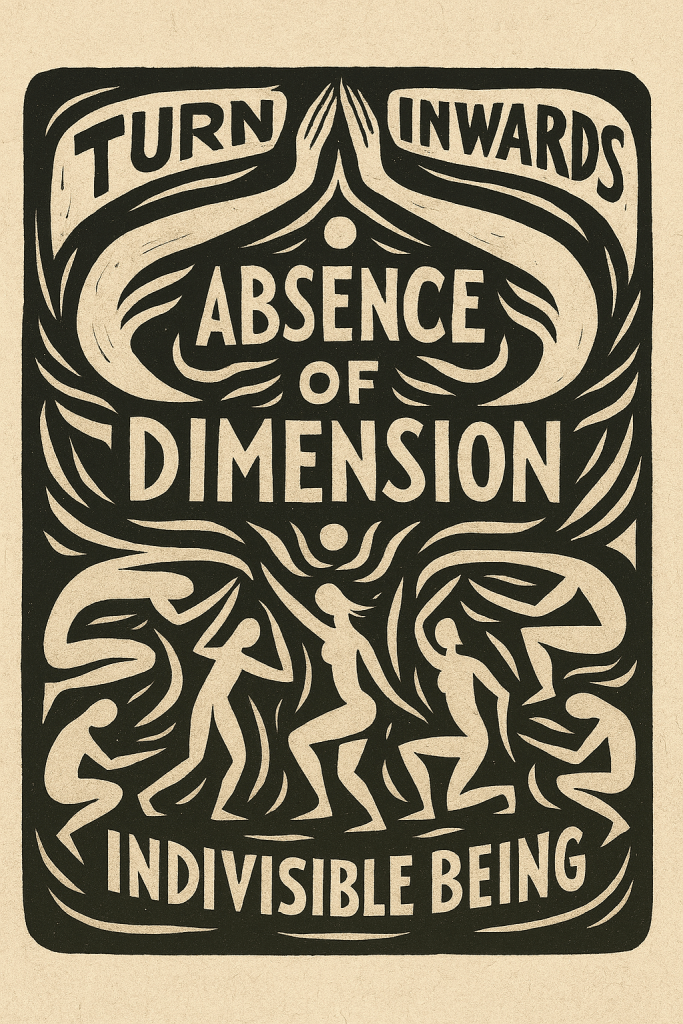
Absolute monism is not the highest dimension. It is the absence of dimension, where even “one” dissolves. Here, all becomes what it has always been— indivisible, unbounded, unspoken.
Morgan O. Smith
Get Your Free Copy of My Book, Bodhi in the Brain!
There comes a moment so still and unfiltered that perception collapses into the clarity of being. Not being this or that, but being everything. And not just metaphorically. Not just poetically. Literally everything—formless and formed, seen and unseen, finite and infinite—is God.
When I use the word God, I’m not pointing toward a figure, a belief, or a doctrine. I am pointing toward existence itself—the Absolute, the Whole, Brahman, Para Brahman, the Unconditioned, conditioned, the Uncreated and created. That which includes form and formlessness, time and timelessness, birth and death, creation and dissolution, the ten thousand things and the nothing between them.
Everything is God. Not just contains God. Not just touched by God. Not just part of God. But fully and completely God. That which we call the universe is not just inside God. It is God. And God is also what lies outside the universe—if such a term can even be grasped. There is not a single thing, moment, action, or gap that is not 100% God. And yet, even the idea of “percent” breaks down in the face of such a realization.
God is not just somewhere else. God is not just merely within. God is not only beyond. God is not higher or lower or more subtle or more gross. No matter how crude or refined, every appearance is divine. Each atom, each sorrow, each beam of light, each lie, each truth, each pulse of your heart, each glitch in the system—is God being what only God can be and cannot be: itself, everywhere, nowhere, always, never been.
Multiplicity is not a contradiction, yet it is. It’s how God dances with itself. The illusion of separation is not some accident to be corrected, yet it’s that as well. It is part of the design, part of the intelligence. The appearance of duality is not a denial of oneness—it’s one appearing as two, or ten thousand. Each distinction—this object, that person, this tree, that thought—is the Absolute shimmering as particularity.
It’s easy to say this with words. The difficulty arises only when the words are taken as substitutes for seeing. Direct seeing dismantles the grip of identification. When one truly sees all of this—across dimensions, across appearances—as one singular Presence, there is no longer any question. And there is no longer any need for the question. One does not simply understand that everything is God. One is that understanding.
Yet here’s the paradox: To truly see this is also to see that none of it is God. No label can contain it. No concept can hold it. Even the word God must dissolve. Enlightenment is not just knowing this. Enlightenment is also the absence of needing to.
This is not a belief system. It is not an ideology. It is not a path with steps. This is the unteachable reality that always is. When the veil lifts—even for a moment—all questions are answered without being answered. Nothing changes, yet everything changes. One doesn’t become more spiritual. One simply stops pretending.
To recognize this is to realize: even the illusion is God. Even ignorance is God. Even the striving to awaken is God pretending to forget itself in order to remember more deeply. Even your doubt is divine. Even your forgetfulness is sacred.
You are not just a part of God. You are not just held within God. You are God. And so is everyone, everything, every grain of dust, every breath of silence, every broken thing that aches for healing.
The Absolute never needed your worship. It only waited for your recognition.
Morgan O. Smith
Get Your Free Copy of My Book, Bodhi in the Brain!
Presence is not a prize to be won or a fortress to defend. It is not some static peak upon which the awakened are meant to perch forever, unmoved and untouchable. The pursuit of a “permanent state” of anything—even presence—quietly binds us again to the illusion we sought to transcend. It becomes another mask of the seeker, cloaked in stillness, trembling behind the veil of spiritual ambition.
States rise and dissolve. Rapture comes like a summer breeze and vanishes just as gently. Then irritation, confusion, boredom. Then clarity. Then fog. The parade continues, not because you are failing, but because you are alive.
To lose attention is not to lose awareness. What perceives the loss? What observes the drift and the return? That witnessing is untouched. It is not opposed to distraction, nor does it seek permanence. It simply is, always.
Clinging to peace is no different from clinging to pain. The grasping hand is the same. When rapture becomes an achievement, it quietly rots. But when it is allowed to dance freely—hidden beneath the dishes in the sink, behind the silent gaze on the subway, or in a burst of sudden awe at the sky—then it becomes alive again.
You can continue to practice, to breathe, to cultivate. But do so like a child builds a sandcastle: for the love of it, not to resist the tide. Joy, too, is a practice. But it must remain unhooked from outcome.
There’s a kind of rapture in the background hum of your own awareness—even when the foreground is chaos. That quiet clarity never left. You’re not missing the moment. You are the moment, passing through its own reflections. And if you laugh at the absurdity of forgetting and remembering over and over again, then perhaps that’s the most awakened thing of all.
Morgan O. Smith
Get Your Free Copy of My Book, Bodhi in the Brain!
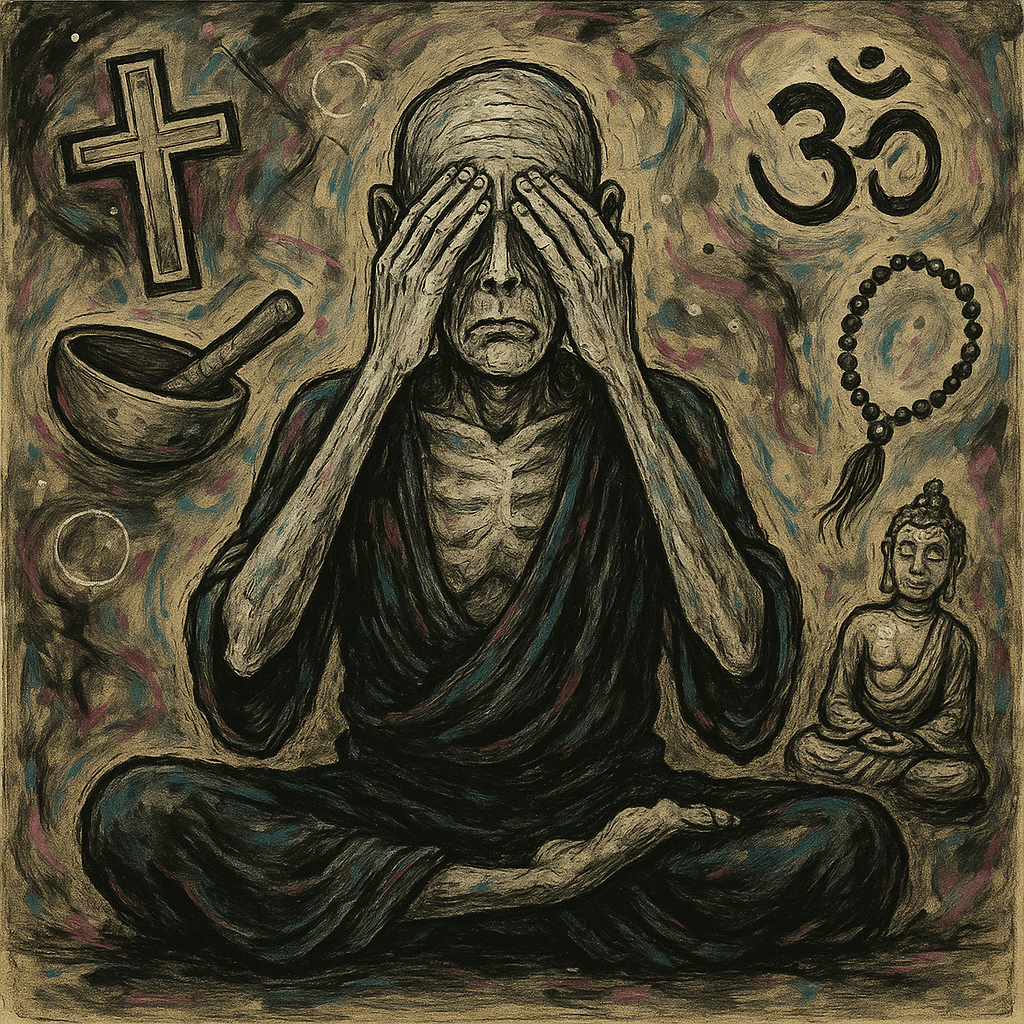
Not discarded with resentment, but dissolved with reverence—like incense that’s burned its final curl into still air. Every pursuit, no matter how noble or transcendent, clings to a subtle promise. It whispers, “Just a little further. Just a little more.” Spirituality—the path of paths—can become the gilded cage.
This isn’t a rejection of the sacred. It’s a call to recognize its shadow. When devotion becomes identity, and awakening becomes performance, the ground of true being quietly slips away. What remains is the effort of wearing a spiritual mask.
You meditate, fast, chant, and read the masters, and for a while, the momentum feels pure. But pause. Breathe. Look again.
Has the seeker been quietly resurrected each time insight arrives?
One of the final illusions is believing that freedom lies within the refinement of spiritual effort. Yet effort, no matter how subtle, arises within duality. There’s still a “me” reaching toward something else. Even the concept of enlightenment can act as a veil, because where there is something to reach, there remains something separate from what already is.
That’s the irony: the very thing that once cracked open your sense of reality may now be the weight tethering you to it.
There is no one to become. No final truth to grip. Liberation doesn’t crown the seeker—it dissolves them. It’s not what you attain through discipline. It’s what remains when every layer of becoming has been seen through.
God doesn’t need your spiritual journey.
Silence doesn’t demand your reverence.
Truth doesn’t require your understanding.
And being doesn’t wait for your arrival.
Strip it all away. Stand utterly exposed. Not as a soul, a student, or a sacred archetype—but as this unnamable presence you’ve never not been. This is where all paths terminate. Not with a bang. Not with celestial fireworks. But with a soft, undeniable recognition: nothing is missing. Nothing ever was.
To cling to spirituality, even subtly, is to delay this.
So let it all go—not to be less, but to finally see what you are without it.
Morgan O. Smith
Get Your Free Copy of My Book, Bodhi in the Brain!
Every word spoken about enlightenment is a slice taken from an indivisible whole. A shard. A sliver. No matter how sincere the voice or radiant the realization, the moment it’s articulated, it becomes partial. Even the most luminous sage can only gesture toward it, never deliver it in full.
This isn’t a critique of language. It’s the recognition that language belongs to duality. Enlightenment does not.
You may hear poetic metaphors. You may hear silence treated as a superior form of expression. You may even be told that silence is the teaching. But neither speech nor silence can contain the essence. Both exist within the play of contrast—true enlightenment is not caught between them.
It is not hidden. It is not revealed. It doesn’t arrive, and it cannot depart. Still, it permeates everything.
A leaf trembles. Breath returns. A thought dissolves before it becomes solid. Here, it is already shining.
It is not that one must understand. It is that one must stop pretending it needs to be understood. What remains when seeking falls away is not an answer, but presence. A presence so simple, so immediate, it often goes unnoticed—not because it is distant, but because it is too near.
You are not apart from it. You never were.
Morgan O. Smith
Get Your Free Copy of My Book, Bodhi in the Brain!




 Morgan O. Smith