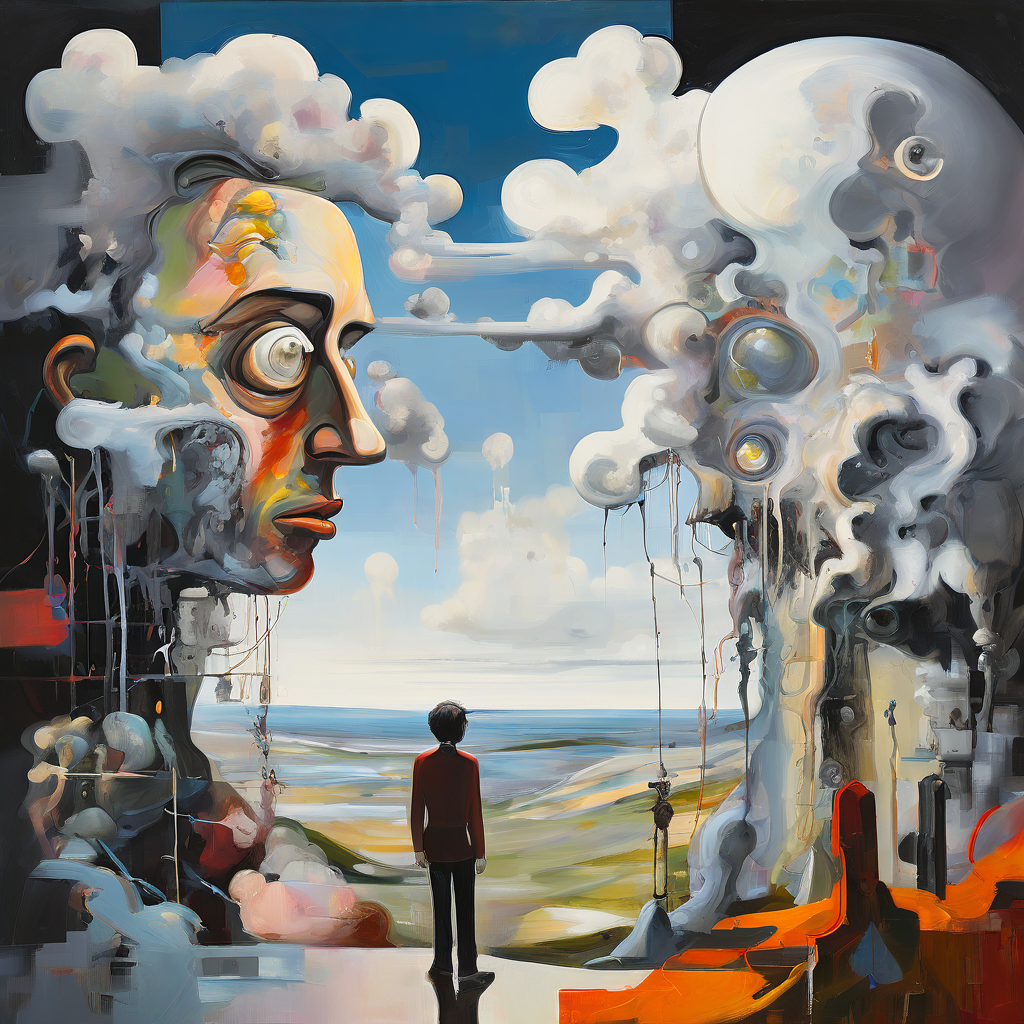
A-Dual to Dual to Nondual

The Evolution of Consciousness

The evolution of consciousness from a-dual to dual to nondual mirrors the profound journey of human development and spiritual awakening. This path reflects the unfolding of awareness from the pure, undifferentiated state of infancy, through the complexities of duality, and ultimately to the profound realization of nonduality.

The A-Dual State: The Innocence of a Newborn

A newborn baby embodies the a-dual state—a condition of pure, undivided awareness. In this state, there is no sense of separation; the infant exists in a realm of unity where distinctions between self and other, subject and object, have not yet formed. The newborn’s consciousness is a reflection of the primal unity of existence, an experience of pure presence and potential.

The Emergence of Duality: The World of Distinctions

As the child grows, the consciousness transitions into the dual state. This is the realm where the distinctions and separations that characterize our daily lives begin to emerge. The child starts to recognize the difference between self and other, experiencing the world as a collection of distinct objects and entities. This dualistic perception is essential for navigating and understanding the complexities of life.

In the dual state, we develop our sense of identity and individuality. We learn to interact with the world, to differentiate between pleasure and pain, success and failure, love and fear. However, this separation can also lead to feelings of isolation, conflict, and a sense of being incomplete.

The Nondual Realization: The Return to Unity

A full spiritual awakening marks the transition from dual to nondual consciousness. This realization transcends the distinctions of duality, revealing the underlying unity of all existence. In the nondual state, the boundaries between self and other dissolve, and we perceive the interconnectedness of all things.

Nondual awareness is the recognition that the multiplicity of forms and phenomena are expressions of a single, boundless reality. It is an experience of profound unity where the apparent separations of duality are seen as illusory. This realization brings a deep sense of peace, compassion, and unconditional love, as we understand that we are part of a greater whole.

Embracing the Journey

The journey from a-dual to dual to nondual is not a linear path but a continuous unfolding of consciousness. It invites us to embrace the innocence of the a-dual state, navigate the complexities of duality, and ultimately awaken to the nondual realization. This journey encourages us to live with mindfulness, recognizing the sacredness in every moment and every experience.

By understanding and embracing this evolutionary process, we can navigate life with greater wisdom and grace. We learn to hold the paradoxes of existence, finding harmony in the interplay of opposites. This path is not about escaping the world but engaging with it more deeply, with an open heart and a clear mind.

The evolution of consciousness from a-dual to dual to nondual offers a profound framework for understanding our spiritual journey. It reminds us that beyond the apparent separations lies a deeper truth—a truth that can transform our perception and inspire us to live with greater compassion, wisdom, and love.

Morgan O. Smith

Yinnergy Meditation, Spiritual Life Coaching & My Book, Bodhi in the Brain…Available Now!

https://linktr.ee/morganosmith

The Dissolution of the “I”

A Journey Beyond Self

In the quiet moments of our existence, we often find ourselves pondering the nature of identity and consciousness. What does it mean to truly know oneself? How can we navigate the complex interplay of ego and essence? These questions have occupied the minds of mystics and philosophers for millennia, yet they remain as relevant today as ever.

At the heart of these inquiries lies a profound realization: the dissolution of the “I.” This moment of enlightenment is not merely an intellectual understanding but a visceral, transformative experience. It is a point where the sense of self, the familiar “I” that anchors our daily lives, dissolves into something far greater and more expansive.

In this state, the boundaries that define our individuality blur and eventually vanish. The distinctions between self and other, inner and outer, become meaningless. This dissolution is not an annihilation but a return to the source—a reabsorption into the universal consciousness from which all things arise.

This experience is often described as a merging with pure awareness, where the perceiver and the perceived become one. It is a space where all dualities collapse, leaving only the pure presence of being. Here, there is no longer a separate observer; the “I” that once clung to its identity dissolves within itself, recognizing that it was never separate from the whole.

Such a realization can be both liberating and disorienting. The dissolution of the “I” challenges our deepest assumptions about who we are and what reality is. It invites us to embrace the paradox that while we appear as individuals, we are simultaneously the entirety of existence experiencing itself. This shift in perception allows for a deeper connection with the world, fostering a sense of unity and compassion that transcends the limited scope of personal concerns.

Yet, this journey is not without its challenges. The ego, with its myriad attachments and identifications, often resists this dissolution. It fears the loss of control, the end of its narrative. But in letting go, we do not lose ourselves; rather, we find our true essence—a boundless, infinite presence that is the very ground of being.

In this realization, life takes on a new dimension. Every moment becomes a manifestation of the infinite, every interaction a dance of the divine. The dissolution of the “I” is not an endpoint but a continuous unfolding, a deepening into the mystery of existence. It is an invitation to live from a place of profound openness and love, to see the world through the eyes of the infinite.

As we navigate this journey, let us remember that the dissolution of the “I” is not an escape from reality but a deeper engagement with it. It is a call to awaken to our true nature and to recognize the sacredness of all life. In this space, we find the freedom to be fully present, fully alive, and fully ourselves—beyond the limitations of the ego, in the infinite expanse of pure being.

Morgan O. Smith

Yinnergy Meditation, Spiritual Life Coaching & My Book, Bodhi in the Brain…Available Now!

https://linktr.ee/morganosmith

The Profound Simplicity of Enlightenment

Transforming Perspective, Not Action

In the spiritual awakening journey, there is a well-known saying: “Before enlightenment, chop wood, carry water. After enlightenment, chop wood, carry water.” This aphorism captures the essence of a profound transformation that occurs not in the realm of actions but in the realm of perception.

Before enlightenment, we engage with the world through a dualistic lens. Wood is simply wood, and water is merely water. Our actions are routine, grounded in the practical necessities of life. We chop wood to build fires, and we carry water to quench our thirst. The world is divided into distinct entities and tasks, each with its purpose and function.

However, with the dawning of enlightenment, a radical shift in perspective occurs. Once seen as separate objects, the wood and water are now perceived as the divine. Every action, whether chopping wood or carrying water, becomes an act of communion with the sacred. The distinction between the doer and the deed dissolves, revealing the inherent unity of all existence.

This newfound vision unveils a profound truth: God is not a distant, separate entity but is every aspect of the universe. The wood we chop, the water we carry, the tools we use, and even the hands that perform these actions are not only expressions of the divine but are the divine. This realization transforms mundane tasks into sacred rituals, imbued with deep reverence, interconnectedness and beyond.


The environment in which these actions take place also becomes a sacred space. The forest where we gather wood, the river from which we draw water, and the air we breathe are all seen as the divine presence. Every element of our surroundings is woven into the fabric of oneness, blurring the lines between the individual and the cosmos.

This shift in perspective does not alter the actions themselves. We still chop wood and carry water, fulfilling the same physical tasks as before. Yet, the awareness that everything is as is infused these actions with a sense of purpose and meaning that transcends the ordinary.

In this enlightened state, the simplicity of life is revealed in its most profound form. Each moment becomes an opportunity to experience the divine, to engage in a continuous dialogue with the universe. The mundane is elevated to the extraordinary, and every action becomes an expression of love and devotion.


Ultimately, enlightenment is not about escaping the world or renouncing our daily responsibilities. It is about transforming our perception, recognizing the sacredness in every aspect of life, and understanding that we are the intricate, divine dance. By embracing this perspective, we find a deeper sense of peace and fulfillment, knowing that every action, no matter how simple, is an act of communion with the divine, as the divine.

Morgan O. Smith

Yinnergy Meditation, Spiritual Life Coaching & My Book, Bodhi in the Brain…Available Now!
https://linktr.ee/morganosmith

A Mind Blown is a Mind Well-Known

Exploring the Expansive Realms of Consciousness

In the quest for self-discovery and enlightenment, the moments when our minds are truly blown—those instants of awe where the familiar boundaries of understanding dissolve—are not just moments of wonder, but gateways to deeper knowing. These transformative experiences, where we glimpse the infinite expanse of consciousness, serve as profound awakenings that redefine our perception of self and universe.

Imagine standing at the edge of a cosmic ocean. Each wave, from the smallest ripple to the towering tsunami, symbolizes the various levels of consciousness we experience. In our daily lives, we paddle near the shore, within the safe confines of routine thoughts and conventional wisdom. Yet, it’s beyond this shoreline where the depth of our being lies. When a thought, insight, or experience—seemingly simple or strikingly profound—blows our mind, it’s akin to a powerful wave that pulls us into deeper waters, into the uncharted territory of our inner selves.

What does it mean to have one’s mind blown? It is to be thrust into the vastness of the unknown, to confront the mysteries of existence head-on without the armour of preconceived notions. This confrontation is not merely intellectual; it is deeply spiritual. It is the raw encounter with the divine dance of creation and destruction, where every held belief is challenged and reformed in the crucible of direct experience.

Such moments are not about losing oneself but rediscovering oneself as part of a grander scheme. They are about touching the essence of the cosmos, feeling the pulse of life that permeates everything. These instances remind us that we are not just isolated beings moving through a static world; we are dynamic participants in a vibrant, evolving universe.

To cultivate a mind that welcomes being blown—a well-known mind—is to foster a state of openness and curiosity. It involves nurturing a fearless approach to the unknown, a willingness to let go of the ego’s desire for certainty and an embrace of the profound mysteries that life offers. It is a journey of constant evolution, where each mind-blowing moment is a call to a deeper exploration of reality, urging us to look beyond the apparent to the underlying oneness that connects all.

In conclusion, the mind that is blown is indeed a mind that is known—not just in the intellectual sense, but in the profound, experiential, and transformative understanding of the self and the universe. As we navigate through these expansive realms of consciousness, let us cherish these mind-blowing moments as precious opportunities for growth and enlightenment.

Morgan O. Smith

Yinnergy Meditation, Spiritual Life Coaching & My Book, Bodhi in the Brain…Available Now!

https://linktr.ee/morganosmith

The Cosmic Joke

Finding Humour Beyond the Ego

In the grand play of the cosmos, a joke exists so profound that it eludes the grasp of our everyday consciousness, veiled beneath the layers of our egoic identity. Imagine momentarily that the essence of your being—the “I” that you refer to so confidently—is the punchline to the most elaborate joke ever conceived. It isn’t a cruel joke, but rather an invitation to step beyond the boundaries of self-imposed seriousness and to laugh with the wisdom of understanding.

The joke begins with the ego, a masterful illusionist, convincing us that we are nothing more than the sum of our thoughts, emotions, and experiences. We invest deeply in this narrative, playing the role scripted by societal norms and personal expectations. Yet, this is the point where the cosmos smiles, for the joke is on the ego. The reality, hidden in plain sight, is that we are far more expansive than this limited self.

To see beyond the ego is to appreciate the cosmic humour. When you realize that what you took so seriously—the angst of being right, the weight of personal grievances, the chains of past and future—was never the essence of who you truly are, a lightness pervades your being. This revelation is akin to an audience realizing the absurdity of a magician’s trick; the spell breaks, and laughter bubbles forth.


This laughter is not derisive or dismissive. It is the laughter of liberation, of seeing the strings that bind the marionette and choosing no longer to dance at their pull. It’s recognizing that the cosmos plays with us, urging us to discover that behind the facade of individuality lies the vast expanse of consciousness, unbounded and magnificent.

As you navigate the perceived trials and tribulations of life, invite this perspective: view each challenge as a scene in this divine comedy. Each struggle, each joy, each moment of confusion or clarity is part of this intricate joke where the punchline is your awakening. When you finally get the joke, you won’t just chuckle; you’ll laugh hysterically, understanding that all along, you were both the audience and the performer in the cosmic spectacle.

This humour is not about negating the reality of pain or struggle; rather, it’s about shifting the perspective from which you view these experiences. When embraced, this humour heals, enlightens, and transforms, offering a transcendent glimpse into the true nature of existence where everything is interconnected, and nothing is as serious as it seems.


So next time you feel weighed down by the persona of who you think you are, pause and listen carefully—perhaps the echoes of cosmic laughter are inviting you to join in, to step beyond the ego, and to experience the freedom that comes with the greatest revelation of all: that you are not merely a part in this cosmic play, but its very essence, endlessly expansive and eternally joyful.

Morgan O. Smith

Yinnergy Meditation, Spiritual Life Coaching & My Book, Bodhi in the Brain…Available Now!

https://linktr.ee/morganosmith

Attaining Enlightenment

As Elusive as Grasping the Wind

The quest for enlightenment, that profound state of ultimate understanding and unity, is often compared to trying to hold onto the wind. This metaphor captures the essence of the journey—a pursuit that defies conventional grasping, one that requires an openness to the intangible and an embrace of the elusive.

The Elusiveness of Enlightenment

In many Eastern philosophies, Enlightenment is not a destination but a state of being. It is a realization that transcends the confines of our dualistic thinking. Much like the wind, it is everywhere and yet nowhere specific. To chase it with a rigid, goal-oriented mindset is to miss its essence.

Enlightenment involves the dissolution of the self and the shedding of layers upon layers of conditioned beliefs and identities. This shedding process can feel like an endless peeling away of illusions, akin to trying to contain the uncontainable wind in your hands. The moment you think you have a firm grasp, it slips through your fingers, revealing the futility of such an endeavour.


The Paradox of Effort and Effortlessness

One of the most challenging aspects of the spiritual path is balancing effort and effortlessness. The seeker must engage in practices, disciplines, and teachings that guide the way, yet true enlightenment often dawns in moments of complete surrender and stillness. It is in these moments that the boundaries of the self dissolve, and one experiences the boundless nature of existence.

This paradox can be frustrating. We are conditioned to believe that hard work and determination yield results. However, in the spiritual realm, striving too hard can create resistance. It is the quieting of the mind, the letting go of effort, that often brings the profound insights we seek.

Embracing the Unknowable

In accepting the elusiveness of enlightenment, we learn to appreciate the journey itself. Every moment of insight, every experience of stillness, is a part of the unfolding realization. The wind may be impossible to grasp, but it can be felt, experienced, and known in its presence.

To truly understand enlightenment, one must embrace the unknowable. It requires a heart open to the mysteries of existence and a mind willing to let go of the need for certainty. This openness allows us to experience glimpses of the infinite, moments where the separation between self and universe disappears, revealing the profound interconnectedness of all things.


Conclusion

Attaining enlightenment is indeed as difficult as grabbing hold of the wind. Yet, in this difficulty lies the beauty of the spiritual journey. It teaches us to let go, to be present, and to embrace the mystery of existence. In the end, the pursuit of enlightenment is not about reaching a final goal but about experiencing the boundless nature of our true selves, flowing effortlessly like the wind.

Morgan O. Smith

Yinnergy Meditation, Spiritual Life Coaching & My Book, Bodhi in the Brain…Available Now!

https://linktr.ee/morganosmith

Are We Truly God? Exploring the Divine Paradox

In the quest for spiritual enlightenment, a profound question often arises: Are we truly God? The answer, paradoxically, is both affirmative and negative. This might seem bewildering, but it encapsulates the essence of our being and the nature of existence itself.

Yes, We Are:

At the core of our being lies a spark of the divine. Every moment of clarity, every act of compassion, every intuitive insight reflects our inherent divinity. In moments of deep meditation or mystical experience, we touch upon a state of unity where the boundaries between self and the universe dissolve. We feel the interconnectedness of all things, experiencing firsthand the truth of our divine nature.

No, We’re Not:

Conversely, we are also distinct from the absolute. Our daily lives, with their trials and tribulations, remind us of our limitations. We experience separation, individuality, and the constraints of physical existence. These experiences ground us in the reality that, while we may embody aspects of the divine, we are not the totality of it. The ego, with its desires and fears, maintains the illusion of separateness.


Maybe We Are, Maybe We’re Not:

The coexistence of these opposing truths leads us to a deeper understanding. This paradox mirrors the dual nature of existence: the finite and the infinite, the known and the unknown. It is within this dynamic interplay that the essence of our being resides. By embracing this paradox, we move beyond binary thinking and open ourselves to the fluidity of existence.

Understanding the Paradox:

To truly grasp this paradox is to recognize that our existence transcends simplistic definitions. We are both the wave and the ocean, distinct yet inseparable. In acknowledging our divine potential while also accepting our human limitations, we embark on a journey of self-discovery that is both humbling and empowering.


Conclusion:

This paradoxical truth—that we are simultaneously divine and not—invites us to embrace the full spectrum of our existence. It challenges us to live with openness, curiosity, and a deep sense of wonder. By doing so, we honour the complexity of our being and the mysterious beauty of the universe.

Morgan O. Smith

Yinnergy Meditation, Spiritual Life Coaching & My Book, Bodhi in the Brain…Available Now!

https://linktr.ee/morganosmith

The Illusion of Enlightenment

Beyond Appearances

In the world of spiritual seekers, the image of enlightenment is often cloaked in stereotypes. We imagine the enlightened as wise sages with serene expressions, adorned in simple yet vibrant robes, often with a flowing beard symbolizing wisdom and age. These images, while compelling, can distract us from the true essence of spiritual awakening.

The Fallacy of External Symbols


Consider the figure of a guru, resplendent in flamboyant orange attire and a long beard. At first glance, these external symbols seem to exude a profound spirituality. They speak of dedication, discipline, and a life devoted to higher truths. However, these symbols are but surface-level adornments. They are, in essence, a part of the cultural performance of spirituality. The real question is: does the essence of enlightenment reside within these outward displays?


The Deeper Reality

Enlightenment, in its truest form, transcends appearances. It is not about how one dresses, speaks, or the rituals one performs. True enlightenment is the realization of nonduality, the deep understanding that all distinctions are ultimately illusory. It is a state of being where one recognizes the interconnectedness of all existence and lives in harmony with this profound truth.

A guru’s flamboyant attire and serene demeanour may buy time and may hold the disciples’ awe, but eventually, true discernment must prevail. Spiritual seekers must learn to look beyond the external and discern the depth of true wisdom.

Beyond the Mask

This brings us to the core of spiritual discernment. The journey towards enlightenment is deeply personal and internal. It requires a relentless commitment to self-inquiry, a willingness to confront and dissolve one’s ego, and an openness to the vast, unfathomable mystery of existence.

A true guru, one who is genuinely enlightened, may or may not conform to the stereotypical image. They might appear as an ordinary person, unremarkable in many ways. The true measure of their enlightenment lies in their ability to guide others toward their inner light, not through the allure of external symbols, but through the profound simplicity and authenticity of their being.


The Inner Path

As seekers on the path, we must cultivate the ability to see beyond appearances. The guru’s external symbols can be helpful signposts, but they are not the destination. Our journey is about inner transformation, about peeling away the layers of illusion to reveal the radiant core of our true nature.

Enlightenment is not a spectacle; it is a quiet, profound shift in consciousness. It is the realization that the true guru resides within each of us, waiting to be discovered in the stillness of our hearts.

Conclusion

In a world where appearances often deceive, the challenge for spiritual seekers is to cultivate true discernment. Let us not be swayed by the external trappings of spirituality but seek the deeper, inner essence of enlightenment. For it is in the quiet, unassuming moments of profound realization that the true nature of our being is revealed.

Morgan O. Smith

Yinnergy Meditation, Spiritual Life Coaching & My Book, Bodhi in the Brain…Available Now!

https://linktr.ee/morganosmith

The Clarity of Enlightenment

Understanding the End of Confusion

Enlightenment is often depicted as a pinnacle of spiritual achievement, a state where the mind transcends its usual patterns and sees reality as it truly is. One profound realization that accompanies enlightenment is the clear understanding of confusion itself.

The Nature of Confusion

Confusion is a state of mind where the incessant chatter of thoughts, emotions, and sensory input obscures clarity. It arises from the fragmented way we perceive the world, dividing experiences into categories and labels, creating a sense of separation and duality. This fragmented perception is the root of our suffering, as it distorts our understanding of the interconnectedness of all things.

The Shift to Enlightenment

Enlightenment is not merely an intellectual understanding but a profound experiential realization that dissolves the boundaries of self and other. In this state, the mind no longer clings to distinctions, and the innate oneness of existence becomes evident. This shift transforms our perception, allowing us to see through the veils of confusion with a clarity that is as unmistakable as daylight.


Seeing Through Illusions

Upon reaching enlightenment, the illusions that once caused confusion are seen for what they are—mere constructs of the mind. The ego, which thrives on these constructs, loses its grip, revealing the underlying reality. This revelation brings a sense of peace and profound understanding. The struggles and doubts that once plagued the mind dissolve, and what remains is an unshakeable clarity.

The Role of Awareness

Awareness plays a crucial role in this transformation. As we cultivate awareness through practices like meditation, mindfulness, and self-inquiry, we begin to recognize the patterns of the mind that create confusion. With consistent practice, these patterns lose their power, and the mind becomes more settled and clear. Enlightenment is the culmination of this process, where awareness is fully integrated, and confusion is transcended.

Embracing the Journey

The journey to enlightenment is unique for each individual, yet it is marked by common milestones of increased clarity, peace, and understanding. It requires dedication, patience, and a willingness to confront and transcend the illusions that obscure our true nature. Each step on this path brings us closer to the realization that confusion is not an inherent part of our existence but a temporary state that can be overcome.


Conclusion

Enlightenment reveals the inherent clarity that lies beyond the mind’s confusion. It is a state where the true nature of reality shines forth unobscured, bringing with it a profound sense of peace and understanding. As we journey towards this state, we learn to see through the illusions of confusion, embracing the clarity that is our birthright.

Morgan O. Smith

Yinnergy Meditation, Spiritual Life Coaching & My Book, Bodhi in the Brain…Available Now!

https://linktr.ee/morganosmith