Navigating the Shades of Morality

Embracing Our Humanity Through Spiritual Evolution

In the labyrinth of human experience, we often find ourselves at a crossroads between contrasting moral landscapes. This journey, fraught with myriad complexities, guides us through a transformative process—a shift from seeing the world in stark contrasts to embracing the nuanced shades of morality that define our existence. It’s a journey that doesn’t just challenge our perceptions but also enriches our understanding of what it means to be inherently human.

The Evolution of Perception

As we embark on this spiritual and psychological evolution, our initial encounters with morality are often painted in broad strokes of black and white. This dichotomy, while offering clarity, is also a testament to our nascent understanding of the moral universe. However, as we delve deeper into our journey of self-discovery and spiritual awakening, we begin to notice the emergence of grey areas. These are not mere anomalies but signposts of our evolving consciousness.

The Tug of War Within

This recognition ushers in a period of internal conflict—a tug-of-war between the polarities of good and evil, right and wrong. It’s a battle that rages within, pulling us in opposing directions. Yet, it’s through this struggle that we learn the invaluable lesson of acceptance. By integrating these disparate aspects of our being, we unlock a more profound comprehension of our nature and the world around us.

Standing Firm in the Middle

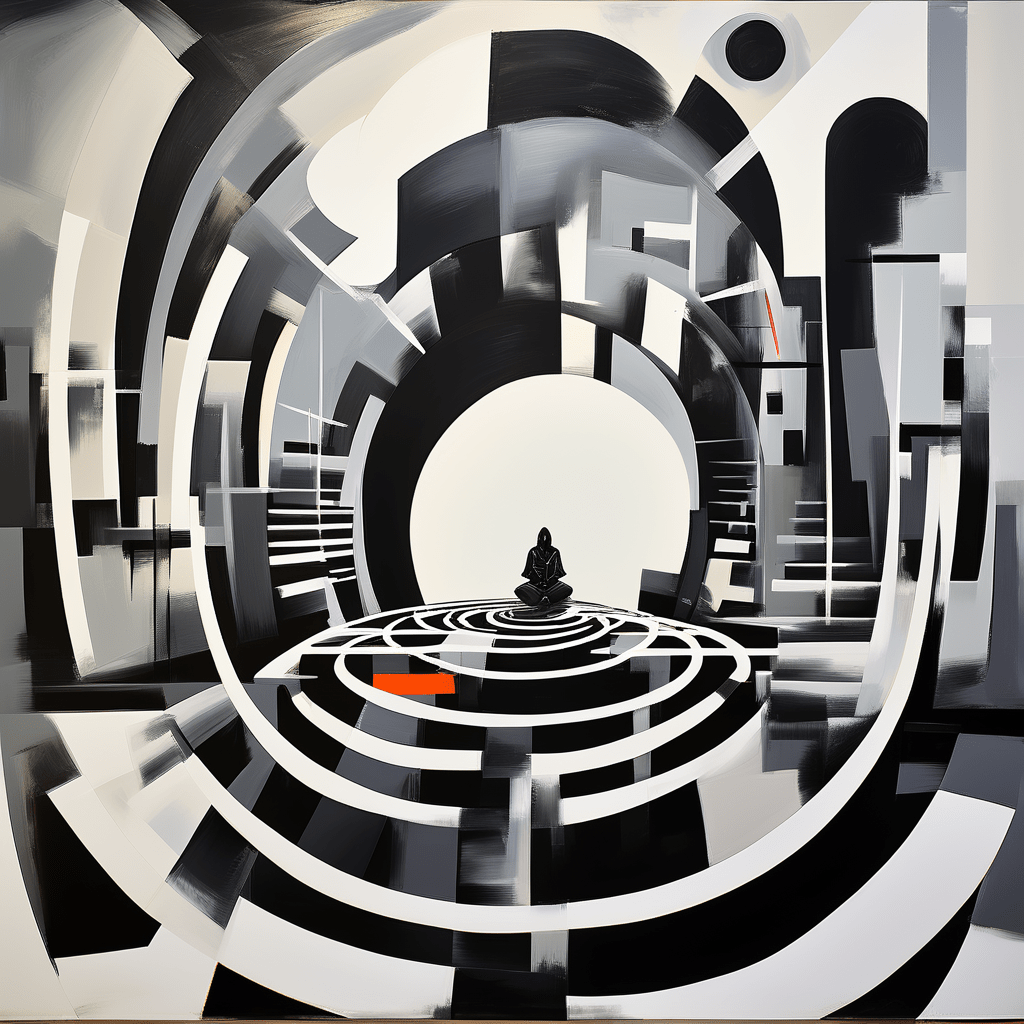
The ultimate aim of this journey is not to choose a side but to find equilibrium amidst the chaos. To stand firm in the middle is to acknowledge our capacity for both the divine and the diabolical. It is in this space that we discover true empathy and compassion, unburdened by bias and judgment. This balanced stance does not signify indifference but a deeper connection to the vast spectrum of human experiences and emotions.

The Gift of Empathy and Compassion

By embracing the grey areas of morality, we cultivate a more empathetic and compassionate perspective. This transformation is not just personal but collective, as our increased understanding and acceptance ripple outwards, influencing our interactions and relationships. In recognizing our complexities, we become more forgiving of others, bridging divides and fostering a sense of shared humanity.


Conclusion: Embracing Our Humanity

The journey through the shades of morality is an integral part of our spiritual evolution. It challenges us to confront and reconcile the complexities within ourselves, leading to a more empathetic, compassionate, and balanced existence. By standing in the middle of our moral landscape, we embrace the full spectrum of our humanity, finding peace in the acceptance of our multifaceted nature.

Morgan O. Smith

Yinnergy Meditation, Spiritual Life Coaching & My Book, Bodhi in the Brain…Available Now!

https://linktr.ee/morganosmith

Navigating the Complexities of Wisdom and Morality

In spirituality and personal development, the distinction between the message and the messenger often becomes blurred. A question that frequently arises is how to approach the teachings of spiritual leaders or gurus who are embroiled in controversies, particularly those involving moral transgressions like sexual assault. The predicament is whether their teachings, often profound and life-changing, lose their value when the teachers themselves fall from grace.

At the core of this dilemma is the age-old debate of separating the art from the artist, the wisdom from the wise. A parallel can be drawn with a simple mathematical truth: “1+1 equals 2.” This statement remains true regardless of who states it – be it a revered mathematician or someone convicted of a heinous crime. The truth, in its purest form, is untainted by the character of its proponent. In the same vein, can spiritual teachings retain their worth even if their source is flawed?

The key lies in discerning the message from the individual. Spiritual teachings, at their best, transcend the personal attributes of the one who delivers them. They tap into a universal truth that is not diminished by personal failings. However, this is not to say that the actions of the teacher are inconsequential. While the wisdom may still hold, the credibility and the moral authority of the teacher to impart these teachings come into question.

This leads to a nuanced approach. One can accept the wisdom that resonates and is beneficial while simultaneously acknowledging and condemning the wrongful actions of the teacher. It is about not idolizing the individual to the point where their failings are ignored or excused. It’s about focusing on the essence of the teachings and applying critical thinking to discern what is valuable and what aligns with one’s ethical and moral compass.

In conclusion, the journey of spiritual growth is inherently personal and complex. It involves navigating through the gray areas where wisdom can be found in imperfect vessels. The challenge is to embrace the truth in the teachings while maintaining a critical awareness of the human fallibility of the teacher. It’s about evolving our understanding of spirituality beyond the confines of idealized figures to a more grounded, discerning, and inclusive practice.

Morgan O. Smith

Yinnergy Meditation, Spiritual Life Coaching & My Book, Bodhi in the Brain…Available Now!

https://linktr.ee/morganosmith


The Pursuit of Absolute Nothingness

A Journey Towards Enlightened Emptiness

Introduction: In the dynamic, incessant stream of thoughts, preferences, and subjective biases that characterize the human experience, the concept of attaining a state of Absolute Nothingness captivates imaginations. Is it possible to achieve a mental and emotional vacuum where thoughts, biases, judgments, and self cease to exist?

Understanding Absolute Nothingness:

  • Absolute Nothingness isn’t simply the absence of thought, but a profound emptiness that transcends understanding and defies our typical notions of existence and selfhood.
    • Exploring philosophical and theological contexts (Buddhism’s Sunyata or Zen’s Mu) can unveil varied interpretations and methods to approach nothingness.
  • The Paradox of Pursuing Nothingness:
  • Engaging in a quest towards absolute emptiness ironically imposes a desire and a goal, an antithesis to the state of desirelessness intrinsic to nothingness.
    • Considering the Daoist perspective, acting without intention (Wu Wei) might provide insights on pursuing without pursuing, and attaining without seeking.
  • Dismantling the Self:
  • Dissolving the self involves peeling away layers of personal identity, biases, and preconceptions, effectively blurring the lines between self and non-self.
    • This dismantlement raises questions about existence, consciousness, and whether one can truly function without the scaffold of selfhood in a society constructed upon individual identity.
  • Navigating Through Socio-Cultural Paradigms:
  • The endeavour to transcend preferences, judgments, and selfhood might be perceived as antithetical to societal norms that emphasize individuality, accomplishment, and progress.
    • Achieving absolute nothingness within the structural and cultural boundaries of our world presents a paradox between isolation and immersion in societal dynamics.
  • Ethical and Moral Dimensions:
  • The state of having no judgments, preferences, or perspectives raises questions regarding moral and ethical obligations. Does transcending biases and perspectives dissolve moral compasses?
    • Exploring the ethical implications of an unbiased existence may unravel whether absolute neutrality coexists with moral responsibility.
  • Psychological and Neuroscientific Perspectives:
  • The psychological viability of achieving a state devoid of thought and self-perception opens an intriguing discourse. Can one’s mental health be preserved, or even enhanced, in a state of nothingness?
    • Neuroscientific inquiries might delve into the processes and consequences of perpetually inhibiting cognitive and emotional functionalities to sustain a blank slate of consciousness.
  • Relinquishing Time and Anticipation:
  • With no anticipation, worries, or references to the past or future, time dissolves into an irrelevant concept, creating a perpetual ‘now’ with neither history nor destiny.
    • Contemplating a timeless existence fosters a reflection on how human experiences, relationships, and endeavours are intimately entwined with temporal perception.

Conclusion: Absolute Nothingness, both as a philosophical concept and a spiritual aspiration, navigates through paradoxes, ethical conundrums, and existential inquiries, offering a mesmerizing void that invites and perplexes. The possibility and implications of achieving a state devoid of self-thought, and time present not only a spiritual journey but also a philosophical and scientific exploration into the profound depths of consciousness and existence.

Morgan O.  Smith

Yinnergy Meditation & My Book, Bodhi in the Brain…Available Now!
https://linktr.ee/morganosmith

Absolute Monism

Unraveling the Tapestry of Oneness

The vast universe, with its manifold entities and infinite complexities, often bewilders human minds. Philosophers and thinkers from time immemorial have grappled with questions about the nature of existence and the ultimate reality. One profound idea that surfaces recurrently is that of Absolute Monism: the belief that beneath the apparent multiplicity, there is but one undivided reality. Let’s take a deeper look into this captivating worldview.

### A Universe from One Thread


At the heart of Absolute Monism lies the assertion that all differences and diversities we perceive are mere illusions. This assertion may seem contradictory to our daily experiences. After all, isn’t the world teeming with diversity?

Yet, this is where Eastern and Western philosophies converge. Ancient Hindu scriptures speak of *Brahman* as the ultimate, undifferentiated reality. The Hindu philosophy of Advaita Vedanta encapsulates this belief by stating that the world’s multiplicity, driven by *Maya*, is an illusion. Meanwhile, in the West, the philosopher Spinoza proposed that God and Nature are two names for the same reality, implying a singular, infinite substance. These ideas, separated by continents, come together to champion a singular reality beneath the apparent diversity.

### Seeing Beyond the Illusion

The concept of illusion is integral to understanding monism. In life, appearances can often be deceiving. A mirage in the desert, a rainbow after the rain, and even our reflection in the water are all illusions. If such simple things can deceive our senses, might it be possible that our entire perception of diverse reality is similarly mistaken?

*Mysticism* has been one avenue through which individuals across cultures have described experiences consistent with Absolute Monism. The interconnectedness of all things, a theme found in the tapestry of monism, speaks to the heart, nudging us to see beyond divisions and differences.

### Implications for Modern Times

If Absolute Monism holds that all is one, then what does this mean for us in the present age, surrounded by divisive forces and fragmented views?

Firstly, on an ethical plane, it implies that harm inflicted upon one is harm to the entirety. This perspective could drastically alter how we approach interpersonal relationships, environmental concerns, and global crises. If we truly internalize this philosophy, then every act of kindness and harm has far-reaching consequences.

Secondly, it brings to the fore the importance of self-realization. In many monistic traditions, the realization of this singular truth is the end goal, bringing about an end to suffering.

Lastly, it sparks curiosity about the nature of our universe. With advancements in modern physics and cosmology, we find theories that echo monistic thoughts. The Big Bang, for instance, suggests that everything we see, touch, and experience emerges from a singular point.

### Embracing Diversity within Unity

Absolute Monism does not negate the value of diversity. Rather, it calls for a deeper understanding. Imagine a tapestry. Up close, one can see the myriad of colours, textures, and patterns. But from a distance, it’s one cohesive artwork. Similarly, monism asks us to appreciate the individual threads while recognizing the grand design.

In an age teeming with division, perhaps the idea of Absolute Monism can be the bridge that reminds us of our interconnectedness. As we stand at the cusp of profound global challenges, this ancient philosophy might just hold the key to a unified, harmonious future.


Embracing the ideas of Absolute Monism requires introspection and openness. Whether you fully resonate with its tenets or not, it undoubtedly serves as a beacon, guiding us toward unity, understanding, and profound interconnectedness.

Morgan O. Smith

Yinnergy Meditation & My Book, Bodhi in the Brain…Available Now!

https://linktr.ee/morganosmith

The Constructed Sovereign Born from our Profound Void

The Illusion of Divinity and the Awakening of Inner Sovereignty

When we summon the image of an omnipotent moral authority, an unseen deity, we’re sketching a spectre birthed within the confines of our minds. This entity isn’t a divine phenomenon, but an offspring of our collective ego — an abstract amalgamation of ethics, morality, societal norms, rules, and dogmas. It thrives within the interconnected webs of our cultural and religious environment, existing as a part of us we’ve divorced from our understanding, enthroned too high in sacred spheres to accept it as our creation.

This fabricated deity stands as a sentinel, shielding us from the lure of a so-called demon, our id. This id, a tempestuous, liberated facet of our psyche, intimately bound to our physicality, represents the part we battle relentlessly. It’s in this internal war where the dream of resolution dawns, an arena where the ego and the id duel to claim dominance, awaiting a day when one will stand victorious upon the self’s throne.

We hold a solution in our grasp. Yet when enlightened souls, unhindered by societal constructs, attempt to illuminate the truth about this divine entity, we recoil. We revile them with hushed condemnations, predicting their doom by the flickering light of divine retribution. We imagine they’ll be smitten by a wrathful deity, ironic considering we believe this god granted us the right to reason critically and voice our truths.

Despite the inflexibility of our beliefs, the spectre remains. Even if we dismantle our collective ego, or raze all institutional bodies of authority and religious tenets, this deity will endure. Its eradication would unleash the collective id in a surge of high entropy chaos, shredding order, poised to reconstruct once our desires breed more disillusionment.

So, we are left under the shadow of a perceived dominator, who indeed governs as long as we believe it defends virtue. We extol this deity as the supreme entity, blind to the reality that we, the self-proclaimed limited beings, are the puppeteers. The stern god we fear is merely a man-made construct, a mythical lord over a land it doesn’t possess. We’re the true sovereigns, unknowingly directing a god on a leash, a faithful creature that bows to our every whim.

I implore you to see beyond the shimmering facade of your golden idol. The essence of the authentic divine, indivisible from us, is the omnipresent force permeating the All. To fathom the authentic divine is to realize there’s no puppet god, and in embracing this enlightenment, we shatter the chains of ignorance.

A creator does exist, but not outside of you. The world you perceive as external is an extension of your internal narrative. You are Consciousness, Spirit, Existence, and Ultimate Reality embodied, performing the roles of physical, psychological, and emotional existence. You are not merely a being, but a Presence, an omnipresent force enacting a grand cosmic play of energy, particles, atoms, cells, objects, systems, and their operational mechanics. This essence, forever within your grasp, is empowered by your belief in it, yet you offer this power to a creator birthed from you, the genuine Almighty.

Morgan O. Smith

Yinnergy Meditation & My Book, Bodhi in the Brain…Available Now!

https://linktr.ee/morganosmith