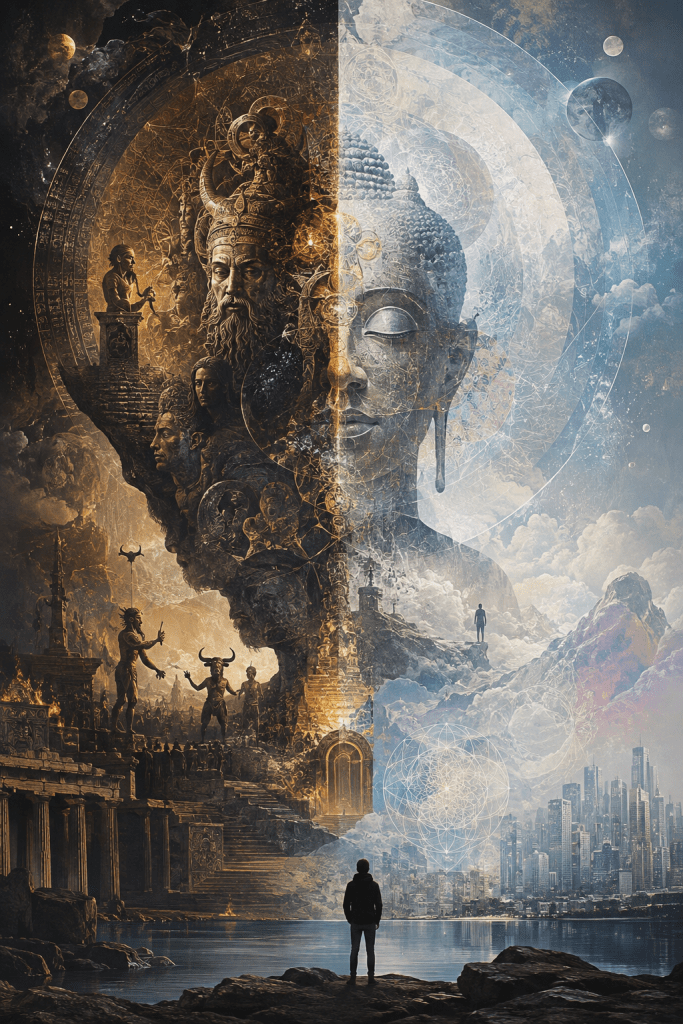
The God We Were Developed Enough to Imagine

What if many of humanity’s earliest ideas about God reveal as much about the psychological development of human beings as they do about the Divine?

The archaic, magical, and mythical God did not simply appear from nowhere. These images of God emerged through human consciousness at particular stages of individual and collective development.

A God who demands obedience.

A God who rewards loyalty and punishes disobedience.

A God who belongs to one tribe and fights against another.

A God who controls storms, harvests, fertility, illness, victory, and defeat.

A God who must be pleased through sacrifice.

A God who watches human behaviour and keeps score.

A God who condemns outsiders while protecting the chosen.

These conceptions make considerably more sense when understood through developmental psychology.

We Could Only Imagine God Through the Consciousness Available to Us

Human beings interpret reality through the cognitive, emotional, moral, and cultural capacities available to them.

A child does not understand authority the same way an adult does. A tribal society does not necessarily conceptualize identity the same way a modern pluralistic society does. A consciousness organized primarily around survival, kinship, magical causation, or mythic belonging will naturally interpret ultimate reality through those structures.

God becomes understandable by becoming psychologically recognizable.

When human authority is organized around powerful chiefs and kings, God becomes the greatest King.

When social order depends upon obedience, God becomes the ultimate Lawgiver.

When tribal survival depends upon distinguishing “us” from “them,” God becomes our God rather than their God.

When natural events cannot yet be understood through scientific causation, thunder, drought, disease, eclipses, fertility, and catastrophe can become expressions of supernatural intention.

Human beings did not necessarily fabricate these experiences from nothing. Mystical experiences, altered states, dreams, intuitions, visions, awe, terror, transcendence, and encounters with the unknown may have been entirely genuine.

The interpretation of those experiences, however, passed through the developmental structures available to the person and culture experiencing them.

That distinction changes everything.

The Experience of the Sacred Is Not the Same as Its Interpretation

Someone can have an extraordinary experience while interpreting it through a relatively limited worldview.

This remains true today.

A profound state of consciousness does not automatically produce profound interpretation.

A person can experience ego dissolution and interpret it psychologically, neurologically, Buddhistly, Christianly, Vedantically, magically, or through some entirely personal cosmology.

The experience and the explanation are not identical.

Ancient humanity faced the same problem.

A genuine encounter with something overwhelming, boundless, numinous, or transpersonal could subsequently be translated into the language of spirits, gods, ancestors, demons, cosmic battles, divine commandments, or supernatural intervention.

The sacred encounter may have been profound.

The conceptual container could still have been developmentally limited.

Then the Collective Reinforced the God It Could Understand

Individual consciousness does not develop separately from culture.

Once a particular image of God becomes embedded within a community, that image can be reinforced through stories, rituals, institutions, authority structures, family systems, and social expectations.

Eventually, questioning the image of God becomes almost indistinguishable from questioning the community itself.

This is where developmental structures become collective structures.

The mythical God is no longer simply believed.

The mythical God organizes reality.

He determines morality, identity, belonging, sexuality, authority, social hierarchy, acceptable knowledge, and sometimes who deserves protection or punishment.

The collective then reproduces the developmental worldview that produced its God.

Children inherit it before possessing the cognitive capacity to examine it.

Adults defend it because their identity has formed around it.

Institutions preserve it because their authority may depend upon it.

What began as an interpretation of the sacred can eventually become an unquestionable description of reality.

God Evolves Because Our Capacity to Conceive God Evolves

This does not necessarily mean God evolves.

Our conception of God evolves.

That difference is crucial.

The Absolute may not become more sophisticated because human beings become more sophisticated.

Human beings become capable of recognizing dimensions of reality that previous structures of consciousness could not adequately conceptualize.

God as tribal protector can become God as universal Creator.

God as cosmic ruler can become God as unconditional Love.

God as separate supernatural Being can become Ground of Being.

God as object can dissolve into God as the very condition within which subject and object arise.

Eventually, even the word God begins to become problematic.

Advaita speaks of Brahman.

Mahayana Buddhism points toward emptiness.

Taoism warns that the Tao that can be named is not the eternal Tao.

Christian mystics speak of a God beyond concepts.

Apophatic traditions approach the Divine through negation, stripping away every description until nothing conceptual remains to grasp.

At sufficient depth, the question changes.

Instead of asking, “What kind of being is God?”

we begin asking,

“Why did we assume Ultimate Reality was a being at all?”

The Death of the Mythical God Is Not Necessarily the Death of God

This may explain one of the great tensions between religion, atheism, mysticism, and developmental spirituality.

Modern rational consciousness examines the mythical God and finds contradictions.

Where is this supernatural ruler?

Why would an omnipotent being require worship?

Why would an infinite intelligence possess human emotions such as jealousy?

Why would the creator of billions of galaxies privilege one tribe, scripture, denomination, or historical period?

Why would eternal truth depend upon accepting propositions produced within a particular ancient culture?

These are powerful criticisms.

Yet atheism can sometimes reject the developmental representation of God while assuming it has rejected every possible meaning of the Divine.

The mystic makes a different move.

Rather than defending the old image, the mystic penetrates beneath it.

The question is no longer whether an invisible cosmic personality exists somewhere beyond the universe.

The inquiry becomes consciousness itself.

Being itself.

Existence itself.

Awareness itself.

Nothingness.

Infinity.

The mystery that remains when every concept has collapsed.

Perhaps Humanity Created God in Its Own Developmental Image

The famous claim that human beings created God in their own image may contain more truth than either believers or atheists usually recognize.

But the statement does not settle the question of Ultimate Reality.

It opens it.

Human beings may repeatedly construct images of the Divine according to their developmental capacity while something immeasurably deeper remains prior to every construction.

The mistake is not necessarily believing in God.

The mistake may be confusing our representation of God with whatever the word God is attempting to indicate.

A magical consciousness creates a magical God.

A mythical consciousness creates a mythical God.

A rational consciousness critiques that God.

A pluralistic consciousness discovers many Gods.

An integral consciousness begins recognizing the developmental structures producing all of these perspectives.

Mystical consciousness eventually encounters something stranger still:

Reality does not need our concepts.

The Absolute does not require mythology.

Brahman does not need to become an object of belief.

Perhaps spiritual maturation ultimately requires allowing our image of God to die repeatedly.

Not because there is nothing beyond it.

Because every God the mind can construct remains smaller than that which cannot be contained by mind.

And perhaps what humanity called God was never the old man above the clouds.

Perhaps that was simply as far as consciousness could see at the time.

Morgan O. Smith

https://linktr.ee/morganosmith

The Evolution of Karma

From Fear to Freedom

Karma is often spoken of as a simple equation, action and consequence, sowing and reaping, yet its meaning changes dramatically as consciousness evolves. What begins as superstition matures into wisdom, and what once felt like punishment reveals itself as love wearing the mask of correction. Each stage of development reshapes the lens through which karma is seen, shifting from fear-driven obedience to effortless alignment with the infinite.

At the earliest level, karma is pure survival instinct. The world feels hostile and unpredictable, and unseen forces must be appeased to ensure safety. The primitive heart interprets karma as a storm to endure or a curse to lift. As tribes form, rituals emerge, dances, offerings, sacrifices, gestures meant to influence invisible powers. Karma becomes a chant of control: “If I act correctly, the gods will spare me.”

Later, as morality crystallizes, karma transforms into a cosmic scoreboard. The universe appears governed by divine law, rewarding the righteous and punishing the wicked. Good deeds promise heaven; bad ones, rebirth or torment. This view comforts the soul with order but binds it to duality, virtue and sin, reward and penalty. The self remains separate from the whole, forever calculating its balance sheet in the eyes of the divine.

Rational thought then dismantles myth and replaces faith with logic. Karma becomes causality, stripped of mysticism. The mind begins to see that every thought and action has a psychological echo. The focus turns inward: emotional patterns, cognitive biases, behavioral loops. The sacred turns scientific. What was once divine justice becomes neurochemistry and feedback loops. Yet beneath analysis lies the same longing for meaning; a search for the invisible intelligence behind visible consequence.

As empathy expands, karma broadens into a shared field. The suffering of one is recognized as the suffering of all. Ecological, social, and ancestral interdependence reveal a larger moral ecology. Karma is now the pulse of the collective; the planet’s way of balancing itself through the actions of its inhabitants. The desire shifts from being “good” to being whole, from fear of punishment to care for harmony.

Integral awareness sees karma as consciousness refining itself through experience. Every situation, pleasant or painful, becomes a mirror; a feedback loop teaching the self about itself. What was once labeled misfortune becomes medicine. Karma is not something done to us but something expressed through us, a self-correcting rhythm of the universe returning us to coherence.

Beyond even that, karma dissolves. The one who acts and the one who receives the result are seen as the same awareness, dancing within itself. Causality collapses into immediacy. Every moment becomes self-liberated the instant it appears. There is no ledger, no lesson, only the timeless presence expressing as everything. What remains is compassion without motive, action without actor, freedom within form.

Morgan O. Smith

Get Your Free Copy of My Book, Bodhi in the Brain!

https://subscribepage.io/oTSZQu

Walking Beyond the Self

Expanding the Horizons of Perspective

Most human conflict is rooted in the inability to step outside the narrow confines of the self. We tend to move through the world tethered to a singular point of view, unable to grasp that reality shifts depending on who is looking. Perspective is not fixed; it unfolds in layers, from the egocentric stance of “me and mine,” through the ethnocentric loyalty of “us and ours,” into the broader realms of worldcentric care for humanity, and ultimately the kosmocentric embrace of all beings and existence itself.

When our awareness stops at the egocentric, we see others only as extensions of ourselves; or worse, as threats to what we hold dear. At the ethnocentric level, we expand slightly, but compassion remains conditional, bounded by tribe, religion, race, or nation. Yet the real flowering of human consciousness emerges once we realize that every being, regardless of sex, class, culture, or creed, carries within them a mirror of our own existence.

To recognize yourself in another is not simply an ethical exercise; it is an ontological revelation. The more deeply you understand that the same fears, desires, and vulnerabilities pulse through all lives, the less room remains for judgment. Hatred fades not because you suppress it, but because understanding transforms it. Even the figure we call “devil” becomes less monstrous when we glimpse the fractured angel hidden inside.

Imagine what collective life would feel like if this capacity for expanded perspective became the norm rather than the exception. Entire systems of oppression, exploitation, and alienation would dissolve under the weight of genuine empathy. Politics would no longer be about “sides” but about solutions; communities would no longer divide over difference but celebrate the very diversity that teaches us new ways of being human.

To walk in anyone’s shoes is more than a metaphor. It is the necessary step toward becoming fully human. The journey from ego to cosmos is not only possible, it is imperative. The future depends not on technological advancement alone, but on whether we can evolve into beings capable of holding multiple perspectives at once, anchored in compassion and guided by wisdom.

Morgan O. Smith

Get Your Free Copy of My Book, Bodhi in the Brain!

https://subscribepage.io/oTSZQu

God Through the Lens of Integral Theory

From Archaic Roots to Super Integral Horizons

Integral Theory, a comprehensive framework developed by philosopher Ken Wilber, offers a unique lens to understand the evolution of human consciousness and culture. Through this lens, the concept of God, a central figure in many spiritual and religious traditions, has undergone a profound transformation. This blog post explores this transformation from the archaic to the super integral stage, shedding light on how our perception of the divine reflects our developmental stage.

The Archaic Understanding of God

In the archaic stage, the earliest human consciousness, God was perceived in a very elemental and life-centric manner. This stage, characterized by a deep connection with nature and the immediate physical environment, saw God as an omnipresent force, deeply intertwined with the natural world. The divine was not seen as a distinct entity but as an integral part of the living earth.

The Traditional View of God

As humanity entered the traditional stage, God began to take on a more anthropomorphic character. Here, God was often seen as a supreme being, ruling over the universe with omnipotence and omniscience. This stage reflected a hierarchical view of the world, with God at the apex, guiding and judging human affairs according to a set of moral and ethical codes.


The Modern Perspective on God

The modern stage brought a significant shift. The Enlightenment and the rise of scientific rationalism introduced a more skeptical view of God. The divine was often seen as a construct of human thought, a necessary idea to explain the unknown in a pre-scientific world. In this stage, God was often relegated to the margins of society, as human reason and empirical evidence took center stage.

The Postmodern Interpretation of God

Postmodernism, with its emphasis on relativism and subjectivity, offered a pluralistic view of God. Here, God was understood in multiple ways, reflecting the diverse perspectives of various cultures and individual experiences. The divine was no longer seen as a singular, absolute entity but as a concept open to interpretation and personal meaning.

The Super Integral Conception of God


Finally, the super integral stage, a more recent development in human consciousness, presents a holistic and inclusive understanding of God. This stage integrates the insights of all previous stages, seeing God as a multifaceted and evolving concept. Here, God is not just a being or an idea but an all-encompassing reality that transcends and includes all stages of development. This view acknowledges the complexity and depth of the divine, embracing both the immanent and transcendent aspects of God.


In conclusion, the journey from the archaic to the super integral understanding of God reflects our evolutionary path as human beings. As our consciousness expands, so does our perception of the divine, revealing the limitless potential of both humanity and God.

Morgan O. Smith

Yinnergy Meditation, Spiritual Life Coaching & My Book, Bodhi in the Brain…Available Now!

https://linktr.ee/morganosmith

Embracing Commonalities and Differences

An Integral Path to Wholeness

The world we inhabit is a rich tapestry of unique elements, woven together by a common thread that binds us all. From individuals to societies, from practices to systems, each entity carries its unique vibrancy and yet somehow, they all harmonize in the melody of existence. This melange of uniqueness and commonality may seem paradoxical at first, but as we evolve through our psychological stages of development, we begin to perceive a fascinating interplay of difference and similarity that makes us more whole, more integral.

The Paradox of Uniqueness and Commonality

Every person, every culture, every practice holds a distinct character, setting it apart from others. Just as no two snowflakes are the same, no two humans, cultures, or systems are exactly alike. This diversity is the engine of evolution, driving creativity, innovation, and growth. It sparks curiosity, challenges norms, and pushes us to explore beyond the boundaries of the known.

On the flip side, an equally profound truth is our commonality. We all share the same elemental building blocks of existence and thrive under the same sun. All humans experience joy, pain, hope, and fear. All cultures treasure family, community, and tradition. All systems – biological, social, or technological – operate under universal laws of cause and effect. These shared elements are the glue that holds our diverse universe together.

As we grow and evolve, our understanding of the world shifts from a narrow perspective of isolation to a more inclusive and interconnected view. This is where the psychological stages of development play a pivotal role.

The Psychological Stages of Development

Our perception of the world matures as we advance through various stages of psychological development. Each stage represents a unique worldview and corresponds to different ways of thinking, feeling, and interacting with the world.

In the initial stages, our understanding of similarities and differences is basic. We perceive ourselves as separate entities and categorize others based on superficial characteristics. As we progress, we start to understand that while there are differences, there are also common threads binding us. Our worldview expands, and we appreciate diversity while acknowledging shared experiences and universal truths.

This evolution culminates in the integral stage of development, where we see the world not as fragmented pieces but as an interconnected web of existence. Here, we appreciate both the unique individuality of each element and the underlying unity that connects everything.

The Integral Perspective: Embracing Wholeness

At the integral stage, we become conscious of the intricate dance of difference and similarity. We realize that our world is a beautiful paradox, where every unique expression contributes to a shared, collective experience. We understand that diversity is not a source of division, but a rich resource that enhances our shared human experience.

When we perceive differences, we do so with a sense of respect and curiosity, eager to learn and grow. When we spot commonalities, we do so with a sense of shared destiny and collective responsibility. We value each person’s unique contribution while realizing that we are all part of something bigger.

In this stage, we become more whole, as we internalize the complexity and interconnectedness of our world. We appreciate the dance of the unique and the common, the separate and the connected, the diverse and the shared. We become more integral, realizing that every part of our world has a unique role in shaping the grand tapestry of existence.

Conclusion: Growing Into an Integral Worldview

Cultivating an integral perspective is a lifelong journey. It requires patience, openness, and a willingness to embrace the complexity of our world. It involves acknowledging and appreciating differences, recognizing and celebrating commonalities, and integrating these insights to develop a more nuanced understanding of our world.

In a world that seems increasingly divided, adopting an integral perspective is not only enlightening but also crucial. This perspective allows us to appreciate the nuances of our environment, acknowledging that differences are essential for innovation and evolution, while similarities foster empathy and unity. By straddling the paradox of difference and commonality, we foster a world where diversity is celebrated, commonality is revered, and the entire spectrum of existence is seen as a beautiful, interwoven mosaic.

As we continue to evolve through the stages of psychological development, we realize that it’s not about choosing between the differences or the commonalities. Instead, it’s about seeing them in tandem, understanding that they co-exist, intertwine, and interplay in ways that create the fabric of life itself.

By doing so, we become more aware, more present, and more engaged with the world around us. We start to perceive patterns that were previously invisible, recognize connections that were earlier overlooked, and appreciate the underlying unity that threads through all existence.

The power of this perspective lies in its ability to reconcile opposites, bringing together the many and the one, the diverse and the common, the individual and the collective, into a harmonious whole. It’s about finding unity in diversity and diversity in unity, transcending the binary thinking of either/or to embrace the integrative mindset of both/and.

This is not just about intellectual understanding; it’s about embodying this wisdom in our everyday lives. It’s about interacting with others with respect and curiosity, fostering mutual learning and growth. It’s about contributing to our communities with an understanding of our interconnectedness. It’s about embracing the diversity of the world while recognizing the common threads that bind us.

As we step into this integral way of being, we become more open, more compassionate, and more harmonious. We evolve into more complete beings, capable of navigating the complexity of our world with grace and wisdom. And in doing so, we make our world a little more whole, a little more integrated, a little more beautiful.

Embrace the dance of commonality and difference. Grow through the stages of development. Evolve into the integral being you are meant to be. It’s a journey of a lifetime, a journey toward wholeness and completion. It’s the journey of becoming more and more integral, and it’s a journey that’s well worth embarking upon.

Morgan O. Smith

Yinnergy Meditation & My Book, Bodhi in the Brain, Available Now!

https://linktr.ee/morganosmith