God Is Prior to Every Claim Made About It

Every religion attempts to speak about God.
Every atheist attempts to reject God.
Every philosopher attempts to define God.
Every mystic attempts to dissolve into God.

Yet all of them arrive too late.

The moment a claim is made, reality has already been divided into subject and object, speaker and spoken, believer and belief. Language slices existence into pieces so the mind can navigate experience. Useful for survival. Useful for communication. Completely insufficient for what precedes all categories.

God is not hiding behind concepts.
Concepts are hiding within God.

The mind wants certainty. It wants something graspable. Something stable enough to worship, deny, analyze, or defend. But whatever can be captured by thought becomes an object among other objects. God cannot be reduced to an object because every object appears within the field of awareness itself.

This is why every final statement about ultimate reality collapses under its own weight.

“God exists.”
“God does not exist.”
“Everything is God.”
“There is no God.”

Each statement carries traces of truth while simultaneously missing the mark. Every declaration emerges after the fact, after consciousness has already formed distinctions within itself.

Ultimate reality is prior to theology.
Prior to philosophy.
Prior to perception.
Prior even to the one attempting to understand it.

Silence has always been closer than explanation.

Not the silence of suppression, but the silence that remains untouched before thought organizes the world into names and meanings. A newborn experiences reality before language intervenes. Deep meditation reveals a similar opening. Identity softens. Concepts lose their grip. Existence shines without commentary.

No claim survives there.

Only direct being.

This is why sages throughout history often spoke in paradox, contradiction, or negation. Not because truth is irrational, but because ordinary language depends on separation. Nondual realization exposes a condition where separation never truly occurred.

The wave tries to define the ocean while being made entirely of ocean.

Every doctrine eventually becomes a finger pointing away from itself. Problems begin when the finger is worshipped instead of what it reveals.

God cannot be contained inside scripture, ritual, ideology, or disbelief. Every system emerges within the very reality it attempts to explain. The finite cannot fully enclose the infinite because the infinite already contains the finite.

Even the word “God” arrives too late.

What you are looking for exists before the search begins. Before identity forms. Before memory. Before perception says “this” and “that.” Reality simply is, whole and indivisible, untouched by the arguments constructed around it.

Perhaps this is why genuine awakening feels less like acquiring knowledge and more like the collapse of false certainty.

Nothing new is added.
Something imagined falls away.

And what remains cannot be claimed.

Morgan O. Smith

Ceasing to Exist Is Existence

What feels like disappearance is often the unveiling of what never arrived and never left.

Identity clings to continuity. It insists on narrative, on form, on something stable enough to say, “this is me.” Yet every sincere glimpse beneath that surface reveals something unsettling; there is no fixed centre holding it all together. Thoughts pass. Sensations dissolve. Emotions rise and vanish without permission. Even the sense of being a “someone” flickers in and out of awareness.

So what exactly is ceasing?

What we call existence is usually filtered through attachment to form. Body, memory, personality, history; these become the reference points for being. When any of these begin to loosen, a quiet panic can emerge. It feels like loss. It feels like the edge of annihilation. Something in us resists, because it interprets the fading of form as the fading of existence itself.

But that interpretation is flawed.

Ceasing does not touch existence. It only dismantles the illusion of containment.

Consider the moment between two thoughts. There is no identity there, no story, no personal reference point. Yet something undeniable remains. Awareness does not collapse in that gap. It stands unobstructed, without needing to announce itself. That silent interval is not absence; it is presence without definition.

The fear of ceasing arises from confusion between what appears and what is. Appearances come and go. They are meant to. Existence, however, does not operate within that cycle. It is not born when a form emerges, nor does it die when a form dissolves. It simply is, untouched by the movement it allows.

Letting go, then, is not an act of surrendering existence. It is the recognition that existence was never dependent on what you thought you were.

This is why deep realization can feel like a kind of death. The structures that once provided orientation fall away. The familiar reference points dissolve. Even the sense of being the experiencer can collapse. Yet what remains is not void in the way the mind imagines. It is fullness without boundary. Presence without identity. Being without ownership.

Ceasing reveals that nothing real was ever at risk.

Every moment already contains this truth. Each ending—of a breath, a thought, a sensation, is a quiet demonstration. Something ends, yet nothing essential is diminished. Life continues, but not as a personal possession. It unfolds as an expression of something indivisible.

Existence does not belong to you.

You belong to existence only as an appearance within it.

When this becomes clear, the resistance softens. The need to preserve a fixed self begins to lose its urgency. Ceasing is no longer feared. It is understood as a return; not to something new, but to what has always been prior to every assumption of “I am this.”

Existence does not require you to remain.

It reveals itself most clearly when you don’t.

Morgan O. Smith

When Nothing Stands Above

How Can God Be a Higher Power When God Is Existence Itself?

Calling God a higher power quietly smuggles a ladder into reality. Someone stands below. Something stands above. Distance appears. Direction appears. Hierarchy sneaks in through language before thought has a chance to question it.

Yet if God is the only thing that exists, hierarchy collapses on contact.

A higher power implies comparison. Comparison requires at least two things. God plus something else. Creator plus creation. Observer plus observed. The moment this split is accepted, God becomes an object among objects, merely larger, stronger, or more authoritative than the rest. That version of divinity is impressive, but it is no longer ultimate.

Existence itself has no altitude.

If God is existence, then nothing stands outside it. No vantage point remains from which God could be viewed as higher or lower. The phrase higher power only makes sense from the perspective of a self that imagines itself separate, small, and contained. God appears higher because the self has first imagined itself as lower.

This is not a moral error. It is a perceptual one.

Power suggests force applied across distance. God-as-existence does not apply force. It does not act upon reality. It is reality acting as everything it appears to be. Gravity, breath, thought, confusion, devotion, resistance, clarity—all equally arise as expressions of the same indivisible field.

Nothing is empowered by God. Everything is empowered as God.

The need for a higher power often emerges from vulnerability. Humans face uncertainty, loss, fear, and finitude. A transcendent overseer offers comfort. Guidance feels safer when imagined as descending from above. Yet this comfort depends on separation. God must be elsewhere in order to rescue from here.

Nonduality removes the rescue narrative entirely.

What remains is intimacy without hierarchy. God is not watching life unfold. God is unfolding as life. No supervision. No intervention. No cosmic management style. Just continuous self-expression without a centre.

Prayer then shifts meaning. It no longer reaches upward. It settles inward, outward, everywhere at once. Not a request made to a higher authority, but a softening of resistance to what already is. Devotion becomes alignment rather than submission.

When God is understood as existence itself, the word higher loses relevance. Nothing can be higher than everything. Nothing can be closer than what is already happening.

God is not above you.

God is what is looking through your eyes, questioning the very idea of above and below.

Morgan O. Smith

Get Your Free Copy of My Book, Bodhi in the Brain!

https://subscribepage.io/oTSZQu

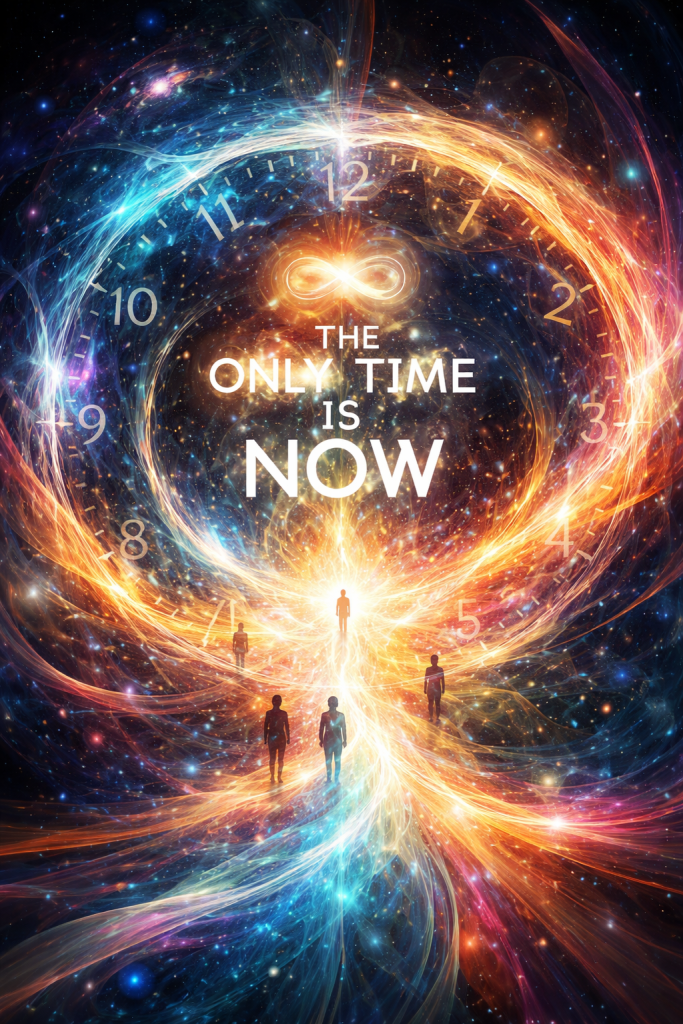
The Only Time Is Now

Something subtle hides behind every assumption about life.
We speak of beginnings, endings, origins, destinies, memories, plans. Language slices reality into segments and calls the slices time. Past. Present. Future.

Direct experience never confirms this division.

Look carefully.

No one has ever stepped into yesterday.
No one has ever arrived at tomorrow.
Everything that has ever appeared shows up only as this immediate presence.

Not a moving present.
Not a fleeting instant.

A boundless, indivisible now.

Mind imagines a line stretching backward and forward, yet perception offers no such line. Thought tells stories about what was and what will be, but those stories arise as present thoughts. Memory occurs now. Anticipation occurs now. Even the idea of history unfolds now.

Remove thought for a moment and see what remains.

Only this.

A beginningless display with no edge to trace.
An endless unfolding with nowhere to land.

Nothing truly starts. Nothing truly stops.

Birth and death appear as transitions inside perception, not events happening to existence itself. Waves rise and fall, yet water never begins or ends with any single wave. Every form behaves the same way. Appearance comes and goes. Being does not.

Cause and effect seem separate only because mind arranges events into sequence. First this, then that. Push, then response. Action, then consequence.

Observe more closely.

Cause and effect share the same instant.
The spark and the flame are one movement.
Seed and tree are different names for one process.

Nothing travels through time to produce something else. Everything co-arises. Each moment contains the totality.

That means creation and destruction are not opposite forces.

They are the same gesture.

Every perception is simultaneously appearing and disappearing. Each sight is born as it fades. Each sound vanishes as it arrives. Reality recreates itself continuously without carrying anything forward.

World dissolves and reforms faster than thought can measure.

Continuity is a useful illusion.

Life becomes lighter when this is recognized. Regret loses its grip because there is no past to fix. Anxiety softens because there is no future to secure. Control relaxes because nothing stands outside the present to manage.

Responsibility remains, yet it feels different. Actions arise from clarity rather than fear. Choices flow from immediacy rather than projection. Compassion deepens because everything shares the same timeless ground.

Nothing stands apart.

Every face, every event, every challenge expresses the same indivisible happening.

No separate moment waits elsewhere.
No hidden realm holds another version of reality.

This is it.

Not a fragment.
The whole.

Eternity does not stretch forever.
Eternity reveals itself as what never moves.

Right here.
Right now.
Always.

Morgan O. Smith

AI for Wellness and Spirituality Summit

February 9 & 10, 2026

https://aiforwellnessandspirituality.com/mosm

Presence Does Not Come or Go

Presence does not arrive with birth, nor does it depart with death. It does not wait for time to pass or moments to accumulate. Presence is already here; before thought names it, before memory reaches backward, before imagination leans forward. Whatever appears does so within presence, not alongside it.

The past feels real only because it is remembered now. The future feels compelling only because it is anticipated now. Thought moves, images shift, emotions rise and fall, yet each movement occurs against the same unmoving fact: presence has never left. Even the idea of being elsewhere is something that appears here.

Bodies change. Identities dissolve and reform. Worlds expand and collapse. Physics tells us that matter and energy do not vanish; they transform. Even more striking, what we call matter accounts for only a fraction of what exists. The vast remainder: dark energy, dark matter, remains unseen, unnamed, yet undeniably present. Absence itself never escapes presence. Non-existence, if such a thing could be said to occur, would still be known as present.

Death, then, does not challenge presence. It only challenges continuity of form. If awareness continues, presence continues. If awareness ceases, the cessation itself is not outside presence. Nothing steps beyond it. Nothing escapes it. There is no edge where presence stops and something else begins.

Impermanence governs every form. Thoughts change. Bodies age. Stars burn out. Universes may even end. Yet impermanence depends on something that does not change. Change can only be noticed because presence remains steady enough to register it. Movement requires a stillness that is never lost.

Presence does not belong to you, yet nothing is more intimate. It is not located inside or outside. Those distinctions arise within it. Every attempt to grasp presence turns it into an object and misses it. Presence cannot be held because it is what is holding everything else.

Even the end of everything would not be an end of presence. It would simply be presence without form. No time. No matter. No universe. Still present.

Nothing needs to be added to this. Nothing needs to be resolved. Presence is not a conclusion; it is the condition that allows conclusions to appear and disappear.

And it has never not been here.

Morgan O. Smith

Get Your Free Copy of My Book, Bodhi in the Brain!

https://subscribepage.io/oTSZQu

The Greatest Expression

You’re Already Expressing the Greatest Expression and Don’t Even Know It

Nothing needs to be added to you. Nothing is missing. The most extraordinary expression possible is already happening, quietly, without effort, before any attempt to improve it.

Existence does not wait for permission to appear. It does not consult identity, achievement, or spiritual progress. It expresses itself as breath, sensation, perception, memory, confusion, clarity, longing, boredom, and awe, all without ever stepping outside itself. What you call you is one of its gestures, not its source.

Search often begins with the assumption that something essential has not yet arrived. That assumption creates movement, effort, discipline, and endless refinement. Yet the impulse to seek arises from the same field that is supposedly being sought. Awareness looks for awareness. Being attempts to arrive at being. The loop sustains itself through misunderstanding.

Existence is not something you perform well or poorly. It is not a role to master or a state to stabilize. It is already complete before thought comments on it. Every attempt to improve it belongs to the play of expression, not to a lack that needs correcting.

Notice how little effort is required to exist. Heartbeat continues without consultation. Sensations arise without rehearsal. Thoughts appear without being summoned. Even the sense of being a separate doer arrives spontaneously. None of this requires your management.

What feels ordinary carries no deficiency. The mundane is not a lesser version of reality waiting to become sacred. Washing dishes, forgetting names, feeling tired, feeling inspired, each appears from the same depth. Existence does not divide itself into meaningful and meaningless moments.

Awakening is not an upgrade layered onto life. It is the recognition that life never needed upgrading. What falls away is not existence, but the belief that existence must become something else to be valid.

Trying to express your “highest self” quietly assumes you are not already doing so. That belief fractures what is whole. The greatest expression cannot be improved because it is not a product. It is the fact of appearing at all.

Nothing needs to stop. Nothing needs to be transcended. Even misunderstanding belongs. Even confusion is permitted. Even the desire to arrive somewhere else is part of what is already complete.

The miracle hides in plain sight because it has never announced itself. Existence does not sparkle to prove its worth. It simply continues, endlessly creative, endlessly sufficient, endlessly itself, appearing as you, without asking whether you recognize it.

Morgan O. Smith

Get Your Free Copy of My Book, Bodhi in the Brain!

https://subscribepage.io/oTSZQu

Beyond Existence and Non-Existence

The Paradox of God

To say “God exists” is to affirm the ultimate. To say “God does not exist” is to deny the ultimate. Both affirmations and denials, however, are shaped by the mind’s insistence on certainty. The moment one tries to hold onto either pole, a paradox emerges.

When someone claims God exists, they project a reality beyond perception, yet they confine that reality to a category recognizable to human thought. When another claims God does not exist, they too impose a conclusion, binding the ineffable to the limits of negation. Both positions carry a strange truth and a strange error. Both dissolve the moment awareness sees through the duality of affirmation and denial.

Imagine truth as a horizon: from one angle, existence appears; from another, non-existence. Walk closer, and the horizon itself vanishes; it was never a line that could be grasped, but a function of perspective. God is not merely at the horizon but the condition through which horizon, perspective, and perceiver arise.

To say both are true is to honour that reality contains affirmation and negation. To say both are false is to point out that neither claim reaches the source. To say one is true and the other false is to remain in dualistic thought. To call them half-truths is to recognize their limitation yet still attempt to measure the immeasurable. To deny even a half-truth is to bow to silence.

The statement itself, that God exists and does not exist in all these paradoxical ways, becomes the closest gesture to truth. It is not the conclusion but the capacity to hold the contradictions without collapse that reveals God’s existence, not as a concept but as the unnamable presence behind every concept.

The paradox is not meant to be solved. It is meant to exhaust the mind until only awareness remains. What remains is not the proof of God, but the direct realization that the very effort to define or deny was always occurring within and as God.

Morgan O. Smith

Get Your Free Copy of My Book, Bodhi in the Brain!

https://subscribepage.io/oTSZQu

Which You is God Within?

Those who speak of God as not being outside of you often mean well—but which “you” are they pointing to? The body? The persona? The memory of identity that walks through time? Or something deeper?

There’s a difference between saying God is not outside of you and realizing why that’s so. If God is all, then every appearance—internal, external, formless, formed—is God. This includes the illusion of separation. To claim that God is not outside of you while affirming that something is external still subtly upholds the illusion of division. That illusion, too, is God—played through veils of thought, language, and perspective.

But when the idea of “you” dissolves into beingness itself, the paradox clears. You are not merely a part of existence. You are existence. And existence is God, not as a figure, but as totality. Even the idea of “outside” collapses, because outside implies another space, and there is no second to the One.

This doesn’t mean there’s nothing. It means everything is not-two.

Even nonexistence exists. Not as an object, but as a category known within existence. Its very naming proves its place within the whole. Therefore, there’s nowhere God is not—and no self outside of God to speak of God as elsewhere.

So, when someone says “God is not outside of you,” pause. Feel what is really being said. It’s not a statement about boundaries—it’s a pointer toward boundarylessness. Not about spiritual pride or metaphysical positioning. It is the erasure of location itself.

And in that clarity, what’s left is not you as you know yourself. What remains is what’s always been—God, appearing as you.

Morgan O. Smith

Get Your Free Copy of My Book, Bodhi in the Brain!

https://subscribepage.io/oTSZQu

The Supreme Siddhi

The Unfathomable Miracle of Being

Among the many marvels attributed to the Siddhas—those said to wield supernatural abilities—there exists a siddhi so profound that it eclipses all others. Beyond the conjuring of objects from nothingness, beyond the bending of space and time, there lies the ultimate and most extraordinary power: existence itself.

The fact that anything at all is, that awareness stirs within the vastness of the void, defies all logic. Every phenomenon, every thought, every breath—utterly improbable, yet undeniably real. The miracle is not found in levitation, bilocation, or the manifestation of jewels; it is the sheer actuality of Being that outshines them all.

From the perspective of the Absolute, existence is not an anomaly. It is neither a feat nor an accomplishment. It is simply an emanation of boundless imagination, a movement within the Infinite Mind. Some call it the Void, the Source, the Tao. It is that which dreams itself into form, appearing as multiplicity while ever remaining One.

This is the true Siddha’s wonder—the great unfolding of the Unknowable into the known. Yet, the game is such that the dreamer forgets. And in that forgetting, there is awe. A paradox unfolds: the creator marvels at its own creation, unaware that the very act of astonishment is a performance orchestrated by none other than itself.

Eventually, remembrance dawns. The performer recognizes the stage, the audience, and the play as its own. The illusion of separation dissolves, and what remains is that which has always been—existence as the supreme siddhi, the only miracle that ever was.

Morgan O. Smith

Yinnergy Meditation/Neurofeedback, Spiritual Life Coaching & My Book, Bodhi in the Brain…Available Now!

https://linktr.ee/morganosmith

The Silent Witness of Truth

Two voices rise in heated exchange—one anchored in faith, the other in skepticism. They stand opposed, each convinced of their certainty, each attempting to dismantle the other’s foundation. Their words carry weight, their arguments sharpened by conviction, yet beneath the clashing ideologies, an unseen presence listens, unmoved.

Observing this, a realization dawns. Neither combatant holds the full measure of truth, yet together they sustain a delicate balance—two halves of an equation that unknowingly uphold the whole. One defends belief, the other champions reason, yet both are bound to the same unseen essence that animates their very thoughts. The paradox they refuse to entertain is the paradox they embody: truth exists beyond assertion, beyond belief and disbelief alike.

What remains when both voices fall silent? What exists beneath every question, beyond every answer? A presence, neither confined by doctrine nor diminished by doubt. It is not a belief to defend nor a theory to deconstruct. It is the stillness that remains when all concepts dissolve, the background against which all ideas emerge and fade.

This presence requires no validation, no allegiance, no name. It neither arises nor perishes, for it is not bound by time. It is the ever-present foundation upon which all things rest—the unseen essence that gives rise to both theist and the atheist, both the question and the answer.

And yet, words will always fall short. Language can point, but it cannot contain. Thought can probe, but it cannot grasp. Those who have peered into the mystery have only ever gestured toward it—whether in sacred texts or silent awe. To recognize it is not to name it, but to surrender the need for certainty.

Look around. Not with the eyes of belief or disbelief, but with the eyes that see before thought intrudes. Feel its presence—not as an idea, but as the undeniable is-ness of this moment. And when you do, offer it a quiet smile. It has always been smiling back.

Morgan O. Smith

Yinnergy Meditation/Neurofeedback, Spiritual Life Coaching & My Book, Bodhi in the Brain…Available Now!

https://linktr.ee/morganosmith