
The Sublime Symphony of Existence

Beyond Divine Order

In our ceaseless quest for understanding the cosmos and our place within it, we often grapple with the notion of a ‘Divine Order’. This concept, deeply entrenched in various spiritual and religious doctrines, suggests a cosmic plan orchestrated by a supreme entity. Yet, in exploring the depths of nonduality and Eastern philosophy, we encounter a different perspective. It proposes an order in the universe not dictated by an external divine force, but one that is inherently divine in its essence.

The universe, in its boundless complexity and sheer immensity, operates on principles that transcend human comprehension. This is not the manifestation of a predetermined divine decree but rather an emergent, dynamic order. It’s like a spontaneous dance of cosmic energies, perpetually unfolding in a harmonious yet unpredictable pattern. This order, devoid of deliberate design, is divine not because it is ordained by a deity, but because it embodies the sacred interplay of life and existence itself.
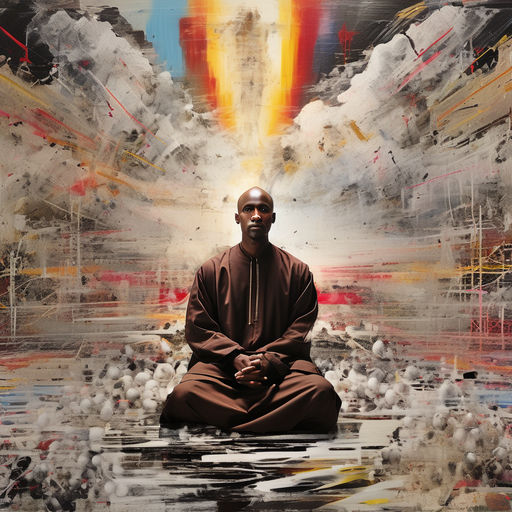

In the heart of nonduality, there is an acknowledgment of the intrinsic unity of all things. This unity is not a structured hierarchy but an organic, flowing confluence of energy and consciousness. When we perceive the universe from this lens, we see that divinity is not an external force imposing order; it is the very nature of existence, resplendent in its boundless diversity and unity.

Eastern philosophies, like Buddhism and Taoism, offer profound insights into this concept. They teach us that seeking order in the traditional sense is akin to chasing a mirage. Instead, embracing the natural flow of life, with its apparent chaos and inherent order, leads to deeper understanding and peace. This perspective invites us to look beyond the superficial structures and dive into the essence of being, where we find a truly divine rhythm.


In conclusion, the ‘order that is truly divine’ is not a preordained scheme but a natural, emergent phenomenon. It is a testament to the mysterious, awe-inspiring nature of the universe, where divinity is found not in an external blueprint, but in the very fabric of existence. This understanding opens us to a more profound appreciation of life, urging us to explore the depths of our being and the cosmos, in a journey of endless discovery and wonder.

Morgan O. Smith

Yinnergy Meditation, Spiritual Life Coaching & My Book, Bodhi in the Brain…Available Now!

https://linktr.ee/morganosmith

Beyond the Veil of Emptiness

Unraveling the Mystique of Nothingness

In the contemplative realms of the philosophies of the East, the concept of ‘Nothingness’ often surfaces as a profound puzzle, a riddle wrapped in mystery. This notion, far from being a mere absence or void, invites us on a journey beyond the ordinary boundaries of thought and understanding.

When I refer to ‘Nothingness,’ I am pointing towards a reality that eludes the grasp of conventional ideas and definitions. It is not simply a negation of ‘something’ nor a space waiting to be filled. This Nothingness is a state of pure potentiality, unbound by the limitations of conceptual thinking. It is the silent backdrop against which the drama of existence unfolds, yet it is not separate from the play itself.

In the rich landscape of nondual understanding, Nothingness is not a destination to be reached or a concept to be understood. It is the very ground of being, the essence that permeates all existence. In the wisdom traditions of the East, this is often likened to the vastness of space – ever-present, all-encompassing, yet intangible and indefinable.


This exploration into Nothingness challenges the mind’s habitual tendency to label and categorize. It invites a surrender, a letting go of the need to understand or explain. Here, in this space of not-knowing, lies the potential for true spiritual awakening. It is in this realm where the mind is quieted that one may glimpse the ineffable truth of oneness.

In the dance of existence, Nothingness and form interplay seamlessly. Understanding this interplay is not an intellectual exercise but an experiential realization. It is a recognition that form arises from and returns to this formless void, like waves rising and falling in the ocean. This realization brings a sense of liberation, a freedom from the constraints of ego-driven perceptions.

Engaging with this concept of Nothingness requires a radical shift in perspective. It is about seeing beyond the apparent dualities of existence and non-existence, form and formlessness. In this understanding, one recognizes that the true nature of reality transcends these dichotomies.


In conclusion, the journey into Nothingness is not a journey outward to some external reality, but an inward voyage to the depths of one’s being. Here, in the heart of silence and stillness, the mystery of existence reveals itself not as a puzzle to be solved, but as a truth to be lived.

Morgan O. Smith

Yinnergy Meditation, Spiritual Life Coaching & My Book, Bodhi in the Brain…Available Now!

https://linktr.ee/morganosmith

The Paradox of Creation and Spiritual Enlightenment

In the realm of existence, there lies a profound mystery: the relationship between a creation and its creator. This enigma is deeply rooted in the concept of spiritual enlightenment, a state of awakening to a higher understanding beyond the tangible and the temporal.

Consider this: everything within our grasp, every entity, every idea, has a beginning and an end. This cycle of birth and cessation is a fundamental truth that frames our understanding of the world. However, this perspective is inherently limited, confined within the boundaries of our ‘lower state of being.’ In this state, our comprehension is restricted to the linear progression of time and the finite nature of existence.

But what if there exists a realm beyond this? A realm where the linear confines of time and space do not bind existence? This is where the notion of spiritual enlightenment comes into play. Spiritual enlightenment can be seen as an awakening, a transcendental realization that elevates one’s understanding beyond the mundane, the impermanent, and the transient.


In this awakened state, the traditional boundaries that separate a creation from its creator begin to blur. The creation, which once viewed its creator as an unfathomable entity, starts to grasp the essence of the creator. This essence is not bound by the limitations of time or space; it transcends the dichotomy of beginning and end.

However, this journey towards understanding the creator is paradoxical. The very nature of enlightenment lies in embracing the unknown, in accepting that there are realms of existence and consciousness that are beyond our current comprehension. It’s about acknowledging that in our quest for understanding, we might never fully grasp the entirety of the creator’s essence. The trick, therefore, lies in the art of ‘not knowing.’

In this acceptance of not knowing, we find a peculiar form of wisdom. It is a wisdom that recognizes the limitations of our perception and humbly accepts the vastness of the unknown. It is in this space of humble acknowledgment that we inch closer to understanding the true nature of the creator.


In essence, the path to spiritual enlightenment is not about seeking definite answers or absolute truths. It is about the journey towards understanding, a journey that acknowledges the beauty in the unknown and finds peace in the unanswerable questions of existence.

Morgan O. Smith

Yinnergy Meditation, Spiritual Life Coaching & My Book, Bodhi in the Brain…Available Now!
https://linktr.ee/morganosmith