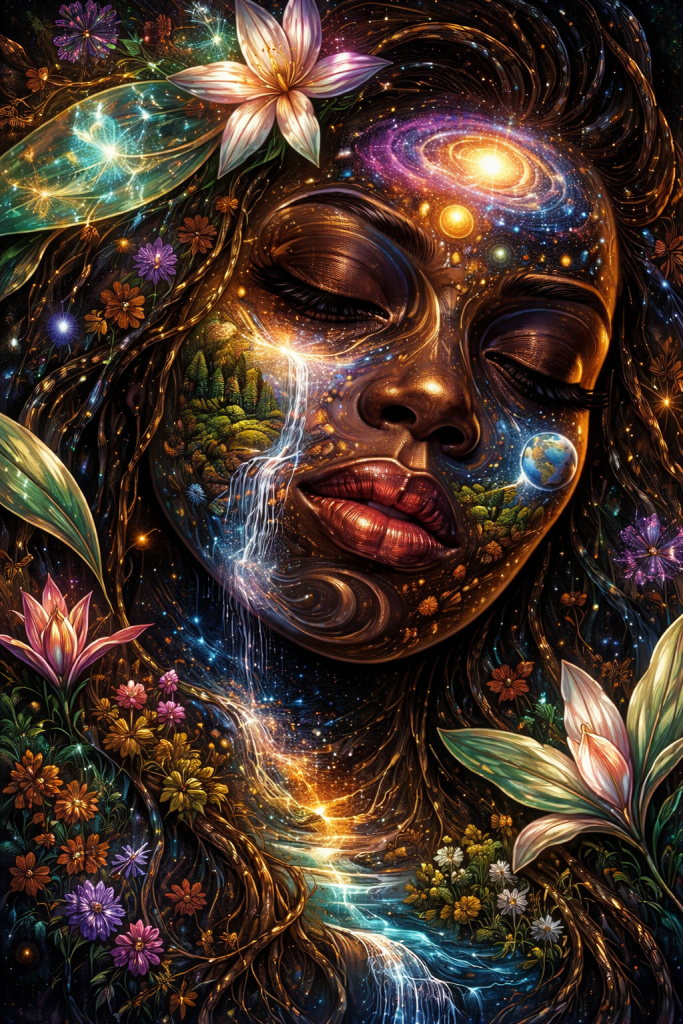
A strange intimacy reveals itself when awareness no longer stands apart from the world it observes. Trees are no longer objects. Oceans are no longer scenery. The body is no longer a private possession. Everything breathes as one movement.
Mystics across cultures have described this shift differently, yet the essence remains unchanged: Nature is not something encountered. Nature is what is happening as you.
Imagine Mother Nature not as a mythic figure in the sky, but as the very process unfolding through every cell, every star, every collapsing galaxy. She is not separate from her creation. She is the contraction and expansion, the seed splitting underground, the animal hunting, the volcano erupting, the lover trembling. She is labour and release, genesis and dissolution.
Birth is not gentle from her perspective. It is pressure, rupture, intensity. Galaxies tear themselves open through gravitational force. Bodies break to allow new bodies through. Evolution demands friction. She pushes herself into form, again and again, through unimaginable compression.
Then comes destruction. Stars implode. Species vanish. Civilizations crumble. The universe cools toward entropy. This is not tragedy to her. This is exhalation. The same force that tightens also relaxes.
Creation and annihilation are not opposites in this vision. They are phases of one continuous pulse.
Sexuality belongs to this pulse as well. Attraction between bodies mirrors attraction between particles. The longing of lovers reflects the magnetic urge of existence to know itself through union. Pleasure is not an accident. It is nature recognizing her own vitality through sensation. The climax is not separate from cosmic expansion; both are explosive affirmations of aliveness.
When one witnesses oneself as this total movement, something dissolves. Personal suffering shifts context. Pain is still felt. Loss still stings. Yet beneath the narrative of “my pain” lies a wider recognition: this is nature feeling her own contraction through this particular configuration of matter and awareness.
Grief becomes the earth, mourning her forests. Joy becomes the sun rising in the nervous system. Desire becomes the universe leaning toward itself.
Calling this process “Mother Nature” offers poetry. Calling it the Tao offers philosophy. Both point toward the same reality: a self-arising order that moves without external command. Nothing stands outside it. Nothing directs it from beyond. It flows as all phenomena, yet cannot be captured by any single phenomenon.
Tao is not an entity giving birth. Tao is the giving birth. Tao is not an organism dying. Tao is the dying. Tao is not the pleasure between forms. Tao is the current moving as pleasure.
Personification helps the mind relate to what cannot be grasped conceptually. A mother birthing herself expresses paradox more vividly than abstract metaphysics ever could. She is both the womb and the child. Both the lover and the beloved. Both the body writhing in ecstasy and the vast silence containing it.
Seen clearly, this vision does not inflate the ego into cosmic grandeur. It erases the boundary that allowed ego to imagine separation in the first place. “I” am not a fragment witnessing nature. This body-mind is one eddy within the larger river. The river flows as every eddy simultaneously.
Nature mysticism does not romanticize suffering or glorify destruction. It recognizes them as intrinsic movements within the same whole that produces beauty and delight. Forest fires clear space for renewal. Supernovas forge the elements required for life. Orgasm dissolves the sense of separateness, if only briefly.
Labour, death, and ecstasy belong to one indivisible rhythm.
To awaken to this is to sense that nothing is happening outside of what you are. Every cry, every birth pang, every collapsing star, every trembling pleasure is the Tao unfolding without preference.
Mother Nature is not somewhere else. She is the totality of appearance recognizing itself through countless forms. She births. She dies. She delights. She grieves.
All of it is one movement, witnessing itself.
Morgan O. Smith
 Morgan O. Smith