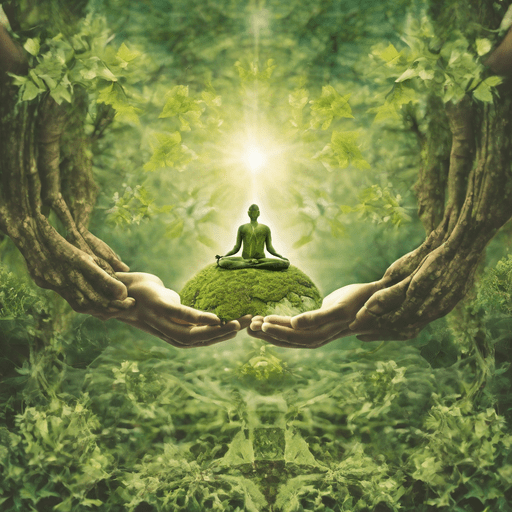
The Environment’s Role in Spiritual Growth

Spiritual growth is an inward journey that involves deepening self-awareness, a connection to a higher purpose, and a pursuit of inner peace and enlightenment. Though one might perceive spiritual growth as purely internal, the environment plays an instrumental role in shaping this voyage.

**The Outer Reflects the Inner**:
Spirituality isn’t limited to the realm of meditation, prayers, or religious practices. It’s also about understanding oneself to the larger world. The environment serves as a mirror, reflecting the chaos or calm we feel within. A serene setting, like a tranquil forest or a quiet beach, can provide the space needed for introspection, while a tumultuous environment might challenge and refine our spiritual resilience.

**The Playground of Experiences**: Our experiences, heavily influenced by our environment, serve as lessons that guide our spiritual evolution. Facing economic hardships might teach us humility and gratitude while being in a nurturing emotional environment can facilitate feelings of love and empathy. Each environment, with its unique challenges and blessings, offers distinct lessons for our soul’s growth.

**Environmental Genetics and The Enlightened Individual**:
Modern scientific understanding acknowledges that both genes and the environment play roles in determining our characteristics. This interplay is also valid for spiritual inclinations. An individual with a genetic predisposition towards introspection and an environment that encourages self-reflection might have a smoother path toward enlightenment. Conversely, someone genetically predisposed to anxiety but raised in a supportive environment might learn to channel that anxiety into a deeper spiritual quest.

Yet, it’s crucial to remember that enlightenment isn’t a one-size-fits-all concept. The combination of genetics and environment produces a spectrum of enlightened individuals, each with unique strengths, perspectives, and wisdom to offer.

### Balancing Agency with Environmental Influences

While the environment significantly shapes us, spiritual growth also involves recognizing and exercising our agency. It’s about acknowledging environmental influences while taking proactive steps to seek experiences and environments that align with our spiritual goals.

For many, this might mean seeking spiritual communities, immersing oneself in nature, or actively creating a personal sanctuary that facilitates inner reflection and growth. For others, it might involve challenging and transforming their environments.

In conclusion, the environment isn’t just a backdrop against which the drama of life unfolds; it’s an active participant, a teacher, a mirror, and a guide on our spiritual journey. Recognizing its influence can empower us to harness its lessons, navigate its challenges, and embark on a more profound, fulfilling spiritual voyage.

Morgan O.  Smith

Yinnergy Meditation & My Book, Bodhi in the Brain…Available Now!

https://linktr.ee/morganosmith

The Harmony Within

Exploring Integral Theory’s Perspectives on Nature vs. Nurture

Introduction:
In the quest to unravel the essence of human existence, the age-old debate of Nature vs. Nurture finds itself intertwined in the heart of discourse. The Integral Theory, founded by philosopher Ken Wilber, offers a unique lens to dissect this debate through its Four Quadrants. This thought-provoking analysis aims to delve into how the Integral Theory’s Four Quadrants elucidate the interplay between nature and nurture.

The Four Quadrants:
For context, Integral Theory’s Four Quadrants are a framework to understand reality. They are: Interior-Individual (Upper-Left), Exterior-Individual (Upper-Right), Interior-Collective (Lower-Left), and Exterior-Collective (Lower-Right). These quadrants reflect the inner and outer, as well as the individual and collective dimensions of existence.

1. Interior-Individual (Upper-Left) – The Subjective Self:
Here, nature manifests as the innate essence, such as genetic predispositions and temperament. Nurture, on the other hand, shapes our consciousness through personal experiences and emotions. The harmony or dissonance between one’s nature and the nurturing influences could define their subjective reality.

2. Exterior-Individual (Upper-Right) – The Observable Self:

In this quadrant, nature is viewed through the lens of biology – our brain structure, hormones, and genetic makeup. Nurture is the external stimuli that alter our biology. Understanding how the external environment (nurture) impacts our physiological being (nature) helps in comprehending the fluidity of human behaviour.

3. Interior-Collective (Lower-Left) – Shared Cultural Values:
This quadrant takes into account the collective consciousness, where nature represents the innate human desire to belong and socialize. Nurture is the culture we imbibe. It is critical to examine how societal norms and values (nurture) can either support or conflict with our innate tendencies (nature).

4. Exterior-Collective (Lower-Right) – Social Structures:

The Lower-Right quadrant emphasizes the social systems and structures. Here, nature is the evolution of societies, while nurture represents the societal systems such as education, law, and governance. The structures that societies create (nurture) can either facilitate or hinder the natural progression of human evolution.

Finding Balance:

The Integral Theory’s Four Quadrants reveal the intricate tapestry woven by the threads of nature and nurture. Recognizing the dialogues between these dimensions empowers us to find balance. Are we honoring our innate essence while being responsive to external influences? How are our societal structures and shared values nurturing our natural propensities or thwarting them?

Conclusion:
As we navigate through the currents of existence, the Integral Theory’s Four Quadrants provide us with the compass to explore the depths of Nature vs. Nurture. By seeking harmony between our inherent nature and the nurturing environments, we create a symphony that resonates with the very core of human existence. It is through this understanding that we can work towards a more holistic, compassionate, and evolved society.

Morgan O. Smith

Yinnergy Meditation & My Book, Bodhi in the Brain…Available Now!
https://linktr.ee/morganosmith