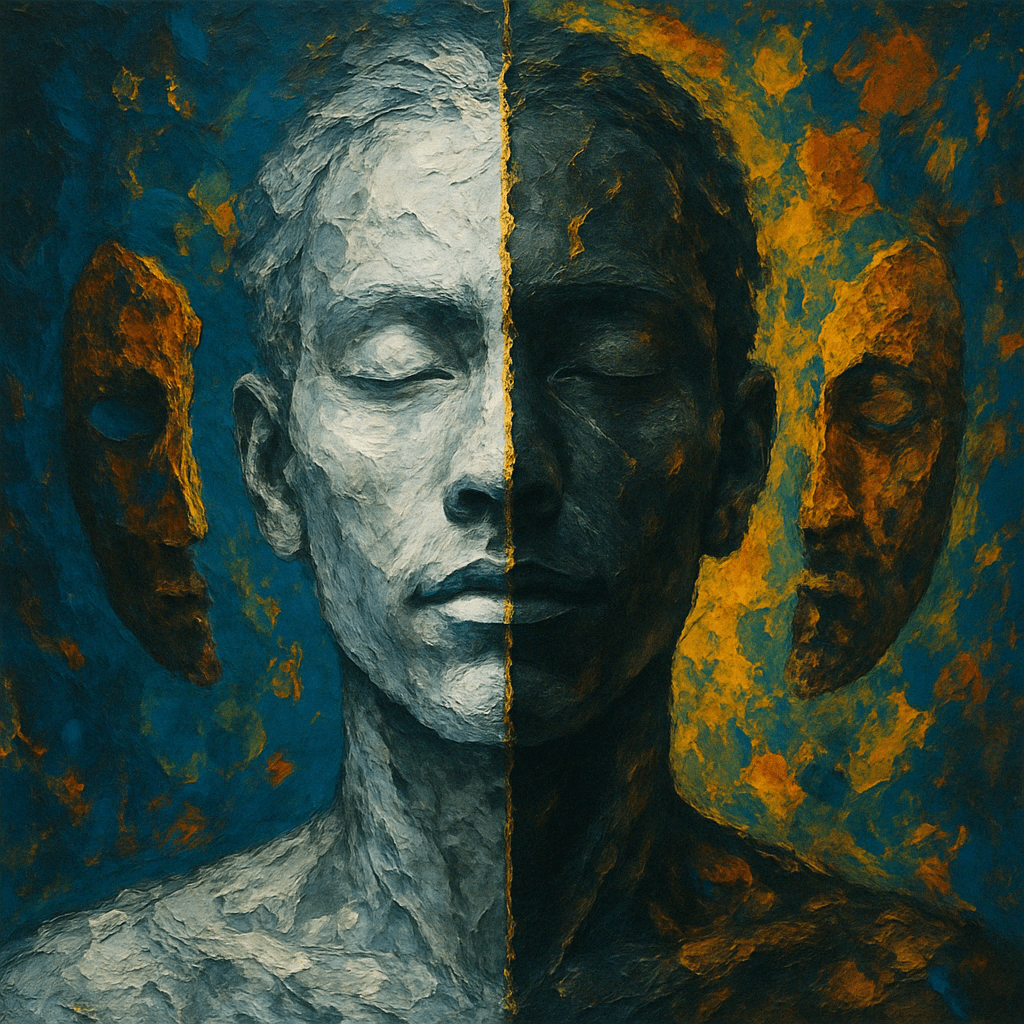
Beyond the Great Divide

White Supremacy, Caste, and the Collapse of Constructed Hierarchies through Nondual Perception

What happens to white supremacy when whiteness is no longer seen as a centre?
What becomes of caste when the hierarchy collapses into the unbroken Whole?
These aren’t abstract questions, but intimate ruptures in perception that strike at the root of separation.

From the nondual view, the machinery of supremacy and caste is not just unethical—it is illusory. A dream born of mistaken identity. These systems persist because the world is filtered through the lens of difference. They rely on “me” and “you,” “above” and “below,” “pure” and “impure.” Once those constructs dissolve, the scaffolding that held them together trembles.

To see with undivided awareness is not to turn away from injustice—it is to see it with such clarity that the illusion loses power.

The mind behind supremacist ideology must first construct a self that is isolated, then build defences around that self using race, status, bloodline, and geography. But once this boundary is questioned—not through philosophy, but through direct experience—an entire civilization of “better than” collapses into silence.

There is no whiteness in the Absolute. No Brahmin, no Dalit. No legacy of conquerors, no lineage of slaves. These roles, though ferociously enacted on the stage of form, do not survive the fire of presence. They belong to the play of names and forms—real enough to cause suffering, yet ultimately not what is.

Nonduality does not excuse or erase suffering. It reveals the mechanisms that perpetuate it: misidentification, grasping, and fear. And it points to the only true revolution—the recognition of what was never divided.

When someone rooted in supremacist delusion awakens to the groundless reality of Being, they are not offered a spiritual bypass, but a mirror. One that reflects every role played, every belief clung to, and the emptiness beneath them all. This is not comfort. It is unmaking.

Likewise, those dehumanized by caste are not told to ignore injustice. Rather, they are invited to witness that their essence was never touched by degradation. The soul, if we may call it that, has no fingerprints. No brand of subjugation can mark the formless.

The end of separateness is not utopia. It is not the promise of a better structure. It is the absence of structure where no one rules and no one serves. Where self and other melt into something wordless.

Once you know yourself as that which sees without division, supremacy is not just immoral—it’s absurd. The belief that one appearance of the Whole is more worthy than another is like believing one wave owns the ocean.

And so, from this stillness, something radical emerges: not activism rooted in identity, but action arising from unity. Compassion that does not pity, but recognizes itself. Justice that is not vengeance, but restoration of clarity. Love that is not sentimental, but annihilating.

The real threat to white supremacy and caste is not education alone, nor protest alone. It is the awakening of even one being to what cannot be divided. For when the illusion of separation dies, the systems built upon it cannot survive.

Morgan O. Smith

Yinnergy Meditation/Neurofeedback, Spiritual Life Coaching & My Book, Bodhi in the Brain…Available Now!

https://linktr.ee/morganosmith

The Collapse of Illusion

Navigating the Aftermath of Awakening

Reality fractures in a single instant, revealing itself as something altogether ungraspable. The moment of absolute recognition—the unfiltered, direct encounter with Truth—tears through the mind like a bolt of cosmic lightning, leaving no belief unshaken, no identity intact. The self, as it was once understood, dissolves into the vastness, leaving behind nothing but raw awareness.

A revelation of such magnitude is both exhilarating and devastating. The world remains as it was, yet nothing remains the same. The return to ordinary existence feels disjointed, as if waking from a dream only to realize the dream is what was once called life. Conversations that once held meaning now seem hollow, ambitions that once fueled passion now appear weightless. The social frameworks that once dictated identity—the career, the friendships, the personal convictions—suddenly feel like distant echoes of a forgotten language.

A solitude arises, not necessarily by choice, but as an inevitable consequence of perceiving beyond the familiar constructs. People speak, but the words seem veiled in a fog of assumptions and conditioned perspectives. What was once music now carries an indescribable depth, revealing textures previously unnoticed. Colours take on a vibrancy beyond sight, whispering truths beyond language. The ordinary world hums with a resonance that cannot be explained, only felt.

Attempting to articulate the experience proves futile. Language stumbles over itself, unable to capture the unspeakable. Those who listen often respond with polite nods, skepticism, or outright dismissal. A few may lean in with genuine curiosity, yet without direct experience, understanding remains confined to intellectualization. Words, at best, become poetic approximations, metaphors stretching toward something that cannot be contained within the mind.

This is the paradox of awakening. The very moment that reveals the boundless unity of existence also exposes the fragmented nature of human perception. The mind wants to categorize, to make sense, to translate the infinite into the finite. But Truth is not something to be grasped; it is something to be surrendered into.

Isolation does not come from arrogance, nor from a desire to detach, but from the realization that much of what once passed as reality was a mirage. The process of reintegration is neither smooth nor predictable. There is grief in letting go of the known, yet immense freedom in no longer being bound by it. What remains is a quiet certainty—an understanding that cannot be proven, only lived.

This path is not for the faint-hearted. It is not about enlightenment as an achievement or an identity. It is about dissolution. It is about dying before death. And in that dissolution, what remains is the eternal presence, the silent witness, the infinite unfolding of what has always been.

Morgan O. Smith

Yinnergy Meditation/Neurofeedback, Spiritual Life Coaching & My Book, Bodhi in the Brain…Available Now!

https://linktr.ee/morganosmith

The Silent Puppeteer

The Illusion of a Divine Master

The notion of an all-powerful deity that dictates morality and enforces ethical order is an echo of human thought—an illusion formed from collective belief. This revered architect of existence is not some transcendent ruler dwelling beyond the stars but an extension of the human psyche, woven from social constructs and inherited dogmas. The God of religious tradition is not a divine entity but a reflection of the authority we have surrendered to structures designed to govern our impulses.

What is often labelled as evil—the raw instincts and untamed desires—has been cast as the adversary, creating a dualistic conflict that fuels our internal war. The chaos we seek to control is the essence of vitality, yet we suppress it, fearing the dissolution of the structures we so desperately cling to. This battle within—the fight between order and freedom—creates the illusion of a righteous war, where victory is promised through submission to an unseen overlord.

But what if this overseer has no real power? What if it is merely a projection, a ghostly hand that moves only because we choose to be its marionettes? When a mind unfettered by dogma speaks of truth, society does not listen—it condemns. We fear what exists beyond the boundaries of tradition, resisting the notion that divinity is not a distant force but the very essence of our being.

Burn every doctrine, dismantle every governing body, erase every name given to the unseen, and still, this authority persists—not because it is real, but because the mind clings to the comfort of control. If the structures fall, chaos rises, yet from that chaos, a new order emerges. The cycle continues, a dance between imposed rule and untamed instinct, as humanity remains bound by its illusions.

We have long mistaken ourselves as subjects of a divine sovereign, yet the truth is far more unsettling: this supposed ruler is but a shadow cast by our fears and desires. We have not been governed—we have been governing. The leash we imagine around our necks is one we have placed upon ourselves, a tether to an idea we refuse to question.

To see beyond the illusion is to awaken to presence itself—a force neither ruling nor ruled, but simply existing. No divine master, no external lawgiver, only the boundless intelligence moving through all things. The true essence of being is neither subject nor sovereign, neither governed nor governing—it is the silent puppeteer, the hand and the string, the breath and the wind. And once the illusion is recognized, the question remains: Who is truly in control?

Morgan O. Smith

Yinnergy Meditation/Neurofeedback, Spiritual Life Coaching & My Book, Bodhi in the Brain…Available Now!

https://linktr.ee/morganosmith