The Mosaic of Interpretations

Navigating the Perception of Ultimate Truth

In the vast landscape of human consciousness, the concept of Ultimate Truth stands as an immutable beacon, untouched by time and the flux of subjective experience. It is not the Truth itself that intrigues me, but rather the myriad ways in which individuals interpret and express it. This divergence in interpretation is where the true beauty and complexity of human experience lie.

The pursuit of Ultimate Truth is a journey that transcends the boundaries of culture, religion, and philosophy. It calls upon us to look beyond the surface of our conditioned beliefs and to delve into the depths of our consciousness. However, this journey is often clouded by personal biases, societal influences, and the limitations of language. Each individual’s interpretation of Truth becomes a reflection of their inner landscape, shaped by their unique experiences, perceptions, and spiritual inclinations.

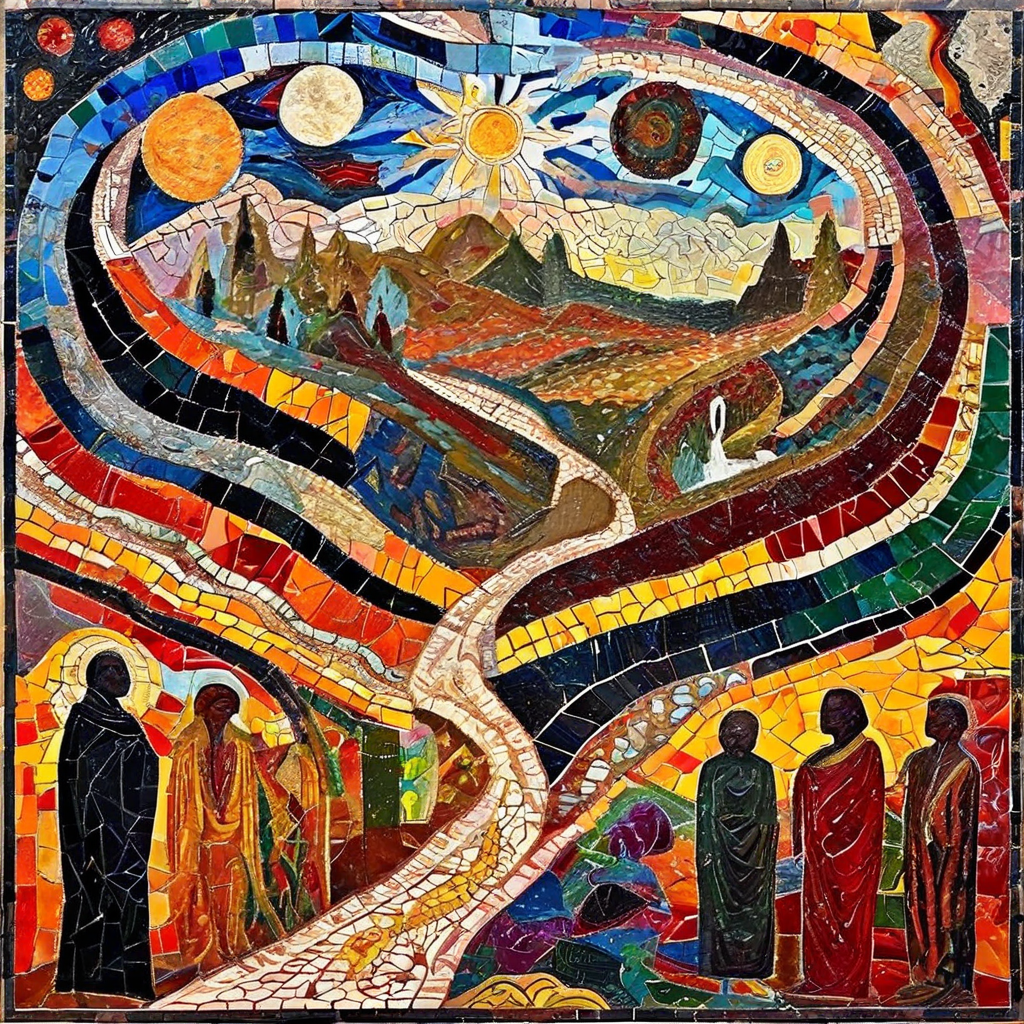
In questioning these interpretations, we are not seeking to undermine the sincerity of one’s spiritual journey. Rather, we are engaging in a deeper exploration of the nuances that colour our understanding of reality. It is an invitation to recognize that our interpretations, no matter how profound, are still filtered through the lens of our perception. They are, in essence, a part of the grand mosaic of human consciousness, where each piece offers a distinct yet incomplete glimpse of the Whole.

This exploration invites a profound humility and openness. It encourages us to listen to the diverse voices that speak of Truth, not as competing claims, but as different facets of a shared journey toward understanding. By embracing this diversity, we move closer to an authentic dialogue that transcends dogma and opens the door to a more inclusive and compassionate worldview.

Moreover, this inquiry into the interpretations of Truth can lead us to a deeper appreciation of the paradoxical nature of existence. As we peel back the layers of our conditioned beliefs, we find that the Ultimate Truth is not something to be grasped or owned, but rather experienced as a living, dynamic presence that defies conventional categorization. It is in this space of not knowing, of embracing the mystery, that we find the most profound revelations.

In conclusion, the questioning of interpretations is not an act of skepticism, but of reverence for the ineffable nature of Ultimate Truth. It is a reminder that the journey is ongoing and that each step along the path is a vital part of the unfolding process. By engaging in this exploration, we honour the richness of the human experience and the boundless potential for growth and transformation that lies within us all.

Morgan O. Smith

Yinnergy Meditation, Spiritual Life Coaching & My Book, Bodhi in the Brain…Available Now!

https://linktr.ee/morganosmith

Embracing Falsehoods at the Pinnacle of Awareness

In the realm of human consciousness, there exists a fascinating paradox. At the highest level of awareness, a person can reach a state where they can believe in something, fully aware that it is not true. This peculiar aspect of human psychology offers a deep insight into the nature of belief, perception, and the human mind.

What does it mean to believe in something while knowing it isn’t true? It’s like willingly suspending disbelief while watching a movie. You enter into a contract with the fiction, fully aware that dragons don’t exist or that superheroes don’t fly, yet you allow yourself to believe in these concepts for the duration of the experience. This phenomenon isn’t just limited to entertainment but extends to the very core of our everyday lives.

Why do people engage in such seemingly contradictory behaviour? The answer lies in the complexity of the human mind and its quest for meaning and comfort. Beliefs, even those acknowledged as false, can provide a sense of comfort, belonging, or identity. They can be a source of inspiration or a means of coping with the harsh realities of life. In a world that often feels chaotic and unpredictable, these beliefs, however, detached from reality, can offer a sense of order and purpose.


This ability to believe in the unbelievable highlights the power of the human imagination and creativity. It’s a testament to our ability to envision worlds and possibilities beyond our immediate reality, a skill that has been a driving force behind art, literature, and scientific innovation. It allows us to explore ideas and scenarios that, while not real, can lead to real-world insights and advancements.

However, this power comes with a responsibility. While it can be enriching and beneficial, deliberately believing in falsehoods can also lead to dangerous delusions and collective harm if not approached with critical thinking and ethical considerations. It’s vital to find a balance, to know when to embrace these beliefs as a source of inspiration and when to acknowledge them as mere constructs of our imagination.


In conclusion, the capacity to believe in something while knowing it isn’t true is a unique aspect of human consciousness, reflecting our complex psychology. It’s a powerful tool that, when used wisely, can enrich our lives and propel us toward greater heights of imagination and understanding. However, it’s crucial to navigate this terrain with discernment and a keen sense of reality.

Morgan O. Smith

Yinnergy Meditation, Spiritual Life Coaching & My Book, Bodhi in the Brain…Available Now!
https://linktr.ee/morganosmith

Inner Flame

The Dual Paths to Spiritual Enlightenment

Spiritual enlightenment is often perceived as the pinnacle of human consciousness, a state of profound insight and understanding that transcends ordinary perception. But is this enlightenment an attainment through arduous pursuit, or is it a state into which some are born?

The notion of being born spiritually enlightened is intriguing. It implies an intrinsic connection with the divine, an innate wisdom that does not require the rigours of spiritual discipline to uncover. This concept is not new; various traditions speak of souls incarnating with a certain level of spiritual awareness, suggesting that enlightenment is a continuing journey across lifetimes rather than a single life’s goal.


On the other hand, the pursuit of spiritual enlightenment is a cornerstone of many religious and philosophical systems. It is seen as a process of transformation, involving practices such as meditation, self-inquiry, and ethical living. This path suggests that enlightenment is not a starting point but a destination, reached through the cultivation of consciousness and the shedding of ignorance.

The difference between these perspectives raises profound questions. Is enlightenment a universal potential, available to all who seek it, or is it a rarefied state, the birthright of only a chosen few? The journey towards enlightenment, for many, involves peeling back the layers of personal illusion and societal conditioning to reveal a truth that is said to be ever-present, not granted or achieved but realized.


This duality of enlightenment — as both an inherent state and an achievement — reflects the complexity of the human spirit. Perhaps the truest answer lies in the synthesis of both views: that we are all born with a spark of the divine, yet it is through living, learning, and loving that we fan this spark into a flame bright enough to illuminate the depths of our being.

Morgan O.  Smith

Yinnergy Meditation & My Book, Bodhi in the Brain…Available Now!

https://linktr.ee/morganosmith