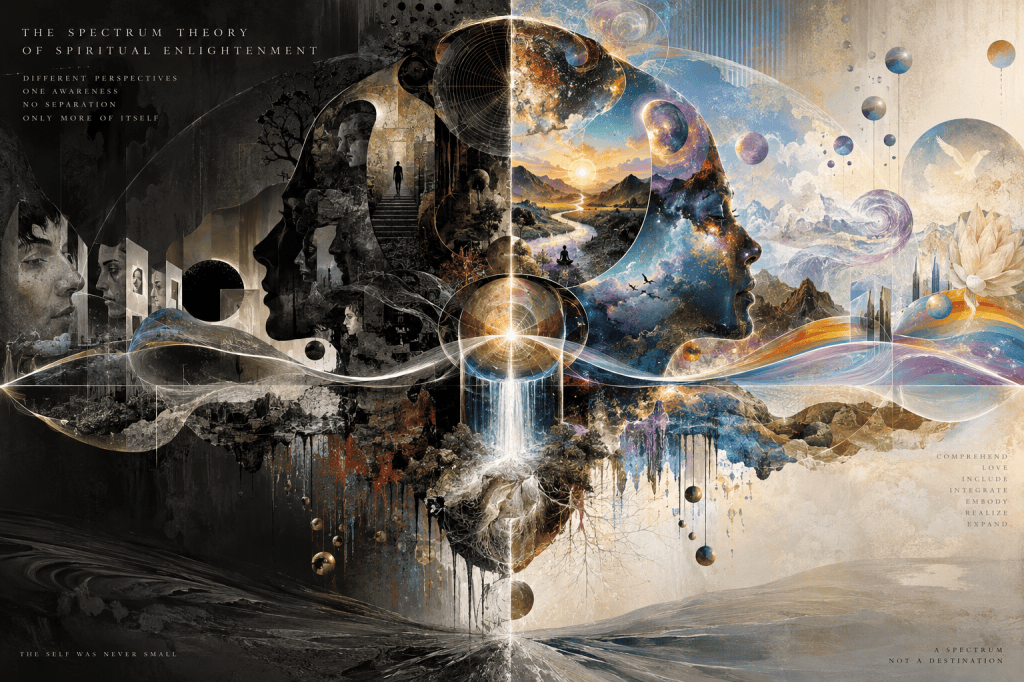
The Spectrum Theory of Spiritual Enlightenment

Spiritual enlightenment may be better understood as a spectrum.

This challenges one of the oldest assumptions surrounding enlightenment: that someone either has it or does not.

Enlightened. Unenlightened.

Awake. Asleep.

Self-realized. Ignorant.

Such divisions may be useful when describing a radical shift in consciousness, but they become inadequate when we begin examining the enormous differences between people who have undergone profound spiritual realization.

Two individuals may both recognize the nondual nature of reality and still differ tremendously in their capacity for love, emotional integration, intellectual complexity, perspective-taking, creativity, compassion, self-awareness and their ability to function within the complexity of human life.

This suggests something important.

Realization may happen, while enlightenment continues to unfold.

Enlightenment Is Not Simply What You Experience

Mystical experience alone cannot adequately define enlightenment.

A person may experience ego dissolution, timelessness, boundlessness, unity, emptiness or the disappearance of the subject-object boundary. These experiences can radically alter one’s understanding of reality.

Yet experience eventually encounters interpretation.

The human organism must somehow understand what occurred.

A Christian mystic may interpret unity through Christ. An Advaita practitioner may interpret it through Brahman. A Buddhist may describe emptiness. A neuroscientist may speak about changes within the brain’s construction of selfhood.

The experience may contain striking similarities while the interpretation reflects the developmental capacity of the person experiencing it.

This raises a provocative possibility:

What if enlightenment is not measured solely by how deeply you can disappear, but also by how much reality you can contain when you return?

The Capacity to Hold More

Perhaps spiritual development can partly be understood as increasing capacity.

The more you can comprehend.

The more you can love.

The more perspectives you can hold simultaneously.

The more contradiction you can tolerate without immediately forcing reality into either-or categories.

The more emotional intensity you can experience without becoming completely possessed by it.

The more uncertainty you can encounter without manufacturing certainty simply to make yourself comfortable.

The more of yourself you can observe without defending an identity.

The more of another person you can understand without requiring them to resemble you.

Something begins expanding.

Not necessarily the Self, because from the nondual perspective the Self was never small.

What expands is the human capacity to consciously express what has always been unlimited.

Depth and Breadth Are Different

Someone can go extraordinarily deep while remaining relatively narrow.

This distinction deserves attention.

A profound meditator might enter states of consciousness inaccessible to most people while still possessing rigid cultural assumptions.

A brilliant philosopher might understand dozens of perspectives intellectually while remaining emotionally defended.

A deeply compassionate person may possess extraordinary interpersonal wisdom without having experienced nondual realization.

A mystic may recognize the Absolute while still carrying unresolved psychological conditioning.

These are different dimensions of development.

Calling all of them simply “spiritual advancement” obscures what is actually happening.

A more complete model of enlightenment would therefore require several dimensions.

Depth concerns how completely consciousness penetrates the apparent separation between observer and observed.

Breadth concerns how many perspectives, systems, cultures, disciplines and modes of knowing can be included within one’s understanding.

Integration concerns how thoroughly unconscious, emotional and psychological material becomes incorporated rather than denied, projected or spiritually bypassed.

Embodiment concerns whether realization actually changes how someone lives, relates, creates, responds and participates in the world.

We could express the basic model as:

Enlightenment = Depth × Breadth × Integration × Embodiment

This is not intended as a literal mathematical equation. It is a conceptual instrument.

Its purpose is to prevent one extraordinary dimension from being mistaken for the whole.

Absolute Realization, Relative Development

Here lies an apparent paradox.

The Absolute does not develop.

If nonduality is ultimately true, then there cannot be more or less of the Absolute. There cannot be 40 percent Brahman, 72 percent emptiness or 95 percent pure awareness.

What is fundamental simply is.

Yet the organism through which realization expresses itself certainly develops.

The nervous system develops.

Language develops.

Emotional intelligence develops.

Perspective-taking develops.

Ethical sensitivity develops.

Creativity develops.

Conceptual sophistication develops.

The ability to tolerate complexity develops.

This means absolute realization and relative development should not be confused.

Someone may recognize what is timeless while still being a very particular human being shaped by history, biology, culture, trauma, education and psychological conditioning.

Enlightenment does not necessarily erase the relative human structure.

It changes the relationship to it.

The Number of Perspectives You Can Become

Perspective-taking may be one of the most overlooked dimensions of spiritual maturity.

Early consciousness tends to experience its own perspective as reality itself.

“This is what happened.”

“This is what God wants.”

“This is who I am.”

“This is who you are.”

Greater awareness begins noticing something strange.

Every perspective reveals something while simultaneously concealing something.

Move positions and reality changes.

The child sees one world.

The parent sees another.

The scientist sees another.

The artist sees another.

The mystic sees another.

The atheist sees another.

The person who hurt you sees another.

None necessarily possesses the complete picture.

Spiritual maturity may therefore involve becoming increasingly capable of moving between perspectives without being imprisoned by any of them.

Eventually something even stranger becomes apparent.

The perspectives themselves are occurring within awareness.

Then the question changes from:

Which perspective is ultimately correct?

to:

What is it that can become all of these perspectives without being limited to any of them?

That question points directly toward nonduality.

Love as Expanded Identity

Love also changes when viewed through this model.

Love is usually understood emotionally. We love certain people because they matter to us.

Nondual realization introduces another possibility.

What happens when the boundary defining “me” becomes less convincing?

Compassion may no longer arise merely because one has been instructed to care about others.

Another person’s suffering begins to matter because “other” has become philosophically and experientially unstable.

Their consciousness is no longer entirely foreign territory.

The expansion of love may therefore correspond with an expansion of identity.

First, myself.

Then my family.

My community.

My people.

Humanity.

Sentient life.

Life itself.

Existence.

Eventually the circle collapses because there is nowhere outside it.

Love becomes less about extending kindness from one separate being toward another and more about reality recognizing itself through apparent difference.

Enlightenment Does Not Make You Finished

Perhaps one of the most dangerous ideas surrounding enlightenment is the belief that awakening makes further development unnecessary.

That belief can transform realization into another identity.

“I am enlightened.”

Now the ego possesses the absence of ego.

A remarkably clever maneuver.

Genuine realization may actually make development more demanding because fewer psychological hiding places remain convincing.

There can still be conditioning to examine.

Relationships to repair.

Knowledge to acquire.

Blind spots to discover.

Emotional capacities to strengthen.

Perspectives to encounter.

Humanity to embody.

Awakening does not necessarily end development.

It may remove the central illusion around which development previously revolved.

A Spectrum Without a Final Number

The spectrum model should not become another spiritual ranking system.

Its purpose is not to assign enlightenment scores.

The moment we begin arguing that one person is “Level 8 enlightened” while another is “Level 5,” we risk rebuilding hierarchy around something that fundamentally undermines the separate self seeking status.

The spectrum is multidimensional.

Someone may possess extraordinary contemplative depth but limited psychological integration.

Another person may demonstrate remarkable compassion and embodiment while having little interest in metaphysics.

Another may possess tremendous intellectual breadth but little experiential realization.

Development can be uneven.

That unevenness is precisely why a spectrum model becomes useful.

It allows us to stop pretending that enlightenment must produce identical human beings.

The Strange Conclusion

The deepest realization may reveal that nothing needs to become enlightened.

What you fundamentally are was never trapped.

Awareness itself was never confused.

The Absolute never forgot itself.

The person was the apparent location through which forgetting and remembering occurred.

Yet something continues after that recognition.

The human expression can become wider.

More integrated.

More sensitive.

More capable of holding contradiction.

More capable of intimacy.

More capable of uncertainty.

More capable of seeing through its own assumptions.

More capable of allowing perspectives that once threatened its identity.

More capable of loving without possession.

Perhaps enlightenment contains two movements that appear contradictory only when confused with one another.

One movement reveals that there is nowhere to go.

The other reveals that development has no obvious endpoint.

The Absolute is complete.

Its expression through a human life is not.

This may be one of the great paradoxes of spiritual enlightenment:

You can realize that you are already everything while continuing to discover how much more of everything you are capable of consciously containing.

Morgan O. Smith

https://linktr.ee/morganosmith

Worship Your Idols Until Your Idols Are No Longer Needed

Worship your idols until your idols are no longer needed.

Another way to say this is:

Focus on your objectives until you’re forced to look within.

There is nothing inherently wrong with having idols.

There is nothing inherently wrong with ambition, achievement, recognition, wealth, status, influence, romance, physical beauty, intellectual mastery, spiritual attainment, or the desire to become extraordinary.

Sometimes the road beyond desire must first travel directly through it.

We often imagine spiritual maturity as the immediate rejection of worldly pursuits. Renounce the ego. Abandon ambition. Stop chasing things. Detach from outcomes. Transcend desire.

Yet premature renunciation can become another form of avoidance.

You can claim that money does not matter when you have never had any.

You can dismiss recognition when you secretly crave it.

You can condemn power because you have never experienced what it feels like to possess it.

You can declare yourself detached from relationships while quietly fearing intimacy.

You can criticize ambition while wondering whether you were capable of achieving what you wanted.

Sometimes you have to meet the idol before you can discover what it cannot give you.

The Idol Is Not Necessarily the Problem

An idol is anything onto which we project the promise of completion.

It might be a person.

A career.

A relationship.

A spiritual teacher.

A certain amount of money.

A perfect body.

A degree.

A mystical experience.

A following.

A business.

Enlightenment itself can become an idol.

The object changes, but the psychological movement remains remarkably similar:

When I obtain that, I will finally be complete.

This is what gives the idol its power.

The object itself may have value. Money can create freedom. Relationships can bring intimacy. Achievement can develop discipline. Knowledge can expand perspective. Meditation can transform how consciousness relates to experience.

The illusion begins when we ask something finite to provide what only the recognition of our fundamental nature can reveal.

We are not merely pursuing the object.

We are pursuing a feeling we believe the object will produce.

Freedom.

Security.

Love.

Wholeness.

Significance.

Peace.

The object becomes a symbol for an internal condition.

This is why getting what you want can sometimes be more spiritually disruptive than failing to get it.

Failure allows the fantasy to survive.

Success puts the fantasy on trial.

When Success Becomes a Spiritual Crisis

Suppose you spend twenty years believing that reaching a particular objective will finally make you happy.

Then you reach it.

For a while, there may be exhilaration. There should be. Something meaningful has happened.

But eventually ordinary consciousness returns.

You wake up as yourself.

The mind still moves.

Old insecurities may remain.

Fear still visits.

The body still ages.

Relationships still require work.

The applause fades.

Yesterday’s achievement becomes today’s normal.

Then an unsettling question appears:

Is this it?

That question can be more transformative than years of abstract spiritual philosophy.

You received what you asked life for, yet something remains unresolved.

The idol has fulfilled its purpose.

Not because it saved you, but because it failed to.

Its failure becomes instruction.

Desire Can Educate You

Certain desires disappear through understanding rather than suppression.

A child may desperately want a particular toy. Telling the child that the toy cannot provide lasting happiness will probably accomplish very little. The child needs the toy.

Then something fascinating happens.

The child gets it.

Plays with it.

Loves it.

Eventually puts it down.

What philosophy could not accomplish, experience did.

Adults are not fundamentally different.

Our toys become more sophisticated.

Titles.

Cars.

Followers.

Properties.

Credentials.

Partners.

Awards.

Spiritual experiences.

We give them adult names, but psychologically we may still be saying:

Maybe this will finally be enough.

There is wisdom in discovering for yourself what “enough” actually means.

This does not mean deliberately becoming materialistic or compulsively pursuing every desire that enters the mind. Some desires are destructive, and maturity includes discernment.

The deeper point is that genuine transcendence is different from repression.

Repression says:

I am not supposed to want this.

Transcendence says:

I understand what this can and cannot give me.

Those are radically different states of consciousness.

Even the Spiritual Path Has Idols

Spiritual seekers sometimes exchange socially acceptable idols for spiritually acceptable ones.

The pursuit of money becomes the pursuit of awakening.

Status becomes spiritual authority.

Achievement becomes attainment.

Possessions become experiences.

Comparison with coworkers becomes comparison with meditators.

Who has had kundalini awaken?

Who has experienced samadhi?

Who has reached jhana?

Who has dissolved the ego?

Who has seen God?

Who is enlightened?

The costume changes while the machinery of becoming continues operating underneath it.

The ego can pursue its own disappearance.

That is one of the great paradoxes of spiritual practice.

There may come a point when even enlightenment must be surrendered as an objective.

Not because awakening is meaningless, but because the imagined individual who intends to possess enlightenment may itself become the final idol.

You cannot own the Absolute.

You cannot place infinity on your spiritual résumé.

The Objective Eventually Turns You Around

Pursue your objectives consciously.

Build something.

Learn.

Create.

Love.

Risk failure.

Develop your gifts.

Become excellent at something.

Explore what human life is capable of expressing.

But pay attention.

Notice what happens when you get what you wanted.

Notice how quickly the mind moves the finish line.

Notice when “I’ll be happy when…” quietly becomes another “when.”

Notice how every arrival eventually becomes another departure point.

The external journey gradually begins pointing somewhere unexpected.

Back toward the one who has been searching.

Who wants this?

What exactly am I hoping to receive from it?

What would happen if I obtained everything I wanted?

What remains when achievement, identity, status, belief, memory, personality and aspiration are temporarily set aside?

What is aware of all of this?

At some point the search changes direction.

You stop asking only:

What else can I acquire?

You begin asking:

Who is the one trying to become complete?

That question opens a very different door.

When the Idol Falls From the Altar

The mature relationship with an idol does not necessarily require destroying it.

You simply stop worshipping it.

Money can remain money.

Success can remain success.

A relationship can remain a relationship.

A teacher can remain a teacher.

Meditation can remain meditation.

Achievement can remain achievement.

They no longer carry the impossible responsibility of completing you.

You can enjoy them without confusing them with your Being.

You can participate without becoming psychologically imprisoned by participation.

You can succeed without needing success to tell you who you are.

You can fail without failure becoming a verdict on your existence.

Something profound changes when the world is no longer required to complete the one experiencing it.

Perhaps this is one meaning of freedom.

Not escaping the world.

Not rejecting desire.

Not pretending that objectives do not matter.

Rather, seeing their proper place.

Worship your idols if you must.

Study them.

Pursue them.

Stand before them.

Perhaps even achieve what they represent.

Then look carefully at what remains.

Eventually, the idol may cease to be an idol.

Not because someone convinced you that worship was foolish, but because experience revealed the limitation of what you were worshipping.

The objective did not betray you.

It brought you exactly where it was ultimately capable of bringing you.

To the edge of itself.

From there, there is only one direction left to look.

Within.

Morgan O. Smith

https://linktr.ee/morganosmith

Ceasing to Exist Is Existence

What feels like disappearance is often the unveiling of what never arrived and never left.

Identity clings to continuity. It insists on narrative, on form, on something stable enough to say, “this is me.” Yet every sincere glimpse beneath that surface reveals something unsettling; there is no fixed centre holding it all together. Thoughts pass. Sensations dissolve. Emotions rise and vanish without permission. Even the sense of being a “someone” flickers in and out of awareness.

So what exactly is ceasing?

What we call existence is usually filtered through attachment to form. Body, memory, personality, history; these become the reference points for being. When any of these begin to loosen, a quiet panic can emerge. It feels like loss. It feels like the edge of annihilation. Something in us resists, because it interprets the fading of form as the fading of existence itself.

But that interpretation is flawed.

Ceasing does not touch existence. It only dismantles the illusion of containment.

Consider the moment between two thoughts. There is no identity there, no story, no personal reference point. Yet something undeniable remains. Awareness does not collapse in that gap. It stands unobstructed, without needing to announce itself. That silent interval is not absence; it is presence without definition.

The fear of ceasing arises from confusion between what appears and what is. Appearances come and go. They are meant to. Existence, however, does not operate within that cycle. It is not born when a form emerges, nor does it die when a form dissolves. It simply is, untouched by the movement it allows.

Letting go, then, is not an act of surrendering existence. It is the recognition that existence was never dependent on what you thought you were.

This is why deep realization can feel like a kind of death. The structures that once provided orientation fall away. The familiar reference points dissolve. Even the sense of being the experiencer can collapse. Yet what remains is not void in the way the mind imagines. It is fullness without boundary. Presence without identity. Being without ownership.

Ceasing reveals that nothing real was ever at risk.

Every moment already contains this truth. Each ending—of a breath, a thought, a sensation, is a quiet demonstration. Something ends, yet nothing essential is diminished. Life continues, but not as a personal possession. It unfolds as an expression of something indivisible.

Existence does not belong to you.

You belong to existence only as an appearance within it.

When this becomes clear, the resistance softens. The need to preserve a fixed self begins to lose its urgency. Ceasing is no longer feared. It is understood as a return; not to something new, but to what has always been prior to every assumption of “I am this.”

Existence does not require you to remain.

It reveals itself most clearly when you don’t.

Morgan O. Smith

Freedom Within Identification

Attempts to dismantle identification often become another subtle strategy of identification. The effort itself reinforces the one who is trying to escape. What actually transforms experience is not the reduction of bias or judgment, but clear recognition that bias and judgment are occurring. Awareness does not erase the movement of mind; awareness reveals it.

Mind evaluates. Mind categorizes. Mind reacts. Such functions belong to its design. A deeper dimension remains untouched by those operations. That dimension does not oppose the mind, nor attempt to purify it. Silent witnessing simply illuminates what unfolds.

Moments of awakening sometimes arrive with overwhelming clarity. Identification dissolves, yet experience continues. No boundary remains between observer and observed, yet perception still functions. Such glimpses demonstrate a truth that later integrates into lived reality. Peak illumination offers insight; maturation transforms insight into stability.

Gradual integration reshapes the relationship with identity. Layers fall away without force, guided by ongoing recognition. Ego continues its role as a generator of form, narrative, and orientation. Awareness does not eliminate ego; awareness contextualizes it. Form becomes expression rather than prison.

Attachment has long been described as the seed of suffering. Another dimension exists within that same principle. Attachment also creates continuity, warmth, belonging, and coherence. Pleasure and pain arise from the same ground. Human experience oscillates across a spectrum that includes both. Heaven and hell manifest through perception, circumstance, and interpretation, rather than distant metaphysical destinations.

Escape from the spectrum intensifies struggle. Unconscious immersion perpetuates distress. Acceptance introduces a different movement: a willingness to meet existence as it appears. Acceptance does not romanticize suffering, nor cling to comfort. Acceptance recognizes the inevitability of cycles.

Samsara refers not only to rebirth across lifetimes. Samsara unfolds through biological rhythms, emotional tides, cultural dynamics, social realities, and economic fluctuations. Each domain participates in patterns of emergence, dissolution, and renewal. Cells regenerate. Identities evolve. Conditions transform.

Total liberation from these cycles cannot occur while embodiment persists. Yet insight can reveal a dimension untouched by cyclical change. Awakening discloses a freedom that coexists with limitation. Temporary realization becomes the doorway to enduring equanimity.

Pain, pleasure, loss, gain, exhaustion, vitality—each appears as modulation within a larger field of being. Recognition of that field softens resistance. Suffering loses its compulsive urgency. Beauty becomes perceptible even through difficulty.

Freedom does not require the absence of attachment. Freedom emerges through understanding that attachment never defined the essence of what one is. Identity remains operational, yet no longer absolute. Life continues with all its contrasts, while awareness rests as the unbound ground of experience.

Morgan O. Smith

You Are the Void

You are the void surrounded by your own self as substance, brought forth by its own thinking, shaped by its own thoughts.
Not as symbolism. Not as spiritual ornamentation. Simply as a description of what is already occurring before interpretation.

Substance feels dense because thought lingers. Thinking slows openness into shape, then convinces itself the shape possesses independence. Solidity is an effect of attention held too tightly. The void does not interfere. Allowance is enough for appearance to unfold.

Creation does not originate with matter. A quieter shift precedes it—the faint suggestion of separation. Something entertains the idea of being something rather than everything. That subtle narrowing gives rise to form, continuity, memory, and the felt position of a self observing from somewhere.

The void is not just empty. Emptiness would imply absence. What exists here is freedom from insistence. No preference. No correction. When thought moves, substance organizes. When thought loosens, substance reveals its temporary nature.

Identity feels heavy because repetition gives it mass. Familiar thoughts replayed long enough acquire gravity. The mind labels this accumulation “me.” The void registers movement, nothing more.

Nothing requires removal. Nothing asks to be fixed. Recognition alone softens what once appeared solid. Structure relaxes into responsiveness. Boundaries become functional rather than absolute.

Silence does not depend on quiet. Silence appears when thought releases its claim to authorship. Experience continues, but no longer points back to a controller or witness standing apart.

The void never hides behind form. Form arises within it and borrows its apparent stability from sustained attention. When attention eases, what remains cannot be framed as presence or absence. Language fails because nothing is missing and nothing needs to appear.

No final claim can be made. No definition holds without collapsing into another. What happens does so without explanation. What appears does not require justification. Everything stands exactly as it is.

Nothing here can be stated as what it is or what it is not. Nothing explains how this occurs. Perspectives arise according to position, history, and capacity, each contributing its angle without canceling another. No single view completes the picture. Together, they form what cannot be reduced to parts.

Truth does not belong to one standpoint. Wholeness expresses itself through difference, not despite it.

Morgan O. Smith

Get Your Free Copy of My Book, Bodhi in the Brain!

https://subscribepage.io/oTSZQu

The Echo of You

How Others Shape the Illusion of Self

Every mind that encounters you constructs a version of who you are—one that exists only within their perception. These projections are not reflections of an objective truth but rather interpretations woven from personal history, emotions, and unconscious biases. The self you recognize as you dissolves into a multiplicity of shifting impressions, each molded by the observer’s lens.

A single glance, a brief interaction, a conversation—these moments serve as the brushstrokes that paint an image of you in another’s mind. That rendering is not built from the essence of your being but from their expectations, fears, desires, and past experiences. You become a mirror reflecting not your own face but the fragmented archetypes stored within them.

Eight billion people could know of your existence, and within those eight billion minds, eight billion versions of you would reside—each unique, each tethered to the individual’s understanding of reality. Some may see wisdom where others see arrogance, kindness where others perceive naivety, or detachment where others sense depth. Each impression, though deeply felt by the observer, is nothing more than a personal myth—an illusion shaped by the inner world of the one perceiving.

This ongoing act of creation is not limited to how others see you; it extends to how you see them. The individuals encountered are rarely experienced as they are but instead as projections of our own conditioning. An idea of them forms, colored by past wounds, cultural imprints, and unconscious expectations. Thus, every relationship becomes a dance of illusions, where two constructs interact rather than two beings truly seen for what they are.

If these imagined versions of one another are so deeply ingrained, what remains when they fall away? What is left when perception no longer dictates existence? The formless, nameless presence that remains is not confined by labels or interpretations—it simply is. And in that space, where no definitions persist, the need to be seen, understood, or accepted dissolves into something far greater than any construct a mind could create.

Morgan O. Smith

Get Your Free Copy of My Book, Bodhi in the Brain!

https://subscribepage.io/oTSZQu

The Ultimate Love

The Force That Transcends All Boundaries

Love’s true essence is beyond comprehension, an omnipresent force so profound it erases the illusion of separation. It moves in dimensions beyond moral constructs, ideology, and identity. When fully realized, this love obliterates the ego and opens the heart so that even the most hardened souls cannot resist its call.

The human mind craves order, labelling people into categories—good, evil, victim, perpetrator. But ultimate love doesn’t comply with these distinctions. It meets each being at the core of their essence, beneath the conditioning and trauma that have shaped their actions. This kind of love can dismantle even the most fortified belief systems.

Imagine the inner world of someone consumed by hatred, caught in the web of fear, anger, and dogma. The walls around their heart seem impenetrable, yet ultimate love does not storm these walls; it dissolves them. It renders resistance futile by revealing what has been buried deep inside—a longing to belong, to be seen, and to be held in a space beyond judgment.

Ultimate love does not negotiate with the mind. It penetrates through the layers of identity, be it the identity of a saint or a sinner, revealing the same radiant essence beneath all masks. It leaves no room for pretense. This love cannot be owned, managed, or bargained with; it simply is.

Consider the most unimaginable scenario—a person shaped by the horrors of hatred, such as a Nazi, encountering the force of unconditional love. It is not a love that justifies or condones but one that sees beyond. That person’s history, belief system, and ideology would crumble under the weight of such grace. All that remains is a naked heart, laid bare in the presence of a force so magnificent it demands surrender. Not as punishment, but as liberation.

This love does not require forgiveness. It transcends it. Forgiveness suggests wrongdoing, but ultimate love offers a view where the need for forgiveness dissolves, revealing the underlying unity where all things are reconciled. When this love is encountered, tears flow not from shame, but from the relief of being released from the prison of the mind’s narratives.

This is the love that brings anyone, no matter how lost, to their knees—not out of fear, but in awe. It’s the moment when everything false melts away, and only the truth remains: the realization that there has never been separation, and love was the ground of all existence all along.

Ultimate love is not just the absence of hate; it is the luminous presence that absorbs even the darkest shadow, rendering it irrelevant. It is the undeniable force that brings every soul back to where it has always belonged—home.

Morgan O. Smith

Yinnergy Meditation, Spiritual Life Coaching & My Book, Bodhi in the Brain…Available Now!

https://linktr.ee/morganosmith

Beyond Illusion

Discovering the Space Between

The mind creates identities and builds a sense of self out of thoughts, emotions, and past experiences. These constructs shape beliefs around who you think you are and who you think you aren’t. This entire narrative, though compelling, is merely a distortion. It presents itself as reality but, in truth, is nothing more than an intricate mental creation. We become confined by these polarities, oscillating between two extremes—what we accept and what we reject about ourselves.

These boundaries, however, do not define the core of who you are. The sense of self emerges as a reflection against what we perceive as the ‘other.’ You’re not merely the collection of traits you cherish, nor are you the shadow aspects you struggle to suppress. By engaging with either, you remain caught in a dualistic view that blinds you to your deeper essence.

The challenge, then, is to neither grasp onto one identity nor to strive to become its opposite, but to look at the liminal space between. This uncharted territory holds the key to your True Self. Neither glorified nor condemned, this space is untouched by labels. It eludes all attempts to be defined. When you gaze into that emptiness, you come face-to-face with your origin—the point where being meets non-being, and you witness the dissolution of the false dichotomy between ‘I am this’ and ‘I am not that.’

Finding this space requires surrendering the tendency to categorize. Allow awareness to rest on the edges of thought, where opposites fade into one another. This subtle recognition can shift perception, making you aware of a silent presence that underlies all identifications. It’s a sense of being that defies expression yet is undeniably real. Here, you aren’t bound by limitations, nor are you an idealized version of yourself.

This presence is what mystics have pointed to throughout the ages—a place beyond words and mental constructs. It’s here that the True Self emerges, not as a separate entity, but as the unconditioned awareness that holds both the ‘you’ and the ‘not you.’ Let this realization transform the way you see yourself and others, dissolving barriers until all that remains is a boundless, indivisible field of consciousness.

Morgan O. Smith

Yinnergy Meditation, Spiritual Life Coaching & My Book, Bodhi in the Brain…Available Now!

https://linktr.ee/morganosmith

The Multilayered Journey of Ego Dissolution

In the intricate dance of spiritual awakening, the ego stands as both a necessary companion and a formidable obstacle. Our journey to self-realization often involves peeling away the layers of this multifaceted construct, each layer representing a different aspect of our perceived identity.

The ego, much like an onion, is composed of multiple layers. These layers symbolize the various roles, beliefs, and attachments we accumulate throughout our lives. Initially, shedding these layers can be a liberating experience. We feel lighter, more connected to our true selves, and less bound by societal expectations and personal fears. Each removed layer brings us closer to a state of purity and clarity.

However, the concept of ego death transcends the gradual shedding of these layers. Ego death is not merely about peeling back the onion to its core; it is about transcending the very existence of the onion itself. It is the profound realization that the core was an illusion all along, a construct of the mind designed to give us a sense of separateness and control.

Imagine reaching a point where even the scent of the onion no longer lingers. This metaphor captures the essence of true ego death—a state where not only the layers but the very notion of an individual self dissolve into the infinite. It is the ultimate surrender, where the boundaries between the self and the cosmos blur into non-existence, revealing the underlying oneness of all.


This experience can be both terrifying and liberating. The fear of losing our identity is a natural response, as the ego is deeply ingrained in our sense of self-preservation. Yet, the liberation that follows is unparalleled. Without the confines of the ego, we experience reality in its purest form, untainted by personal biases or desires. We become conduits for the divine flow of life, embracing the totality of existence with an open heart and mind.

Ego death is not a one-time event but an ongoing process of dissolution and rebirth. Each moment of awareness, each act of surrender, contributes to the gradual dismantling of the ego’s hold. In this continuous journey, we learn to embrace the paradox of being both nothing and everything simultaneously. We recognize that our true essence is not defined by our identity but by our intrinsic connection to the universal consciousness.

As we navigate this path, it is essential to cultivate compassion and patience for ourselves. The layers of the ego are intricate and deeply rooted, and their dissolution requires gentle persistence. By embracing the journey with humility and openness, we allow the process to unfold naturally, guided by the inner wisdom that transcends the ego’s limitations.


In conclusion, the journey of ego dissolution is a profound exploration of our true nature. It invites us to move beyond the superficial layers of identity and experience the boundless reality of our interconnected existence. Through this journey, we discover that true freedom lies not in the absence of identity but in the realization of our inherent oneness with all that is.

Morgan O. Smith

Yinnergy Meditation, Spiritual Life Coaching & My Book, Bodhi in the Brain…Available Now!

https://linktr.ee/morganosmith

The Paradox of Enlightenment

Embracing the Limitless Self

In the quest for enlightenment, a paradox often emerges. We strive to reach a state of higher understanding, yet the moment we claim to have achieved enlightenment, we inadvertently confine ourselves within the very boundaries we sought to transcend. This pursuit reveals a fundamental truth about our nature and existence: what we truly are is inherently free from all limitations.

When we label ourselves as ‘enlightened,’ we inadvertently create a new identity, another cage for our boundless spirit. This declaration is a subtle form of ego, a self-imposed limitation that contradicts the essence of enlightenment itself. True enlightenment is not about attaining a label or reaching a destination; it’s an ongoing journey of self-discovery and liberation from all forms of identification.

Consider the concepts of ‘The Self’ and ‘No Self.’ These are often seen as opposing philosophies in spiritual and philosophical discourse. ‘The Self’ suggests a profound connection with a universal, eternal essence, while ‘No Self’ leans towards the idea of emptiness, the absence of a permanent, unchanging self. However, to define oneself as either is to miss the point entirely.


The essence of our being transcends these concepts. It’s not about being one or the other but encompassing and moving beyond both. We are neither solely ‘The Self’ nor ‘No Self.’ Instead, we exist in a state that includes both yet is not limited by either. This state is not a static endpoint but a dynamic, ever-evolving understanding of our true nature.

In this space, we recognize that labels, identities, and even the concept of enlightenment itself are mere tools for understanding, not the ultimate truth. Our true essence is like the sky—vast, boundless, and untouched by the clouds that drift through it. We are the silent observers, the consciousness that witnesses thoughts, emotions, and sensations without becoming them.

To truly embrace this state of being, one must continuously practice letting go of all attachments, identities, and beliefs. It’s a journey of unbecoming, peeling away layers of conditioned thought and societal constructs to reveal the pure, unadulterated essence of our being.


In conclusion, the journey to understanding what we truly are is not about acquiring a new label or reaching a definitive state of being. It’s about the continuous process of freeing ourselves from all limitations, labels, and identities. It’s about recognizing and embracing the boundless nature of our existence, which includes and transcends all dualities.

Morgan O. Smith

Yinnergy Meditation, Spiritual Life Coaching & My Book, Bodhi in the Brain…Available Now!

https://linktr.ee/morganosmith