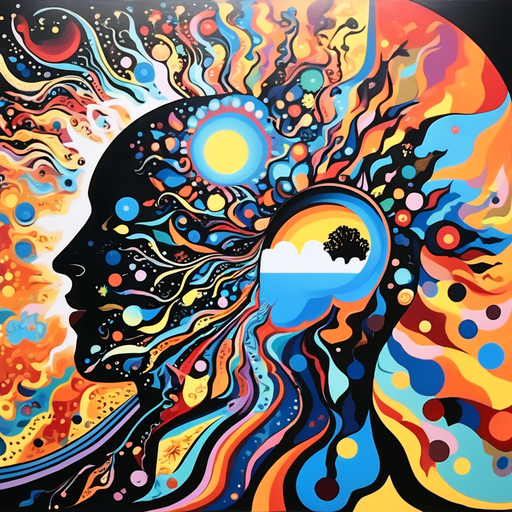
The Child and the Keeper of Walls

Awakening Beyond Belief

Many have longed to grasp the mystery of existence, to touch the essence of something vast, limitless, and wholly beyond the conditioned intellect. Some wander outward, chasing knowledge across lifetimes, while others, weary of the chase, turn inward and dissolve into the revelation that the answer was never elsewhere.

There is a being who awakens, eyes once sealed now open, untethered from the weight of what was once mistaken for reality. This one recognizes that what they sought as God was never separate from themselves. Not a distant deity reigning above, nor a dogmatic construct built to cage the mind, but a living essence radiating through all things. They once believed this ideal self was an unreachable mirage, an aspiration always slipping beyond the grasp of physicality. But upon awakening, they no longer chase it—they become it.

What is this awakening? It is nothing more and nothing less than remembering how to imagine with the boundless wonder of a child. And not imagination as the mind toys with, but an intelligence so refined that it gives birth to worlds, perceives the invisible, and dances in the paradox of what is and what is not. The one who awakens does not strive to merge with God, for they see that this very merging is the illusion. There was never a separation to begin with.

Yet, alongside them walks another—one who clings tightly to a framework set in place long before their arrival. They follow the lines drawn by those who feared their depths, mistaking doctrine for truth and control for salvation. Their mind, fortified with walls of certainty, rejects the fluidity of growth. Anything that threatens their inherited beliefs is cast aside as danger, as corruption, as false prophecy.

The awakened one embraces their shadows, understanding that transformation does not come by denying the full range of human experience but by walking through the fire of it, unafraid to be burned. Shame is not an enemy to be conquered, nor is desire a force to be chained. They do not rush to crucify what it means to be fully human. Instead, they enter the chaos willingly, knowing that only by standing at the center of their own storm can they emerge as the calm itself.

Something miraculous happens in that surrender. The one who awakens watches their unfolding with wonder, like an artist witnessing a masterpiece take form in real time. Each step is both the path and the arrival, a self-created adventure where the destination remains unimportant. The act of movement itself—the curiosity, the play, the willingness to jump without knowing where they will land—is the divine act. The shimmering glow of their being is not a thing to be achieved but something they always were, now recognized at last.

Meanwhile, the fundamentalist stands still, mistaking their immobility for stability. Their beliefs, rigid and unyielding, have encased them in a fortress. To them, water is dangerous—too unpredictable, too wild. The awakened one drinks deeply from this same stream, intoxicated by its endlessness, while the fundamentalist sees it as a force of destruction, something to be feared and avoided at all costs.

Yet, both are children of the same source, actors within the same unfolding story. Neither is greater than the other, for both play their roles in the grand theater of existence. But only one of them has chosen to create the map of their becoming. Only one has dared to build a bridge where others have built walls.

So, the question arises: who would you rather be? The keeper of walls, or the architect of the infinite?

Morgan O. Smith

Yinnergy Meditation/Neurofeedback, Spiritual Life Coaching & My Book, Bodhi in the Brain…Available Now!
https://linktr.ee/morganosmith

The Convergence of Imagination and Divinity

Understanding the Oneness

In spiritual exploration, a question often arises, echoing through the corridors of our deepest inquiries: “How can we assert that everything is an embodiment of the divine?” This question, at its core, challenges us to delve into the paradoxical nature of reality and the divine, prompting an examination of where imagination and spiritual truth converge.

The notion that “everything is God” is not merely a statement; it’s a profound recognition of the intrinsic unity in the universe. When individuals question this assertion, often pointing to the imagination as a possible source of such a belief, they unknowingly touch upon a profound truth. Indeed, it is through our imagination that we begin to perceive the divine in everything. However, this is not a limitation but rather a gateway to a deeper understanding.

Imagination, often dismissed as mere fantasy or whimsy, is a powerful tool for spiritual realization. It is through the imaginative process that we transcend the ordinary, stepping beyond the boundaries of conventional perception. In this transcendent state, what was once considered imaginary merges with the ultimate reality. This convergence is not a denial of the imaginary, but rather an acknowledgement of its essential role in our spiritual journey.


This fusion of imagination and divine reality invites us to reconsider what we perceive as real. The mystical experiences and insights that arise from this union are not figments of imagination in the dismissive sense; they are glimpses into a reality that is all-encompassing and deeply interconnected. In this sense, the divine and the imaginary are not opposites but reflections of the same profound truth.

The journey towards this realization is as unique as each individual, yet it is bound by a common thread – the pursuit of understanding beyond the conventional. It is a journey that challenges us to see the divine not as something separate and distant, but as an intimate and integral part of our existence. In this realization, the boundary between the self and the divine dissolves, revealing a unity that encompasses all of existence.

As we embrace this perspective, we begin to see the world not just as a physical reality, but as a manifestation of the divine dance of existence. Everything, from the smallest particle to the vast expanse of the cosmos, becomes a reflection of this divine essence. In this light, the question of whether it is all ‘just imagination’ loses its relevance, for imagination becomes the very lens through which the divine is perceived and experienced.


In conclusion, the dialogue between imagination and divinity is not one of conflict but of deep harmony. It is a reminder that our spiritual journey is not about escaping reality, but about discovering the profound depths of truth that lie within it. In this exploration, we find that imagination and divinity are not just interconnected – they are, indeed, the same.

Morgan O. Smith

Yinnergy Meditation, Spiritual Life Coaching & My Book, Bodhi in the Brain…Available Now!

https://linktr.ee/morganosmith

Embracing Falsehoods at the Pinnacle of Awareness

In the realm of human consciousness, there exists a fascinating paradox. At the highest level of awareness, a person can reach a state where they can believe in something, fully aware that it is not true. This peculiar aspect of human psychology offers a deep insight into the nature of belief, perception, and the human mind.

What does it mean to believe in something while knowing it isn’t true? It’s like willingly suspending disbelief while watching a movie. You enter into a contract with the fiction, fully aware that dragons don’t exist or that superheroes don’t fly, yet you allow yourself to believe in these concepts for the duration of the experience. This phenomenon isn’t just limited to entertainment but extends to the very core of our everyday lives.

Why do people engage in such seemingly contradictory behaviour? The answer lies in the complexity of the human mind and its quest for meaning and comfort. Beliefs, even those acknowledged as false, can provide a sense of comfort, belonging, or identity. They can be a source of inspiration or a means of coping with the harsh realities of life. In a world that often feels chaotic and unpredictable, these beliefs, however, detached from reality, can offer a sense of order and purpose.


This ability to believe in the unbelievable highlights the power of the human imagination and creativity. It’s a testament to our ability to envision worlds and possibilities beyond our immediate reality, a skill that has been a driving force behind art, literature, and scientific innovation. It allows us to explore ideas and scenarios that, while not real, can lead to real-world insights and advancements.

However, this power comes with a responsibility. While it can be enriching and beneficial, deliberately believing in falsehoods can also lead to dangerous delusions and collective harm if not approached with critical thinking and ethical considerations. It’s vital to find a balance, to know when to embrace these beliefs as a source of inspiration and when to acknowledge them as mere constructs of our imagination.


In conclusion, the capacity to believe in something while knowing it isn’t true is a unique aspect of human consciousness, reflecting our complex psychology. It’s a powerful tool that, when used wisely, can enrich our lives and propel us toward greater heights of imagination and understanding. However, it’s crucial to navigate this terrain with discernment and a keen sense of reality.

Morgan O. Smith

Yinnergy Meditation, Spiritual Life Coaching & My Book, Bodhi in the Brain…Available Now!

https://linktr.ee/morganosmith