Tracing the Divine Contours

Metaphorical Exploration of the Three Faces of God

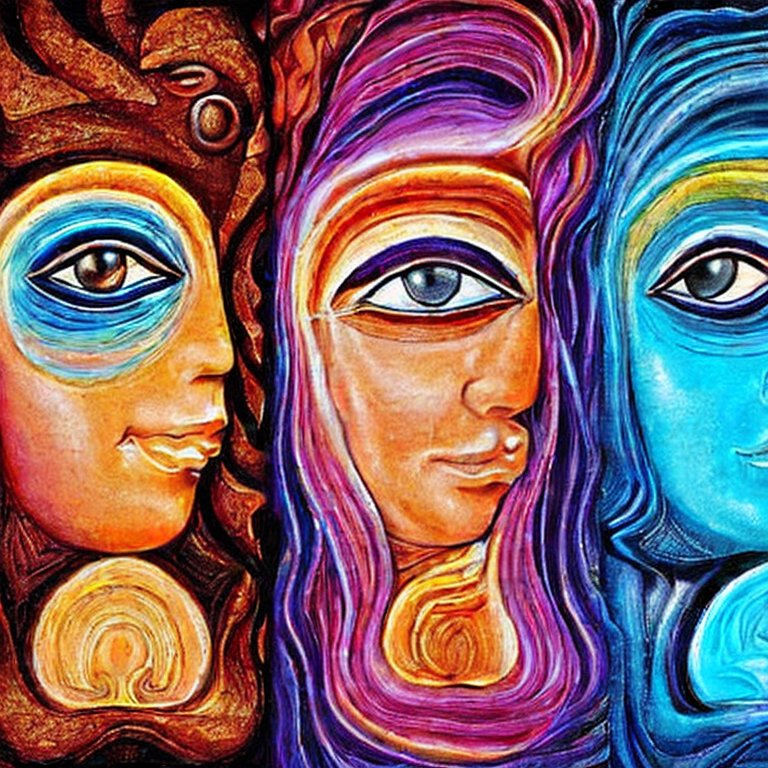
As we endeavour to understand the divine, let’s imagine sketching three different portraits of God, each revealing a unique aspect of the divine. These are the “Three Faces of God,” metaphorically spoken of as “I am That,” “Thou art,” and “It, the Ground of All Being.” Each face provides a different set of facial features, offering a new perspective and experience of the divine.

1. The First Portrait: “I am That”

Envision drawing the first portrait, where you sketch not with your hand, but with your consciousness. This portrait, entitled “I am That,” represents the divine as the reflection of our inner selves. The eyes in this portrait mirror our own, sparkling with the wisdom of unity and oneness. These eyes are windows into the soul, witnessing the divine within us and in everything around us.

The lips are sealed, symbolizing the silence that encapsulates the profound realization of this facet of divinity. It is a silence not born of absence but of completeness, tranquillity that resonates with the essence of existence. The serene countenance of this portrait is a silent affirmation of our inherent divinity.

2. The Second Portrait: “Thou Art”

Now, we turn to the second portrait, “Thou Art.” Here, the divine is perceived as the other, an entity separate from ourselves. In this image, the eyes are compassionate, gazing at us with empathy and understanding, reflecting a personal deity who knows us intimately, one who listens, guides, and protects.

The lips are gently curved into a comforting smile, a symbol of the divine’s eternal love and benevolence. This portrait embodies a divine entity that exists independently of us, yet is deeply connected in a loving and caring relationship.

3. The Third Portrait: “It, the Ground of All Being”

The third portrait, “It, the Ground of All Being,” is an abstract masterpiece. Instead of conventional facial features, it is an evolving canvas of colours, shapes, and patterns, capturing the unfathomable depths and dimensions of the divine as the fundamental essence of existence.

This image lacks eyes and lips because it symbolizes the impersonal aspect of the divine. It is the primordial backdrop from which all forms arise and into which they merge. This face does not interact or engage in the usual sense but is simply there, perpetually present, the immutable reality underlying all of existence.

Wrapping Up

This metaphorical exploration of the “Three Faces of God” is like an artful journey into divinity’s vast and varied landscapes. It encourages us to recognize the divine in our reflections, in a comforting gaze, and in the ever-changing canvas of existence.

Each of these faces, with its unique set of features, invites us to a different experience and understanding of God, enabling us to connect with the divine on multiple levels. It’s a contemplative journey that opens up possibilities for self-discovery and spiritual growth, enhancing our cosmic connection. In these divine portraits, we don’t just see different faces of God; we see reflections of our own quest for spiritual understanding and existential meaning.

Morgan O. Smith

Yinnergy Meditation & My Book, Bodhi in the Brain…Available Now!

https://linktr.ee/morganosmith

Three Perspectives on Divinity

A Journey of Self-Discovery and Cosmic Connection

Every human being, at some point, grapples with the concept of divinity. How we perceive the divine greatly influences how we understand ourselves and our place in the cosmos. While there are many ways to envision divinity, let us ponder the “Three Faces of God” – “I am That,” “Thou art,” and “It, the Ground of All Being.” Each provides a distinct lens through which we may view and experience the divine.

1. Divine Within: The Face of “I am That”

“I am That” is a call to recognize the divine within us. It is not just a statement; it’s an acknowledgment of our inherent divinity. This perspective dissolves the illusion of separateness, helping us realize that we’re not merely fleeting existences in an indifferent universe, but integral fragments of a divine whole.

This face asks us to engage in deep introspection, to see beyond the veil of our mundane identities, and to understand that our true essence is not our transient ego, but the eternal spirit. Could it be that we’re more divine than we’ve ever imagined? This face prompts us to explore that possibility.

2. Divine As Other: The Face of “Thou Art”

The face of “Thou Art” offers a contrasting perspective. Here, the divine is seen as the ‘Other,’ an entity outside ourselves with whom we can establish a personal connection. This relationship with the divine, filled with reverence and love, is akin to the bond between a devotee and their deity.

In this model, God is the figure we pray to, seek comfort from, and surrender our troubles to. It’s a perspective that creates a powerful, intimate bond with the divine, letting us experience the divinity not as a part of us, but as a separate, caring, and guiding entity.

3. Divine As All: The Face of “It, the Ground of All Being”

The third face, “It, the Ground of All Being,” portrays God as an impersonal essence, the primal energy that permeates the cosmos. This face of divinity does not personify the divine but sees it as the raw material of existence. It is the unchanging reality amidst the ceaseless flux of the universe.

This view urges us to go beyond the traditional understandings of God and probe deeper into the mysteries of existence. Could it be that the divine is not just a deity or a spirit within, but also the very fabric of reality?

Wrapping Up

The Three Faces of God offer a multidimensional understanding of the divine, guiding us on our spiritual and philosophical quest. They propose different ways to connect with the divine, based on our personal inclinations and spiritual needs. More than a simple triad, they represent a spectrum of possibilities on our spiritual journey.

In acknowledging these perspectives, we can foster a richer understanding and experience of God, allowing us to discover the divine within ourselves, in an intimate relationship, and as the underlying reality of existence. Such an exploration can become a catalyst for personal growth and spiritual evolution, leading us to new levels of self-discovery and cosmic connection. After all, isn’t that what the quest for understanding divinity is all about?

Morgan O. Smith

Yinnergy Meditation & My Book, Bodhi in the Brain…Available Now!

https://linktr.ee/morganosmith