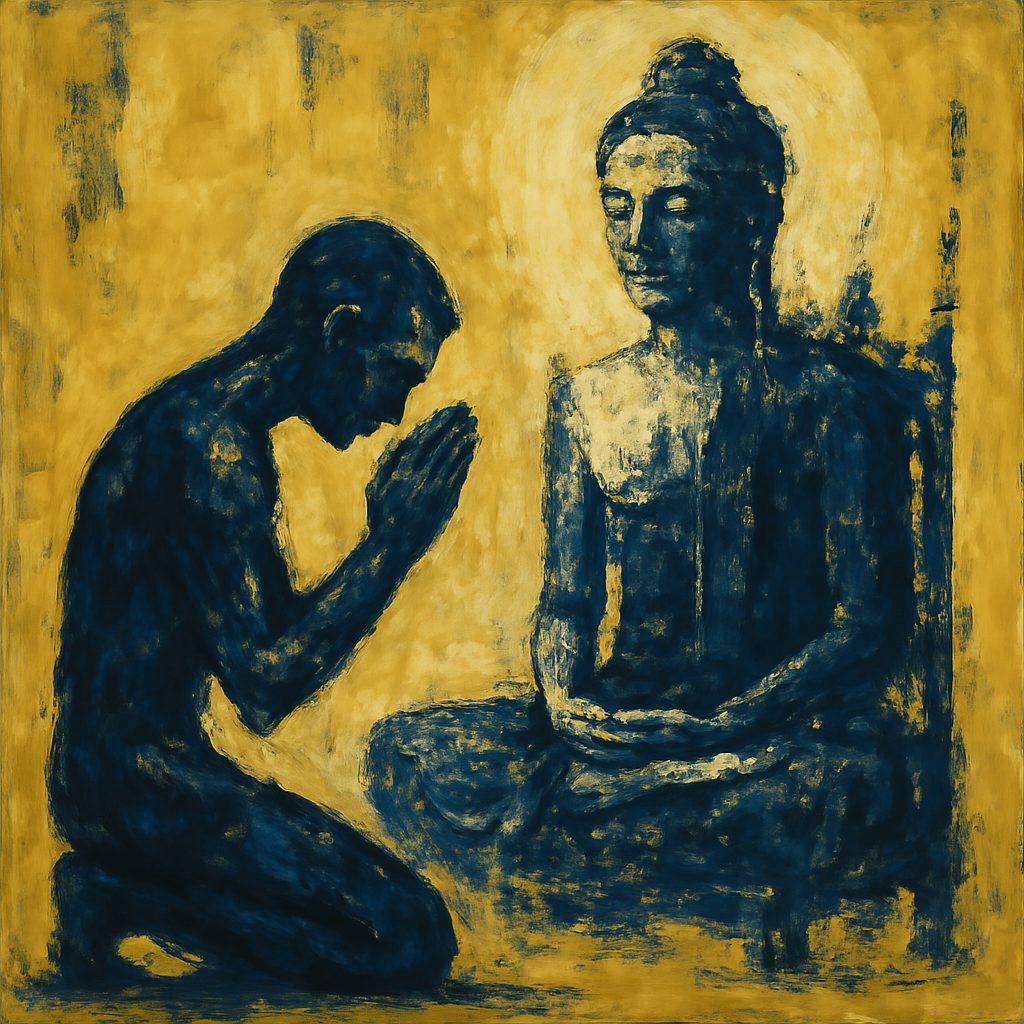
Worship your idols until your idols are no longer needed.
Another way to say this is:
Focus on your objectives until you’re forced to look within.
There is nothing inherently wrong with having idols.
There is nothing inherently wrong with ambition, achievement, recognition, wealth, status, influence, romance, physical beauty, intellectual mastery, spiritual attainment, or the desire to become extraordinary.
Sometimes the road beyond desire must first travel directly through it.
We often imagine spiritual maturity as the immediate rejection of worldly pursuits. Renounce the ego. Abandon ambition. Stop chasing things. Detach from outcomes. Transcend desire.
Yet premature renunciation can become another form of avoidance.
You can claim that money does not matter when you have never had any.
You can dismiss recognition when you secretly crave it.
You can condemn power because you have never experienced what it feels like to possess it.
You can declare yourself detached from relationships while quietly fearing intimacy.
You can criticize ambition while wondering whether you were capable of achieving what you wanted.
Sometimes you have to meet the idol before you can discover what it cannot give you.
The Idol Is Not Necessarily the Problem
An idol is anything onto which we project the promise of completion.
It might be a person.
A career.
A relationship.
A spiritual teacher.
A certain amount of money.
A perfect body.
A degree.
A mystical experience.
A following.
A business.
Enlightenment itself can become an idol.
The object changes, but the psychological movement remains remarkably similar:
When I obtain that, I will finally be complete.
This is what gives the idol its power.
The object itself may have value. Money can create freedom. Relationships can bring intimacy. Achievement can develop discipline. Knowledge can expand perspective. Meditation can transform how consciousness relates to experience.
The illusion begins when we ask something finite to provide what only the recognition of our fundamental nature can reveal.
We are not merely pursuing the object.
We are pursuing a feeling we believe the object will produce.
Freedom.
Security.
Love.
Wholeness.
Significance.
Peace.
The object becomes a symbol for an internal condition.
This is why getting what you want can sometimes be more spiritually disruptive than failing to get it.
Failure allows the fantasy to survive.
Success puts the fantasy on trial.
When Success Becomes a Spiritual Crisis
Suppose you spend twenty years believing that reaching a particular objective will finally make you happy.
Then you reach it.
For a while, there may be exhilaration. There should be. Something meaningful has happened.
But eventually ordinary consciousness returns.
You wake up as yourself.
The mind still moves.
Old insecurities may remain.
Fear still visits.
The body still ages.
Relationships still require work.
The applause fades.
Yesterday’s achievement becomes today’s normal.
Then an unsettling question appears:
Is this it?
That question can be more transformative than years of abstract spiritual philosophy.
You received what you asked life for, yet something remains unresolved.
The idol has fulfilled its purpose.
Not because it saved you, but because it failed to.
Its failure becomes instruction.
Desire Can Educate You
Certain desires disappear through understanding rather than suppression.
A child may desperately want a particular toy. Telling the child that the toy cannot provide lasting happiness will probably accomplish very little. The child needs the toy.
Then something fascinating happens.
The child gets it.
Plays with it.
Loves it.
Eventually puts it down.
What philosophy could not accomplish, experience did.
Adults are not fundamentally different.
Our toys become more sophisticated.
Titles.
Cars.
Followers.
Properties.
Credentials.
Partners.
Awards.
Spiritual experiences.
We give them adult names, but psychologically we may still be saying:
Maybe this will finally be enough.
There is wisdom in discovering for yourself what “enough” actually means.
This does not mean deliberately becoming materialistic or compulsively pursuing every desire that enters the mind. Some desires are destructive, and maturity includes discernment.
The deeper point is that genuine transcendence is different from repression.
Repression says:
I am not supposed to want this.
Transcendence says:
I understand what this can and cannot give me.
Those are radically different states of consciousness.
Even the Spiritual Path Has Idols
Spiritual seekers sometimes exchange socially acceptable idols for spiritually acceptable ones.
The pursuit of money becomes the pursuit of awakening.
Status becomes spiritual authority.
Achievement becomes attainment.
Possessions become experiences.
Comparison with coworkers becomes comparison with meditators.
Who has had kundalini awaken?
Who has experienced samadhi?
Who has reached jhana?
Who has dissolved the ego?
Who has seen God?
Who is enlightened?
The costume changes while the machinery of becoming continues operating underneath it.
The ego can pursue its own disappearance.
That is one of the great paradoxes of spiritual practice.
There may come a point when even enlightenment must be surrendered as an objective.
Not because awakening is meaningless, but because the imagined individual who intends to possess enlightenment may itself become the final idol.
You cannot own the Absolute.
You cannot place infinity on your spiritual résumé.
The Objective Eventually Turns You Around
Pursue your objectives consciously.
Build something.
Learn.
Create.
Love.
Risk failure.
Develop your gifts.
Become excellent at something.
Explore what human life is capable of expressing.
But pay attention.
Notice what happens when you get what you wanted.
Notice how quickly the mind moves the finish line.
Notice when “I’ll be happy when…” quietly becomes another “when.”
Notice how every arrival eventually becomes another departure point.
The external journey gradually begins pointing somewhere unexpected.
Back toward the one who has been searching.
Who wants this?
What exactly am I hoping to receive from it?
What would happen if I obtained everything I wanted?
What remains when achievement, identity, status, belief, memory, personality and aspiration are temporarily set aside?
What is aware of all of this?
At some point the search changes direction.
You stop asking only:
What else can I acquire?
You begin asking:
Who is the one trying to become complete?
That question opens a very different door.
When the Idol Falls From the Altar
The mature relationship with an idol does not necessarily require destroying it.
You simply stop worshipping it.
Money can remain money.
Success can remain success.
A relationship can remain a relationship.
A teacher can remain a teacher.
Meditation can remain meditation.
Achievement can remain achievement.
They no longer carry the impossible responsibility of completing you.
You can enjoy them without confusing them with your Being.
You can participate without becoming psychologically imprisoned by participation.
You can succeed without needing success to tell you who you are.
You can fail without failure becoming a verdict on your existence.
Something profound changes when the world is no longer required to complete the one experiencing it.
Perhaps this is one meaning of freedom.
Not escaping the world.
Not rejecting desire.
Not pretending that objectives do not matter.
Rather, seeing their proper place.
Worship your idols if you must.
Study them.
Pursue them.
Stand before them.
Perhaps even achieve what they represent.
Then look carefully at what remains.
Eventually, the idol may cease to be an idol.
Not because someone convinced you that worship was foolish, but because experience revealed the limitation of what you were worshipping.
The objective did not betray you.
It brought you exactly where it was ultimately capable of bringing you.
To the edge of itself.
From there, there is only one direction left to look.
Within.
Morgan O. Smith