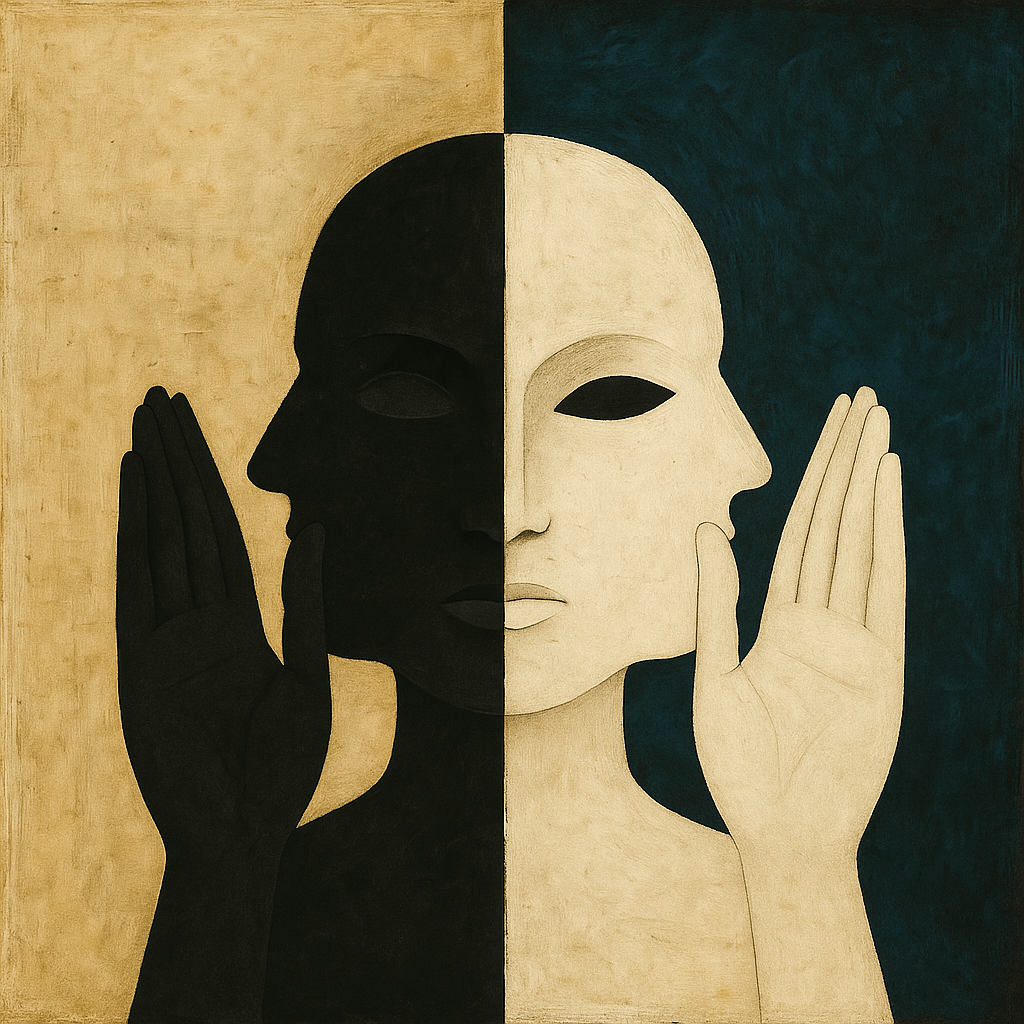
Knowing vs. Believing

The Subtle Divide Between Truth and Interpretation

Knowing there’s a God is not a religious concept; believing in a God is.
One is a recognition—silent, direct, and intimate. The other is a construct—layered with doctrines, culture, and inherited symbols.

What is known requires no belief. It reveals itself without needing validation, much like light doesn’t require agreement to be seen. The moment belief arises, there is already a distance. A gap. A reaching toward what seems separate.

Belief is an echo of knowing, distorted by time, language, and fear.
It builds shrines to certainty where awe once stood unguarded. It memorizes truths that once moved freely through silence. And often, it turns the unknowable into a caricature—a God of preferences, sides, and punishments.

Knowing is not about having answers. It’s the crumbling of the question.
It doesn’t declare “There is a God.”
It dissolves the very boundary between the knower and what is known. There is no longer a subject seeking an object. Only the raw immediacy of Being aware of itself.

Those who know are rarely interested in convincing others.
Those who believe often are.

The danger isn’t belief itself—it’s mistaking belief for truth.
Truth, when known, renders belief obsolete.
It doesn’t divide, it doesn’t declare superiority—it simply is.

To know is to surrender the need for interpretation.
To believe is often to defend the interpretation, even at the cost of truth.

And yet, belief can serve as a bridge. A necessary illusion for those not yet ready to let go of the comfort of form. But let it be a bridge, not a home.

Morgan O. Smith

Get Your Free Copy of My Book, Bodhi in the Brain!
https://subscribepage.io/oTSZQu

Proof No Longer Needed

Once You Have Experienced It, Proof Is No Longer Needed

Doubt thrives in the absence of direct experience. The intellect demands evidence, constructing elaborate justifications for what it cannot yet grasp. But when the veil is lifted – when the mind, body, and awareness dissolve into the unshakable certainty of direct realization – proof becomes irrelevant.

Imagine explaining fire to someone who has never felt its warmth. You could describe its heat, flickering light, and how it devours wood and dances in the wind. Yet words would always fall short. The person might nod, ask for scientific studies, or debate its existence. But the moment their hand hovers near a flame, every question vanishes. There is no longer belief or disbelief -only knowing.

Spiritual awakening functions the same way. Those who have never touched the boundless stillness of their true nature often seek validation from philosophy, neuroscience, or comparative religion. They need the reassurance of others and the intellectual security of consensus. But the one who has dissolved into that stillness no longer seeks permission to believe. Knowing arises effortlessly, beyond language or logic.

This is why those who have crossed the threshold often struggle to articulate their experience. The attempt to translate it into words feels like drawing water from the ocean with a thimble. Everything that could be said remains insufficient. So they speak in metaphors, paradoxes, and silence.

Skepticism serves a purpose. It prevents blind acceptance and encourages discernment. But its power dissolves in the face of truth lived directly. Once seen, it cannot be unseen. Once known, it cannot be doubted.

For those still searching, no explanation will suffice. For those who have arrived, no explanation is necessary.

Morgan O. Smith

Yinnergy Meditation, Spiritual Life Coaching & My Book, Bodhi in the Brain…Available Now!

https://linktr.ee/morganosmith