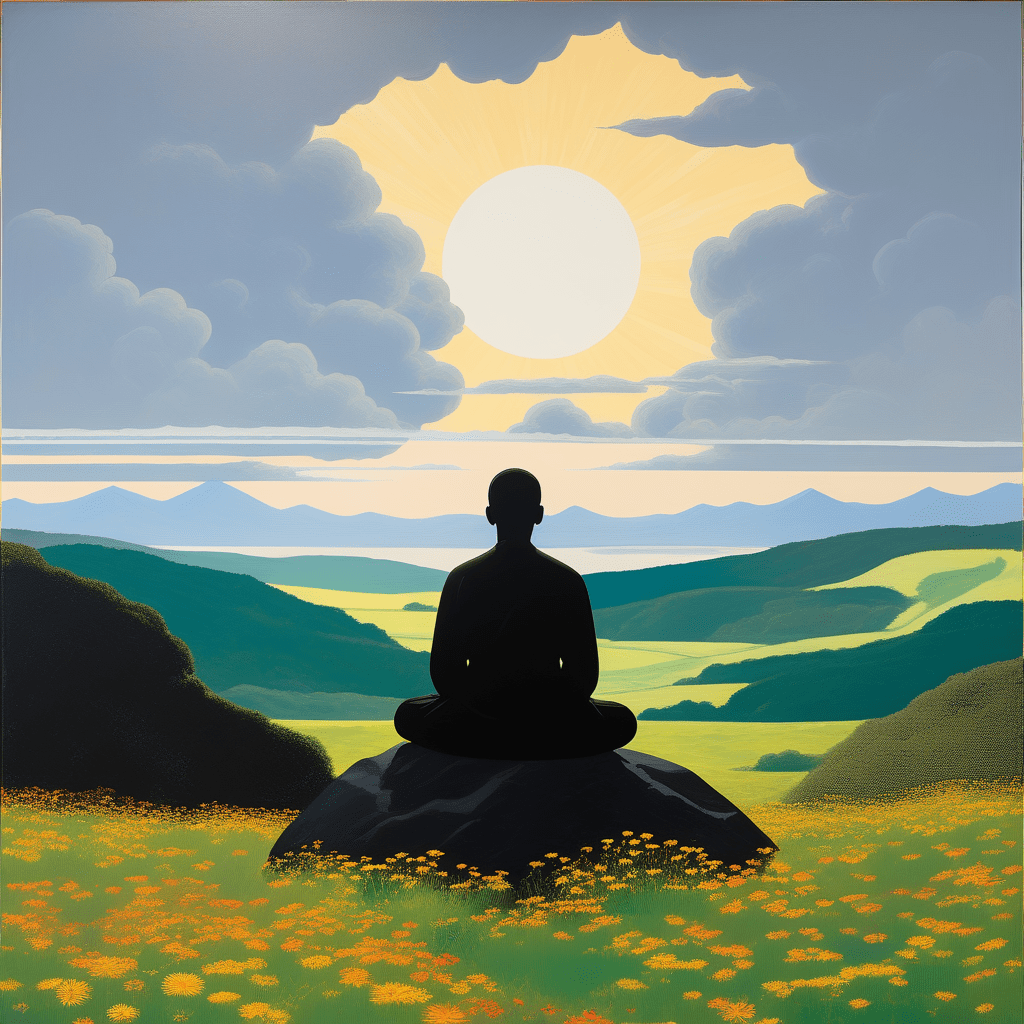
Chase Your Own Tail with Full Awareness

The mind has always been fascinated with pursuit; chasing meaning, purpose, love, and even itself. Every spiritual seeker eventually discovers that what is being sought is also what is doing the seeking. This circular dance is not an error of logic but an essential revelation of consciousness attempting to know its own face.

Self-awareness begins as observation: the witness looking at the one who thinks, feels, or reacts. Yet as the circle tightens, the observer realizes it too is being observed. Awareness turns upon itself, chasing its own tail. The chase appears endless, yet there is no distance between hunter and hunted. Each rotation refines perception until the realization dawns; nothing was ever outside the circle.

To chase your own tail with full awareness is to engage life without trying to escape its paradoxes. The ego may protest, craving resolution, but awareness thrives in the friction between motion and stillness. Every question collapses into its own answer when seen through this lens. Each loop reveals that the seeker and the sought are made of the same light, turning endlessly within a field that neither begins nor ends.

Such pursuit is not futility; it is awakening disguised as repetition. The circle is not a trap; it is the geometry of return. The tail you chase is your own forgotten wholeness, the reminder that every step forward curves you back into what has always been whole, complete, and awake.

To awaken is not to stop the chase, but to see that you were never moving at all.

Morgan O. Smith

Get Your Free Copy of My Book, Bodhi in the Brain!

https://subscribepage.io/oTSZQu

The Shadow Self of the Grandiose

The concept of the shadow self—a term Carl Jung coined—reveals layers of ourselves we often choose to hide, repress, or deny. These shadow aspects are usually relegated to a dark corner of our psyche, only surfacing in fleeting glimpses. Yet, when the shadow self takes on a grandiose form, it ceases to be subtle, becoming instead a dominating force. It blinds us with illusions of superiority, entitlement, or self-importance, distorting our perception and interactions.

In personal growth and spiritual awakening, confronting the shadow self is both inevitable and essential. However, when the shadow becomes grandiose, it can convince us we are immune to error, beyond reproach, or uniquely enlightened. This delusion becomes a veil, preventing authentic growth and genuine self-reflection.

The grandiose shadow is not merely about arrogance. It’s a defence mechanism, an armour forged in the fires of insecurity and fear. By building up the self as untouchable or superior, we attempt to ward off the vulnerability of true introspection. But this shield, rather than protecting us, leads to isolation, as others feel the weight of this projection and distance themselves, sensing the ego’s hunger for validation cloaked in supposed wisdom or enlightenment.

In many spiritual or philosophical circles, grandiosity masquerading as enlightenment can become especially potent. The grandiose shadow asserts itself under the guise of spiritual authority or moral righteousness, leading us to believe we are above others on the path. But this illusion only widens the gap between our authentic self and the mask we’ve constructed.

To navigate this terrain, a key question emerges: Are we genuinely pursuing self-understanding, or are we feeding a need to feel special, above, or untouchable? True growth does not demand recognition or approval; it thrives in humility and quiet awareness.

Recognizing when our shadow has grown too grandiose is challenging but necessary. It requires questioning our motives, embracing vulnerability, and letting go of the need to stand above. Only by shedding the inflated version of ourselves can we step into true authenticity and spiritual liberation.

 Morgan O. Smith

Yinnergy Meditation, Spiritual Life Coaching & My Book, Bodhi in the Brain…Available Now!

https://linktr.ee/morganosmith

The Guru’s Wisdom

Beyond Half-Truths to Awakening

In the quest for spiritual enlightenment, the role of a Guru is often viewed as a beacon of absolute truth. Yet, this journey has an enigmatic twist: the teachings a Guru imparted embody only a fraction of the greater truth. This notion may initially seem confounding, but it is a pivotal insight for those deeply immersed in the pursuit of spiritual understanding.

Consider the Guru’s teachings as signposts, guiding you towards a horizon of enlightenment. These teachings are profound, yet they are not the complete journey. They are like the first hues of dawn, hinting at the full radiance of the day yet to unfold. The Guru provides a foundation, a starting point, but the structure of understanding is built by you, the seeker.

The other half of this truth, the part that remains veiled, is found within the silent chambers of your being. These truths reveal themselves in the quiet moments of introspection and the depths of meditation. This personal awakening is a journey that transcends words and teachings; it’s an experiential realm where knowledge transforms into wisdom.


This revelation is akin to a flower slowly unfurling its petals. The Guru’s words are the sunlight and rain, essential for growth, but the blooming, the realization of one’s spiritual essence, is a personal, intimate process. It is in this space of self-discovery where the half-truths merge into a complete understanding.

In this context, the Guru is not a purveyor of ultimate truths but a guide who points you towards your capacity for enlightenment. The journey inward is marked by a shift from seeking external validation to nurturing an internal dialogue with your true self. It is here, in the sanctum of your inner world, where the dichotomy of half-truths and complete truths dissolves into the singular reality of your experience.


As you continue on this path, remember that each insight, each moment of clarity, is a step closer to the awakening that unveils the other half of the truth. This process is not a contradiction of the Guru’s teachings but a continuation, an expansion into the realms of personal experience and self-realization.

Morgan O. Smith

Yinnergy Meditation, Spiritual Life Coaching & My Book, Bodhi in the Brain…Available Now!

https://linktr.ee/morganosmith

Walking the Sacred Grounds of Being

Exploring the Akashic Field

In the realm of metaphysical exploration, the Akashic field stands as a testament to the boundless possibilities of existence. This concept, often visualized as a vast, ethereal library or a cosmic database, holds the records of all thoughts, actions, events, and emotions that have ever occurred or will occur. It’s an intangible yet profoundly significant space where the grass doesn’t grow as a physical entity, but as an idea, a potentiality.

The concept of the Akashic records originated in the theosophical movements of the 19th century and has been a subject of intrigue for spiritual seekers and mystics ever since. These records are not written on paper but are believed to exist in a non-physical plane of existence. They embody the idea that every individual’s thoughts, experiences, and emotions are imprinted onto a universal consciousness, contributing to the collective knowledge and evolution of the universe.

To plant your footsteps in this sacred ground of being means to engage deeply with the essence of life itself. It’s a journey of introspection, where one seeks to understand the interconnectedness of all things. In this field, grass represents not just a plant, but a concept, a symbol of growth, life, and interconnectedness. It’s a reminder that even the simplest elements of nature hold profound meanings in the grand mosaic of existence.


Engaging with the Akashic field can be a transformative experience. It encourages us to look beyond the material world and understand the deeper spiritual connections that bind us. Through meditation, contemplation, and other spiritual practices, one can ‘access’ this field, gaining insights into past lives, understanding the purpose of current challenges, and even glimpsing potential future events.

However, it’s crucial to approach this journey with humility and respect. The Akashic field is not just a source of information but a sacred space of collective consciousness. Engaging with it requires an open heart and a mind willing to learn and grow.


In conclusion, the Akashic field invites us to ponder the mysteries of existence and our place within it. It challenges us to view life not just as a series of random events but as a part of a grand, interconnected cosmic play. By planting our footsteps on this sacred ground, we embrace the potentiality of all that is, was, and will be, and in doing so, we find deeper meaning in the simple act of being.

Morgan O. Smith

Yinnergy Meditation, Spiritual Life Coaching & My Book, Bodhi in the Brain…Available Now!

https://linktr.ee/morganosmith

In the Mirror of Divinity

A Journey of Self-Realization

In my spiritual odyssey, I have tirelessly sought the face of God in various places: in the serene sanctuaries of nature, within the hallowed walls of churches, and in the sacred texts brimming with ancient wisdom. Yet, as I ventured deeper into this quest, a startling revelation unfolded – the face of God that I was so fervently seeking was, in fact, a reflection of my own.

This epiphany was not an end but a new beginning, an invitation to explore the divine within the human experience. It compelled me to ask: What does it mean to see the divine in oneself? Is it an echo of ancient philosophies proclaiming that the human and the divine are inseparable? Or is it a testament to the boundless potential within each of us?


The realization that we are mirrors of the divine reshapes our understanding of spirituality. It suggests that the sacred is not solely external, but also internal. It speaks to the potential for transcendence and transformation inherent in human nature. This perspective doesn’t diminish the significance of a higher power; instead, it offers a profound understanding that divinity can also be a deeply personal experience, emanating from within.

Embracing this view unlocks a powerful form of self-realization. It encourages us to look within for guidance, strength, and wisdom. It empowers us to trust in our inner voice and intuition, recognizing them as conduits to the divine. This realization also fosters a deeper sense of responsibility towards ourselves and others, understanding that if the divine is in us, it is also in everyone else.


This journey of self-discovery is not without challenges. It requires us to confront our deepest fears, insecurities, and flaws. It asks us to be introspective, to examine the aspects of ourselves that we might not be proud of. But in doing so, it also offers the opportunity for profound personal growth, healing, and enlightenment.

In conclusion, the discovery that the face of God is akin to our own is not a conclusion but an invitation to a lifelong journey. It’s an exploration of the deepest truths about ourselves and our place in the universe. As we continue on this path, we may find that the distinction between the seeker and the sought becomes ever more blurred, revealing a unity that has existed all along.

Morgan O. Smith

Yinnergy Meditation, Spiritual Life Coaching & My Book, Bodhi in the Brain…Available Now!

https://linktr.ee/morganosmith

The Isolation of Consciousness Expansion

In the journey of personal growth and consciousness expansion, a profound yet often overlooked aspect is the sense of isolation that can accompany it. When you undergo a significant shift in consciousness, your perspective and understanding of the world evolve in ways that might not align with the general populace. This divergence can lead to a feeling of being solitary on your path, especially when trying to share your thoughts and experiences with others.

Social media, which ostensibly connects us, can sometimes highlight this isolation. You may find yourself pouring your thoughts into posts, seeking some form of validation or connection, only to be met with silence or indifference. The lack of engagement isn’t necessarily a reflection of the value of your insights, but rather an indication of the differing levels of awareness and interest among your audience.

This new stage of consciousness places you in a unique space. It’s a realm where your thoughts and expressions resonate on a different frequency, one that is not always perceptible or relatable to the majority. In this space, your voice may seem muted to the masses, heard and understood by only a select few who are either on a similar path or are seeking something in your words to ignite their journey of self-discovery.

It’s important to remember that this sense of isolation is not permanent nor entirely negative. It can be a catalyst for deeper introspection and self-reliance. The key is to find balance, to seek out communities or individuals who share your level of consciousness, and to continue expressing your thoughts without the sole expectation of external validation. In doing so, you not only nurture your growth but also potentially provide a beacon for others who might be embarking on similar paths.

In this new stage of consciousness, embrace solitude as a companion in your journey. Some of the most profound growth occurs in these quiet moments of perceived isolation. Remember, the depth and value of your insights are not diminished by the number of likes or comments they receive but by the impact they have on you and those few who truly hear them.

Morgan O. Smith

Yinnergy Meditation, Spiritual Life Coaching & My Book, Bodhi in the Brain…Available Now!

https://linktr.ee/morganosmith

Embracing the Veil of Night

A Journey Through Darkness to Dawn

As the inky shroud of night stretches across the sky, it offers not just a canvas for the stars, but a metaphorical landscape for the soul’s dark night. In these periods of profound introspection and uncertainty, the world seems to pause, holding its breath along with us as we confront the spectres of our fears, doubts, and the vast unknown that the darkness symbolizes.

The dark night is not just an absence of light but a presence of mystery, a deep silence calling for our attention. It’s during these times that the familiar contours of our lives fade into shadows, and we’re invited to sit with the disquiet of our thoughts. Here, devoid of distraction, we encounter the rawest versions of ourselves. But what are we to do in this space between the known and the unknowable?

First, we must accept the dark night when it arrives. The darkness is not a curse but a sacred space. It’s in this seeming void that we’re afforded the chance to shed the superfluous, to strip away the veneer of day-to-day pretenses and stand bare, if we dare, before the truths we’ve cloaked in daylight.

Next, we must learn to navigate by a different set of stars—those that reside within us. This navigation doesn’t involve moving at all, but rather being still. Being still enough to listen to the whispers of intuition, the guidance of a heart untarnished by the glare of artificial lights.

To get through the dark night, we should not rush to fill it with artificial light, lest we miss its lessons. Rather, let’s kindle the inner flame of self-compassion and understanding, allowing it to illuminate our path. This flame is fed by the recognition of our shared humanity, the understanding that no one is immune to the dark night and that it’s a fundamental part of the growth process.

Emerging from the dark night is akin to witnessing the dawn. Just as the first light of daybreak does not erase the night but rather builds upon it, the insights gained in the dark become part of the foundation upon which we build a new day. We carry forward a newfound clarity and strength, a resilience born from having faced the abyss and having the courage to embrace it.

In conclusion, the dark night is an invitation to a profound personal revolution. As we traverse its landscape, let us be gentle with ourselves and others, knowing that each of us battles a silent storm beneath the stars. And remember, it’s always the darkest before the dawn. The new light that awaits us promises not just a new day but a new way of being, forged in the quiet depths of the night.

Morgan O.  Smith

Yinnergy Meditation & My Book, Bodhi in the Brain…Available Now!

https://linktr.ee/morganosmith

Mirrors of the Self

Seeing the Divine in All

In the vast expanse of existence, each entity and every moment is a reflective surface, giving us a glimpse of our deepest selves. When we peer into the world, what we encounter is not just matter arranged in space but a mosaic of mirrors, each offering a unique reflection of who we are. The idea that everything we perceive is a reflection of our face is not just a poetic sentiment but a profound philosophical proposition that invites introspection about the nature of self and the universe.

The reflections we see are not literal but abstract, distilling our essence in the myriad forms and phenomena around us. This abstraction is where the beauty of perception lies; it is a canvas where the mind can project its inner workings—its hopes, fears, and dreams. The world outside becomes a screen for the drama of the self to unfold, the grand play of consciousness where every actor wears a mask that resembles something within us.

In this grand reflection, if we are to see the face of God, then it must be understood that this divine visage is not an entity separate from us but interwoven into our being. The divine reflection is the totality of the cosmos itself, a unity where every face is indeed an aspect of a greater countenance. If we are made in the image of the divine, as many traditions suggest, then it follows that the divine is also made in the countless images reflected to us.

Every interaction, every glance at nature, every piece of art, and every human invention is a facet of this divine reflection. We are constantly in dialogue with the divine through the medium of our experiences. In recognizing this, we might come to treat each moment with reverence, understanding that in the act of observation, we are participating in a sacred exchange.

As we walk through the world, let us consider that the beauty, the ugliness, the sublime, and the mundane are all part of the same tapestry, woven with threads of the divine. It is not just in the extraordinary that we can glimpse the face of God, but in the ordinary, the overlooked, and the understated. By recognizing the divine reflections in all that we encounter, we open ourselves to a more profound sense of connection and purpose.

In the end, the philosophy that everything is a reflection of our face does not isolate us in solipsism but connects us to a greater whole. It offers a vision of unity, where the self is not an isolated entity but a vibrant echo of the universe, a reflection of the divine face in the mirror of existence.

Morgan O.  Smith

Yinnergy Meditation & My Book, Bodhi in the Brain…Available Now!

https://linktr.ee/morganosmith

The Environment’s Role in Spiritual Growth

Spiritual growth is an inward journey that involves deepening self-awareness, a connection to a higher purpose, and a pursuit of inner peace and enlightenment. Though one might perceive spiritual growth as purely internal, the environment plays an instrumental role in shaping this voyage.

**The Outer Reflects the Inner**:
Spirituality isn’t limited to the realm of meditation, prayers, or religious practices. It’s also about understanding oneself to the larger world. The environment serves as a mirror, reflecting the chaos or calm we feel within. A serene setting, like a tranquil forest or a quiet beach, can provide the space needed for introspection, while a tumultuous environment might challenge and refine our spiritual resilience.

**The Playground of Experiences**: Our experiences, heavily influenced by our environment, serve as lessons that guide our spiritual evolution. Facing economic hardships might teach us humility and gratitude while being in a nurturing emotional environment can facilitate feelings of love and empathy. Each environment, with its unique challenges and blessings, offers distinct lessons for our soul’s growth.

**Environmental Genetics and The Enlightened Individual**:
Modern scientific understanding acknowledges that both genes and the environment play roles in determining our characteristics. This interplay is also valid for spiritual inclinations. An individual with a genetic predisposition towards introspection and an environment that encourages self-reflection might have a smoother path toward enlightenment. Conversely, someone genetically predisposed to anxiety but raised in a supportive environment might learn to channel that anxiety into a deeper spiritual quest.

Yet, it’s crucial to remember that enlightenment isn’t a one-size-fits-all concept. The combination of genetics and environment produces a spectrum of enlightened individuals, each with unique strengths, perspectives, and wisdom to offer.

### Balancing Agency with Environmental Influences

While the environment significantly shapes us, spiritual growth also involves recognizing and exercising our agency. It’s about acknowledging environmental influences while taking proactive steps to seek experiences and environments that align with our spiritual goals.

For many, this might mean seeking spiritual communities, immersing oneself in nature, or actively creating a personal sanctuary that facilitates inner reflection and growth. For others, it might involve challenging and transforming their environments.

In conclusion, the environment isn’t just a backdrop against which the drama of life unfolds; it’s an active participant, a teacher, a mirror, and a guide on our spiritual journey. Recognizing its influence can empower us to harness its lessons, navigate its challenges, and embark on a more profound, fulfilling spiritual voyage.

Morgan O.  Smith

Yinnergy Meditation & My Book, Bodhi in the Brain…Available Now!

https://linktr.ee/morganosmith

Beyond Maya

A Profound Exploration of Reality

In the vast tapestry of Hindu philosophy, the concept of ‘Maya’ often emerges as an enigma, enveloping our perception of reality. But what if we were to assert that * everything*, both within and beyond our comprehension, is shrouded in Maya? How would such a revelation change our understanding of the universe and our place within it?

### The Essence of Maya

At its core, Maya is frequently understood as “illusion” or “unreality.” It’s the veil that obscures our true nature and the eternal truth of the universe. The things we perceive, the emotions we feel, and the thoughts that cloud our minds, all dance within the confines of this illusion. Maya convinces us that the temporal is eternal, that the superficial is profound, and that the ephemeral is everlasting.

### Expanding the Bounds

When we claim that everything, in and out of existence, is Maya, we’re delving deeper into an intriguing thought. This suggests that even our most profound realizations, spiritual epiphanies, and the concepts we use to grasp the ineffable are still part of the illusion. It’s not just the tangible, but the intangible; not just the known, but the unknown.

### The Paradox of Understanding

If everything is Maya, then the realization of this truth is also Maya. This presents a paradox: how can one truly transcend the illusion when the very tools and insights we use are part of the illusion itself? This enigmatic thought prompts us to question the very nature of enlightenment and the path to transcendence.

### Embracing the Illusion

Rather than feeling disheartened by the all-encompassing nature of Maya, one can instead embrace it as a transformative understanding. Recognizing that even our loftiest thoughts are touched by Maya can lead to a profound humility. It’s a call to constant introspection, a reminder that there’s always a deeper layer of understanding awaiting us.

### Beyond the Beyond

Perhaps, beyond the layers of Maya, there’s a state of pure consciousness, untouched and unblemished. It’s a state where distinctions fade, where the observer and the observed merge into one. While our journey is fraught with illusions, every step, every realization, brings us closer to this ultimate truth.

In conclusion, the assertion that everything is Maya isn’t a nihilistic statement but a profound recognition of the intricacies of existence. It invites us to look beyond the apparent, challenge our convictions, and seek a deeper, more encompassing truth. It’s a call to journey inward, where the real voyage begins.

Morgan O.  Smith

Yinnergy Meditation & My Book, Bodhi in the Brain…Available Now!

https://linktr.ee/morganosmith