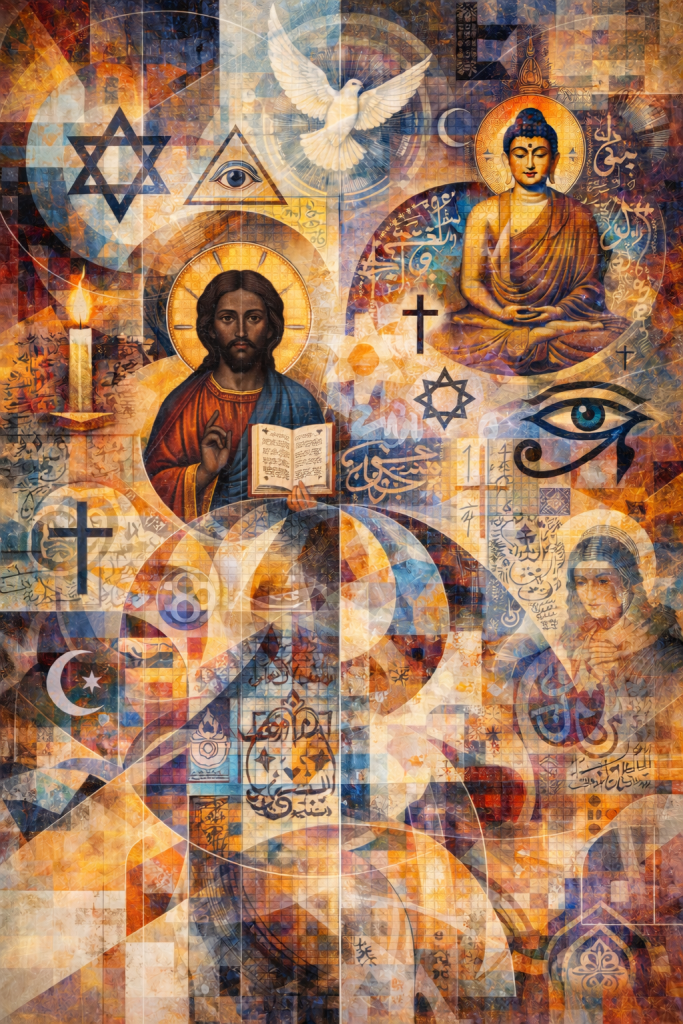
When Empathy Crosses the Threshold of Self

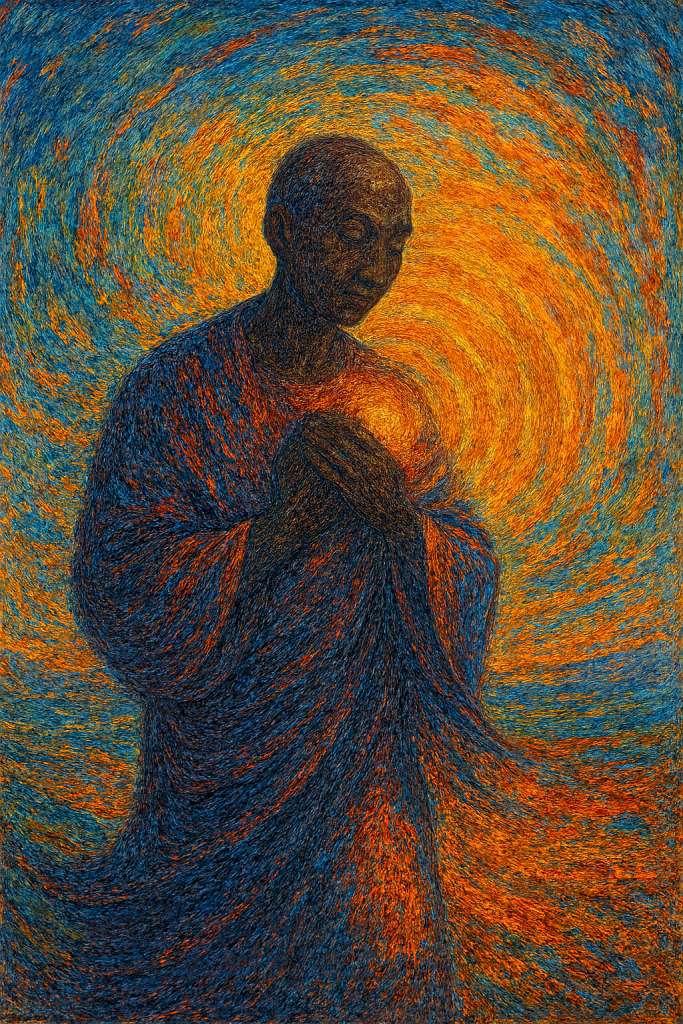
Empathy is often described as understanding another’s feelings, yet this description barely scratches the surface of its deepest expression. At its highest register, empathy ceases to be an act of imagination and becomes an act of participation. Something more radical occurs; identity loosens, boundaries soften, and awareness enters a living intimacy with another mode of being.

Such empathy does not merely observe suffering or joy from a distance. Consciousness steps into the interior rhythm of another life and begins to feel from within. Breath, sensation, and perception reorganize themselves. Experience no longer revolves around a private centre. A wider gravity takes hold.

Kosmocentric awareness emerges at this threshold. Attention no longer privileges the personal narrative or even the collective identity of a group. Life is sensed as a single field expressing itself through countless forms. Compassion, here, is not chosen. It flows naturally, the way heat radiates from fire.

To walk in the shoes of a bodhisattva is not to adopt a moral stance or imitate a spiritual role. It is to feel what it means to be animated by responsibility without burden. The heart expands beyond emotional warmth into something rhythmic and vast, beating not for one life, but for life itself. Suffering is felt directly, yet it does not collapse the system. The capacity to hold pain grows alongside the capacity to love.

Such an experience dissolves the familiar distinction between self and other. Helping another no longer feels like altruism. It feels like circulation; energy moving where it is needed, without hesitation or self-congratulation. Action arises spontaneously, guided by clarity rather than obligation.

This level of empathy cannot be sustained through effort alone. It arises when identification with the separate self loosens enough for consciousness to re-centre itself within the whole. What remains is not detachment, but intimacy without possession. Care without agenda. Presence without contraction.

Moments like these recalibrate what it means to be human. After tasting kosmocentric empathy, ordinary indifference becomes impossible to justify. Even when the experience fades, something irreversible has occurred. A deeper reference point has been established.

Empathy, at its summit, reveals itself not as an emotional skill, but as a shift in being. Life recognizes itself through you, and the heart learns a larger rhythm; one that beats for all beings, without exception.

Morgan O. Smith

Get Your Free Copy of My Book, Bodhi in the Brain!

https://subscribepage.io/oTSZQu

How Far the Heart Can Truly Open

A curious shift occurs when the heart stops functioning as a possession and begins revealing itself as a dimension of awareness. Most people imagine love as something they generate, something that must be earned, strengthened, or directed. Yet once the inner walls begin dissolving, the heart behaves less like a reservoir and more like an unbounded field. Nothing needs to be pushed outward. Nothing needs to be pulled inward. Everything already rests inside the same luminous space.

A bodhisattva’s vow is often misunderstood as a heroic effort to love every being across the cosmos. That interpretation still assumes a separate self stretching itself toward infinity. What actually unfolds is far more intimate. The boundaries that define self and other begin to thin. Compassion arises not from moral intention but from direct recognition: every form is a variation of the same presence gazing through different eyes. Love becomes less a decision and more a consequence of clarity.

A Kosmocentric heart does not expand by accumulating greater quantities of affection. Its expansion is a subtraction—less resistance, less defense, less contraction around identity. As the edges dissolve, the universe is no longer something “out there” that requires love. It is revealed as the very body of consciousness, expressing itself through countless lifetimes, worlds, and histories. To love all beings then becomes effortless, because nothing stands outside the recognition of shared essence.

This realization reshapes the ordinary meaning of devotion. Love ceases to be a feeling sustained by conditions. It becomes the ground from which every moment rises. The heart does not tire. The heart does not question whether it is capable. The heart simply returns to its natural state: vast, quiet, and uncontainable.

A question often arises: “Can a human being truly love the entire universe?”
Yes, but not as a human being. Only when the self drops away does the heart reveal its true scale. What remains is a presence spacious enough to cradle galaxies, tender enough to feel the slightest tremor of suffering, and awake enough to recognize itself in every corner of existence.

This is the heart unbound.
This is compassion without walls.
This is the love the universe has always known through you.

Morgan O. Smith

Get Your Free Copy of My Book, Bodhi in the Brain!

https://subscribepage.io/oTSZQu

Beyond the Self

The Seven Perspectives of Awakening

Most discussions of growth and consciousness circle around the familiar: self, community, humanity, cosmos. Yet the movement of awareness does not stop there. The journey of awakening stretches beyond common frames, carrying identity through successive widenings until even perspective itself dissolves into the unnameable.

First Person – Egocentric

Awareness begins with the single pronoun: I. At this stage, the centre of existence is survival, desire, and self-interest. Spirituality here often means seeking relief, comfort, or control. The lens is narrow, but it is the soil from which broader care must grow.

Second Person – Ethnocentric

Identity expands to we. Family, tribe, religion, or nation become the circle of belonging. Meaning and devotion are tied to group loyalty, while outsiders remain less significant. Spiritual life often manifests as faith in a shared path or allegiance to a sacred tradition.

Third Person – Worldcentric

The pronoun shifts again, embracing they. Humanity as a whole is recognized as one family. Every person, regardless of background, is seen as worthy of dignity and care. This is the ground of universal ethics, human rights, and global responsibility. Spirituality speaks in the language of compassion that knows no borders.

Fourth Person – Kosmocentric

Perspective opens to all. Identity now includes every sentient being, every ecosystem, every galaxy. Care extends beyond human concerns to the life of the Earth and the vast cosmos itself. Spiritual experience often takes on a mystical quality here, where the boundary between self and universe fades into transparency.

Fifth Person – Evolutionary/Integral

A new horizon appears: awareness not only of beings and worlds, but of perspectives themselves. The self sees how “I, we, they, all” arise, evolve, and interrelate. Nothing is fixed; everything is a process. Awakening is understood as developmental, dynamic, ever-unfolding. The soul learns to hold multiple truths at once, to integrate rather than divide.

Sixth Person – Nondual

At this point, perspective collapses. The subject-object split dissolves. I, you, we, they, all, perspectives—everything appears as movements of the same luminous field. This is not an expanded view but the direct recognition that views themselves are appearances within awareness. Spiritual awakening here becomes radical intimacy with all that is.

Seventh Person – The Unmanifest

Beyond even the witness lies the groundless ground. This is not a vantage point but the source of all vantage points. No subject, no object, no seer, no seen. Pure Suchness. Emptiness that is full. From here, compassion arises not by choice but as the spontaneous flow of reality itself.

Closing Reflection

Each stage includes what came before and reaches beyond it. To live awakened is not to discard the earlier circles but to embrace them as nested truths. Self-care, community bonds, global ethics, cosmic reverence, evolutionary vision, nondual awareness, and the unmanifest ground—each is real, each is necessary. Together, they sketch the arc of awakening as it bends toward wholeness.

Morgan O. Smith

Get Your Free Copy of My Book, Bodhi in the Brain!

https://subscribepage.io/oTSZQu

Walking Beyond the Self

Expanding the Horizons of Perspective

Most human conflict is rooted in the inability to step outside the narrow confines of the self. We tend to move through the world tethered to a singular point of view, unable to grasp that reality shifts depending on who is looking. Perspective is not fixed; it unfolds in layers, from the egocentric stance of “me and mine,” through the ethnocentric loyalty of “us and ours,” into the broader realms of worldcentric care for humanity, and ultimately the kosmocentric embrace of all beings and existence itself.

When our awareness stops at the egocentric, we see others only as extensions of ourselves; or worse, as threats to what we hold dear. At the ethnocentric level, we expand slightly, but compassion remains conditional, bounded by tribe, religion, race, or nation. Yet the real flowering of human consciousness emerges once we realize that every being, regardless of sex, class, culture, or creed, carries within them a mirror of our own existence.

To recognize yourself in another is not simply an ethical exercise; it is an ontological revelation. The more deeply you understand that the same fears, desires, and vulnerabilities pulse through all lives, the less room remains for judgment. Hatred fades not because you suppress it, but because understanding transforms it. Even the figure we call “devil” becomes less monstrous when we glimpse the fractured angel hidden inside.

Imagine what collective life would feel like if this capacity for expanded perspective became the norm rather than the exception. Entire systems of oppression, exploitation, and alienation would dissolve under the weight of genuine empathy. Politics would no longer be about “sides” but about solutions; communities would no longer divide over difference but celebrate the very diversity that teaches us new ways of being human.

To walk in anyone’s shoes is more than a metaphor. It is the necessary step toward becoming fully human. The journey from ego to cosmos is not only possible, it is imperative. The future depends not on technological advancement alone, but on whether we can evolve into beings capable of holding multiple perspectives at once, anchored in compassion and guided by wisdom.

Morgan O. Smith

Get Your Free Copy of My Book, Bodhi in the Brain!

https://subscribepage.io/oTSZQu

Transcending Boundaries

The Journey to Kosmocentric Love

In our spiritual odysseys, there lies a zenith not often reached yet profoundly transformative: the state of Kosmocentric love. This is not just an expansion of affection but a profound understanding and acceptance that extends beyond the limits of ego, ethnicity, and even global consciousness. It’s where one’s love becomes boundless, unrestricted by conventional dualities or cultural constraints.

What does it mean to love in a Kosmocentric manner? It is to see the essence of existence—across all time and space—with a heart so open that it encompasses every facet of life, unconditionally. It’s a state where conflicts and contrasts dissolve into an all-encompassing unity that is perceived as the ultimate self, which is Love, spelled with a capital ‘L’.

Such love does not merely observe or empathize—it embraces. It allows life to unfold in its myriad forms and chaos, with the serenity of complete acceptance. This does not suggest passivity but rather a profound engagement with life that is free of desire to control or reshape it. It is to be at peace with the natural flow of existence, trusting in the cosmic dance of the universe.


To approach this state, one must journey deep within and also far beyond oneself. It is a path marked by relentless introspection, meditation, and the shedding of personal and collective conditioning layers. This journey can be accelerated by grace, an unearned gift that propels the soul toward realization.

Those who have experienced this state often describe it as being at one with everything, where personal grievances and the illusion of separation fade away. Love is not just an emotion but a permanent state of being, a lens through which every moment of existence is viewed.

How, then, can we aspire to this expansive state of being? It begins with cultivating an inner sanctuary of silence and meditation, where the whispers of deeper understanding can be heard above the cacophony of daily life. It requires the courage to let go of preconceived notions and to embrace the unknown with love rather than fear.


This exploration of Kosmocentric love challenges us to transcend our ordinary experiences and limitations, inviting us to partake in a more profound narrative of connection and universal love. It asks us to redefine what it means to love and to be loved, expanding our hearts to the very edges of the universe and beyond.

Morgan O. Smith

Yinnergy Meditation, Spiritual Life Coaching & My Book, Bodhi in the Brain…Available Now!

https://linktr.ee/morganosmith

Ascending the Ladder of Wholeness

From Kindergarten Mindsets to Doctorate Souls

Introduction:


In our ever-evolving world, parallels exist between education and Integral Theory’s psychological development stages. Imagine the journey from kindergarten to earning a Ph.D. as analogous to ascending through the levels of consciousness from archaic to super-Integral.

The Foundation: Kindergarten and Archaic Stage

At the base of both ladders lie the kindergarten and the archaic stage. Kindergarteners are mainly self-focused, akin to the archaic level, where consciousness is limited and centred around basic survival – analogous to an egocentric worldview.

Progressing Through the Grades: Ego to Ethnocentric

As children progress through grade school, they learn about broader communities and cultures. This reflects the movement from an egocentric stage to an ethnocentric stage. There’s an expanding awareness and inclusion of one’s tribe or group.

High School Milestone: Achieving Conformist-Pluralist Mindset

High school is a pivotal point. It’s analogous to the transition between 1st and 2nd tier levels of consciousness, where individuals start recognizing multiple perspectives. However, like some stopping their education after high school, not everyone crosses into higher levels of consciousness.

Post-Secondary Education: Reaching World-Centric

Entering college or university symbolizes reaching the world-centric level. Students are exposed to global issues and diverse viewpoints. Likewise, individuals at the world-centric stage care for all people regardless of their background.

The Doctorate of the Soul: Super-Integral and Kosmocentric

Attaining a PhD represents years of dedication and specialized knowledge. In Integral Theory, this is like reaching the super-Integral, 3rd tier level, where consciousness transcends to a Kosmocentric viewpoint. It’s the epitome of understanding and embracing the interconnectedness of all life.

Effort and Choice:

Just as continuing education past high school requires effort, progressing through levels of consciousness isn’t automatic. It requires introspection, learning, and personal growth. Individuals must choose to pursue higher states of being.

Conclusion:

Understanding Integral Theory through the lens of education offers a relatable roadmap for psychological development. Just as the pursuit of a PhD requires effort and dedication, advancing through stages of consciousness demands intentional personal growth.

Morgan O. Smith

Yinnergy Meditation & My Book, Bodhi in the Brain…Available Now!

https://linktr.ee/morganosmith