Beyond the Quadrants

The Letting Go That Lets Go of You

Awakening does not unfold through accumulation but through dissolution. It’s not about adding layers of understanding, but releasing the very framework that holds identity together. Every seeker begins with an “I”—the observer, the experiencer, the one who longs for freedom. Yet that same “I” must eventually surrender its throne.

The paradox lies here: the “I” must decide to release itself. It chooses to let go, though the one who chooses disappears in the act. This gesture is not driven by resistance or desire, but by recognition —an intuitive understanding that attachment to any quadrant is still a form of identification.

The quadrants—I, WE, IT, and ITs—map the totality of human experience: the inner self, the collective, the objective, and the systemic. Each serves a purpose until awakening calls for transcendence. The I is influenced by the ITs—the systems, structures, and conditions of existence. These shape perception and possibility. Through the IT, awareness ripples into the WE, inspiring collective movement. And as the WE shifts, the I is again transformed.

This endless loop of causation refines consciousness but never liberates it. Liberation comes when the loop itself is seen through. When the “I” no longer clings to the role of observer or doer, the quadrants collapse into pure witnessing. There is no longer an experiencer and the experienced, a subject and its object. What remains is unconditioned awareness; the silent axis upon which all quadrants turn.

Awakening, then, is not achieved through effort but through profound surrender. It is the cessation of grasping at identity within any domain—personal, relational, empirical, or systemic. The quadrants remain functional but no longer define reality. They appear and dissolve within the same stillness that has always been awake.

Morgan O. Smith

Get Your Free Copy of My Book, Bodhi in the Brain!

https://subscribepage.io/oTSZQu

Stepping Stones That Lead Nowhere

Most of us spend our lives leaping from one stone to another, convinced each step will bring us closer to a final destination. Career advancement, relationships, possessions, recognition—each stone feels like progress, yet the further we go, the more apparent it becomes that there is no solid shore waiting for us. The path itself was the illusion.

The stones do not extend to a grand arrival point because life was never about arriving. The endless hopping is not failure; it is the nature of the game we entered by being born. Each stone exists only for the moment of stepping, dissolving the instant we shift our weight onto the next. What we mistake for continuity is simply a sequence of vanishing points.

Awakening is not about finding the hidden bridge that others missed. It is the recognition that nowhere is exactly where every step has been leading. To realize this is not despair—it is release. When the compulsion to arrive fades, each step becomes luminous. Even stones that seem unstable or purposeless shimmer with a quiet beauty, because they are not a means to an end. They are the end disguised as a beginning.

The stillness that waits beyond stepping does not appear at the finish line. It is here, beneath the very foot that rises and falls. Nowhere is not absence. Nowhere is the unshakable presence that requires no destination.

Morgan O. Smith

Get Your Free Copy of My Book, Bodhi in the Brain!

https://subscribepage.io/oTSZQu

Non-Attachment

Admiring Her Beauty Without the Need to Possess It

She stood before you—radiant, complete, untouched by your desire. You saw her beauty not as something to claim but something to witness. No attempt to preserve it. No hunger to prolong the moment. Just presence.

This is the essence of non-attachment. The ability to recognize the luminous without needing to make it yours. To love deeply without ownership. To appreciate fully without clinging. To admire, and then walk away—not because you don’t care, but because you’ve seen clearly.

Desire often masquerades as appreciation. It sneaks in, subtle at first, until the gaze becomes gripping. The mind begins to script stories: how it could be, how it should be, how it must be. But true seeing requires no continuation. It is complete in its own silence.

Beauty invites reverence, not possession. When you see her—whatever or whatever she is—truly see her. Let that moment be enough. Let the gaze be unpolluted by longing. Let the love be real because it is free.

To walk away isn’t abandonment. It is freedom for both the viewer and the viewed. There is no trace left behind. No emotional residue. Just the echo of a sacred glimpse, unbroken by need.

And isn’t that the deepest form of intimacy? To allow something or someone to remain what they are, without the distortion of your grasp?

Non-attachment does not dim the light of love; it refines it. It teaches the heart how to hold everything while clinging to nothing. It teaches the soul how to dance with impermanence, and still call it sacred.

Sometimes the most awakened gesture isn’t to stay, or to reach, or to take—but simply to witness beauty… and bow.

Morgan O. Smith

Get Your Free Copy of My Book, Bodhi in the Brain!

https://subscribepage.io/oTSZQu

It’s Not About You, or Me

You may resist hearing it, but nothing here was designed to serve your preferences. Existence doesn’t negotiate with your plans. The ocean doesn’t adjust its tides because you’re having a hard day. Mountains don’t bow to your ambitions. Storms don’t hold back for your convenience.

There is a strange freedom in recognizing that you are not the axis of this world. Your fears, longings, and beliefs are weather patterns blowing through a vast sky. Even your discomfort with this fact is not a problem to be solved—it is part of the very order you imagine resisting.

Ask yourself: When did this story become about you? When did the measure of truth narrow to fit your tastes? The self who wants life to behave is so small it forgets it is born of the very forces it wants to command. You and I are not exceptions to the flow. We are the flow.

Even the frustration that arises when someone says “everything happens as it should” is folded within the shape of things. It isn’t an error. It’s another ripple on the water, another branch growing from the same root.

There is no special exemption that spares you from the dance of impermanence. Life moves through every form—including your insistence that it ought to be different. Even that protest is part of the design.

So let go of the idea that it’s about you, or about me. Something far more mysterious is moving all of this, and we are its fleeting expressions—here for a moment, dissolving back into the whole.

Morgan O. Smith

Get Your Free Copy of My Book, Bodhi in the Brain!

https://subscribepage.io/oTSZQu

The Rapture of Letting Go

Presence is not a prize to be won or a fortress to defend. It is not some static peak upon which the awakened are meant to perch forever, unmoved and untouchable. The pursuit of a “permanent state” of anything—even presence—quietly binds us again to the illusion we sought to transcend. It becomes another mask of the seeker, cloaked in stillness, trembling behind the veil of spiritual ambition.

States rise and dissolve. Rapture comes like a summer breeze and vanishes just as gently. Then irritation, confusion, boredom. Then clarity. Then fog. The parade continues, not because you are failing, but because you are alive.

To lose attention is not to lose awareness. What perceives the loss? What observes the drift and the return? That witnessing is untouched. It is not opposed to distraction, nor does it seek permanence. It simply is, always.

Clinging to peace is no different from clinging to pain. The grasping hand is the same. When rapture becomes an achievement, it quietly rots. But when it is allowed to dance freely—hidden beneath the dishes in the sink, behind the silent gaze on the subway, or in a burst of sudden awe at the sky—then it becomes alive again.

You can continue to practice, to breathe, to cultivate. But do so like a child builds a sandcastle: for the love of it, not to resist the tide. Joy, too, is a practice. But it must remain unhooked from outcome.

There’s a kind of rapture in the background hum of your own awareness—even when the foreground is chaos. That quiet clarity never left. You’re not missing the moment. You are the moment, passing through its own reflections. And if you laugh at the absurdity of forgetting and remembering over and over again, then perhaps that’s the most awakened thing of all.

Morgan O. Smith

Get Your Free Copy of My Book, Bodhi in the Brain!
https://subscribepage.io/oTSZQu

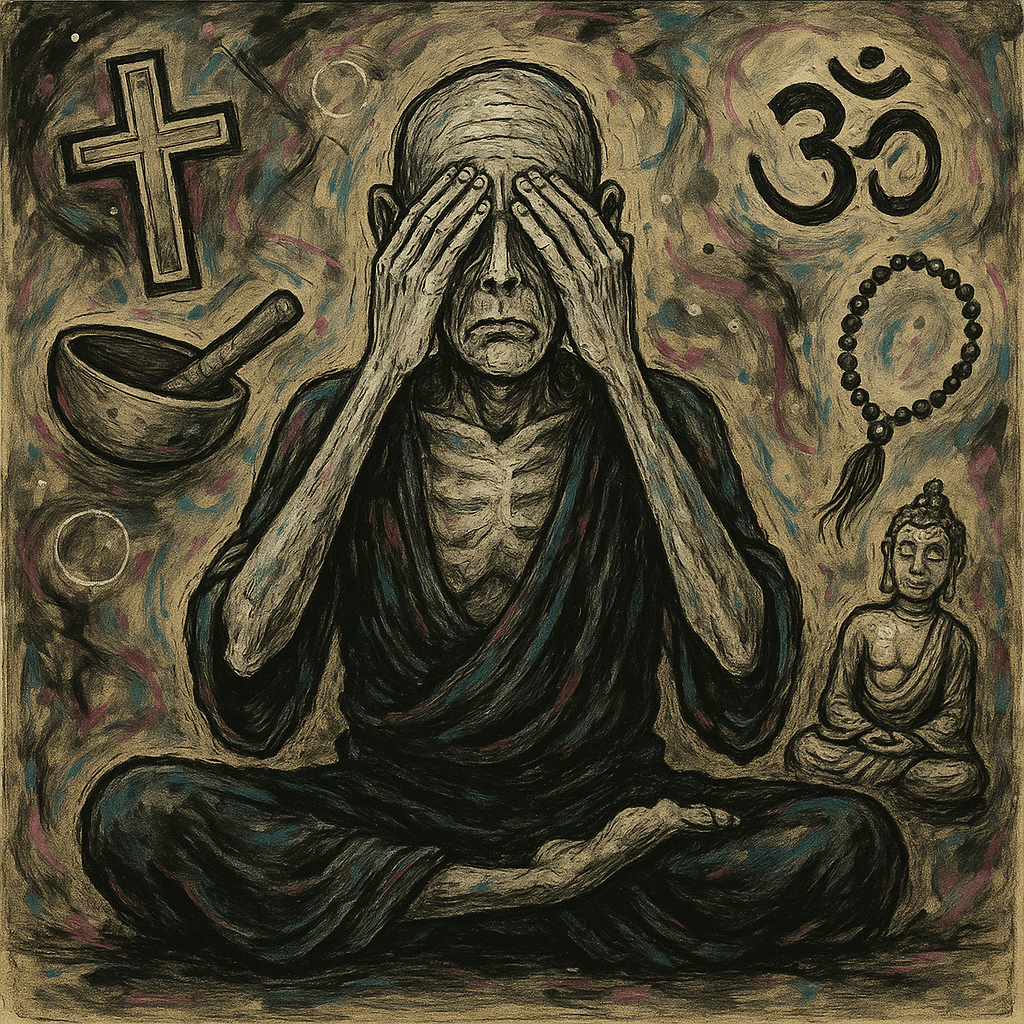
Liberate Yourself from Everything…

This Includes Spirituality

What if even the sacred must be left behind?

Not discarded with resentment, but dissolved with reverence—like incense that’s burned its final curl into still air. Every pursuit, no matter how noble or transcendent, clings to a subtle promise. It whispers, “Just a little further. Just a little more.” Spirituality—the path of paths—can become the gilded cage.

This isn’t a rejection of the sacred. It’s a call to recognize its shadow. When devotion becomes identity, and awakening becomes performance, the ground of true being quietly slips away. What remains is the effort of wearing a spiritual mask.

You meditate, fast, chant, and read the masters, and for a while, the momentum feels pure. But pause. Breathe. Look again.

Has the seeker been quietly resurrected each time insight arrives?

One of the final illusions is believing that freedom lies within the refinement of spiritual effort. Yet effort, no matter how subtle, arises within duality. There’s still a “me” reaching toward something else. Even the concept of enlightenment can act as a veil, because where there is something to reach, there remains something separate from what already is.

That’s the irony: the very thing that once cracked open your sense of reality may now be the weight tethering you to it.

There is no one to become. No final truth to grip. Liberation doesn’t crown the seeker—it dissolves them. It’s not what you attain through discipline. It’s what remains when every layer of becoming has been seen through.

God doesn’t need your spiritual journey.

Silence doesn’t demand your reverence.

Truth doesn’t require your understanding.

And being doesn’t wait for your arrival.

Strip it all away. Stand utterly exposed. Not as a soul, a student, or a sacred archetype—but as this unnamable presence you’ve never not been. This is where all paths terminate. Not with a bang. Not with celestial fireworks. But with a soft, undeniable recognition: nothing is missing. Nothing ever was.

To cling to spirituality, even subtly, is to delay this.

So let it all go—not to be less, but to finally see what you are without it.

Morgan O. Smith

Get Your Free Copy of My Book, Bodhi in the Brain!

https://subscribepage.io/oTSZQu

The Mirage of Paradise

Why Many Turn Away From the Path

Paradise often appears as a shimmering promise on the horizon—a space of unbroken peace, eternal joy, and infinite understanding. Yet, when the steps to reach it feel many, slow, or arduous, even the most sincere seekers may find themselves questioning the journey. Why does the promise lose its lustre when effort is required? Why do we often choose comfort over truth or familiarity over freedom?

The answer lies not in paradise but in our relationship with it.

The Illusion of Arrival

The mind, conditioned by a lifetime of instant gratification and linear progress, believes paradise must be attainable within a predictable framework. When the path to enlightenment stretches beyond its comfort zone, the mind rebels. It whispers doubts, offers shortcuts, or fabricates reasons to abandon the pursuit altogether.

Yet, true awakening does not follow a predictable roadmap. It cannot be squeezed into the limited constructs of time or effort. Enlightenment is not about arriving somewhere—it is about dissolving the illusion of the one who seeks. This is the paradox that discourages many: the realization that the paradise sought is not something to be reached but something to be uncovered within.

The Fear of Letting Go

Another reason many step away from the path is the fear of surrender. Enlightenment demands more than perseverance; it requires the complete letting go of the self we believe ourselves to be. For those deeply identified with their roles, beliefs, or desires, this can feel like annihilation. What lies beyond the familiar can seem less appealing than the comfort of staying as we are.

But surrender is not a loss; it is an opening. It is stepping into the unknown with trust and willingness, allowing paradise to reveal itself not as a destination but as the ever-present reality beneath all appearances.

Walking Without Steps

Paradise cannot be reached because it is not elsewhere. It is not at the end of many steps or behind layers of effort. Those who walk away often believe the steps are external—practices, rituals, or milestones to achieve. The truth is, that the steps are inward, subtle, and immediate. They require no distance travelled, only the courage to turn within and meet the present moment fully.

Each step dissolves the illusion that there is somewhere else to go. Each step reveals that paradise was never absent. The question is not whether enlightenment is too far but whether we are willing to abandon the belief that it lies anywhere but here.

Remaining Open to the Journey

For those who feel the pull to turn back, perhaps the greatest teaching is this: paradise is not reserved for those who walk a perfect path. It embraces even the wanderer, the doubter, and the one who stumbles. The journey is not about reaching paradise but about waking up to its presence at every turn.

Instead of asking how far we have to go, ask this: What illusions am I willing to release today? What layers of resistance, fear, or expectation can I dissolve now? Every step, no matter how small, is a step into paradise itself.

Morgan O. Smith

Yinnergy Meditation, Spiritual Life Coaching & My Book, Bodhi in the Brain…Available Now!

https://linktr.ee/morganosmith

Love as the Wildfire That Consumes All

Regardless of the situation or circumstance, love is the force that transforms. Allow it to spread like wildfire, engulfing everything in its path. Imagine every leaf of hate, every hardened trunk of resentment, and every twisted branch of fear ignited, consumed until only ash remains. The ash is not the end, but the beginning—a fertile soil for renewal, a space where new life can emerge, untouched by the old.

Hate feeds on division, growing thick like a forest of misunderstanding. Yet, fire—pure and unrelenting—brings everything to a singular state, where difference dissolves into unity. In the same way, love has the power to dismantle rigid identities and dissolve the illusions that separate us from others. When you love, you open yourself to the world without conditions. You stop trying to manage what is uncontrollable. You release the need to defend a fixed self and surrender to the flowing, infinite nature of life.

This kind of love requires courage. It demands the willingness to step into discomfort, embrace vulnerability, and face even the shadows within yourself. But as each branch of judgment burns, what is revealed is clarity—a vision unclouded by projection and bitterness. You begin to see the world not as a battleground but as a place of shared experience, where suffering and joy, growth and decay, are all part of the same unfolding.

When you allow love to spread, you release control over where it lands. It may touch those you least expect, and reach places long hidden from sight. It may even burn through your own assumptions about what love should look like. But that is its gift. Love, like wildfire, is indiscriminate—it cannot be contained by preference or limited by attachment. It moves with its own intelligence, revealing truths beyond what the mind can grasp.

In the aftermath, there is only stillness. The forest of illusions is reduced to ash, leaving behind the essence of what truly matters. From this stillness, new growth emerges—not the old recycled patterns of fear and separation but a fresh awareness grounded in presence and peace.

Let love be the fire that purifies and regenerates. Allow every layer of fear to ignite, every doubt to dissolve, and every sorrow to be consumed. Stand in the flames, trusting that what burns away is only what no longer serves. What remains, after all is said and done, is freedom.

Morgan O. Smith

Yinnergy Meditation, Spiritual Life Coaching & My Book, Bodhi in the Brain…Available Now!

https://linktr.ee/morganosmith

Unconditional Surrender

Embracing the Final Letting Go

Unconditional surrender is not simply about relinquishing control over circumstances, desires, or attachments. It goes beyond the surface. This form of surrender requires the release of the very concept of surrender itself. It demands a level of vulnerability so profound that even the notion of letting go must be let go.

What happens when there’s no longer anything to hold on to? Nothing to release? This is where true transformation begins. In this space, we step outside the dualistic framework of control versus surrender and touch something far deeper, a level of being where no effort or resistance exists. We are often conditioned to think that surrender means losing, giving up, or sacrificing. But unconditional surrender is not a loss—it is the full embrace of existence without the filters of ego, fear, or the need to manage outcomes.

When one stands in this openness, fully exposed and defenceless, something extraordinary happens. You come face to face with the reality of all that is. Without the mind’s endless chatter and strategies, there’s nothing left but the raw, unfiltered truth. And in that truth, you find freedom—not in the way we might imagine, but in a way that defies all prior understanding.

In the vulnerability of surrender, we experience what it means to exist without resistance, without striving, without seeking. It’s not about achieving some spiritual milestone or reaching a perfect state of being. Instead, it’s about dissolving the layers of defence we’ve built, trusting that whatever remains is exactly what was meant to be.

This path is not for the faint-hearted. It requires courage to step beyond the boundaries of the self and to let go of everything we’ve ever known. Yet, paradoxically, it is only through this act of ultimate surrender that we come to experience true liberation.

I would like to thank my colleague, Prakash, for mentioning Unconditional Surrender during our The Seekers Mind Clubhouse debate and for inspiring this piece.

Morgan O. Smith

Yinnergy Meditation, Spiritual Life Coaching & My Book, Bodhi in the Brain…Available Now!

https://linktr.ee/morganosmith

To Reach Beyond the Luminous

A Contemplation on Enlightenment and Distractions Along the Path

In our intrinsic pursuit of enlightenment, myriad entities, experiences, and spiritual phenomena often unveil themselves, presenting a paradoxical tapestry where understanding and distraction intertwine. When such entities or guides emerge along our path, they necessitate neither fixation nor rejection. For if they come, let them come, and if they decide to part, let them go. They are merely visitors, not permanent dwellers in our spiritual quest.

The venerable aphorism, “If you meet the Buddha on the road, kill him,” underscores the necessity of liberating ourselves from attachments and anticipated experiences in our spiritual pursuit. For, anything that becomes an object, a tangible or conceptual entity in our path, is not the ultimate truth. Therein, even the luminous light, an experience that many consider synonymous with spiritual ascension, is merely an objective reality, one that still exists within the domain of duality and separation.

The spiritual path unfurls itself as a journey where psychic powers, or Siddhis, may develop. If they do, they are not to be clung to. Enlightenment is neither a culmination nor an accumulation of powers or experiences, but a transcendence that paradoxically both surpasses yet includes all phenomena. It is an unceasing journey toward non-duality, where there is no seer, no seen, and no seeing – only a unified, unblemished consciousness that permeates all.

Phenomena, be they seemingly mundane or extraordinarily mystical, are to be acknowledged, witnessed, and permitted to drift away without attachment or aversion. They are waves on the surface of the ocean of consciousness, significant in their momentary existence, yet ultimately rejoining the vast, undulating expanse from whence they came.

Our ego becomes the most subtle, pervasive, and potentially pernicious impediment in this spiritual journey. It distorts, distracts, and sometimes destructs, coaxing us into traps that appear as enlightening experiences. The seductive allure of these experiences has ensnared many seekers, captivating them in a web that is woven from the threads of spiritual materialism.

The aspiration is not to annihilate the senses but to transcend and include them, to experience them in their fullest, most vibrant expressions, and yet remain unbound by them. It is to dive deep into the very essence of existence until all dichotomies, dualities, and senses converge into a singular, unified experience where distinctions cease, and all that remains is the unbounded, immeasurable expanse of Being.

Hence, the spiritual path might be perceived not as an endeavour of attaining or achieving, but as a continuous unfolding of letting go, a perpetual surrender. For in this surrender, we do not become devoid or nihilistic, but rather, we open ourselves to the entirety of existence, unshielded and unbounded.

All is a dream within the mind of God, and you, the dreamer, are no distinct from the dream you conjure, for at the ultimate level of who and what you are, is even beyond the luminous, beyond objectivity. To witness without becoming witnessed, to experience without becoming experienced – this is the path to enlightenment, where letting go is the ultimate embrace.

Morgan O.  Smith

Yinnergy Meditation & My Book, Bodhi in the Brain…Available Now!

https://linktr.ee/morganosmith