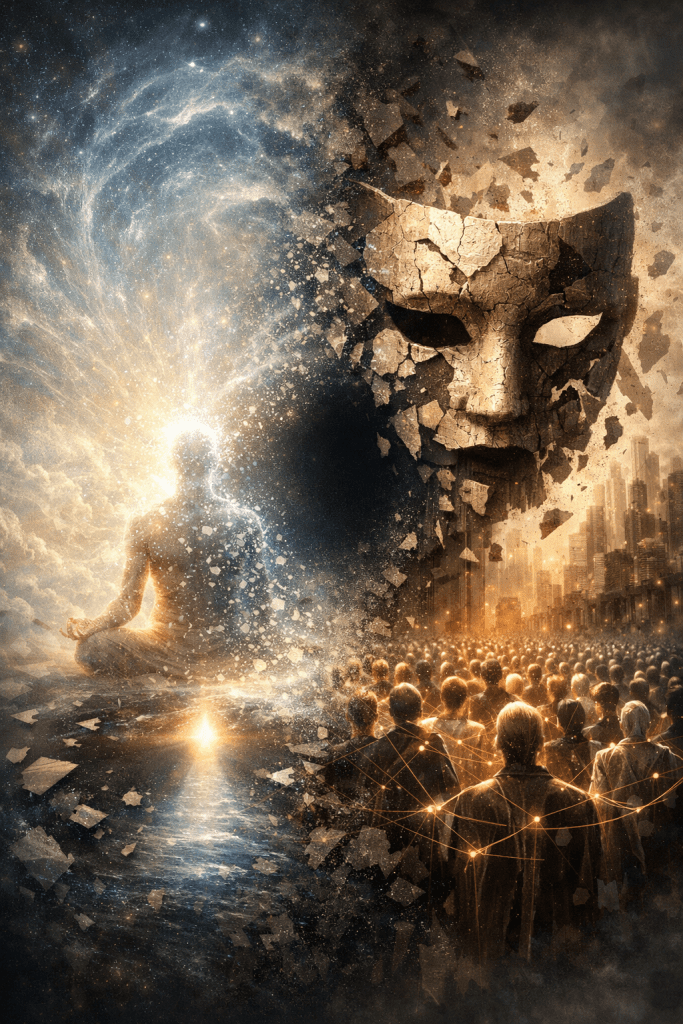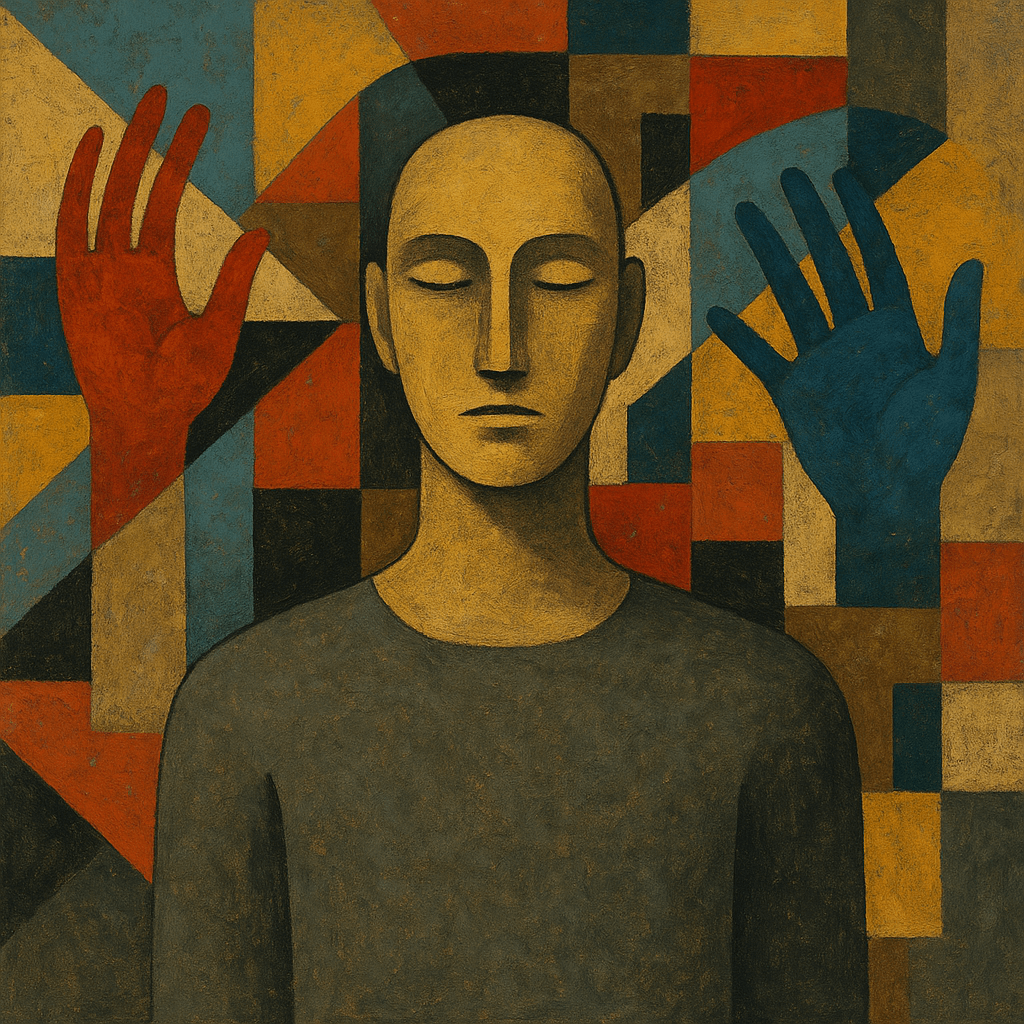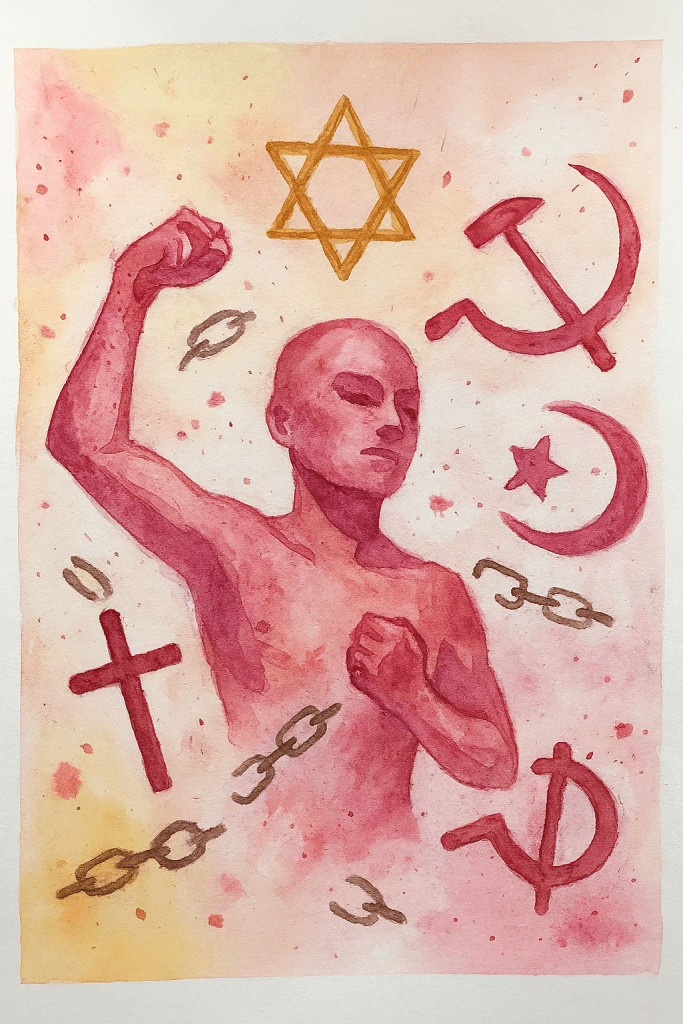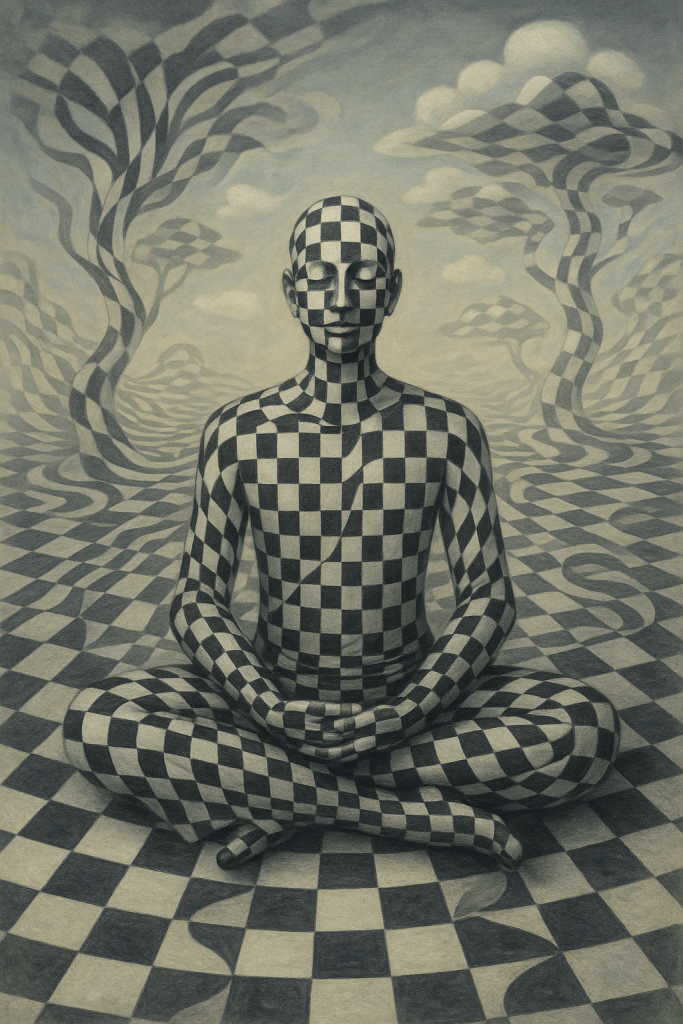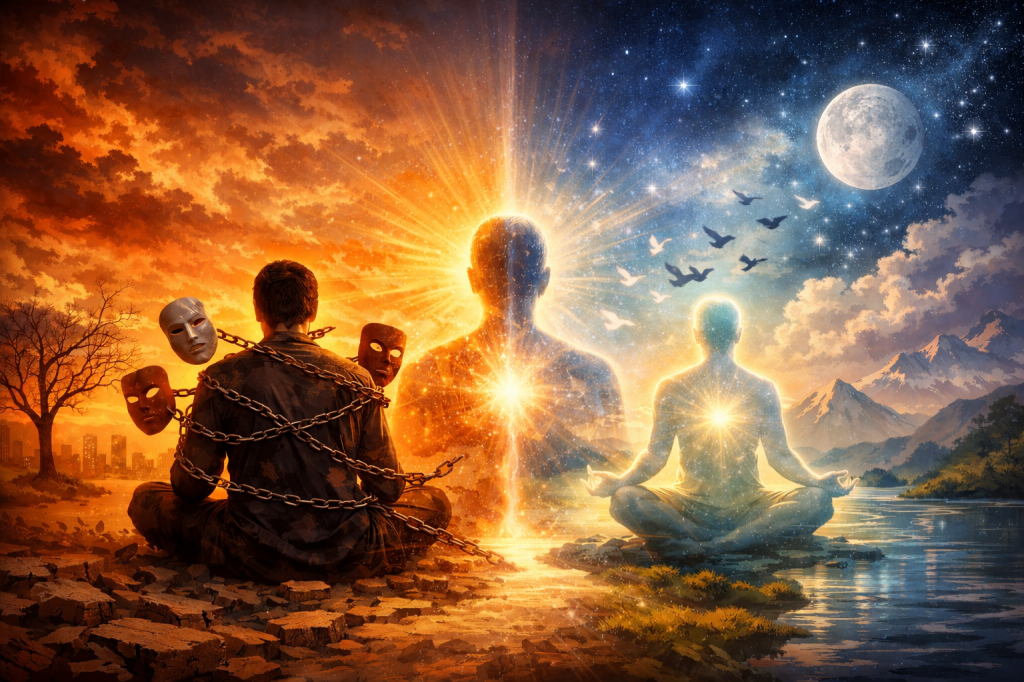
Awakening Never Arrives Because It Never Began

A seeker imagines a future moment where everything will break open, where clarity finally dissolves the boundaries that have shaped a lifetime. That imagined moment appears to sit somewhere ahead, waiting to be earned through discipline, suffering, or the slow maturation of wisdom. Yet the entire notion of “ahead” belongs to the dream of becoming. The one who waits is already suspended inside the very awareness they are longing for.

A deeper look reveals something far more radical: awakening does not unfold across time. It is not a culmination of choices, experiences, or lifetimes. It stands as the ground from which all choices, experiences, and lifetimes arise. What feels like progress toward realization is simply the awakened state appearing as movement, as if it were journeying toward itself while never leaving its own source.

Every universe, every branching possibility, every karmic ripple flows from that unshakable presence. No path leads to awakening because awakening generates the paths. A being may feel capable of choosing away from truth, yet that very sensation is part of truth expressing itself as forgetfulness. Even resistance is a shape taken by the same presence that cannot be diminished or delayed.

Karma does not carve a road toward liberation; karma is the motion of reality already awake, already whole. The cycle of birth and death functions as the dream’s choreography, giving consciousness a taste of separation so it can experience the beauty of returning to what never left. The sense of being “unfinished” is simply awareness folding into the appearance of incompleteness for the sake of its own exploration.

Awakening is not the goal of an individual, nor the endpoint of a soul’s journey. It is the condition that makes both individuality and journey possible. Meditation, inquiry, devotion, and hardship do not cause awakening; they are the movements of awakening playing as effort, yearning, and revelation. The river does not create the ocean; it is shaped by it.

From within the illusion of becoming, awakening looks inevitable. From the perspective of the absolute, inevitability is irrelevant because nothing ever fell out of the state it seeks to reclaim. Every lifetime is a reflection of that single truth refracted through time, space, karma, and choice.

Awakening is not the outcome of the cosmos.
Awakening is the reason the cosmos appears at all.

Morgan O. Smith

Get Your Free Copy of My Book, Bodhi in the Brain!

https://subscribepage.io/oTSZQu

The Disappearance of the Seeker

Meditation isn’t merely a technique; it is the gradual erasure of illusion. Every breath, every moment of stillness, dissolves another layer of pretense until what remains is not a person meditating, but consciousness aware of itself. Liberation is not gained; it is revealed when the striving ends. The self that once sought enlightenment discovers it was never apart from what it pursued.

The unfolding of awareness moves through countless thresholds. There are moments of clarity where boundaries soften, and the familiar sense of “I” loosens its grip. Some call these glimpses samādhi, nirvāṇa, or turiya. Beyond even these is turiyatīta, the unnameable state where all distinctions vanish. Subject and object collapse into one reality. The opposites that define existence, light and dark, life and death, God and creation, are seen as expressions of a single, seamless truth.

This realization does not occur through effort alone. For some, it arrives after years of disciplined practice. For others, it erupts without warning, as if eternity could no longer hide behind time. Yet whether noticed or not, this state is always present. Every being already lives as the infinite, experiencing the play of separation as though it were real.

To awaken is to stop pretending. To drop the mask of becoming and recognize the silent presence that has never moved. Once seen, life cannot return to its previous rhythm. Even the simplest act becomes sacred; a reflection of the whole living through itself. The journey ends where it began: in the undeniable truth that there was never a seeker, only the seeing itself.

Morgan O. Smith

Get Your Free Copy of My Book, Bodhi in the Brain!

https://subscribepage.io/oTSZQu

Beyond the Quadrants

The Letting Go That Lets Go of You

Awakening does not unfold through accumulation but through dissolution. It’s not about adding layers of understanding, but releasing the very framework that holds identity together. Every seeker begins with an “I”—the observer, the experiencer, the one who longs for freedom. Yet that same “I” must eventually surrender its throne.

The paradox lies here: the “I” must decide to release itself. It chooses to let go, though the one who chooses disappears in the act. This gesture is not driven by resistance or desire, but by recognition —an intuitive understanding that attachment to any quadrant is still a form of identification.

The quadrants—I, WE, IT, and ITs—map the totality of human experience: the inner self, the collective, the objective, and the systemic. Each serves a purpose until awakening calls for transcendence. The I is influenced by the ITs—the systems, structures, and conditions of existence. These shape perception and possibility. Through the IT, awareness ripples into the WE, inspiring collective movement. And as the WE shifts, the I is again transformed.

This endless loop of causation refines consciousness but never liberates it. Liberation comes when the loop itself is seen through. When the “I” no longer clings to the role of observer or doer, the quadrants collapse into pure witnessing. There is no longer an experiencer and the experienced, a subject and its object. What remains is unconditioned awareness; the silent axis upon which all quadrants turn.

Awakening, then, is not achieved through effort but through profound surrender. It is the cessation of grasping at identity within any domain—personal, relational, empirical, or systemic. The quadrants remain functional but no longer define reality. They appear and dissolve within the same stillness that has always been awake.

Morgan O. Smith

Get Your Free Copy of My Book, Bodhi in the Brain!

https://subscribepage.io/oTSZQu

Unmoved, Unbound

When You Aren’t Moved by Anything, You’re No Longer a Slave to Anything

The world thrives on pulling us in every direction. Advertisements whisper that happiness lies in the next purchase. Relationships stir waves of desire and fear. Success dangles like a prize that demands endless striving. Each movement within us, longing, anger, excitement, dread- becomes a hook by which the world tugs us.

Freedom arrives not when the world stops moving, but when your inner stillness no longer takes the bait. When nothing stirs you into attachment or aversion, nothing holds dominion over you. A compliment does not inflate your worth; an insult does not diminish it. Gain and loss, pleasure and pain, rise and fall without catching you in their undertow.

This is not numbness. It is not apathy. It is clarity. The heart continues to beat, the eyes continue to see, the hands continue to act, but no chain is forged by what passes through awareness. You walk unbound, as life’s play unfolds without demanding ownership.

When the winds of the world cannot sway you, you discover the ground beneath all experience; the silent witness that was never captive to circumstance. To live from here is to live without fear of being moved, for you have already found what cannot be taken.

Morgan O. Smith

Get Your Free Copy of My Book, Bodhi in the Brain!

https://subscribepage.io/oTSZQu

The Root of Choice

True Free Will and the Causal Realm

Most speak of choice as if it lives at the surface, where preference, fear, habit, and desire jostle for control. But what if true free will does not arise there at all? What if it exists at the root, before thought forms into options, before “I want” emerges to justify itself?

This root is the causal realm: the source of all motion, where intention is not split from manifestation. It is not personal will in the usual sense—no ego negotiating with life to get what it wants. Instead, it is pure causality aware of itself, setting everything in motion without conflict or division.

At the surface, people speak of freedom as the power to choose between alternatives. Yet these alternatives are already conditioned. They are branches of a tree whose root has already determined their growth. To speak of freedom at the stem while ignoring the root is to mistake effect for cause.

However, the paradox reveals itself when one sees no real division between root and stem. The freedom to choose at the surface becomes genuine only when it is recognized as the expression of the root itself. Every choice becomes the revelation of causality. There is no separate chooser apart from the choosing.

This is what lies beyond the ego’s belief in control. The ego claims “I choose” without realizing that its very claim is already part of the causality it denies. True free will is not the assertion of control over life but the recognition that you are life itself choosing, moving, unfolding.

To see this is to dissolve the illusion of separation. Responsibility is no longer a burden but realization: the root chooses through you, as you. There is no conflict left. Choice becomes transparent, ego falls away, and causality shines unbroken.

This is freedom—not as license, not as negotiation, but as total alignment with the source of all that arises.

Morgan O. Smith

Get Your Free Copy of My Book, Bodhi in the Brain!

https://subscribepage.io/oTSZQu

My Religion Is Liberation

Religion need not be a creed one defends or a ritual one performs. For some of us, it is the recognition of the bars we forge around our own minds—and the relentless devotion to dissolving them. Liberation becomes both the path and the sanctuary.

This isn’t about conversion, salvation, or belonging to any particular sect. It is about noticing the prison of belief itself. Every concept, every identity, every longing for certainty can become a gatekeeper denying entry to our own boundless nature.

Liberation demands a fierce honesty. It asks that we examine the illusions that hold our suffering in place, not as moral failings but as invitations to see through the lie of separation. The true heresy in this religion is clinging to what we think we know about ourselves, about others, about reality itself.

No priest is needed here. Authority resides in awareness, and awareness has no master. The teacher is the arising of life as it is—grief, joy, confusion, clarity. Each moment grants a new chance to recognize the play of experience without getting caught in it.

Liberation is not found by rejecting the world but by perceiving its emptiness and fullness simultaneously. Every object, thought, and sensation is free of substance even as it shines in unmistakable vividness. This paradox isn’t a puzzle to solve but a doorway to live through.

When liberation is the religion, love ceases to be a commandment and becomes the ground of being. Judgment collapses, not because everything is permitted, but because everything is understood as oneself. The compulsion to divide the sacred from the profane, the pure from the impure, loses its grip.

Such a path offers no final doctrine. It holds no promise of eternal reward. Yet it is more generous than any creed that trades truth for comfort. It is the faith of those willing to die before death—to watch every cherished certainty burn so that what cannot be burned may reveal itself.

Those who walk this path do so alone, yet never apart.

Morgan O. Smith

Get Your Free Copy of My Book, Bodhi in the Brain!

https://subscribepage.io/oTSZQu

The Game of Black & White

How You Play the Game of Black & White Reveals Your Level of Spiritual Maturity

He doesn’t avoid the black squares. He just stops thinking they’re cursed.

You can tell how spiritually mature someone is by how they engage with contrast—not by how they escape it. The game of black and white is always being played. Light falls beside shadow, certainty walks with doubt, and gain is never far from loss. But while most are trying to land only on the white tiles, the one who has seen beyond duality walks freely across the whole board.

Spiritual growth doesn’t mean becoming invulnerable to darkness; it means seeing the darkness without contracting around it. A child in awareness recoils from discomfort and seeks the promise of the ‘light.’ A grown soul knows that neither is final, and neither needs to be resisted. The black square isn’t a punishment. The white square isn’t a reward. They are moves in the same dance.

The one who awakens learns to stop chasing symmetry. No longer obsessed with winning, they realize it was never about domination of light over dark, nor rising above contradiction. It was about presence through all of it. About meeting each moment with equanimity, whether wrapped in sorrow or shining in joy.

Some play to avoid pain. Others play to seek pleasure. But the wise one plays to see. And seeing, they cease to play as a someone at all.

They simply move.

Morgan O. Smith

Get Your Free Copy of My Book, Bodhi in the Brain!

https://subscribepage.io/oTSZQu

Liberate Yourself from Everything…

This Includes Spirituality

What if even the sacred must be left behind?

Not discarded with resentment, but dissolved with reverence—like incense that’s burned its final curl into still air. Every pursuit, no matter how noble or transcendent, clings to a subtle promise. It whispers, “Just a little further. Just a little more.” Spirituality—the path of paths—can become the gilded cage.

This isn’t a rejection of the sacred. It’s a call to recognize its shadow. When devotion becomes identity, and awakening becomes performance, the ground of true being quietly slips away. What remains is the effort of wearing a spiritual mask.

You meditate, fast, chant, and read the masters, and for a while, the momentum feels pure. But pause. Breathe. Look again.

Has the seeker been quietly resurrected each time insight arrives?

One of the final illusions is believing that freedom lies within the refinement of spiritual effort. Yet effort, no matter how subtle, arises within duality. There’s still a “me” reaching toward something else. Even the concept of enlightenment can act as a veil, because where there is something to reach, there remains something separate from what already is.

That’s the irony: the very thing that once cracked open your sense of reality may now be the weight tethering you to it.

There is no one to become. No final truth to grip. Liberation doesn’t crown the seeker—it dissolves them. It’s not what you attain through discipline. It’s what remains when every layer of becoming has been seen through.

God doesn’t need your spiritual journey.

Silence doesn’t demand your reverence.

Truth doesn’t require your understanding.

And being doesn’t wait for your arrival.

Strip it all away. Stand utterly exposed. Not as a soul, a student, or a sacred archetype—but as this unnamable presence you’ve never not been. This is where all paths terminate. Not with a bang. Not with celestial fireworks. But with a soft, undeniable recognition: nothing is missing. Nothing ever was.

To cling to spirituality, even subtly, is to delay this.

So let it all go—not to be less, but to finally see what you are without it.

Morgan O. Smith

Get Your Free Copy of My Book, Bodhi in the Brain!

https://subscribepage.io/oTSZQu

The Uninvited Companion

How We Cling to Chaos

Suffering is rarely an accident. More often than not, it is a story we tell ourselves, a rhythm we move to, unaware that we are both the dancer and the drum. There is a peculiar comfort in chaos—a familiarity that keeps it tethered to us like an old friend who never truly leaves.

The mind, ever seeking stimulation, crafts elaborate illusions of hardship and unrest, convincing itself that turmoil is necessary. It fabricates conflicts, fuels attachments, and calls it all a search for meaning. This internal theatre of suffering is neither fate nor misfortune; it is the work of our own hands.

Why do we let it persist? Perhaps because it gives us something to hold onto. Something that, despite its weight, feels more certain than the unknown silence beyond it. We surrender to the turbulence, believing it will resolve itself, unaware that it thrives only because we continue to feed it.

Yet, beneath the noise, another possibility waits. A reality untouched by the chaos we’ve grown so accustomed to. To step into it requires nothing but the willingness to recognize that suffering is not a necessary companion—it is a guest we’ve entertained for far too long.

Morgan O. Smith

Yinnergy Meditation/Neurofeedback, Spiritual Life Coaching & My Book, Bodhi in the Brain…Available Now!

https://linktr.ee/morganosmith

The Illusion of Liberation

Phenomena arise, unfold, and dissolve, yet the mind grasps at them, seeking meaning through the lens of interpretation. This act of interpretation is inevitable, but the depth at which one engages with it determines whether understanding remains bound to illusion or expands into realization.

The mythical-magical stage of consciousness perceives reality through archetypes of power, divine will, and cosmic law. This stage gives birth to beliefs about cycles, reincarnation, and karmic loops—explanations that serve as scaffolding for those navigating the existential unknown. There is some truth to these interpretations, just as there is truth in every story we tell ourselves about existence. But truth is not confined to a single stage of development. It unfolds, revealing deeper nuances as perception matures.

Samsara—the wheel of birth, death, and rebirth—has been described as a prison. The path to liberation, as outlined in various traditions, involves transcending this cycle, attaining nirvana or moksha, where rebirth ceases. But even this is an interpretation, one that arises from a more advanced vantage point. The paradox is that what appears as bondage and liberation are not separate realities. Samsara and nirvana are not two. They are the same movement seen through different eyes.

No one is bound, and no one is freed. The concept of liberation implies that something was ever trapped. Yet, what is there to escape when there has never been confinement? The idea of imprisonment is a mind construct, just as freedom is. They depend on one another, forming a duality that collapses upon close inspection.

You are creation itself. Yet, nothing is truly being created. It only appears so. The dance of form and emptiness continues, yet nothing moves. This is the great paradox. The illusion is not that samsara exists—it does, just as dreams exist while sleeping. The illusion is believing that it is something to escape.

Awakening is not an arrival but the recognition that there was never a journey. The cycle persists for those who perceive cycles. Freedom exists for those who perceive bondage. But beyond perception, beyond conceptual grasping, there is only this—eternal, unchanging, and free, regardless of whether one calls it samsara or nirvana.

Morgan O. Smith

Yinnergy Meditation/Neurofeedback, Spiritual Life Coaching & My Book, Bodhi in the Brain…Available Now!

https://linktr.ee/morganosmith