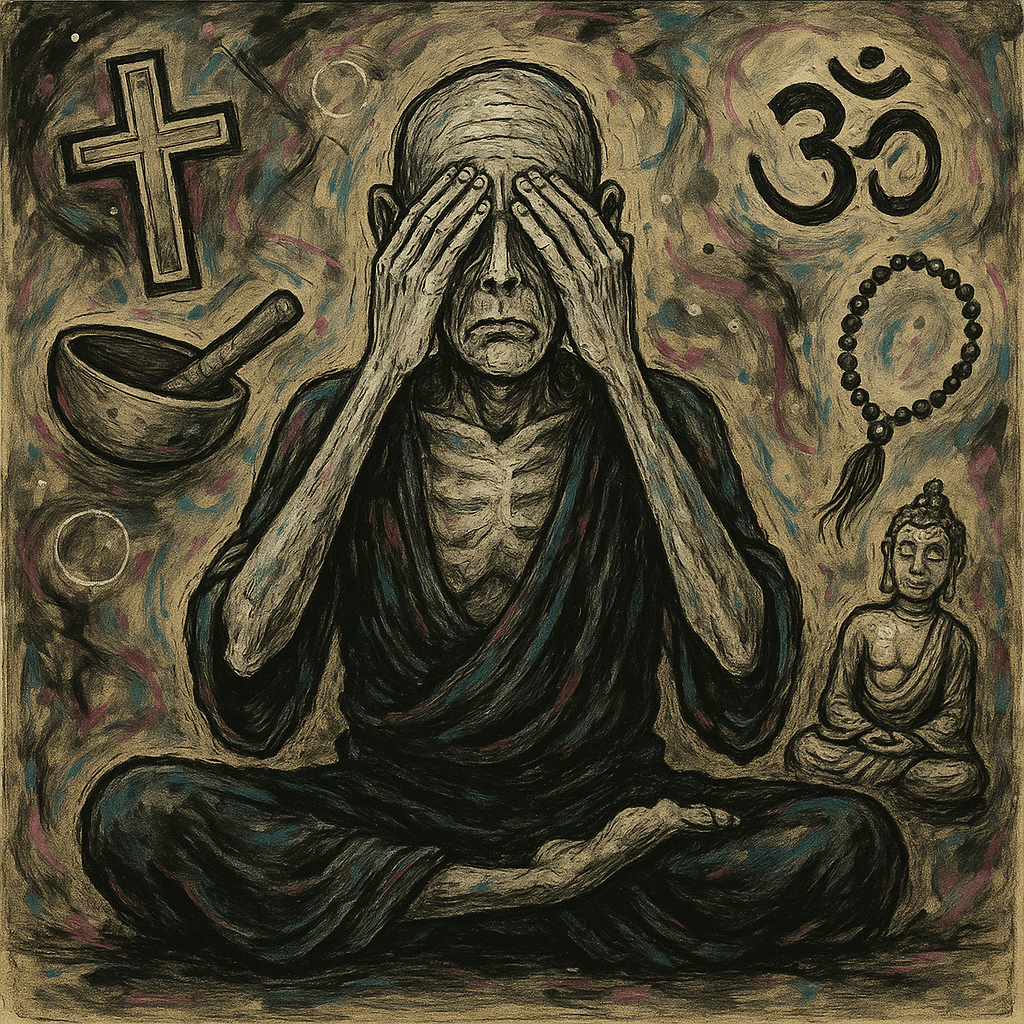
The Birth and Death of Inner Universes

A Perspective on Spiritual Awakening

Spiritual awakening is not merely a personal transformation; it is an intimate cosmic event. Each moment of awakening dismantles the boundaries of identity and creates a vast, living expanse within. This unfolding is as paradoxical as it is profound—a universe arises within, brimming with potential, only to dissolve as swiftly as it appeared.

The creation of this inner cosmos mirrors the nature of existence itself. A moment arises where the self perceives its infinite nature, birthing dimensions of awareness that feel eternal. This universe, however, does not exist to linger. It serves a purpose: to illuminate, to expand, and ultimately to dissolve back into the nothingness from which it came.

Such a process reveals a truth that eludes language. What is born within us during these moments is not separate from what is destroyed. The arising and vanishing are inseparable aspects of the same eternal dance. Within this rhythm, one discovers the impermanence of form and the timeless essence of being.

This creation and destruction shatter attachments to identity, beliefs, and the false security of permanence. It is not an annihilation to fear, but a liberation to embrace. As the mind relinquishes its grip, awareness expands, offering a glimpse into a state where nothing and everything coexist seamlessly.

The universe within is both an expression of the infinite and a reflection of the impermanent. It reminds us that awakening is not a destination but an ever-unfolding realization. Each birth and death within brings clarity to the timeless truth that all is interconnected, arising and subsiding within the boundless field of consciousness.

This experience shifts perception, encouraging a life lived with greater ease, grace, and compassion. As one awakens to the cyclical nature of inner universes, the external world begins to reflect this understanding. The mundane becomes sacred, the transient becomes meaningful, and the self becomes a vessel for the infinite.

Morgan O. Smith

Yinnergy Meditation, Spiritual Life Coaching & My Book, Bodhi in the Brain…Available Now!

https://linktr.ee/morganosmith

The Mind is Samsara

Liberation Through Freedom From Thought

(Inspired by Delson Armstrong)

To grasp the nature of samsara, one must look no further than the ever-turning wheel of the mind. Thoughts arise and dissolve ceaselessly—ideas, beliefs, fears, and anticipations weaving an endless narrative. Each moment feels distinct, yet they are all threads of the same cyclical pattern. This mental turbulence is the very fabric of samsara, the cycle of birth, death, and rebirth experienced not only across lifetimes but also within the subtle rhythms of the mind.

Samsara is not a place. It is the identification with thought itself. Every belief we cling to, every concept we hold sacred, every doubt that gnaws at our certainty—these perpetuate the illusion of separateness. The mind clings to forms, seeking permanence in the impermanent, building castles on clouds. Yet each construction inevitably crumbles, and the cycle begins anew.

Nirvana, often misinterpreted as a distant goal, is not found outside this moment. It is recognizing what remains when all that is transient falls away. Freedom arises not through force or suppression but by witnessing the mind’s movements without becoming entangled. The arising and dissolving of thoughts are no longer resisted; they are observed as passing clouds in the vast sky of awareness.

This realization does not destroy the mind but recontextualizes it. Thoughts may continue to arise, but they no longer hold the power to bind. The very root of suffering—attachment to the mind’s constructs—is severed. What remains is pure Being, an effortless silence that neither clings to birth nor fears death.

To step off the wheel of samsara is to recognize that you were never bound. The liberation of nirvana is not an escape but a profound shift in perspective: to see thoughts for what they are—fleeting phenomena—and rest in the unchanging awareness that witnesses them.

The mind is samsara. Freedom lies not in battling it, but in transcending it through direct experience of your timeless nature.

Morgan O. Smith

Yinnergy Meditation, Spiritual Life Coaching & My Book, Bodhi in the Brain…Available Now!

https://linktr.ee/morganosmith

The Ultimate Love

The Force That Transcends All Boundaries

Love’s true essence is beyond comprehension, an omnipresent force so profound it erases the illusion of separation. It moves in dimensions beyond moral constructs, ideology, and identity. When fully realized, this love obliterates the ego and opens the heart so that even the most hardened souls cannot resist its call.

The human mind craves order, labelling people into categories—good, evil, victim, perpetrator. But ultimate love doesn’t comply with these distinctions. It meets each being at the core of their essence, beneath the conditioning and trauma that have shaped their actions. This kind of love can dismantle even the most fortified belief systems.

Imagine the inner world of someone consumed by hatred, caught in the web of fear, anger, and dogma. The walls around their heart seem impenetrable, yet ultimate love does not storm these walls; it dissolves them. It renders resistance futile by revealing what has been buried deep inside—a longing to belong, to be seen, and to be held in a space beyond judgment.

Ultimate love does not negotiate with the mind. It penetrates through the layers of identity, be it the identity of a saint or a sinner, revealing the same radiant essence beneath all masks. It leaves no room for pretense. This love cannot be owned, managed, or bargained with; it simply is.

Consider the most unimaginable scenario—a person shaped by the horrors of hatred, such as a Nazi, encountering the force of unconditional love. It is not a love that justifies or condones but one that sees beyond. That person’s history, belief system, and ideology would crumble under the weight of such grace. All that remains is a naked heart, laid bare in the presence of a force so magnificent it demands surrender. Not as punishment, but as liberation.

This love does not require forgiveness. It transcends it. Forgiveness suggests wrongdoing, but ultimate love offers a view where the need for forgiveness dissolves, revealing the underlying unity where all things are reconciled. When this love is encountered, tears flow not from shame, but from the relief of being released from the prison of the mind’s narratives.

This is the love that brings anyone, no matter how lost, to their knees—not out of fear, but in awe. It’s the moment when everything false melts away, and only the truth remains: the realization that there has never been separation, and love was the ground of all existence all along.

Ultimate love is not just the absence of hate; it is the luminous presence that absorbs even the darkest shadow, rendering it irrelevant. It is the undeniable force that brings every soul back to where it has always belonged—home.

Morgan O. Smith

Yinnergy Meditation, Spiritual Life Coaching & My Book, Bodhi in the Brain…Available Now!

https://linktr.ee/morganosmith

The Boundless Landscape of Enlightenment

Embracing the All-Encompassing

In the realm of spiritual awakening, a profound truth emerges – all that exists is Enlightenment. This is not a destination but a pervasive state, characterized by complete understanding, absolute awareness, and unbounded liberation. It is a state of being that transcends conventional notions of existence and non-existence, merging the observer and the observed into a singular, seamless experience.

Enlightenment, in its purest essence, is liberation in its most unadulterated form. It is freedom from the shackles of limited perception, a transcendence beyond the ordinary confines of human experience. In this state of boundless liberation, the universe reveals its most paradoxical yet fundamental nature: the power to experience everything, including its seeming opposite.

The absolute nature of Enlightenment mandates its inclusivity. It is not selective, nor does it discriminate. It encompasses the entirety of existence and nonexistence, embracing all dualities, contradictions, and paradoxes. It is in this vast inclusiveness that the true nature of Enlightenment is realized – it is not a selective state of blissful ignorance, but an all-encompassing awareness that integrates every aspect of reality.


In this journey toward Enlightenment, we discover that it is not a static state to be achieved; it is a dynamic process of becoming. It is about recognizing and embracing the fluidity of existence, where every moment is an opportunity to experience the totality of life in its myriad forms. This realization brings with it a profound sense of peace and an understanding of the interconnectedness of all things.

Enlightenment, therefore, is not an escape from reality but an intimate engagement with it. It invites us to dive deeply into the fabric of life, to explore its infinite possibilities, and to acknowledge the presence of the divine in every aspect of existence. It challenges us to live fully, embrace each moment with awareness and compassion, and recognize the unity that underlies the world’s diversity.


In conclusion, the path to Enlightenment is a journey of embracing the absolute. It is about recognizing that all there is, is Enlightenment – a state of total comprehension, awareness, and liberation that includes everything and excludes nothing.

Morgan O. Smith

Yinnergy Meditation, Spiritual Life Coaching & My Book, Bodhi in the Brain…Available Now!

https://linktr.ee/morganosmith

The Divine Dance of Non-Attachment

A Journey Beyond Self

In the quietude that envelops the soul’s journey, there lies a profound realization, a moment that transcends the confines of the self and ushers us into the boundless realm of non-attachment. This is not merely an act of letting go but a sublime embrace of a state of being where one is liberated from every iota of personal existence. It is a passage through the eye of the needle, where the constructs of selfishness that bind the cells of our being dissolve into the ether, revealing the essence of our true nature.

This selfishness, a primal force that ensures our survival, becomes the very shackle we must transcend to experience the oneness of the universe. It is the adhesive that moulds our sense of individuality, carving out a distinct self from the universal continuum. Yet, it is within this self-love, this instinct for preservation, that the seeds of separation are sown. And from these seeds sprout the illusion of duality—the belief in a self apart from the rest.

The decision to let go, to relinquish the grip on this ephemeral identity, is both a death and a rebirth. It is the shedding of old skin, not in rejection of existence, but as an offering to the infinite dance of life. In this sacred act of surrender, one does not disappear but merges into the fabric of everything, becoming indistinguishable from the cosmos itself. This is the essence of non-attachment: the realization that in letting go of what we are, we become what we always were—boundless, timeless, infinite.


This experience of becoming no-thing is not an annihilation but an expansion into all. It is to stand at the heart of existence and see with clear eyes that there is no ‘other,’ no separation between the self and the universe. It is to understand that the individual story we cling to is but a drop in the vast ocean of consciousness, significant not for its separateness but for its part in the whole.

At the pinnacle of non-attachment, we encounter a paradox: in surrendering the idea of life as something to be clutched with desperate hands, we discover true life. This is not a life bounded by the narrow confines of personal gain or loss but a life that flows with the unbounded rhythm of existence itself. It is a state of being that nourishes all creation, not from a place of selfish intent but from the profound realization of our interconnectedness.


In this divine state, we find ourselves not by looking inward but by dissolving into the vastness of everything. We become a mirror reflecting the infinite, a conduit for the universal energy that animates all life. This is the ultimate freedom, the liberation from the self-imposed prison of identity. Here, in the embrace of non-attachment, we come home to our true selves—not as separate entities struggling against the tide of existence but as integral threads woven into the fabric of all that is.

Morgan O. Smith

Yinnergy Meditation, Spiritual Life Coaching & My Book, Bodhi in the Brain…Available Now!

https://linktr.ee/morganosmith

Understanding Spiritual Enlightenment and Nirvana

A Journey Beyond Words

The quest for spiritual enlightenment is a journey that transcends mere words and enters the realm of profound inner transformation. In the West, enlightenment is often equated with a comprehensive understanding of one’s true nature. This interpretation focuses on the illumination of the self, its intricacies, and its connection to the larger universe. It’s a state of comprehension, where the veils of ignorance are lifted, revealing the true essence of being.

In Eastern traditions, particularly Buddhism and Advaita Vedanta, enlightenment takes on a different hue. Here, it’s synonymous with Nirvana or Moksha – the liberation from the endless cycle of birth, death, and rebirth, known as samsara. This liberation is not just an intellectual understanding but a profound realization that leads to the dissolution of the self. In Buddhism, this is conceptualized as Anatta or no-self, a realization that the self is an illusion and liberation lies in transcending it.


Similarly, in Hinduism, Moksha aligns with the concept of Brahman – the ultimate reality or universal self. While seemingly different, both Nirvana and Moksha converge on the same endpoint: liberation from all forms of suffering and the cycle of samsara.

However, there’s a subtle yet significant distinction to be made. One can achieve spiritual enlightenment – a deep comprehension of their nature and the nature of reality – yet still be bound by the chains of samsara. It’s a state of awakening, an important step on the path, but not the culmination. True liberation, as seen in the concepts of Nirvana and Moksha, involves not just comprehension but also a complete surrendering of the self, a realization of its illusory nature, and ultimately, liberation from the cycle of existence.


Thus, while spiritual enlightenment and Nirvana (or Moksha) are often used interchangeably, their meanings diverge significantly based on cultural and philosophical contexts. In the West, enlightenment is primarily about understanding, while in Eastern philosophies, it’s about liberation. Only when the facets of comprehension, surrendering, realization, and liberation are all present can we step beyond spiritual awakening into the realm of true spiritual enlightenment.

Morgan O. Smith

Yinnergy Meditation, Spiritual Life Coaching & My Book, Bodhi in the Brain…Available Now!

https://linktr.ee/morganosmith

Illumination of the Soul

Spiritual Enlightenment and Moksha

As seekers on the path of inner wisdom, we often encounter the concepts of spiritual enlightenment and moksha. Both are beacons that promise to guide us out of the darkness of ignorance, yet they are not the same.

Spiritual Enlightenment is a term that has found its roots in the West, heavily influenced by the philosophies and meditative practices of the East. It implies an awakening to a reality that transcends our ordinary experience of self and the universe. The enlightened being sees the interconnectivity of all life, perceives the illusion of the ego, and often experiences profound peace and understanding of the present moment. It’s an expansive realization of consciousness, often accompanied by a deep compassion for all beings.

Moksha, on the other hand, is a Sanskrit word that originates from ancient Indian philosophy and is integral to spiritual traditions like Hinduism, Buddhism, and Jainism. Moksha goes beyond the realization of interconnectedness; it represents the ultimate release from the cycle of birth, death, and rebirth — the wheel of samsara. It is not merely an enlightenment of the mind but a liberation of the soul from the karmic ties that bind it to the physical plane.

The distinction lies in their ultimate goals and the pathways to reach them. Spiritual enlightenment is often seen as a milestone, a significant spiritual awakening that may happen time and again, deepening one’s insight and wisdom. Moksha, however, is the final destination — a state of eternal bliss and cessation of all suffering.

To consider enlightenment and moksha is to dance with the profound mysteries of existence. Are they two different peaks or simply different paths up the same mountain? Perhaps the journey is less about the distinctions and more about the profound transformation each individual undergoes in their quest for the ultimate truth.

In our modern age, where the material often overshadows the spiritual, revisiting these ancient concepts might offer a lens to reevaluate our lives purpose. Whether we seek enlightenment or moksha, the essence of our search is a testament to the human spirit’s unyielding quest for the absolute.

And so, we continue to explore, meditate, and live virtuously, with the hope that whether through enlightenment or moksha, we may all find our way to that which we most deeply yearn for — peace, understanding, and liberation.

Morgan O.  Smith

Yinnergy Meditation & My Book, Bodhi in the Brain…Available Now!

https://linktr.ee/morganosmith

The Luminous Path

Shaktipat and Darshan in the Quest for Enlightenment

In the rich tapestry of spiritual traditions, the concepts of Shaktipat and Darshan emerge as profound mechanisms of grace, each offering a unique conduit to the divine. These terms are often encountered in the lexicon of Indian spirituality, particularly within the paths of yoga and tantra, where the pursuit of enlightenment takes a form as varied as the seekers themselves.

Shaktipat, often translated as the “descent of grace,” is a spiritual act where a guru or enlightened master transmits spiritual energy to a seeker. This transmission can catalyze a profound transformation, initiating or deepening the spiritual awakening process. It is an act of unlocking, a key turned in the lock of latent spiritual potential, often without the necessity of the seeker’s understanding or effort. It is said to be a direct intervention by the divine through the guru, whereby the seeker’s energy is awakened and the journey towards self-realization is accelerated.

Conversely, Darshan translates to “sight” or “a glimpse” in Sanskrit. It refers to the auspicious seeing or beholding of a holy person, deity, or sacred object. Darshan is not merely a passive observation; it is an active engagement, a reciprocal act where the seer is seen, where the act of viewing is saturated with spiritual significance. In darshan, the barriers between the divine and the devotee dissolve in the act of sacred viewing, and it is in this mutual encounter that blessings are believed to flow.

While Shaktipat can be considered an active transmission of spiritual energy, Darshan is a more passive receipt of divine presence. Yet, both hold the common thread of divine grace as central to their efficacy. They differ not in their ultimate aim—liberation and enlightenment—but in their operation. Shaktipat is akin to the wind that stirs the still waters of a lake, while Darshan is like the sun that is reflected upon it.

In contemplating Shaktipat and Darshan, one realizes that they are not mere practices but experiences that lie at the heart of the mystical relationship between the individual and the absolute. They embody the dual aspects of the spiritual journey: Shaktipat represents the inner transformation through direct intervention, and Darshan symbolizes the outer reflection of the divine in the world.

Ultimately, both Shaktipat and Darshan remind us that enlightenment is not a solitary pursuit; it involves a profound interconnectedness with the divine and the world. They encourage the seeker to remain open to the myriad ways grace manifests and recognize that each moment holds the potential for a deeper awakening.

In the spiritual odyssey, Shaktipat and Darshan are not merely destinations or methods; they are living dialogues with the divine, where each seeker is both a witness and a participant in the eternal dance of consciousness. As we embrace the mystery and beauty of these encounters, we find ourselves woven into the very fabric of spiritual unfolding, a journey that is as unique as it is universal.

Morgan O.  Smith

Yinnergy Meditation & My Book, Bodhi in the Brain…Available Now!

https://linktr.ee/morganosmith

The Liberation in Letting Go

Emptiness, Ignorance, and Identity

In a world incessantly clamouring with the din of possession, certainty, and self-promotion, the mantra “Embracing emptiness, cherishing ignorance, surrendering identity” arrives like a whisper from another realm. It calls on us to consider the counterintuitive notion that there is profound freedom and wisdom to be found in the very things we are conditioned to avoid.

**Embracing Emptiness**

Emptiness often conjures a sense of lack, yet in many Eastern philosophies, it is a profound concept, pregnant with possibilities. To embrace emptiness is not to fall into the void, but rather to make space for the new, the unforeseen, the life-affirming. It is the fertile ground of being from which all things spring and to which they return. In the spaciousness of emptiness, we find the flexibility and resilience to move with life’s undulating rhythms.

**Cherishing Ignorance**

Cherishing ignorance may seem antithetical in our knowledge-driven society. However, this is not an advocacy for willful naivete, but a reverence for the acknowledgment of our limitations. Socrates’ declaration of wisdom beginning with the admission of one’s ignorance holds here. Cherishing our not-knowing is an invitation to perennial learning, to the humility that keeps the mind supple, and the heart open to the mystery that is existence.

**Surrendering Identity**

Our identities, the personas we cultivate and present to the world, are often elaborate constructs grounded in who we think we should be or who we want others to believe we are. To surrender this identity is to strip away the superfluous and encounter the authentic self, the self not defined by accolades or attributes, but existing in simple beingness. This surrender is not a loss but a homecoming, a release from the exhausting endeavour of upholding our masks.

In combining these three tenets—emptiness, ignorance, and identity—we approach a way of living that is at once liberating and grounding. It invites a life lived with open hands, where attachment is a choice rather than a compulsion, and authenticity guides our interactions.

As we contemplate this mantra, we might find ourselves stepping into a flow of existence that is less about accumulation and more about experience, less about certainty and more about exploration, less about being someone and more about being part of something greater.

The journey toward embracing this wisdom is counter-cultural. It moves against the grain of our societal norms, urging us to let go of what we cling to most tightly. Yet, the promise it holds is nothing short of transformational—freedom from the self-imposed prisons of material excess, intellectual rigidity, and egoic constraint.

In this space, we find that emptiness is fullness, ignorance is wisdom, and surrender is power. And so, we continue to explore, with hearts wide open to the vastness of the unknown.

Morgan O.  Smith

Yinnergy Meditation & My Book, Bodhi in the Brain…Available Now!

https://linktr.ee/morganosmith

Unveiling Divinity

A Whisper from the Abyss of Enlightenment

The inscrutable odyssey of a seeker ends at the altar of enlightenment, a realm where words stagger and concepts crumble, birthing an existence of boundless essence. It’s at this moment of spiritual enlightenment that a being enters a sphere of profound reality, touching the tapestry of the universe with a feather of transcendental wisdom. The essence of such a moment cannot be captured by mere words, yet we delve into articulating the aura of the ineffable enlightenment.

At the instant of enlightenment, the veil of duality is lifted and the inherent oneness of existence is realized. This unveiling is akin to a droplet finding its way back to the ocean, realizing its essence has always been part of the larger whole. This realization carries a boundless sense of fulfillment and completion, a harmonious ballet where the eternal dance of existence is experienced in its purest form.

The dichotomy of ego dissolves into the purity of being, transcending the shackles of identification and liberating the essence from the mere corporeal existence. This egolessness unfolds a reality where distinctions are obliterated and the quintessence of pure consciousness shines forth. The abstraction of perfection is experienced in the ordinariness of existence, portraying a canvas where every stroke, dark or bright, contributes to a masterpiece called Life.

A swell of profound empathy and compassion courses through the veins, and the heart beats to the rhythm of universal love, understanding the sufferings and joys of existence in its deepest layer. It’s here that the tear of joy trickles down, embodying the essence of divine love and the boundless openness of being. The feeling is paradoxical, it’s both an amalgamation into the vastness and a dive into the deepest core.

The experience of spiritual enlightenment is akin to a surprise, a shock, and a gentle whisper all at the same time. It’s the embodiment of paradoxes – emptiness and fullness, wonder and knowing, liberation and love. It’s a transcendence into a reality where the boundaries of comprehension extend beyond the horizon, into the realm of the infinite. The spiritual enlightenment is a state of pure existence, unadulterated by the conceptual mind, it’s a state of “suchness” – the true nature of being.

This journey from ignorance to enlightenment is a passage from bondage to freedom, from restlessness to stillness, seeking to finding, questioning to knowing. And yet, this knowing is not the end, but a beginning of living in an enlightened existence where every moment is a whisper from the abyss of the profound.

Morgan O.  Smith

Yinnergy Meditation & My Book, Bodhi in the Brain…Available Now!

https://linktr.ee/morganosmith