The Luminous Path

Shaktipat and Darshan in the Quest for Enlightenment

In the rich tapestry of spiritual traditions, the concepts of Shaktipat and Darshan emerge as profound mechanisms of grace, each offering a unique conduit to the divine. These terms are often encountered in the lexicon of Indian spirituality, particularly within the paths of yoga and tantra, where the pursuit of enlightenment takes a form as varied as the seekers themselves.

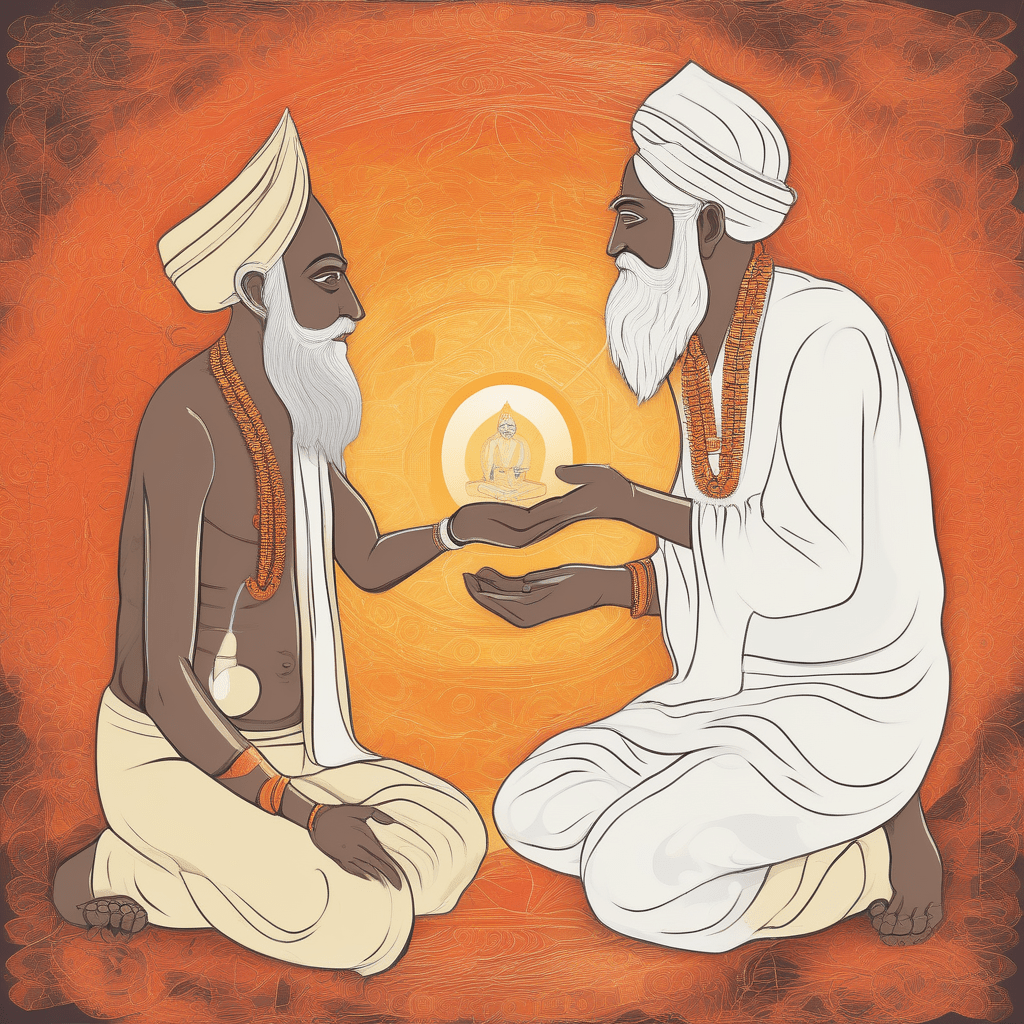
Shaktipat, often translated as the “descent of grace,” is a spiritual act where a guru or enlightened master transmits spiritual energy to a seeker. This transmission can catalyze a profound transformation, initiating or deepening the spiritual awakening process. It is an act of unlocking, a key turned in the lock of latent spiritual potential, often without the necessity of the seeker’s understanding or effort. It is said to be a direct intervention by the divine through the guru, whereby the seeker’s energy is awakened and the journey towards self-realization is accelerated.

Conversely, Darshan translates to “sight” or “a glimpse” in Sanskrit. It refers to the auspicious seeing or beholding of a holy person, deity, or sacred object. Darshan is not merely a passive observation; it is an active engagement, a reciprocal act where the seer is seen, where the act of viewing is saturated with spiritual significance. In darshan, the barriers between the divine and the devotee dissolve in the act of sacred viewing, and it is in this mutual encounter that blessings are believed to flow.

While Shaktipat can be considered an active transmission of spiritual energy, Darshan is a more passive receipt of divine presence. Yet, both hold the common thread of divine grace as central to their efficacy. They differ not in their ultimate aim—liberation and enlightenment—but in their operation. Shaktipat is akin to the wind that stirs the still waters of a lake, while Darshan is like the sun that is reflected upon it.

In contemplating Shaktipat and Darshan, one realizes that they are not mere practices but experiences that lie at the heart of the mystical relationship between the individual and the absolute. They embody the dual aspects of the spiritual journey: Shaktipat represents the inner transformation through direct intervention, and Darshan symbolizes the outer reflection of the divine in the world.

Ultimately, both Shaktipat and Darshan remind us that enlightenment is not a solitary pursuit; it involves a profound interconnectedness with the divine and the world. They encourage the seeker to remain open to the myriad ways grace manifests and recognize that each moment holds the potential for a deeper awakening.

In the spiritual odyssey, Shaktipat and Darshan are not merely destinations or methods; they are living dialogues with the divine, where each seeker is both a witness and a participant in the eternal dance of consciousness. As we embrace the mystery and beauty of these encounters, we find ourselves woven into the very fabric of spiritual unfolding, a journey that is as unique as it is universal.

Morgan O.  Smith

Yinnergy Meditation & My Book, Bodhi in the Brain…Available Now!

https://linktr.ee/morganosmith

The Liberation in Letting Go

Emptiness, Ignorance, and Identity

In a world incessantly clamouring with the din of possession, certainty, and self-promotion, the mantra “Embracing emptiness, cherishing ignorance, surrendering identity” arrives like a whisper from another realm. It calls on us to consider the counterintuitive notion that there is profound freedom and wisdom to be found in the very things we are conditioned to avoid.

**Embracing Emptiness**

Emptiness often conjures a sense of lack, yet in many Eastern philosophies, it is a profound concept, pregnant with possibilities. To embrace emptiness is not to fall into the void, but rather to make space for the new, the unforeseen, the life-affirming. It is the fertile ground of being from which all things spring and to which they return. In the spaciousness of emptiness, we find the flexibility and resilience to move with life’s undulating rhythms.

**Cherishing Ignorance**

Cherishing ignorance may seem antithetical in our knowledge-driven society. However, this is not an advocacy for willful naivete, but a reverence for the acknowledgment of our limitations. Socrates’ declaration of wisdom beginning with the admission of one’s ignorance holds here. Cherishing our not-knowing is an invitation to perennial learning, to the humility that keeps the mind supple, and the heart open to the mystery that is existence.

**Surrendering Identity**

Our identities, the personas we cultivate and present to the world, are often elaborate constructs grounded in who we think we should be or who we want others to believe we are. To surrender this identity is to strip away the superfluous and encounter the authentic self, the self not defined by accolades or attributes, but existing in simple beingness. This surrender is not a loss but a homecoming, a release from the exhausting endeavour of upholding our masks.

In combining these three tenets—emptiness, ignorance, and identity—we approach a way of living that is at once liberating and grounding. It invites a life lived with open hands, where attachment is a choice rather than a compulsion, and authenticity guides our interactions.

As we contemplate this mantra, we might find ourselves stepping into a flow of existence that is less about accumulation and more about experience, less about certainty and more about exploration, less about being someone and more about being part of something greater.

The journey toward embracing this wisdom is counter-cultural. It moves against the grain of our societal norms, urging us to let go of what we cling to most tightly. Yet, the promise it holds is nothing short of transformational—freedom from the self-imposed prisons of material excess, intellectual rigidity, and egoic constraint.

In this space, we find that emptiness is fullness, ignorance is wisdom, and surrender is power. And so, we continue to explore, with hearts wide open to the vastness of the unknown.

Morgan O.  Smith

Yinnergy Meditation & My Book, Bodhi in the Brain…Available Now!

https://linktr.ee/morganosmith

Unveiling Divinity

A Whisper from the Abyss of Enlightenment

The inscrutable odyssey of a seeker ends at the altar of enlightenment, a realm where words stagger and concepts crumble, birthing an existence of boundless essence. It’s at this moment of spiritual enlightenment that a being enters a sphere of profound reality, touching the tapestry of the universe with a feather of transcendental wisdom. The essence of such a moment cannot be captured by mere words, yet we delve into articulating the aura of the ineffable enlightenment.

At the instant of enlightenment, the veil of duality is lifted and the inherent oneness of existence is realized. This unveiling is akin to a droplet finding its way back to the ocean, realizing its essence has always been part of the larger whole. This realization carries a boundless sense of fulfillment and completion, a harmonious ballet where the eternal dance of existence is experienced in its purest form.

The dichotomy of ego dissolves into the purity of being, transcending the shackles of identification and liberating the essence from the mere corporeal existence. This egolessness unfolds a reality where distinctions are obliterated and the quintessence of pure consciousness shines forth. The abstraction of perfection is experienced in the ordinariness of existence, portraying a canvas where every stroke, dark or bright, contributes to a masterpiece called Life.

A swell of profound empathy and compassion courses through the veins, and the heart beats to the rhythm of universal love, understanding the sufferings and joys of existence in its deepest layer. It’s here that the tear of joy trickles down, embodying the essence of divine love and the boundless openness of being. The feeling is paradoxical, it’s both an amalgamation into the vastness and a dive into the deepest core.

The experience of spiritual enlightenment is akin to a surprise, a shock, and a gentle whisper all at the same time. It’s the embodiment of paradoxes – emptiness and fullness, wonder and knowing, liberation and love. It’s a transcendence into a reality where the boundaries of comprehension extend beyond the horizon, into the realm of the infinite. The spiritual enlightenment is a state of pure existence, unadulterated by the conceptual mind, it’s a state of “suchness” – the true nature of being.

This journey from ignorance to enlightenment is a passage from bondage to freedom, from restlessness to stillness, seeking to finding, questioning to knowing. And yet, this knowing is not the end, but a beginning of living in an enlightened existence where every moment is a whisper from the abyss of the profound.

Morgan O.  Smith

Yinnergy Meditation & My Book, Bodhi in the Brain…Available Now!

https://linktr.ee/morganosmith

Embracing the Abyss

An Exploration into the Ground of All Being

In the silence of our hearts, amidst the ceaseless chatter of our fears and desires, lies a profound mystery waiting to be discovered. This mystery, dear reader, is not something alien or external, but a journey inward to meet our most authentic selves. It is about unearthing the Ground of All Being, the core from which our existence emanates and upon which it rests. In the course of human history, many have named it differently—God, The Absolute, Consciousness, and so forth. However, this Ground of All Being is not a distant reality; it’s what we truly are. As articulated succinctly, our deepest fear is not of the unknown, but the known transcending into the realm of the unknown, a realm where words fall short and only experience speaks.

Your deepest fear is yourself. This statement, piercing in its simplicity, unveils the core of our existential dread. We fear what we might discover when all pretenses are shed, and we are left with the raw, unadulterated reality of our being. The question is, are we willing to face that fear, to delve into the abyss and allow it to unravel the boundless potential within?

Why do we shy away from understanding our true nature? It’s a paradox that the unknown we fear is already known, buried within the labyrinth of our being. It’s like a familiar tune, the lyrics of which we have forgotten, yet the melody stirs something deep within. It beckons us to listen, to be still, and in that stillness, the melody unfolds, freeing us from the shackles of ignorance and liberating the profound truths hidden within. This knowledge is not an accumulation but a realization, a moving from the periphery to the core, a journey from the ephemeral to the eternal.

We often seek solace in the external, hoping that objects, relationships, or achievements will fill the void within. However, true liberation and fulfillment lie in the exploration and understanding of our essential nature, the Ground of All Being. It’s about confronting fears, transcending superficial identities, and dissolving into the boundless, formless reality that we are.

It’s a venture into the heart of existence, an invitation to be fearlessly authentic. To step into this journey is to embrace the unknown, which is already known, and to unearth the beauty and magnificence of our true nature. So, pause and listen to that innermost call, for in the heart of fear lies the key to liberation.

Morgan O.  Smith

Yinnergy Meditation & My Book, Bodhi in the Brain…Available Now!

https://linktr.ee/morganosmith

The Illusion of Spiritual Identity

Beyond Stories We Tell Ourselves

Spirituality, at its core, is a profound journey toward understanding one’s place in the vast expanse of existence. However, in our attempt to grasp this elusive understanding, we often pigeonhole ourselves into labels: spiritual, materialistic, moral, and the like. But what if I were to suggest that these labels, these stories, are mere illusions? And that by clinging to them, we might be limiting our true potential.

#### **The Stories We Tell Ourselves**

Every culture, every religion, and every individual has a narrative. These narratives shape our beliefs, our actions, and the way we perceive the world. They are the tapestries upon which our identities are woven. But what happens when we deconstruct these tapestries? Beneath the intricate designs and patterns, what remains?

The reality is that these stories are our creations, shaped by societal norms, personal experiences, and myriad other factors. To say one is ‘spiritual’ or ‘materialistic’ is to adopt a particular perspective, a specific lens through which we view the world.

#### **The Ground of All Being**

But let’s delve deeper. Beneath these self-imposed labels and narratives, there lies a fundamental essence – often referred to as the ‘ground of all being’. This essence is the raw, unfiltered state of existence. It is what you are before the stories, before the labels, and before the definitions. It is the canvas upon which all our narratives are painted.

This ground of being is paradoxical. While it exists beyond all descriptors, it simultaneously encompasses them. Think of it as an ocean. The waves, currents, and whirlpools may differ in their nature and intensity, but they all arise from and subside back into the same vast expanse of water.

#### **Embracing the Beyond**

Realizing this fundamental truth can be liberating. When we understand that our spiritual or materialistic labels are mere waves upon the ocean of existence, we can learn to see beyond them. We can experience the world without the confines of our self-imposed narratives.

This doesn’t mean that one should abandon their spiritual practices or beliefs. Rather, it’s about recognizing them for what they are – beautiful expressions of the infinite variations of existence.

#### **Conclusion**

In the end, whether you consider yourself spiritual, materialistic, or anything in between, it’s crucial to remember that these are just facets of the grander jewel that is existence. By stepping back and seeing beyond our self-crafted stories, we can come closer to experiencing the profound depth of what we truly are.

Morgan O. Smith

Yinnergy Meditation & My Book, Bodhi in the Brain…Available Now!

https://linktr.ee/morganosmith

Exploring Spiritual Enlightenment

Unveiling the Essence of Being

Introduction:
In the realm of spirituality, few concepts captivate the human imagination as profoundly as spiritual enlightenment. It has been sought after, contemplated upon, and revered across cultures and traditions. At its core, spiritual enlightenment encompasses a holistic realization, knowing, comprehension, recognition, and liberation, leading to an intimate understanding of one’s essence as the Ground of all Being. In this thought-provoking blog, we embark on a journey to unravel the depths of spiritual enlightenment and explore its transformative power.

Realization: The Full Realization of What You Are as The Ground of All Being
The journey toward spiritual enlightenment begins with a profound realization—an awakening to the fundamental truth of one’s existence. It is an experiential revelation that transcends intellectual understanding, offering a direct encounter with the essence of reality. This realization unveils the interconnectedness of all existence and dissolves the boundaries that separate the self from the world.

Knowing: Knowing Who and What You Are as The Ground of All Being

Knowing, in the context of spiritual enlightenment, goes beyond intellectual knowledge or beliefs. It is a direct and intimate knowing of one’s true nature, beyond the ephemeral constructs of ego and identity. This knowing arises from experiential wisdom that transcends language and logic, revealing the profound interconnectedness of all life.

Comprehension: Comprehending What You Are as The Ground of All Being
Comprehension in spiritual enlightenment refers to a deep understanding that arises from the integration of realization and knowing. It involves grasping the inherent wisdom that pervades all existence and recognizing the underlying unity amidst the apparent diversity. This comprehension allows us to perceive the world through a lens of compassion, empathy, and interconnectedness.

Recognition: Recognizing What You Are as The Ground of All Being

Recognition entails a moment of profound insight where the illusory veils of separation and limitation fall away, revealing the truth of one’s being. It is a transformative recognition of our true nature as vast, boundless awareness, intimately interconnected with the entire cosmos. Through this recognition, we come to acknowledge the divinity that resides within ourselves and all beings.

Liberation: Being Liberated from Shape or Form, Free from Illusion and Attachments

Liberation represents the ultimate culmination of spiritual enlightenment—a state of profound freedom and liberation from the constraints of ego, attachment, and illusion. It is an experiential transcendence of the limited, conditioned self, allowing one to dwell in the realm of pure emptiness. Yet, paradoxically, this liberation is not a detachment from the world but a unification with it, as the awakened individual realizes their inseparability from the tapestry of existence.

Conclusion:
Spiritual enlightenment encompasses a multidimensional journey that surpasses the limitations of language and rationality. It is a profound exploration of the self and the universe, revealing our interconnectedness and inherent divinity. Through realization, knowing, comprehension, recognition, and liberation, we can embark on a transformative path that leads to a deeper understanding of our existence. By embracing the essence of spiritual enlightenment, we may find ourselves united with everything that is form while being liberated from the illusory constraints that bind us. May this exploration inspire you on your quest for self-discovery and awakening to the timeless truth of the Ground of all Being.

Morgan O. Smith

Yinnergy Meditation & My Book, Bodhi in the Brain…Available Now!
Meditative Practices and the Illusory Nature of the False Self

A Journey Towards Self-Realization

Introduction:
Meditative practices have long been revered as transformative tools in the realm of self-discovery and spiritual growth. They offer a profound pathway for individuals to explore the depths of their consciousness, seeking truth, peace, and liberation. However, beneath the surface lies a fascinating paradox—the false self, which appears as the practitioner, ultimately leads to the revelation of the Ultimate Self, the Ground of All Being.

The Illusion of the False Self:
Within the tapestry of various spiritual traditions, the notion of the false self arises—a deceptive construct born out of our attachments to external roles, labels, and conditioned beliefs. This illusory identity emerges from our tendency to assign significance to transient aspects of our existence, such as social standing, material possessions, and superficial identities. Meditative practices, in their diverse forms, serve as illuminating mirrors, enabling us to perceive the transient nature of the false self and transcend its illusory grasp.

Meditation as a Mirror:
Meditation acts as a reflective surface, offering a clear reflection of the illusory nature of the false self. By turning inward and observing our thoughts, emotions, and sensations without judgment or attachment, we gain a heightened awareness of the ever-changing nature of our experiences. Regular practice nurtures a profound realization—an understanding that our thoughts come and go, emotions rise and subside, and identities shift fluidly. This awakening brings us closer to recognizing that the false self is not a fixed entity but a construct that can be deconstructed through the power of self-inquiry.

The Ultimate Self:
While meditative practices may originate from the false self, they hold within them the potential to reveal the Ultimate Self—the very essence of our being, the Ground of All Being. As we delve deeper into our meditative journey, we begin to touch upon an interconnectedness and unity with the vast cosmos. The boundaries that once separated our individual selves from the external world begin to dissolve, and we catch glimpses of the inherent oneness that permeates all existence. In this expanded state of awareness, the false self loses its grip, and we realize that our essential nature transcends the limitations of individual identity.

Integration and Transformation:
The true essence of meditative practices lies in the interplay between the false self and the Ultimate Self. The false self, while illusory, acts as a vehicle for the exploration and transformation of consciousness. Engaging with meditative practices allows us to intimately observe the patterns and tendencies of the false self, ultimately leading us to transcend its limitations. By embracing the false self as a catalyst for growth, we integrate its lessons and move closer to the realization of our true nature—the Ultimate Self.

Conclusion:
In the realm of meditative practices, the interconnection between the false self and the Ultimate Self invites profound contemplation. While the false self may present itself as real and compelling, it is merely a construct that can be unravelled through the transformative power of meditation. Engaging in these practices propels us on a journey of self-realization, unveiling the essence of our being—the Ground of All Being. Meditative practices serve as bridges, guiding us from the illusion of the false self to the profound truth of our interconnected existence. Embrace these practices, embrace the false self, and embark on the path toward ultimate liberation and self-realization.

Morgan O. Smith

Yinnergy Meditation & My Book, Bodhi in the Brain…Available Now!
https://linktr.ee/morganosmith

The Quest for Wholeness

Nirvana, Moksha, and Sahaja Samadhi

Introduction:

In the frantic, cacophonous world we inhabit, the pursuit of true peace of mind has become more essential than ever. Many of us harbour a longing, often unarticulated, for a state of being that transcends the mundanity of our daily routines. This is not just about calming the mind; it’s about an all-encompassing peace that permeates every fibre of our being – peace of the mind, heart, and gut. This form of liberation, known in different cultures as Nirvana, Moksha, or Sahaja Samadhi, is the ultimate aspiration.

Body:

I. Understanding the Concepts
Nirvana, a term originating from Buddhism, literally means ‘to extinguish’. It is the extinguishing of desires, ignorance, and the sense of self. Moksha, rooted in Hinduism, signifies liberation from the cycle of birth and rebirth, and the realization of one’s unity with the ultimate reality or Brahman. Sahaja Samadhi is an effortless state of deep spiritual absorption, where one is simultaneously aware of the inner Self and the external world. These three concepts, while having different origins, converge on the notion of liberation and inner peace.

II. The Nature of True Peace
True peace is not merely the absence of conflict; it is a profound sense of unity and harmony within oneself and with the universe. It’s a sense of completeness and fulfillment that is not contingent on external circumstances. It is in this state that the heart finds contentment, the mind is unshaken, and even the gut, often referred to as the ‘second brain’, is at ease.

III. The Journey Within
The quest for true peace demands a deep, inward journey. This is a path of self-discovery, contemplation, and inner transformation. Through meditation, self-reflection, and sometimes through guidance from spiritual traditions, one begins to detach from the illusions and constraints of the material world.

IV. The Liberation of the Self

In reaching Nirvana, Moksha, or Sahaja Samadhi, the self is liberated. This liberation is an awakening to the true nature of reality. It’s the realization that our essential self is not separate from the universe. This sense of oneness alleviates the turmoil of the heart, the restlessness of the mind, and the tension within the gut.

V. The Role of Compassion and Mindfulness
Compassion towards oneself and others is a vital component of this journey. It is through a compassionate heart that one can embrace the imperfections of human existence. Additionally, mindfulness helps in cultivating an awareness of the present moment, which is fundamental in the pursuit of inner peace.

Conclusion:

The pursuit of true peace, as epitomized in Nirvana, Moksha, or Sahaja Samadhi, is a deeply enriching and transformative journey. It’s not just an intellectual exercise but an all-encompassing spiritual endeavour that engages the mind, heart, and gut. This form of liberation is the pinnacle of human aspiration and a goal that can guide us toward a more harmonious and fulfilling existence.

Morgan O. Smith

Yinnergy Meditation & My Book, Bodhi in the Brain…Available Now!

https://linktr.ee/morganosmith