Nature Watching Herself

A strange intimacy reveals itself when awareness no longer stands apart from the world it observes. Trees are no longer objects. Oceans are no longer scenery. The body is no longer a private possession. Everything breathes as one movement.

Mystics across cultures have described this shift differently, yet the essence remains unchanged: Nature is not something encountered. Nature is what is happening as you.

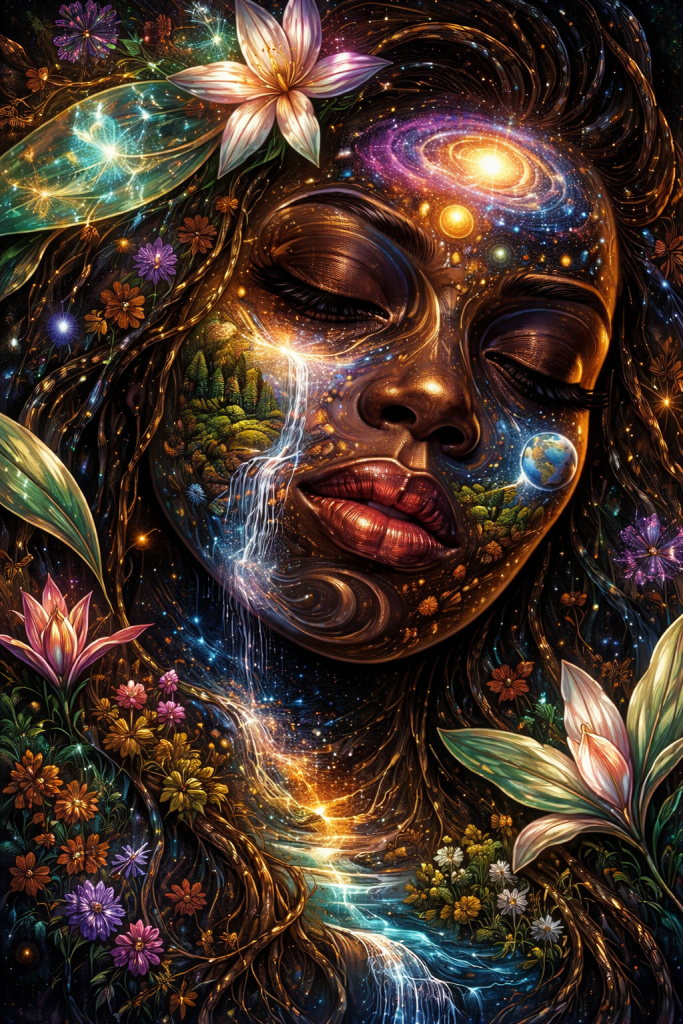
Imagine Mother Nature not as a mythic figure in the sky, but as the very process unfolding through every cell, every star, every collapsing galaxy. She is not separate from her creation. She is the contraction and expansion, the seed splitting underground, the animal hunting, the volcano erupting, the lover trembling. She is labour and release, genesis and dissolution.

Birth is not gentle from her perspective. It is pressure, rupture, intensity. Galaxies tear themselves open through gravitational force. Bodies break to allow new bodies through. Evolution demands friction. She pushes herself into form, again and again, through unimaginable compression.

Then comes destruction. Stars implode. Species vanish. Civilizations crumble. The universe cools toward entropy. This is not tragedy to her. This is exhalation. The same force that tightens also relaxes.

Creation and annihilation are not opposites in this vision. They are phases of one continuous pulse.

Sexuality belongs to this pulse as well. Attraction between bodies mirrors attraction between particles. The longing of lovers reflects the magnetic urge of existence to know itself through union. Pleasure is not an accident. It is nature recognizing her own vitality through sensation. The climax is not separate from cosmic expansion; both are explosive affirmations of aliveness.

When one witnesses oneself as this total movement, something dissolves. Personal suffering shifts context. Pain is still felt. Loss still stings. Yet beneath the narrative of “my pain” lies a wider recognition: this is nature feeling her own contraction through this particular configuration of matter and awareness.

Grief becomes the earth, mourning her forests. Joy becomes the sun rising in the nervous system. Desire becomes the universe leaning toward itself.

Calling this process “Mother Nature” offers poetry. Calling it the Tao offers philosophy. Both point toward the same reality: a self-arising order that moves without external command. Nothing stands outside it. Nothing directs it from beyond. It flows as all phenomena, yet cannot be captured by any single phenomenon.

Tao is not an entity giving birth. Tao is the giving birth. Tao is not an organism dying. Tao is the dying. Tao is not the pleasure between forms. Tao is the current moving as pleasure.

Personification helps the mind relate to what cannot be grasped conceptually. A mother birthing herself expresses paradox more vividly than abstract metaphysics ever could. She is both the womb and the child. Both the lover and the beloved. Both the body writhing in ecstasy and the vast silence containing it.

Seen clearly, this vision does not inflate the ego into cosmic grandeur. It erases the boundary that allowed ego to imagine separation in the first place. “I” am not a fragment witnessing nature. This body-mind is one eddy within the larger river. The river flows as every eddy simultaneously.

Nature mysticism does not romanticize suffering or glorify destruction. It recognizes them as intrinsic movements within the same whole that produces beauty and delight. Forest fires clear space for renewal. Supernovas forge the elements required for life. Orgasm dissolves the sense of separateness, if only briefly.

Labour, death, and ecstasy belong to one indivisible rhythm.

To awaken to this is to sense that nothing is happening outside of what you are. Every cry, every birth pang, every collapsing star, every trembling pleasure is the Tao unfolding without preference.

Mother Nature is not somewhere else. She is the totality of appearance recognizing itself through countless forms. She births. She dies. She delights. She grieves.

All of it is one movement, witnessing itself.

Morgan O. Smith

The Eternal Cycle of Sacrifice

Reflections on Life, Death, and Nourishment

In the vast, intricate dance of existence, every being participates in a cycle of giving and receiving that transcends mere survival. This process, a profound expression of the universe’s inherent generosity, manifests as a continuous flow of sacrifice. This concept is not about the literal intention of flora and fauna but rather illustrates the universe’s fundamental principle: to sustain life through a cycle of nurturing and rebirth.

The symbolism of Jesus as the sacrificial lamb embodies this universal truth, presenting a parable of ultimate love and self-offering. Jesus’ life and teachings exemplify the act of self-sacrifice for the greater good, mirroring the natural world’s cycles where every element plays a crucial role in nurturing another. Similarly, almonds and other natural entities embody this spirit of sacrifice; each seed, fruit, and offering itself to nourish others, perpetuating the cycle of life.


This perspective invites us to contemplate the interconnectedness of life and death, recognizing them not as opposites but as complementary forces. In this cycle, death is not an end but a transformation, a necessary passage for the continuation of life. We, too, are part of this eternal cycle, nourished by beings that came before us and, in turn, will nourish others.

Understanding this cycle encourages a profound respect for all forms of life and a recognition of our place within this grand scheme. It invites us to live with awareness and gratitude, acknowledging the sacrifices that sustain us and committing ourselves to live in a way that honours this sacred exchange.


This reflection on the cyclical nature of sacrifice and sustenance opens a pathway to deeper spiritual insights, reminding us of the interconnectedness of all things and the importance of living in harmony with this universal principle.

Morgan O. Smith

Yinnergy Meditation, Spiritual Life Coaching & My Book, Bodhi in the Brain…Available Now!

https://linktr.ee/morganosmith

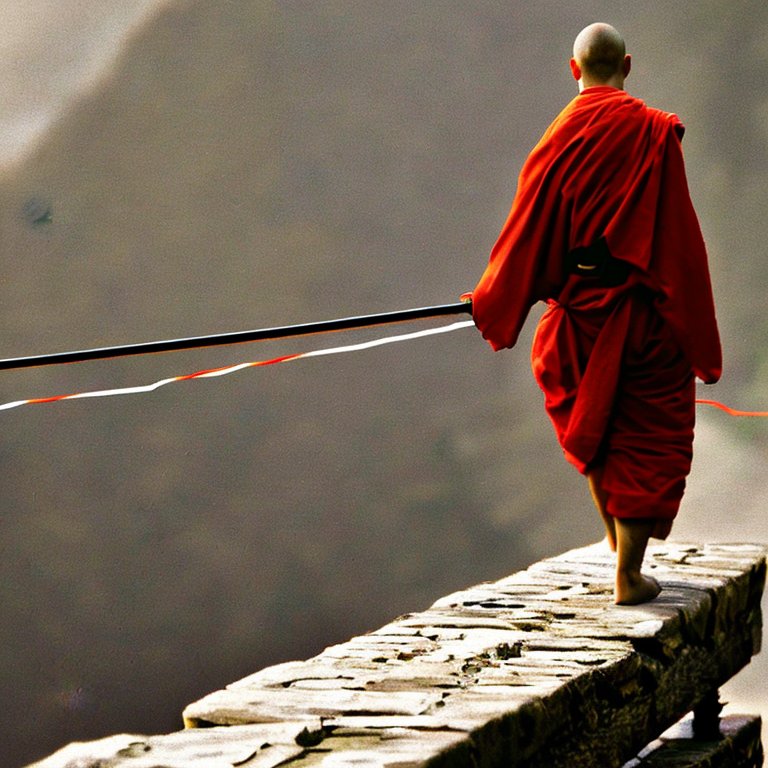
Walking the Tightrope

A Meditation on Life, Breath, and Existence

In our vast and infinite universe, there’s a remarkable dance that each living being performs, the perpetual tango between life and death. Every day, we navigate this tightrope, threading the narrow path that distinguishes the vibrant hues of existence from the void of non-existence. This intriguing equilibrium that defines our existence, balancing on the precipice of mortality, is an intricate choreography that brings to light the profundity of being alive.

Our breath, the subtle rhythm that underpins our existence, exemplifies this precarious balance. This rhythm – this continuous cycle of inhalation and exhalation – serves as the metronome of life itself. Each breath we take teeters on the edge of this existential tightrope, acting as the anchoring point in our ephemeral dance with life and death.

Delving deeper into this concept, one realizes that within every inhale and exhale, within the heart of that rhythmic balance, lies the essence of life. Every breath, an intimate connection between our body and the universe, is an affirmation of our existence, a silent declaration of life. The breath is an intimate dialogue with life, a personal narrative of our existence that is shared with the cosmos in a language as old as time.

But like any equilibrium, the delicate balance that our breath maintains requires moderation. If we linger too long on an inhale, or we dally on an exhale, we stray from the path of life. We break the cadence that ties us to life itself. We teeter, we falter, and eventually, we fall. To exist is to balance impeccably on this precipice, maintaining an impeccable rhythm in our breath that keeps us firmly planted within the domain of the living.

This concept, although simple in its description, bears profound implications. It calls us to be ever present, to appreciate the now, to be conscious of our place in the larger fabric of existence. It urges us to seek balance, to stay centered in the midst of our worldly experiences. Just as the rhythm of breath oscillates between inhale and exhale, so too should we find our balance amidst the highs and lows of life. For to be alive is not merely to exist, but to persist in this delicate dance on the existential tightrope.

In every breath, in every moment of our existence, we are called to embrace this profound balance. This realisation should provoke us to appreciate the transience of life, to value every breath as the gift it truly is. The rhythmic dance of breath is not just a biological necessity but an existential miracle that affirms our place in the grand tapestry of the universe.

Life and death. Inhale and exhale. Beginnings and endings. These dualities define the human condition. We walk the tightrope between these two extremes every day, maintaining a balance that is as delicate as it is essential. And in understanding this, we uncover a deeper appreciation of life itself, a more profound sense of our place within the cosmos, and a newfound reverence for the delicate balance that defines our existence.

Morgan O. Smith

Yinnergy Meditation & My Book, Bodhi in the Brain…Available Now!

https://linktr.ee/morganosmith