The Paradox of God’s Purpose

Beyond Time and Space

The idea of God having a purpose evokes a curious paradox. Purpose, as we understand it, requires time. There’s a beginning, an intention, and an outcome. Yet, God exists beyond time and space, transcending all dimensions that human minds perceive. How, then, can the ultimate transcendence have a purpose when both purpose and fulfillment rely on the passage of time?

God, in the most absolute sense, is timeless. Purpose implies movement from one state to another, a process that cannot apply to something that exists beyond time. God, as the eternal presence, neither moves nor changes. Yet, this same timeless God includes time and space as aspects of reality. Everything exists within God, and time is simply one of the infinite expressions of that existence.

From our limited perspective within time and space, purpose appears necessary and real. The flow of cause and effect shapes our understanding of meaning. Thus, we perceive God as having a purpose, as if the universe itself was an unfolding plan. But this perception only holds because we exist within the constraints of time. In truth, God’s purpose is as illusory as time itself—a projection of human understanding onto a reality that transcends all conceptual boundaries.

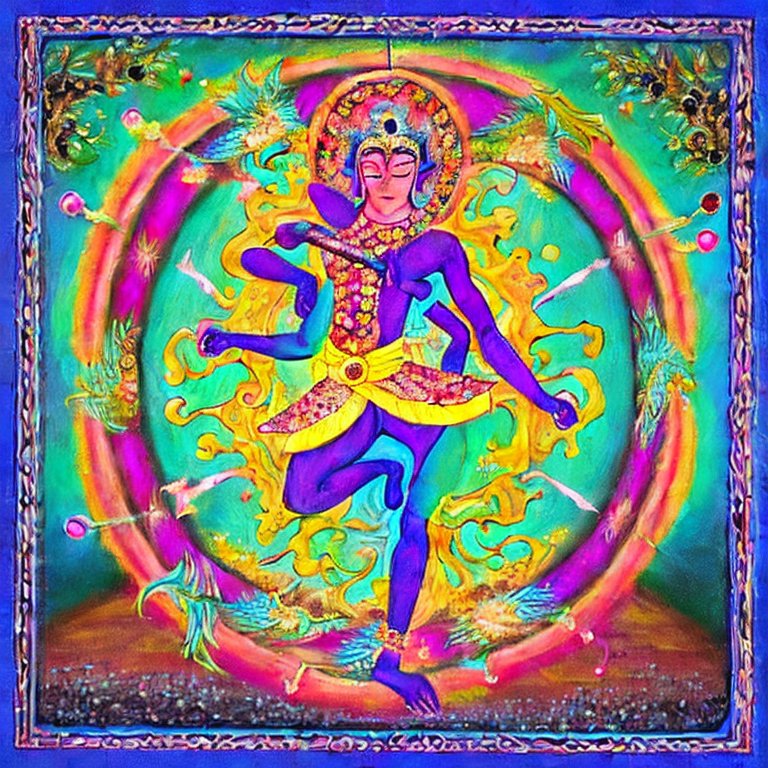
God, being everything, includes the illusion of purpose, yet remains untouched by it. In this sense, what we view as God’s purpose is simply an expression of the unfolding of existence within the framework of time. This divine play, known as *lila* in some traditions, is neither driven by need nor aimed at fulfillment. It is simply the unfolding of what is, without beginning or end.

The purpose we attribute to God is an attempt to understand the unfathomable. But ultimately, God’s true nature exists beyond purpose, beyond time, beyond any duality that our minds attempt to impose. To realize this is to recognize that the essence of existence is purposeless in the most profound sense—not in a nihilistic way, but as a reflection of absolute freedom, where nothing needs to be done because all is already complete.

Morgan O. Smith

Yinnergy Meditation, Spiritual Life Coaching & My Book, Bodhi in the Brain…Available Now!
https://linktr.ee/morganosmith

The Dance of Divine Ignorance

Brahman’s Playful Journey to Self-Realization

From the mysterious depths of Hindu philosophy arises a compelling concept, the notion of divine ignorance. Within this notion, we find an intriguing paradox: Brahman, the supreme reality or absolute truth, embarks on a deliberate voyage of self-forgetfulness, only to rediscover itself anew.

The journey begins with Brahman, the substratum of all existence. As an eternal, infinite entity beyond time, space, and causality, it is all-knowing and all-encompassing. Yet, it willingly dons the cloak of divine ignorance, becoming unaware of its true nature. Why? It’s an act of divine playfulness or ‘lila.’ It is a purposeful exercise to experience life’s duality, diversity, and the contrasts it can offer.

In this state of divine ignorance, Brahman may assume any form, animate or inanimate, and traverse a myriad of experiences, each unique and valuable. As humans, animals, or even as the elements themselves, Brahman willingly dives into the sea of forgetfulness, plunging into the game of life and death, joy and sorrow, love and hatred. Brahman is there in every moment, in every experience, playing hide-and-seek with itself.

Each incarnation in this state is a chapter of the cosmic narrative, leading to an eventual grand finale – the rediscovery of the self as Brahman. This moment of awakening is not a simple return to the start but a profound realization heightened by the accumulated experiences. It is a conscious awareness of oneness, a dissolution of the illusory divide between the self and the universe.

However, this journey isn’t a linear path. It’s a dance, a rhythm of existence where each beat is a cycle of divine ignorance and self-realization. Each turn of the dance spirals upwards, towards an ever-deepening understanding and experience of the truth.

The concept of divine ignorance challenges us to see life not as a series of random events but as a purposeful, meaningful journey toward self-realization. It teaches us that ignorance isn’t a flaw to be eradicated, but an essential part of the cosmic play. It is a transformative cocoon that emerges as the butterfly of awareness.

Divine ignorance invites us to embrace our vulnerabilities, our doubts, and our seeming ‘ignorance,’ and use them as catalysts for growth. It gently reminds us that the path to self-realization isn’t a desperate escape from ignorance but a joyful dance through it.

In conclusion, the dance of divine ignorance is not just Brahman’s journey but ours. We are not separate from Brahman, we are Brahman; playing the role of being a part of it, participating in this cosmic dance. Divine ignorance is not an obstacle but a bridge to our ultimate truth. It’s a profound truth worth reflecting upon, and perhaps, just perhaps, it’s time for us to embrace the dance and rediscover ourselves anew.

Morgan O. Smith

Yinnergy Meditation & My Book, Bodhi in the Brain…Available Now!

https://linktr.ee/morganosmith

Sand Castles of Consciousness

Discovering the Essence Within

Introduction:


In the tranquil tapestry of Eastern philosophy, where contemplation converges with existence, there lies a profound revelation – Everything in existence is composed of Pure Consciousness. Here, Consciousness is not merely an attribute; it is capitalized, symbolizing its omnipresence as the very fabric that weaves through the cosmos. It is akin to an ancient tale of a castle crafted from sand, reflecting that though it may don the guise of a majestic structure, it remains, in essence, sand.

The Sand and the Castle:

Visualize a child meticulously building a sand castle on the shore. The grains of sand, amassed and sculpted, assume the shape of a castle. Does the sand cease to be sand when shaped into a castle? Certainly not. This allegory mirrors the realization that while the myriad forms around us may appear different, they are all permutations of the same unyielding Consciousness.

The Essence of Consciousness:

Consciousness is akin to Brahman in Hinduism or the Tao in Taoism in the Eastern philosophical context. The unchanging, infinite, immanent, and transcendent reality is the Divine Ground of all matter, energy, time, space, being, and everything beyond. Our ephemeral existence is a mere reflection, a ripple in the vast ocean of Consciousness.

Flow of Forms:


Just as a sand castle is subjected to the whims of waves and winds, forms in the material world are in a constant state of flux. The ancient Hindu text, the Bhagavad Gita, illustrates this with the concept of ‘Lila’, depicting the world as a divine play of forms. The Taoist philosophy also reverberates with this thought through the Tao, which flows through and is the inherent nature of all things.

The Inner Alchemy:

One might inquire, how does this realization benefit our daily lives? Understanding that we are not just isolated entities, but integral threads woven into the fabric of Consciousness, can be transformative. It helps us transcend the illusion of separateness and cultivates compassion, humility, and interconnectedness with all beings and the natural world.

Conclusion:


As we embrace the wisdom of Eastern philosophy, let us be mindful of the sand castles we build and the sands that shape them. Let us embark on a spiritual odyssey to unearth the Consciousness within and around us, recognizing that the essence is unchanging, infinite and all-encompassing. Like the sand castles by the sea, our forms are transient, but the Consciousness that shapes us is eternal.

Morgan O. Smith

Yinnergy Meditation & My Book, Bodhi in the Brain…Available Now!

https://linktr.ee/morganosmith

Cosmic Whispers

Deciphering the Divine Blueprint of Creation

Introduction:


In the quiet moments when our minds wander into the realm of the cosmic, we may find ourselves pondering a question that has beguiled philosophers and theologians for centuries: Why did God manifest everything into being? What could be the purpose behind the sprawling tapestry of stars, planets, and life? My answer is that God created everything to become, and to experience the total opposite of itself. However, like threads in a tapestry, there are numerous perspectives woven into this enigmatic question. Let’s unravel a few.

1. **The Divine Artist: Self-Expression and Creativity**

Imagine an artist, brush in hand, dipping into an infinite palette. Some believe that God, the Divine Artist, created the universe as an ongoing expression of self-expression and creativity. Here, the universe is a canvas and God’s creations are brushstrokes – intricate, boundless, and ever-evolving.

2. **Lila: The Cosmic Dance of Divine Play**

Within Hinduism, creation is seen as ‘Lila’ or divine play. Picture God as a dancer, whose movements give birth to galaxies and life. These movements are not driven by need or desire but are spontaneous expressions of joy. Lila suggests that the universe is God’s dance floor, where the Divine revels in the ecstasy of creation.

3. **Harbor of Love: Creation for Relationship**

What if the universe is a love letter? In Christianity and other religious traditions, it is suggested that God created the cosmos and sentient beings for the purpose of relationship and love. The creation is God’s way of extending an invitation to share in divine love and companionship.

4. **Divine Reflection: Creation as Self-Discovery**

Ponder a God yearning for self-knowledge. By manifesting a multitude of beings, each with unique experiences and perspectives, God gazes into a living, cosmic mirror. This mirror reflects different facets of the Divine, allowing God to explore and understand its own infinite nature.

5. **Kabbalah’s Divine Constriction: Creating Space for Others**


Envision a sea retracting to form a shore. Kabbalistic tradition posits that God underwent a self-constriction, known as Tzimtzum, to create space for an independent reality. This act of withdrawal was one of ultimate generosity, allowing for free will and a two-way relationship between creation and the Divine.

6. **The Soul’s Crucible: Testing and Spiritual Growth**

Is the universe a crucible for refining souls? Some belief systems suggest that God created the universe as a testing ground. Through challenges and experiences, souls are purified, tempered, and progress along a spiritual path.

7. **A Purposeless Creation: Philosophical Nihilism**

Not all threads are woven with intention. Some philosophical perspectives maintain that creation has no purpose. It posits that existence is simply a natural by-product of God’s existence and devoid of any inherent meaning.

8. **Pantheism: The Universe as God’s Identity**

Picture a universe where every atom is a fragment of divinity. Pantheism posits that God and the universe are identical. Nature is not a separate creation but a part of the Divine. Through the vastness of space, we witness the body of God.

Conclusion:

As we stand before this intricate tapestry of creation, it becomes clear that the question of why God manifested the universe is as multifaceted as the cosmos itself. Each thread—whether woven with intention, love, curiosity, or even ambiguity—adds depth to this cosmic masterpiece. In examining these threads, we engage not just with the mysteries of creation, but with the essence of our own search for meaning and connection in an unfathomably vast universe.

Morgan O. Smith

Yinnergy Meditation & My Book, Bodhi in the Brain…Available Now!
https://linktr.ee/morganosmith